Self-Ligating Braces: Types, Advantages, Colours, and Cost in India
 Medically Reviewed by Whistle Dental Team
Key Takeaways:
- Self-ligating braces use a built-in clip mechanism instead of elastic ties, allowing smoother tooth movement, greater comfort, and fewer adjustment appointments.
- Whistle exclusively offers self-ligating zirconia braces that are smaller, tooth-colored, stain-resistant, and designed to provide a more discreet orthodontic experience.
- The friction-free design can help reduce treatment time, improve oral hygiene, and minimize discomfort compared to traditional braces.
- Whistle's indirect bonding technique enables precise bracket placement, shorter chair time, and a more comfortable treatment experience for patients.
- With orthodontist-supervised care, advanced diagnostics, transparent pricing, and braces starting from ₹49,900, Whistle combines modern technology with convenience and predictable results.
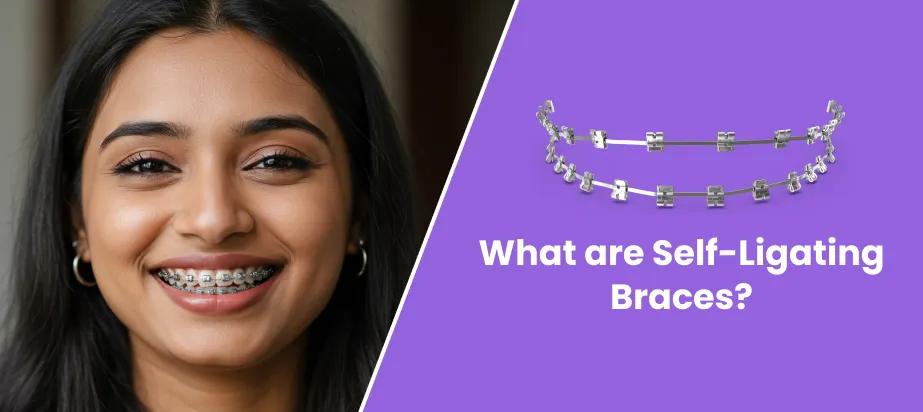
Self-ligating braces are a fixed orthodontic appliance that uses a built-in clip or sliding door mechanism on each bracket to hold the archwire in place - without elastic ties, metal ligatures, or any external fastening material.
They’re designed to move teeth more comfortably, work faster, and make cleaning easier during treatment.
At Whistle, we exclusively offer self-ligating zirconia braces - a lighter, smaller, and more refined option that reflects the best of modern orthodontics. These braces skip the elastic ties and use a smooth clip mechanism instead, making your experience less painful and more efficient.
With fewer appointments, improved hygiene, and a look that blends in better, they’re built for people who want effective results without the hassle. Let’s explore what makes them different—and why Whistle’s version is a better way to get your smile in line.
Key Features of Whistle’s Self-Ligating Braces
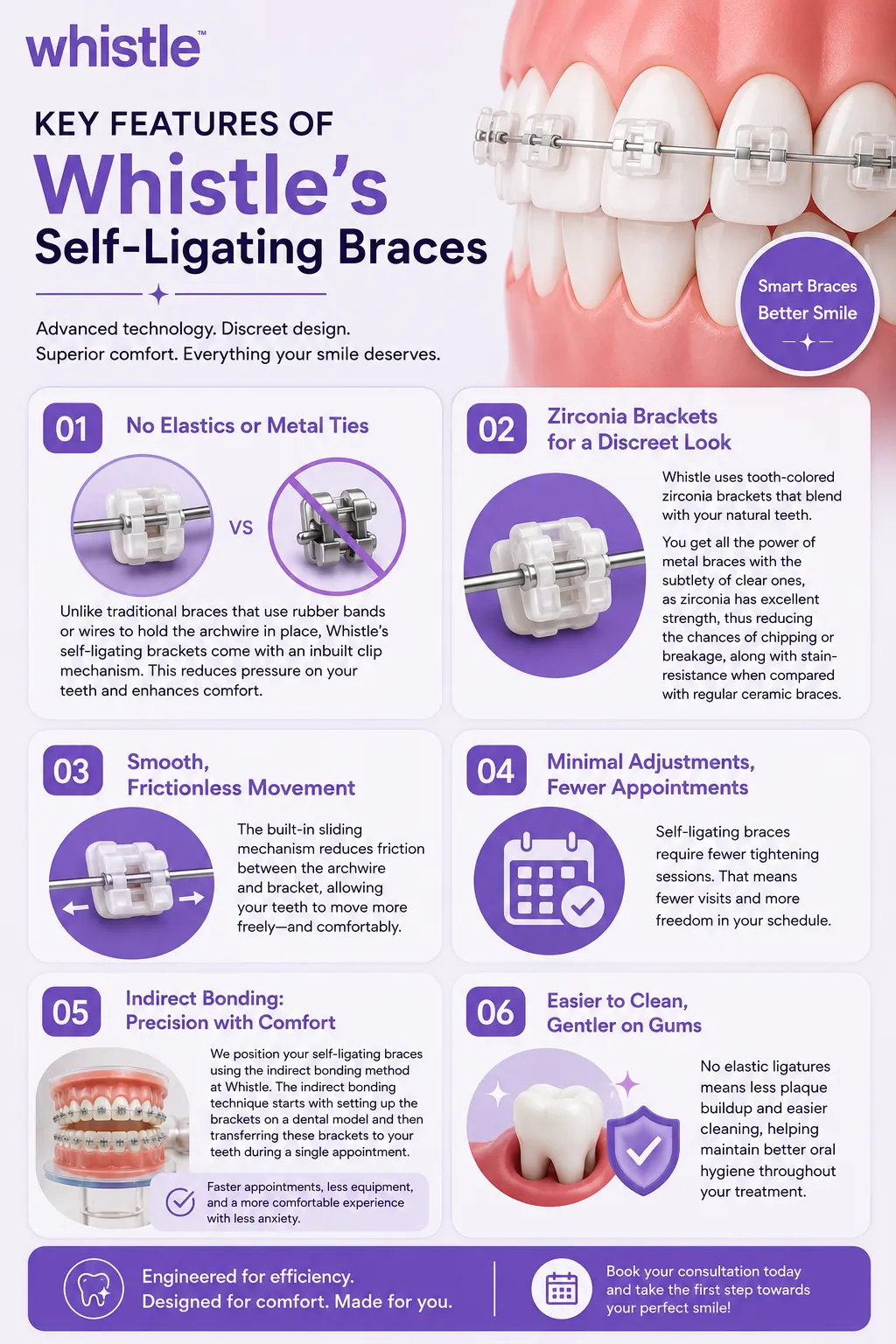
1. No Elastics or Metal Ties
Unlike traditional braces that use rubber bands or wires to hold the archwire in place, Whistle’s self-ligating brackets come with an inbuilt clip mechanism. This reduces pressure on your teeth and enhances comfort.
2. Zirconia Brackets for a Discreet Look
Whistle uses tooth-colored zirconia brackets that blend with your natural teeth.
You get all the power of metal braces with the subtlety of clear ones, as zirconia has excellent strength, thus reducing the chances of chipping or breakage, along with stain-resistance when compared with regular ceramic braces.
3. Smooth, Frictionless Movement
The built-in sliding mechanism reduces friction between the archwire and bracket, allowing your teeth to move more freely—and comfortably.
4. Minimal Adjustments, Fewer Appointments
Self-ligating braces require fewer tightening sessions. That means fewer visits and more freedom in your schedule.
5. Indirect Bonding: Precision with Comfort
We position your self-ligating braces using the indirect bonding method at Whistle. The indirect bonding technique starts with setting up the brackets on a dental model and then transferring these brackets to your teeth during a single appointment.
Your appointment becomes faster and less complicated because this method cuts down on the amount of equipment required. The use of fewer tools and shorter chair time creates a calmer and more comfortable dental experience that helps decrease anxiety among patients who feel apprehensive about orthodontic treatments.
6. Easier to Clean, Gentler on Gums
No elastic ligatures means less plaque buildup and easier cleaning, helping maintain better oral hygiene throughout your treatment.
Types of Self-Ligating Braces
Self-ligating brackets are available in two material types: metal and ceramic. Both use the same clip mechanism but offer different aesthetic properties.
Metal Self-Ligating Braces
Metal self-ligating braces use stainless steel brackets with an integrated clip door — the same high-grade steel used in conventional metal braces but with the added self-ligating mechanism built into the bracket body.
These are the stronger of the two material options. The steel door mechanism can withstand the forces involved in more complex tooth movements without risk of fracture, making metal self-ligating braces appropriate for a full range of case complexity from mild spacing to significant bite correction.
The visual profile of metal self-ligating brackets is similar to conventional metal braces: clearly visible but typically slightly smaller in profile because the bracket doesn't require the added bulk of a separate tie wing around which the elastic loops. Patients who are comfortable with visible braces and want to maximise the mechanical efficiency of self-ligating design will find metal self-ligating braces the most robust choice.
Children and teenagers who might otherwise want to personalise their braces with coloured elastic bands should be aware that the self-ligating mechanism changes what's possible in this area — more on that below.
Self-Ligating Ceramic Braces
Self-ligating ceramic braces combine the reduced-friction, tie-free clip mechanism of self-ligating design with the aesthetic discretion of tooth-coloured or clear ceramic brackets.
This is where self-ligating technology offers its most notable advantage over conventional ceramic braces. In standard ceramic braces, the main aesthetic concern is not the bracket itself the bracket material is fairly stain-resistant — but the elastic ligature ties that hold the wire in place. Those ties stain rapidly with coffee, tea, turmeric, and coloured foods, turning yellow or brown between adjustment appointments.
Self-ligating ceramic braces eliminate this entirely. There are no elastic ties. The wire is held by the bracket's built-in ceramic or clear clip which doesn't absorb staining pigments the way elastic does. The result is a significantly more stable aesthetic appearance throughout the treatment period.
This makes self-ligating ceramic braces the most practical aesthetic fixed brace option for adults particularly working professionals who want discreet orthodontic treatment without the monthly embarrassment of stained elastic ties.
The ceramic bracket material in self-ligating systems is typically polycrystalline alumina or, in premium systems, a blend with zirconia reinforcement for improved strength. The clip mechanism itself is usually made from the same ceramic material or a stain-resistant clear composite. Both maintain good translucency and tooth-matching properties.
Advantages of Self-Ligating Braces
Self-Ligating Braces Colours: What's Actually Possible?
This is a question that comes up frequently and the answer requires honesty rather than a simple yes or no.
Traditional braces can be personalised with coloured elastic ties the small rubber rings wrapped around each bracket. Patients, particularly children and teenagers, often enjoy choosing colours that change at each appointment.
Self-ligating braces do not use elastic ties. The wire is secured by the bracket's own clip mechanism, which means there is no elastic for colour. As a result, the classic colour customisation experience is not available with standard self-ligating bracket systems.
This is the key trade-off: you gain all the mechanical and aesthetic advantages of the self-ligating design, but you give up the ability to add coloured accessories.
Some nuances:
Some self-ligating bracket systems offer a "hybrid" mode where, for specific clinical purposes, a traditional elastic tie can be added on top of the self-ligating door. In these cases, a coloured tie can technically be applied - but this partially defeats the friction-reduction advantage of the self-ligating design.
A small number of bracket manufacturers offer tinted or coloured clip designs (rather than the clear or metallic standard). These are rare and less clinically validated than standard systems.
In practice: Colour customisation is better suited to patients who choose conventional braces specifically for that feature. For patients whose priority is clinical efficiency, aesthetic discretion, and oral hygiene - self-ligating braces are the better match. For children and teens who find the colour experience motivating during a long treatment, conventional braces may be the more enjoyable choice.
Benefits of Self-Ligating Braces – Why Whistle Recommends Them
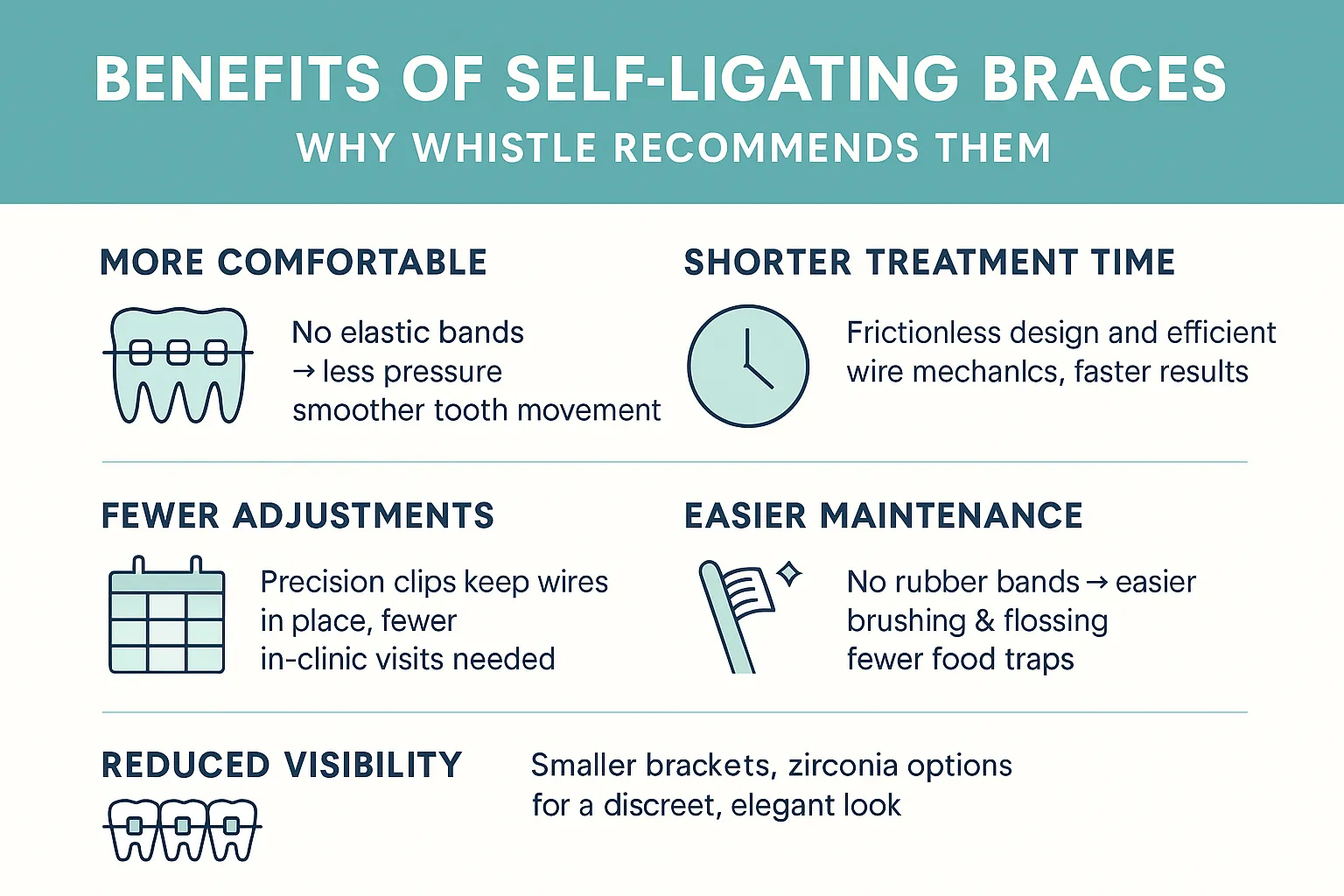
At Whistle, we don’t just offer self-ligating braces we’ve built our treatment philosophy around their advantages. Here’s why:
1. More Comfortable Experience
No elastic bands = less pressure. That translates to a gentler and smoother teeth-straightening process.
2. Shorter Treatment Time
Thanks to the efficient wire mechanics and frictionless design, most patients complete treatment faster compared to traditional braces.
3. Fewer Adjustments Needed
Whistle’s braces hold the wire with precision, meaning your teeth stay on track longer between visits. That’s less time in the chair, more time living life.
4. Easier Maintenance
The absence of rubber bands makes it easier to brush and floss. Fewer food traps mean cleaner teeth and healthier gums during your treatment.
5. Reduced Visibility
With Whistle’s self-ligating brackets whether metal or zirconia the smaller bracket size naturally reduces the visibility of your braces. For an even more discreet, low-profile look, zirconia braces are the perfect choice, offering elegance without sacrificing strength. This makes them ideal for working professionals, teens, and anyone seeking a less noticeable orthodontic solution.
Whistle Self-Ligating Braces vs. Traditional Braces
Self-Ligating Braces Cost in India
Who Is a Good Candidate for Self-Ligating Braces?
Good Candidate:
- Adults who want discreet treatment with lower maintenance (self-ligating ceramic)
- Working professionals with limited availability for frequent adjustment appointments
- Patients with moderate crowding or spacing who want efficient treatment
- Anyone with a history of bracket-area sensitivity or gum irritation from elastic ties
- Patients concerned about decalcification risk due to difficulty maintaining hygiene around conventional brackets
- Children and teenagers who want coloured elastic customisation for motivation
- Patients with a very tight budget for whom the cost premium is a genuine barrier
- Very straightforward short-duration cases where the efficiency advantages of self-ligating have less time to compound
- Complex cases requiring very specific torque control in multiple planes simultaneously (where an experienced orthodontist may prefer a particular conventional bracket's torque prescription)
Are Self-Ligating Braces Right for You?
Self-ligating braces are an excellent choice for:
- Teens and adults who want less visible braces
- People with busy schedules who prefer fewer appointments
- Patients seeking gentler, more comfortable orthodontic care
- Anyone with mild to moderate crowding, bite issues, or spacing problems
Even in complex cases, Whistle’s advanced diagnostic planning helps determine if extractions or traditional braces are needed - or if self-ligating braces can do the job efficiently.
And in most cases, our patients complete their treatments with no extractions at all, thanks to the space-creating potential of our expansion-first approach.
How Much Do Braces Cost at Whistle?
Whistle’s self-ligating zirconia braces start from ₹74,900 (Insert actual pricing). Compared to the wide price swings in the market, we keep it simple. One all-inclusive price for a complete smile transformation—backed by experts, powered by technology. Also, our metal self-ligating braces are less visible than the other available in the market, due to their compact design feature, available at a starting price of ₹49,900.
Why Whistle Makes Self-Ligating Braces Even Better
At Whistle, we don’t stop at offering self-ligating braces we redefine how they’re delivered.
- Smarter Planning - 3D scans, facial analysis, and AI tools create orthodontist-approved plans that are precise and low-risk.
- Best-in-Class Braces, Only - We exclusively offer self-ligating braces for superior comfort, hygiene, and efficiency.
- Care That Prioritizes You - Our orthodontists collaborate with your dentist to plan minimally invasive, extraction-free treatments whenever possible.
Oral Hygiene with Self-Ligating Braces
Self-ligating braces aren’t just a new type of bracket—they represent a smarter, smoother way to align teeth.
At Whistle, we’ve taken this technology and built a full ecosystem around it: intelligent diagnostics, better-looking hardware, and a commitment to comfort.
If you’re considering braces and want a treatment that’s faster, cleaner, and more discreet, Whistle’s self-ligating zirconia braces might be the perfect fit.
Book your consultation today and discover how Whistle is reinventing the braces experience—one confident smile at a time.
Teeth Braces in Your City
Teeth Braces in Ahmedabad | Teeth Braces in Amritsar | Teeth Braces in Bengaluru | Teeth Braces in Bhiwadi | Teeth Braces in Chandigarh | Teeth Braces in Chennai | Teeth Braces in Derabassi | Teeth Braces in Dombivli | Teeth Braces in Faridabad | Teeth Braces in Ghaziabad | Teeth Braces in Greater Noida | Teeth Braces in Gurgaon | Teeth Braces in Hyderabad | Teeth Braces in Jaipur | Teeth Braces in Jalandhar | Teeth Braces in Kakinada | Teeth Braces in Ludhiana | Teeth Braces in Mohali | Teeth Braces in Navi Mumbai | Teeth Braces in New Delhi | Teeth Braces in Noida | Teeth Braces in Panchkula | Teeth Braces in Panvel | Teeth Braces in Pune | Teeth Braces in Secunderabad | Teeth Braces in Surat | Teeth Braces in Thane | Teeth Braces in Vadodara | Teeth Braces in Vijayawada | Teeth Braces in Vizag | Teeth Braces in Zirakpur
Book 3D Teeth Scan
Consult our experts and get a 3D preview of your smile transformation!
What Are Self-Ligating Braces
Self-Ligating Braces
FAQ's
Q1.Are Whistle’s braces suitable for professionals and adults?
Absolutely, Whistle’s zirconia self-ligating braces are smaller and less visible, making them ideal for working professionals and adults who prefer a subtle solution.
Q2.Can self-ligating braces treat complex orthodontic cases?
Yes, for most clinical scenarios. Metal self-ligating braces handle the full range of case complexity. Self-ligating ceramic braces are appropriate for mild-to-moderate cases with higher aesthetic demands. Very complex bite corrections or cases requiring specific torque on multiple teeth in multiple planes may need careful bracket system selection - your orthodontist advises based on your specific case anatomy.
Q3.Are self-ligating braces good for children?
Self-ligating braces are clinically suitable for children and work well mechanically. The practical consideration is that children often find the colour customisation of conventional braces motivating — an engagement tool that disappears with self-ligating design. Some orthodontists recommend conventional braces for younger children specifically for this reason, switching to self-ligating designs for teenagers and adults.
Q4.Can I get self-ligating ceramic braces if I drink coffee daily?
Yes - this is one of the strongest use cases for self-ligating ceramic braces. Because there are no elastic ties, the main staining pathway of conventional ceramic braces is eliminated. The ceramic bracket clip itself is far more stain-resistant than elastic. Coffee drinkers who want ceramic braces will find self-ligating ceramic a significantly better aesthetic choice than conventional ceramic.
Q5.Are self-ligating braces faster than traditional braces?
Self-ligating braces often allow for fewer and shorter adjustment appointments, which makes the treatment process feel more efficient. Whether total treatment duration is meaningfully shorter is debated in clinical literature studies show mixed results. The bigger, consistent advantage is appointment efficiency rather than weeks shaved off total treatment time.
You May Also Like
 Medically Reviewed by Whistle Dental Team






 Medically Reviewed by Whistle Dental Team
 Medically Reviewed by Whistle Dental Team