
Braces Before and After Jawline: Can Braces Change Your Face and Side Profile?
 Medically Reviewed by Whistle Dental Team
Examining your braces before and after jawline reveals significant improvements in facial harmony, chin projection, and side profile symmetry resulting from corrective orthodontic bite alignment.
By fixing overbites, underbites, open bites, and severe crowding, modern treatments reposition the dental arches and restore balanced soft-tissue lip support.
- Real Aesthetic Transformations: Orthodontic treatment reshapes your lower facial third by aligning your bite, restoring proper lip drape, and enhancing chin definition.
- Bite-Specific Profile Changes: Overbites often conceal a recessed chin, while underbites cause a prominent lower jaw. Correcting these malocclusions brings facial features into natural balance.
- Soft-Tissue and Bone Remodeling: Braces and clear aligners stimulate gentle alveolar bone remodeling, allowing lips and cheeks to rest in natural, tension-free positions.
- Clear Aligners vs Braces Efficacy: Both Whistle Clear Aligners and self-ligating braces create predictable facial profile improvements when guided by 3D digital treatment planning.
- Transparent Indian Pricing: Whistle offers comprehensive aligner plans from Rs. 60,000 to Rs. 1.75 Lakhs and self-ligating braces from Rs. 45,000 to Rs. 70,000 with flexible monthly EMI options.
Patients can achieve transformative facial aesthetics with Whistle Clear Aligners (Rs. 60,000 to Rs. 1.75 Lakhs) or Whistle Self-Ligating Braces (Rs. 45,000 to Rs. 70,000), supported by flexible monthly EMI options and in-person MDS Orthodontist supervision across 600+ partner clinics nationwide.
Can Braces Change Your Jawline and Face Shape?
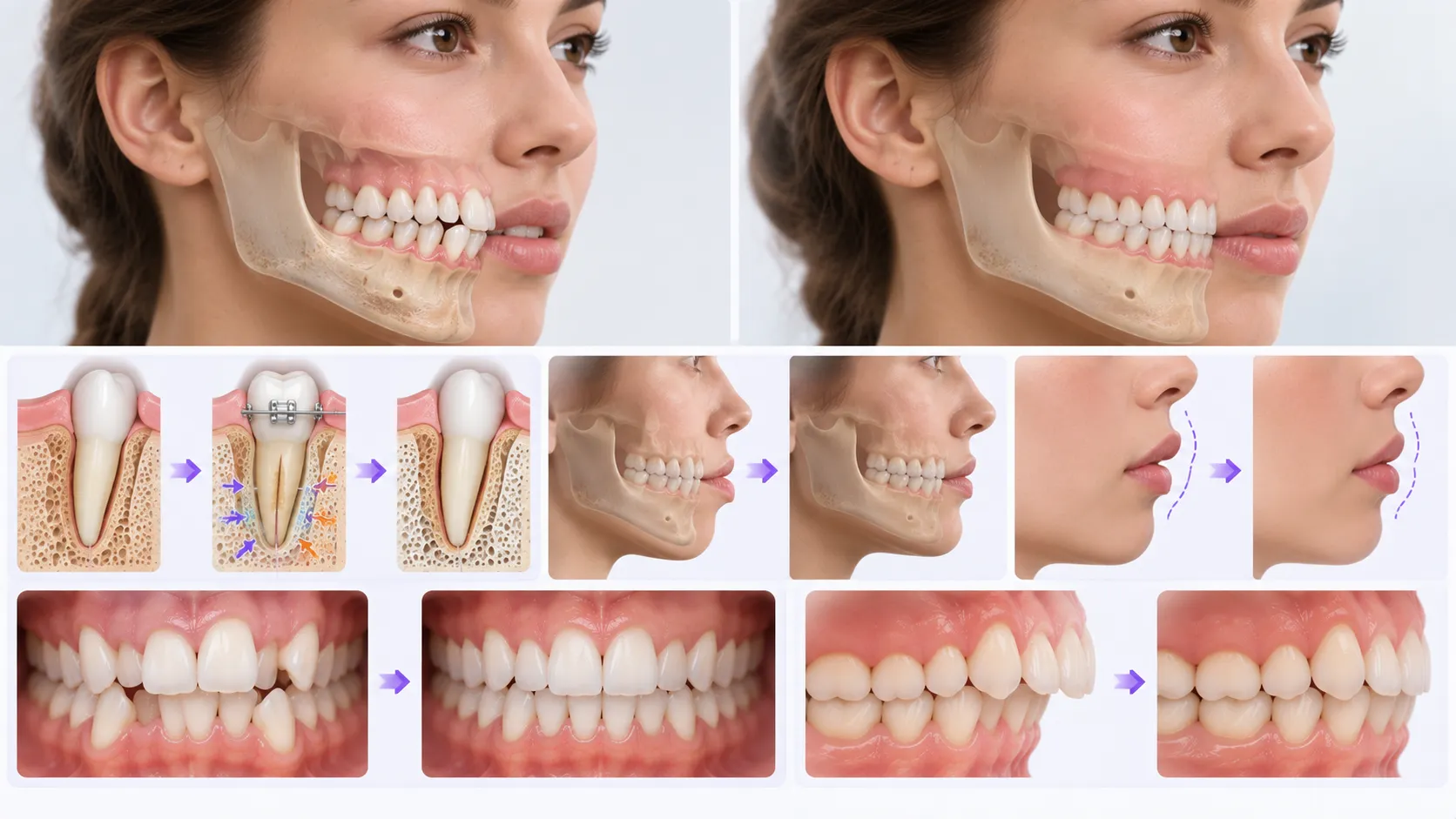
The Biomechanical Link: How Orthodontic Movement Shapes Your Face
- Alveolar Bone Remodeling: When orthodontic appliances apply sustained, light forces, specialized cells called osteoclasts break down bone ahead of the tooth while osteoblasts rebuild new bone behind it. This alters the dental support ridge beneath the lips and cheeks.
- Normalized Resting Jaw Posture: A deep overbite or crossbite often forces the lower jaw into an unnatural, backward or sideways position. Fixing the dental collision allows the jaw to settle into its true, relaxed anatomical position.
- Restoration of Natural Lip Seal (Competence): When front teeth protrude (overjet), patients must actively stretch their facial muscles to close their lips. Retracting these teeth eliminates muscle strain, softens the chin area, and creates a clean neck-to-jawline angle.
Jawline Before and After Braces: Changes Across Different Bite Types
Braces Side Profile Before and After: Clinical Aesthetics Matrix
| Clinical Metric | Before Treatment State | After Treatment State | Primary Aesthetic Improvement |
| Chin Projection (Pogonion) | Recessed or artificially pushed backward by deep bite. | Forward projection as lower jaw settles in neutral bite. | Sharper jawline contour; diminished appearance of double chin. |
| Lip Competence | Strained mentalis muscle (pebble chin) to close lips. | Effortless lip closure with relaxed facial muscles | Smooth, youthful chin texture with no strain wrinkles. |
| Lower Face Height (Subnasale to Menton) | Excessively short (deep bite) or long (open bite). | Balanced golden ratio (equal lower facial third). | Proportional, symmetrical facial structure from all angles. |
| Cheekbone & Buccal Corridor | Narrow, dark corridors with hollowed smile edges. | Broad, illuminated dental arch filling smile corners. | Fuller cheek support and radiant, wide smile arc. |
Age Dynamics: Kids and Teens vs Adult Jawline Transformations
The extent of jawline transformation differs based on biological maturity:
Children and Teenagers (Ages 8 to 17): Because facial bones and growth plates are still actively developing, orthodontists can utilize functional appliances and palatal expanders to guide actual orthopedic jaw growth, creating dramatic, structural jawline enhancements.
Adults (Ages 18 to 50+): In adults, the jawbones are fully fused. Orthodontic treatment achieves significant facial improvements through dental repositioning, alveolar bone remodeling, and soft-tissue draping. For severe adult skeletal deformities (greater than 8 to 10 mm discrepancy), combining braces with corrective orthognathic jaw surgery may be indicated.
Debunking the "Mewing" and DIY Jawline Trend: Internet trends like "mewing" (forcefully pressing the tongue against the palate) lack scientific evidence for reshaping adult jawbones. In-person orthodontic treatment using calibrated 3D forces is the only proven, clinically safe method to correct jaw alignment and enhance facial structure.
How does jaw alignment braces treatment fix an overbite or underbite?
Different bite issues impact your facial aesthetics in specific, predictable ways.
Overbite Correction (Class II Malocclusion)
An overbite occurs when the upper front teeth overlap excessively over the lower front teeth, often accompanied by a retrognathic (recessed) lower jaw. This creates a "weak" chin and an undefined jawline. Orthodontic bite correction pulls the upper teeth back while bringing the lower jaw into a forward, natural alignment. This forward shift enhances chin projection, tightens the skin beneath the chin, and establishes a strong, well-defined jawline.
Underbite Correction (Class III Malocclusion)
An underbite happens when the lower teeth sit in front of the upper teeth, causing a prognathic (protruding) chin. This can make the lower face appear dominant and harsh. Braces work by guiding the upper teeth forward and bringing the lower teeth backward into harmony. Correcting this reverse bite softens the lower jawline, bringing the upper and lower facial proportions back into ideal balance.
Open Bite Correction
An open bite leaves a vertical gap between the front teeth even when the back teeth bite together. Patients with open bites often strain their facial muscles to seal their lips, causing facial elongation. Closing an open bite relaxes the mentalis muscle in the chin, shortening the perceived lower face height and restoring a compact, structured jawline.
Can braces fix jawline asymmetry?
Does age affect how braces change your jawline?
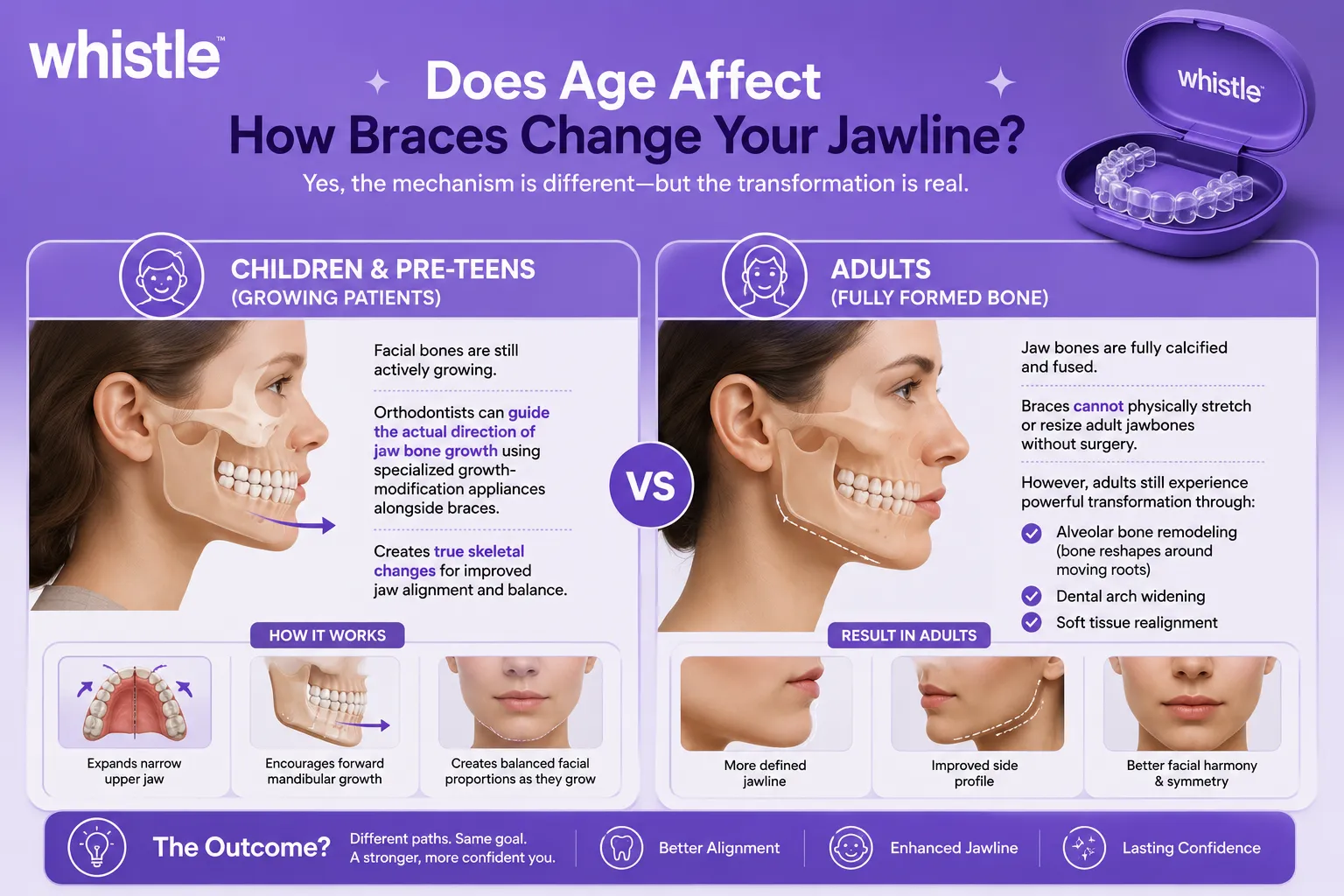
Here's the thing. The biological mechanism behind jawline changes varies significantly between young patients and adults.
Children and Pre-Teens (Growing Patients)
In young patients whose facial bones are still actively growing, orthodontists can perform dentofacial orthopedics. Using specialized growth-modification appliances alongside braces, an orthodontist can guide the actual direction of jaw bone growth.
For instance, they can expand a narrow upper jaw or encourage forward mandibular growth. In children, orthodontic treatment creates true skeletal changes in the jawbone structure.
Adults (Fully Formed Bone)
In adults, the jawbones are fully calcified and fused. Braces cannot physically stretch or resize adult jawbones without surgery. However, adult jawlines still undergo noticeable transformation through alveolar bone remodeling (the process where bone tissue reshapes around moving tooth roots), dental arch widening, and soft tissue realignment.
Adults achieve a tighter, sharper jawline because their lips, cheeks, and resting jaw posture reposition into aesthetic harmony.
What is the difference between braces, clear aligners, and jaw surgery for jawline transformation?
| Treatment Option | How It Works | Jawline & Profile Impact | Best Suited For | Typical Treatment Time |
|---|---|---|---|---|
| Traditional Braces | Metal brackets and wires gradually move teeth into the correct position. | Moderate to significant improvement by correcting bite alignment and tooth position. | Complex crowding, severe rotations, and major bite issues. | 12–24 months |
| Whistle Clear Aligners | Custom-made clear aligners gently shift teeth using controlled pressure. | Moderate to significant improvement by improving bite and smile alignment. | Mild to severe crowding, spacing, overbites, underbites, and crossbites. | 6–18 months |
| Orthognathic Surgery + Orthodontics | Surgery repositions the upper and/or lower jaw, followed by orthodontic treatment. | Dramatic improvement in jawline, facial profile, and overall facial balance. | Adults with severe jaw misalignment or skeletal discrepancies. | 18–36 months (including recovery) |
Wondering how much your facial profile could improve with custom treatment? Book a free Whistle Smile Assessment at your nearest Whistle partner clinic (no commitment required).
Orthodontist Observation: Real-World Mistakes Patients Make Expecting Jawline Changes
- Falling for Dangerous At-Home Mewing or Jaw Exercisers: Chewing on hard rubber jawline exercisers can cause acute inflammation of the temporomandibular joint, disc displacement, and severe chronic headaches without improving facial symmetry.
- Assuming Facial Soft-Tissue Changes Happen Overnight: While teeth begin shifting within weeks, soft-tissue adaptation and bone remodeling occur gradually over 12 to 18 months. Patience and consistent appliance wear are essential for lasting facial results.
- Removing Aligners Frequently During Social Hours: Wearing clear aligners for fewer than 20 to 22 hours per day halts active bone remodeling, preventing the dental expansion required to fill out narrow facial corridors.
- Skipping Retainers After Completing Treatment: Without faithful retainer wear, teeth naturally drift back toward their old crowded or overbite positions, causing the newly defined jawline and lip support to recede.
- YMYL Clinical Safety Warning: Never use unmonitored mail-order aligners or DIY dental tricks to attempt bite correction. Moving teeth without evaluating your jaw joints (TMJ) and periodontal bone support can lead to permanent bite collapse, gum recession, and facial asymmetry.
Your Next Steps
Braces don’t just straighten teeth - they sculpt your jawline too. That sharper, selfie-ready look? Just a few wire-tightenings away.
Achieving a balanced, defined jawline through orthodontic treatment is a gradual, highly rewarding process.
Whether you suffer from an overbite, underbite, crossbite, or severe crowded teeth, correcting your bite does far more than straighten your smile. It optimizes your lower facial proportions, enhances chin projection, and improves your side profile naturally.
By choosing clear aligners or teeth braces supervised by a Whistle orthodontist, you receive a personalized treatment plan designed specifically for your unique facial anatomy and aesthetic goals.
Ready to transform your smile and facial harmony? Book a free Whistle Smile Assessment at your nearest Whistle partner clinic today.
Also Read:
Book 3D Teeth Scan
Consult our experts and get a 3D preview of your smile transformation!
Braces Before and After Jawline
FAQ's
Q1.Can braces improve my jawline?
Yes! They align your teeth and jaw, giving a sharper, more balanced look.
Q2.Can braces fix jawline issues completely?
Braces can fix jawline issues caused by dental misalignments, overbites, underbites, and crossbites. If your jawline issue is purely skeletal and structural in a fully grown adult, a combination of braces and orthognathic jaw surgery may be recommended.
Q3.Can clear aligners change your jawline as effectively as metal braces?
Yes, custom clear aligners like Whistle aligners can change your jawline just as effectively as metal braces for mild to severe malocclusions by applying precise 3D-planned forces to correct your bite.
Q4.What happens if a jawline issue is purely skeletal in adults?
In adults with severe skeletal jaw discrepancies, an orthodontist works in coordination with an oral surgeon to perform orthognathic surgery alongside braces treatment to realign the underlying jaw bones.
Q5.Can braces really change your jawline before and after?
Yes. Braces and clear aligners change your jawline by correcting bite misalignments such as overbites, underbites, and crossbites. Aligning the dental arches restores proper lip support, improves chin projection, and allows the lower jaw to rest in its natural, symmetrical position.
Q6.How do braces change your side profile?
Braces improve your side profile by retracting flared front teeth to create a natural lip seal, opening deep bites to bring recessed chins forward, and correcting underbites to soften protruding lower jaws. This produces a balanced relationship between your nose, lips, and chin.
Q7.How long does it take to see facial changes with braces?
Initial tooth movement begins within 4 to 8 weeks, but noticeable changes in lip posture, chin projection, and jawline definition typically become visible between 6 and 12 months as the bite aligns.
You May Also Like



 Medically Reviewed by Whistle Dental Team













 Medically Reviewed by Whistle Dental Team

 Medically Reviewed by Whistle Dental Team