
Permanent Retainer after Braces: What It Costs in India, and How to Care for It
 Medically Reviewed by Whistle Dental Team
Getting your braces removed is a massive milestone. The brackets are off, your teeth feel unbelievably smooth, and your new smile looks pristine.
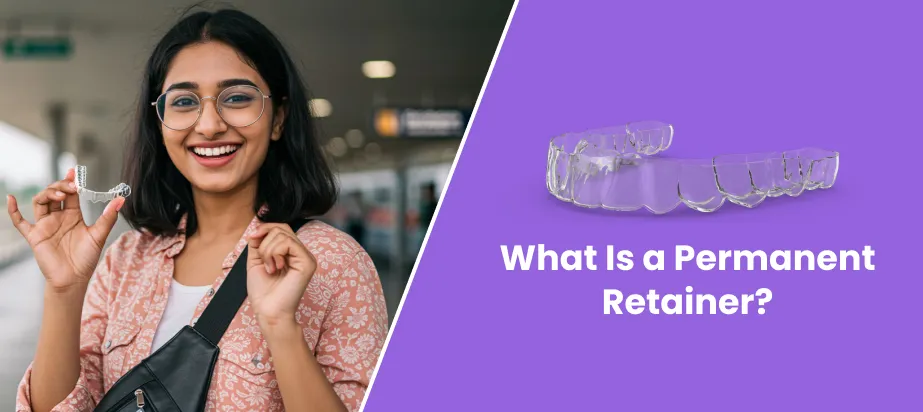
But right as you celebrate, your orthodontist hands you the golden rule of orthodontic retention your teeth need support so they never drift back. A permanent retainer after braces is a custom-contoured medical wire bonded directly behind your front teeth.
Key Takeaways
- A permanent retainer is a thin wire bonded to the back of your teeth - invisible from the front, working 24 hours a day without any effort from you.
- The most common recommendation in India is a permanent wire for the lower teeth combined with a removable retainer for the upper arch.
- The main care challenge is flossing - but a water flosser or floss threader makes it entirely manageable.
- Whistle's post-braces protocol includes regular retainer check appointments to confirm the wire stays correctly bonded throughout the years.
- Maintaining a bonded lingual wire is simple once you master interdental brushes, floss threaders, or a targeted water flosser to prevent tartar accumulation.
It acts as an invisible, 24/7 security guard for your smile. Because it stays fixed behind your lingual tooth enamel, it prevents orthodontic relapse automatically without requiring you to track daily wear hours or worry about losing clear plastic trays during busy workdays or wedding festivities.
How to Check If Your Permanent Retainer Is Still Working
1. The Tongue Touch Test
2. The Visual Mirror Check
3. The Bite Sensitivity Check
Why Do You Need a Retainer after Braces in the First Place?
- Alveolar Bone Remodeling Latency: Alveolar bone remodeling (the continuous process where bone tissue dissolves on the tension side and rebuilds on the pressure side) requires 6 to 12 months to achieve full mineral density and bone consolidation around newly aligned roots.
- Continuous Lifetime Mesial Drift: Mesial drift (the natural, gradual forward pressure exerted across human teeth throughout adult life) continues indefinitely. Without a stable retainer after braces, this natural forward force causes gradual crowding, particularly in the lower front jaw.
- Periodontal Ligament Elastic Memory: The periodontal ligament (the flexible fibrous tissue connecting each tooth root to the alveolar socket) possesses strong elastic memory. When braces come off, these collagen fibers remain stretched and exert a persistent recoiling pull for 9 to 12 months.
What Does a Permanent Retainer Look and Feel Like?
What Are the Real Pros and Cons of a Permanent Retainer?
Honestly, the pros are significant. And the cons are manageable - not reasons to avoid it.
What works in its favour:
It requires zero daily compliance. You cannot forget to wear it. You cannot lose it in a tissue at a restaurant. It works the same on a busy Monday morning in office as it does on a late night during Diwali celebrations. For patients with high relapse risk - especially those who had significant lower front tooth crowding before treatment - this 24/7 retention is genuinely superior to a removable retainer that depends on the patient remembering to wear it every night.
It is also completely invisible. No one will see it. No social awkwardness, no taking it out at dinner, no explaining it to anyone.
What you need to know and manage:
Hard and sticky foods can dislodge the bonding. Biting directly into a sugarcane piece, toffee, hard mathri, ice cubes, or whole apples can pop a bond loose. It's not a fragile appliance by any means, but it's not indestructible either.
If you ever develop significant gum disease that requires deep treatment, the wire may need to be removed temporarily. This is uncommon, but worth knowing.
Benefits of Permanent Retainers
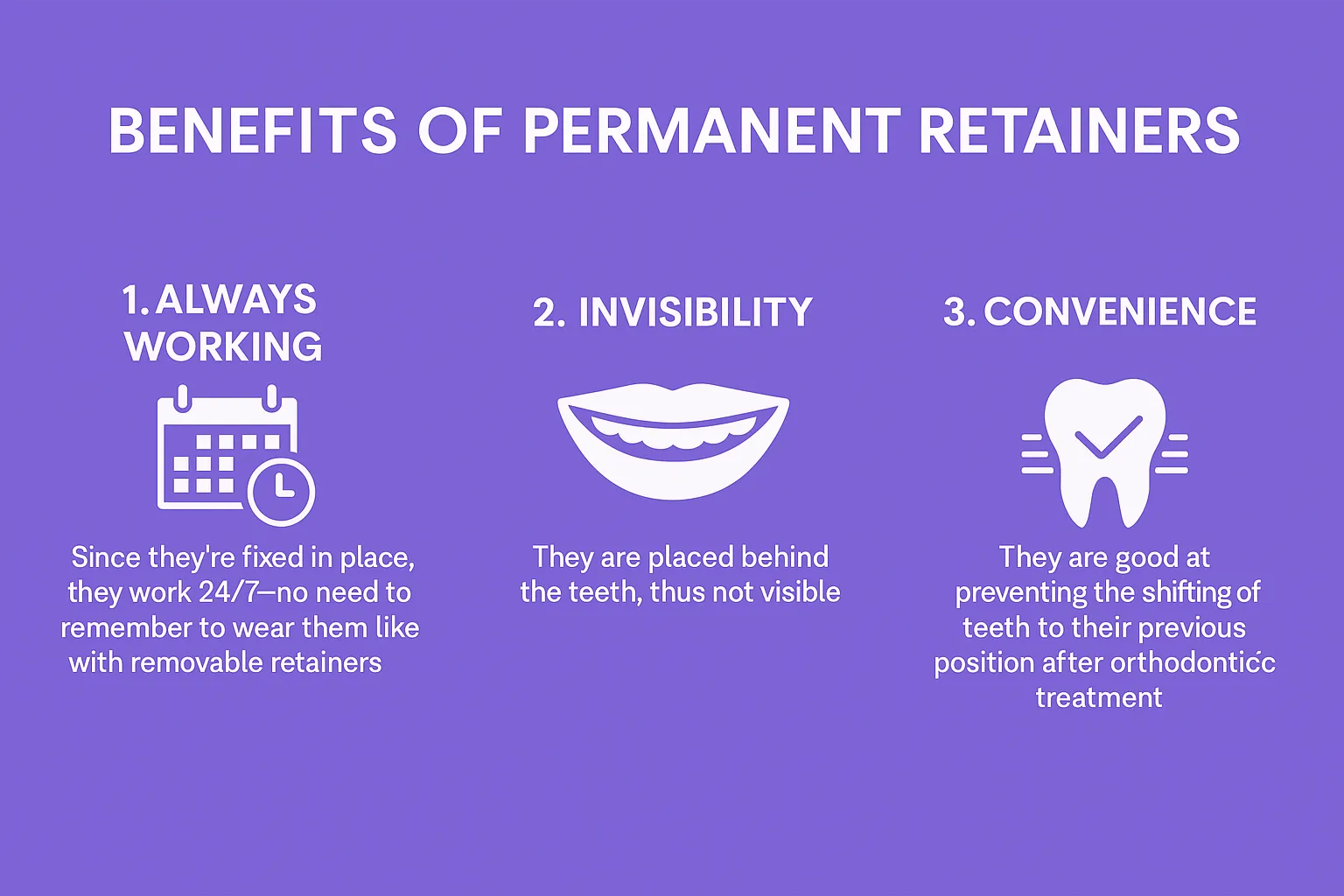
- Prevents teeth from shifting: Helps maintain the alignment achieved after braces.
- Works continuously: Since the retainer is fixed to the teeth, it provides consistent retention without needing daily wear reminders.
- Low-maintenance: You don't need to remember to put it in or take it out.
- Less visible: The thin wire is usually placed behind the teeth, making it discreet.
- Ideal for high relapse risk: Can be useful for teeth that are more likely to move back to their previous positions.
- Convenient for long-term retention: Once properly bonded, it can help maintain your smile for years with regular dental check-ups.
How Much Does a Permanent Retainer Cost in India?
In India, the cost of a permanent retainer typically ranges from ₹3,000 to ₹10,000 per arch, depending on the clinic, city, wire type, and whether it is included as part of your orthodontic treatment package.
- Braided wire tends to sit toward the higher end due to material complexity; solid wire is more economical
- If the retainer debonds and needs repair: Rs. 1,000 to Rs. 3,000 per repair appointment
- Metropolitan clinics (Mumbai, Delhi, Bangalore) typically price slightly higher than Tier 2 cities
The fixed retainer often works out to be more economical over five or more years. Removable retainers crack, warp, and get lost and each replacement costs money. A well-maintained permanent wire can last a decade or more without replacement.
At Whistle your orthodontist will confirm the exact fixed retainer cost for your specific treatment plan at your post-braces consultation. In many treatment packages, the initial retainer is included in the overall braces cost confirm this with your clinic before treatment ends.
How Do You Take Care of a Permanent Retainer?
The care routine is straightforward once you get the technique right. Most patients master it within two weeks.
1. Flossing:
This is the part that needs adjusting. Thread your floss through a floss threader, then guide it gently under the wire and between two teeth. Curve the floss in a C-shape around each tooth surface and move it up and down. Repeat for each gap between the bonded teeth. A water flosser is an excellent alternative - aim the tip at a 45-degree angle toward the gum line, move slowly between each tooth, and let the water jet do the work. Use it on medium pressure to avoid gum irritation.
2. Brushing:
Use a soft-bristled toothbrush and angle the bristles toward the gum line at the wire. An interproximal brush (a small cone-shaped brush on a thin handle, available at most dental supply counters for Rs. 50 to Rs. 150) is excellent for cleaning directly underneath and around the wire.
3. Foods to be careful with:
Avoid biting directly into hard items with your front teeth. Cut apples and similar fruits before eating. Keep toffees, hard biscuits, ice cubes, and sugarcane pieces away from the bonded area. These don't need to leave your diet permanently — just change how you eat them.
4. Professional cleanings:
Every six months. Tartar builds up around and under the wire in ways that daily brushing cannot address. A professional dental cleaning that includes careful scaling around the retainer wire is essential. At Clove Dental post-treatment appointments, the team inspects each bonding point and cleans professionally around the wire - something home care genuinely cannot replicate.
What to Do If Your Permanent Retainer Breaks or Comes Loose
How Can You Protect Your Retainer and Make It Last Longer
A few habits make a real difference over years of wear. Get a professional cleaning every six months without fail. This is not optional for permanent retainer patients. Never bite into hard foods directly with your front teeth - use your back teeth, or cut things first.
If you grind your teeth at night, tell your orthodontist - a night guard (a removable protective tray worn while sleeping to absorb grinding force) may be recommended alongside your retainer to prevent bonding stress.
How to Take Care of the retainers?
- Brushing well around the wire.
- Flossing a little harder, one can use floss threaders or a water flosser.
- Visiting the dentist regularly for cleanings and to keep a check that the wire is still firmly attached.
- Avoid very sticky or hard foods, so that the wire doesn’t come off.
What If I Don’t Want a Permanent Retainer
If you don’t want a permanent retainer after braces, you can usually discuss a removable retainer with your orthodontist. Clear retainers or Hawley retainers can help keep your teeth aligned, but they need to be worn as recommended and replaced when they become worn or damaged.
Keep in mind that teeth can gradually shift after braces if retention is stopped. Your orthodontist can assess your teeth, bite, and risk of relapse to determine whether a removable retainer is suitable for you.
Also Read:
Difference in Permanent vs Removable Retainers
| Type | Looks Like | Good For | Things to Know |
| Permanent Retainer | Hidden wire | People who want low-maintenance | Needs special care while brushing and flossing |
| Removable Retainer | Clear tray or wire with plastic | People who can wear it daily | Can be lost or forgotten |
Wondering whether a permanent or removable retainer is the right choice for your teeth after braces? Your Whistle orthodontist and will assess your bite pattern, tooth positions, relapse risk, and daily routine to recommend the exact retention plan your smile needs. Book a free post-braces consultation at your nearest Whistle Partner clinic - no commitment required.
How to Maintain Your Smile After Braces
- If your braces are coming off this month: Ask your treating orthodontist about the hybrid retention protocol (a bonded lingual wire on the lower arch paired with a clear removable retainer for the upper arch). This gives you maximum stability and zero aesthetic compromise.
- If you already have a bonded retainer: Run the 60-Second At-Home Mirror Check today. Sweep your tongue along the back of your front teeth and use a smartphone flashlight to ensure every bonding resin dot is firm and intact.
- If you feel a loose bond or sharp wire: Do not attempt any DIY glue fixes. Schedule a prompt re-bonding visit at your nearest Whistle partner clinic within 24 to 48 hours to prevent your teeth from shifting.
- Book your 6-month preventive checkup: Mark your calendar for biannual ultrasonic scaling at a Whistle partner clinic so our dental team can clear calculus and verify your wire integrity under clinical magnification.
Also Read:
Book 3D Teeth Scan
Consult our experts and get a 3D preview of your smile transformation!
Permanent Retainer
Permanent Retainer after Braces
FAQ's
Q1.How long should I wear a permanent retainer after braces?
Q2.What is the permanent retainer cost in India?
Q3.Is a permanent retainer painful after it is placed?
Q4.Can a permanent retainer be removed if I change my mind?
Q5.Does getting a permanent retainer hurt?
No, placing a permanent retainer is completely painless and non-invasive. Your orthodontist simply conditions the back surface of your teeth with a mild gel, positions the custom wire, and hardens the composite resin using a dental curing light without any drilling or local anesthesia.
Q6.Can you feel a permanent retainer with your tongue?
You will notice the smooth contour of the wire with your tongue during the first week. However, the lingual surface quickly becomes second nature, and within two weeks, most patients completely forget the wire is even there.
You May Also Like



 Medically Reviewed by Whistle Dental Team





















 Medically Reviewed by Whistle Dental Team

 Medically Reviewed by Whistle Dental Team