
Can I Put Braces at the Age of 35? The Truth About Mid-Life Orthodontics
 Medically Reviewed by Whistle Dental Team
By your mid-30s, you have likely settled into your career, perhaps started a family, and generally figured out who you are. You make smart investments in your health and your future. Yet, every time you look closely in a mirror, or feel a dull ache in your jaw after a long workday, you are reminded of the one thing you never quite fixed: your smile.
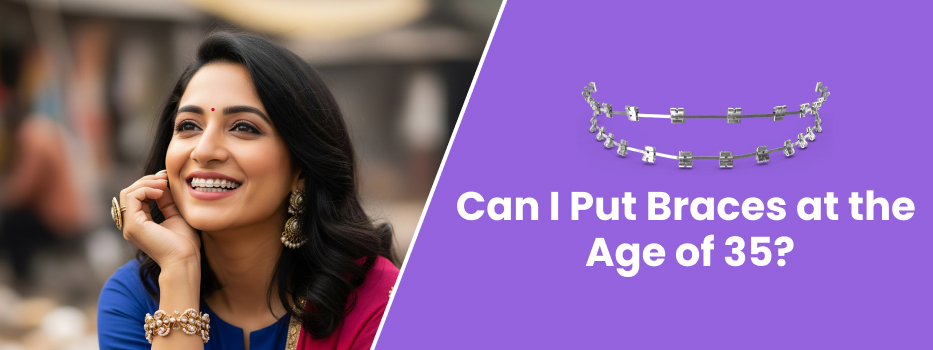
Can I put braces at the age of 35? Absolutely. In modern clinical orthodontics, 35 is considered a prime age for treatment. While the biology of bone movement is slightly different than that of a teenager, adults in their 30s make exceptional, highly successful patients. Whether you choose discreet clear aligners or specialized braces at 35, the focus often shifts from purely cosmetic straightening to restoring vital oral function and preventing permanent tooth wear.
Key Takeaways
- No Age Limit: Is 35 too old for braces? Not at all. As long as your gums and jawbone are healthy, there is absolutely no biological age limit to moving teeth.
- The Wear Factor: A misaligned bite often begins showing its true damage in your 30s, leading to chipped enamel, receding gums, and chronic headaches.
- The Periodontal Prerequisite: Healthy gums are mandatory. Mid-life orthodontics requires excellent periodontal health to ensure safe tooth movement.
- Boardroom Ready: Whistle clear aligners and Zirconia braces offer practically invisible solutions that fit seamlessly into a professional lifestyle.
- The Compliance Advantage: Adult patients frequently finish their treatment exactly on time because they actually follow instructions and wear their retainers.
Yes, you can get braces at the age of 35. Adult braces are common and effective for correcting crooked teeth, bite problems, and alignment issues. While treatment may take slightly longer than in teens because adult bones are fully developed, modern options like Zirconia braces and clear aligners make the process more comfortable and discreet.
It's never too late to improve your smile. Age is never an obstacle to orthodontic treatment. Nowadays, many adults choose to align their teeth in their 30s, 40s, and beyond for both aesthetic and functional reasons.
Is There an Age Limit for Teeth Braces?
Many people believe braces are only for teenagers, but that is a common misconception. There is no maximum age limit for teeth braces. As long as your teeth, gums, and supporting jawbone are healthy, you can undergo orthodontic treatment at almost any age.
If you're wondering, "Can I put braces at the age of 35?" the answer is yes. Adults in their 30s, 40s, and even 50s successfully straighten their teeth with braces or clear aligners every year.
Healthy Gums Matter More Than Age
When deciding whether you're a suitable candidate for braces, orthodontists focus on your oral health rather than your age. Healthy gums and adequate bone support are essential for safe tooth movement.
Before starting treatment, your orthodontist will evaluate:
- Gum health
- Bone support around the teeth
- Overall oral hygiene
- Bite and tooth alignment
If any gum disease or dental issues are present, they are usually treated first before orthodontic treatment begins.
How to Check If You Are Ready for Adult Braces
Before you worry about the aesthetics of braces, you must evaluate the foundation of your teeth. Try this quick self-assessment at home:
- The Pink Firmness Test: Look closely at your gumline in the mirror. Your gums should be firm, tight, and light pink. If they are puffy, bright red, or bleed easily when you floss, you may have early gum disease.
- The Stability Check: Gently press against your front teeth with a clean index finger. They should feel deeply rooted and solid. Any noticeable wiggle means you need a periodontal checkup immediately.
- The Result: If your gums are healthy and your teeth are solid, you are perfectly qualified for adult orthodontics.
Symptoms to notice for braces
- Visibly crooked or crowded teeth
- Difficulty in brushing around and flossing between crooked teeth
- Frequent biting or cutting of the tongue by the teeth
- Teeth that fail to close over each other properly when the mouth is at rest
- Difficulty in pronouncing some sounds due to the tongue’s position under the teeth
- Clicking of jaws on chewing or on first waking up
- Fatigue or stress on the jawline after chewing food
Also Read:
Can You Put Braces at Age of 35?
Yes. If you are over the age of 35, you can still get braces and achieve excellent results. Modern orthodontic treatment is no longer limited to teenagers or young adults. In fact, many people choose to straighten their teeth in their 30s, 40s, and even later to improve both their smile and long-term oral health.
The deciding factor is not your age but the health of your teeth and gums. If your gums are healthy, your jawbone provides adequate support, and any existing dental issues have been treated, braces can safely move your teeth into proper alignment.
While tooth movement in adults may be slightly slower than in teenagers because jaw growth has already finished, this does not affect the final outcome. With proper treatment planning and good oral hygiene, adults over 35 can expect predictable, effective, and long-lasting results.
Whether your goal is to correct crowded teeth, spacing, bite problems, or improve your smile, being over 35 is not a barrier to orthodontic treatment. After a comprehensive dental evaluation, your orthodontist can recommend the most suitable option, including traditional braces, ceramic braces, zirconia braces, or clear aligners based on your clinical needs.
Why a Bad Bite Catches Up With You at 35
When you were 15, crooked teeth were mostly an aesthetic annoyance. By the time you reach 35, a malocclusion (a bad bite) becomes a structural health issue.
- Decades of Friction: If your upper and lower jaws do not align correctly, your teeth have been crashing together improperly millions of times over the last two decades. This leads to flattened chewing surfaces, chipped edges, and micro-fractures in the enamel.
- TMJ Strain: A misaligned bite forces your jaw muscles to constantly overcompensate. By your mid-30s, this chronic muscle tension often manifests as temporomandibular joint (TMJ) pain, jaw clicking, and severe morning headaches.
- Plaque Traps: Crowded, overlapping teeth become incredibly difficult to keep clean as you age, increasing your risk of deep cavities and periodontal bone loss.
Benefits of Getting Braces as an Adult?
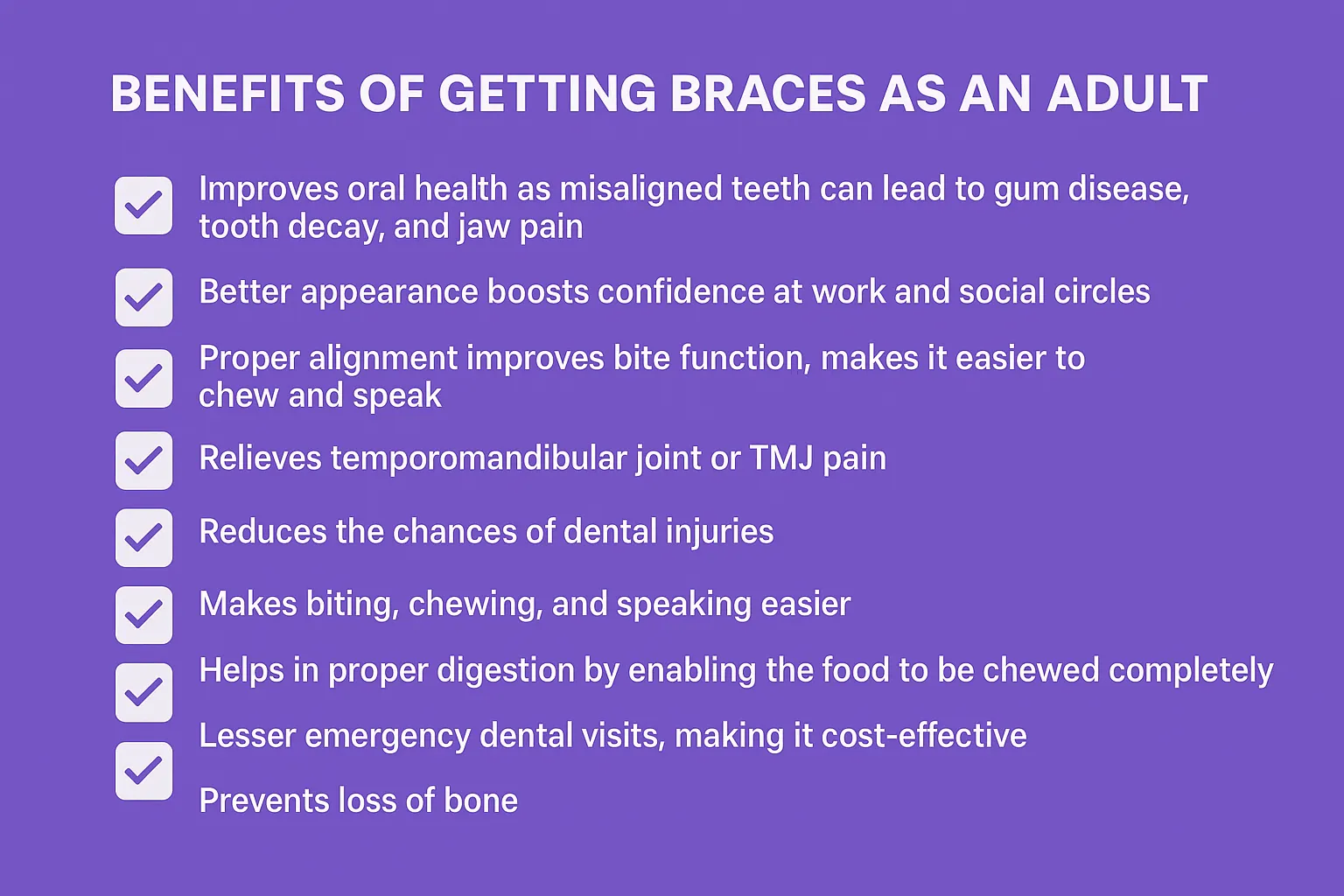
The various advantages of getting dental braces as an adult include:
- Improves oral health as Misaligned teeth can lead to gum disease, tooth decay, and jaw pain.
- Better appearance boosts confidence at work and social circles
- Proper alignment Improves bite function, makes it easier to chew and speak.
- Relieves temporomandibular joint or TMJ pain
- Reduces the chances of dental injuries
- Makes biting, chewing, and speaking easier
- Helps in proper digestion by enabling the food to be chewed completely
- Lesser emergency dental visits, making it cost-effective
- Prevents loss of bone
- Improves general oral health
- Shortest Time for Braces: Is a Fast Fix Possible?
- Can I Put Braces at the Age of 25?
- Braces Side Effects: Not What You Expect, But You’ll Love Them Anyway
- How Thumb Sucking Affects the Bite?
- How Long Does It Take to Close a 1mm Gap to Braces?
Does Age Affect Braces Treatment?
Yes, age can influence certain aspects of orthodontic treatment, but being 35 does not reduce the effectiveness of braces. The main difference is that adults have fully developed jawbones, so tooth movement may occur more gradually than it does in teenagers. However, with a well-planned treatment approach, adults over 35 can achieve the same healthy, well-aligned smile.
Bone Remodeling Happens More Gradually
Braces work by applying gentle, continuous pressure that triggers bone remodeling - a natural process in which bone tissue breaks down on one side of the tooth and forms on the other. This process continues throughout life, which is why teeth can still be moved safely after the age of 35.
Because bone metabolism slows slightly with age, orthodontists use carefully controlled forces to protect the teeth, roots, and surrounding bone during treatment.
Treatment May Take Slightly Longer
Adults over 35 may experience a slightly longer treatment period compared to teenagers. This is because adult bone responds more slowly, and orthodontists often move teeth more conservatively to maintain long-term stability.The exact treatment time depends on several factors, including:
- The complexity of your bite and alignment issues
- Your gum and bone health
- The type of braces or clear aligners used
- How well you follow your orthodontist's instructions
Many adults complete treatment within the expected timeframe by maintaining good oral hygiene and attending regular adjustment appointments.
Success Rates Remain High After 35
One of the biggest misconceptions is that braces become less effective with age. In reality, the success rate of braces after 35 remains very high when your gums and supporting bone are healthy.
Many adults achieve results comparable to younger patients because they are often more committed to wearing aligners as instructed, maintaining oral hygiene, and attending follow-up visits consistently.
The Biological Difference: Teen vs. Adult Orthodontics
The core mechanism of moving teeth remains exactly the same whether you are 14 or 35. When pressure is applied, the bone on one side of the tooth dissolves, and new bone builds up on the other side.
However, because adult facial bones have completely stopped growing, the bone remodeling process is slightly slower. Your orthodontist will use much lighter, gentler forces to move your teeth. This careful approach prevents damage to your adult roots and protects your bone levels, ensuring your teeth remain stable for the rest of your life.
Options for Adults
You have several discreet and effective choices:
- Traditional metal braces:
- Use stainless steel bands, wires, and brackets, the most effective for complex cases.
- Ceramic braces:
- The brackets, and ligatures, are tooth-colored to blend in with one's teeth, less noticeable than metal.
- Lingual braces:
- These are placed behind the teeth, making them invisible.
- Self-ligating braces:
- They make use of a built-in system in order to hold the archwire in its place.
- Clear aligners:
- It is also an option Popular with adults due to their appearance and convenience.
- How to Fix a Teeth Gap Without Braces
- Braces for Teeth Gaps: Everything You Need to Know
- Teeth Braces Price in India: What to Expect & Why Whistle is Worth It
- Is There a Special Toothbrush for Braces? Here’s What You Need to Know
What Challenges Might You Face When Getting Braces at an Older Age?
There are some risks and challenges associated with dental braces treatment at an older age, which may include the following:
Higher risk of developing periodontal disease (serious infection affecting the gums and underlying jaw bone)
- Receding gums
- Bone tissue erosion
- Loss of teeth stability
- Erosion of the outer layer of teeth causes root exposure and even tooth loss
- Bone structures have stopped growing and additional surgeries may be needed if developmental conditions are untreated
- The duration of treatment will be longer
- Do You Have to Wear Retainers Forever?
- Before and After Braces Change Lips: Do Braces Change Your Lip?
- What’s the Difference Between a Dentist and an Orthodontist?
- Types of Braces for Gap Teeth: Which One Is Right for You?
- Is Tooth Extraction Necessary for Braces?
Discreet Options for the Working Professional
You do not have to walk into a client meeting or a boardroom with a mouth full of heavy metal. Modern adult orthodontics offers highly discreet solutions:
- Whistle Clear Aligners: The ultimate choice for the working adult. These ultra-clear, removable trays gently shift your teeth without wires. You take them out to eat, drink, and brush, meaning zero dietary restrictions and zero boardroom embarrassment.
- Whistle Zirconia Braces: If your bite requires fixed braces, Zirconia is the "ceramic steel" of orthodontics. These brackets are completely tooth-colored, resist coffee stains entirely, and offer the mechanical power of metal with a virtually invisible profile.
Talk to an Orthodontist
A consult with an orthodontist helps with:
- Cost estimates
- Duration of treatment
- Best type of braces for ones lifestyle and goals
- Your First Week in Braces: Tips for a Smooth Transition
- Life After Braces: The Importance of Retainers and Ongoing Care
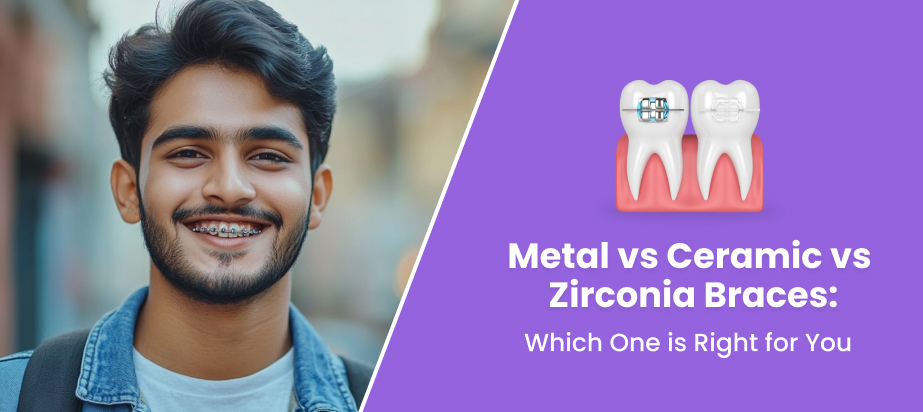
- Metal vs. Ceramic vs. Zirconia Braces: Which One is Right for You?
- Maintaining Retainers While Traveling: A Complete Guide
- Can Braces Fix Facial Asymmetry?
Your Next Steps
Your 30s are about making intelligent, long-term decisions. Straightening your teeth now prevents severe structural dental failures, tooth loss, and expensive rehabilitative surgeries in your 50s and 60s. It is never too late to take control of your oral health and finally achieve the confident smile you deserve.
Stop wondering if it is too late. Book a free consultation at your nearest Whistle Partner clinic today to explore your options.
Also Read:
Book 3D Teeth Scan
Consult our experts and get a 3D preview of your smile transformation!
can i put braces at the age of 35
is 35 too old for braces
FAQ's
Q1.What is the maximum age for braces?
There is no maximum age limit for undergoing dental braces treatment provided that the jaw bone is in a healthy condition. Your orthodontist will evaluate you thoroughly to determine if your gums and bones are in a healthy condition for undergoing dental braces treatment.
Q2.Can a 31-year-old get braces?
Q3.Is 30 too late for braces?
No, 30 is not late for orthodontic treatment.The teeth continue to shift as we age even after the jawbone stops growing in adulthood. So, there is never any time when the dental braces will not work.
Braces adjust the teeth by applying pressure on them, and this pressure will work even after the bones stop growing. The time taken to straighten the teeth in adults will be longer as the bones are less flexible. Yet, braces can be effective at any age.
Q4.Will treatment take much longer because I am older?
Adult bone remodeling is slightly slower, meaning your treatment may take a few months longer than it would for a teenager. However, most adult cases are successfully completed within 12 to 24 months, depending on the severity of the bite.
Q5.Will braces at 35 fix my jaw clicking?
If your jaw clicking (TMJ dysfunction) is caused by a misaligned bite forcing your jaw muscles to overcompensate, correcting your bite with orthodontics can significantly reduce or completely eliminate the clicking and associated headaches.
Q6.What is the minimum age limit for teeth braces?
There is no fixed minimum age limit for teeth braces, as every child's dental development is different. Orthodontists generally recommend braces after most permanent teeth have erupted, which is typically between 10 and 14 years of age. However, children should have their first orthodontic evaluation by the age of 7 to identify any developing bite or jaw problems.
You May Also Like



 Medically Reviewed by Whistle Dental Team












 Medically Reviewed by Whistle Dental Team

 Medically Reviewed by Whistle Dental Team