How to Reduce Braces Pain: Fast Relief Tips, Power Chain Care & Pain-Free Recovery
 Medically Reviewed by Whistle Dental Team
To reduce braces pain quickly, use ice-cold water rinses, over-the-counter pain relievers (such as paracetamol or ibuprofen as recommended by your doctor), apply oral anesthetic gel to sore gums, place orthodontic wax over poking brackets, and stick strictly to a soft Indian diet (dal khichdi, cool curd rice, soft paneer).
Key Takeaways:
- Peak Discomfort Window: Pain peaks 24 to 48 hours after fitting or tightening, subsiding completely within 3 to 5 days.
- Bone Remodeling Mechanics: Pressure compresses the periodontal ligament, triggering temporary cell inflammation as bone reshapes.
- Power Chain Pressure: Power chains exert continuous elastic traction to close gaps, causing extra soreness for 2 to 3 days after placement.
- Top Relief Remedies: Cold water drinks, warm saline rinses, orthodontic wax on sharp brackets, and topical oral gels offer instant relief.
- Aligner Comfort Advantage: Whistle clear aligners eliminate wire friction, sharp brackets, and power chain pressure, delivering smooth gap closure.
Braces cause temporary soreness during initial placement and monthly tightening because archwires exert mechanical pressure on the periodontal ligament (connective tissue around tooth roots). This triggers controlled bone remodeling (osteoclast bone absorption and osteoblast bone formation). Discomfort peaks within 24 to 48 hours and resolves within 3 to 5 days.
How Do Braces Work? The Science Behind Tooth Movement
Understanding how braces work helps ease anxiety when soreness strikes. Tooth movement is not a simple mechanical pull. It is a biological process involving controlled bone remodeling.
Braces consist of metal or ceramic brackets bonded to each tooth, connected by a flexible archwire. When your orthodontist secures the archwire into bracket slots, the wire exerts continuous, gentle pressure on your teeth. This pressure compresses the periodontal ligament (the microscopic connective tissue cushioning your tooth root inside the jawbone).
Compression triggers a cellular response. On the side experiencing pressure, specialized cells called osteoclasts break down tiny amounts of bone tissue (bone resorption). On the opposite side under tension, cells called osteoblasts build new bone tissue (bone formation). This cellular activity creates space for the tooth to move into ideal alignment. The temporary inflammation during bone breakdown is what causes sore teeth from braces.
Why Pain May Occur During Initial Fitting & Tightening
Feeling soreness after getting braces or having your wires tightened is completely normal. It signals that your teeth are responding to active orthodontic forces.
Discomfort typically follows a predictable timeline. After your initial fitting or routine adjustment appointment, your teeth usually feel fine for the first 2 to 4 hours. As periodontal ligament inflammation builds, sensitivity peaks between 24 and 48 hours. During this peak window, even light contact between upper and lower teeth can feel tender. By day 3 or 4, inflammation subsides, and teeth feel comfortable again by day 5 to 7.
How to Reduce Braces Pain: 7 Immediate Relief Hacks
1. Cold Therapy and Ice-Cold Drinks
2. Over-the-Counter Pain Relievers
3. Orthodontic Wax for Cheek & Lip Friction
4. Warm Saline Water Rinses
5. Topical Oral Anesthetic Gels
6. Soft Indian Recovery Diet
7. Gentle Gum Massage
How to Relieve Pain from Power Chain Braces
- Expect a 48-Hour Peak: Power chain pressure peaks during the first two days. Knowing that soreness drops significantly by day 3 helps you manage expectations.
- Rely on Cold Smoothies & Cold Water: Sipping ice-cold drinks cools down the elastic power chain material, temporarily reducing force delivery and soothing sore roots.
- Maintain Soft Food Habits: Avoid biting into firm foods with front teeth while wearing a power chain. Cut soft foods into tiny bites and chew exclusively with back molars.
- Do Not Cut or Tamper with the Elastic: Never attempt to cut or stretch a power chain with scissors or tweezers. Cutting the elastic halts tooth movement and requires an immediate clinic visit.
How to Fix Sore Teeth from Braces: Daily Behavioral Modifications
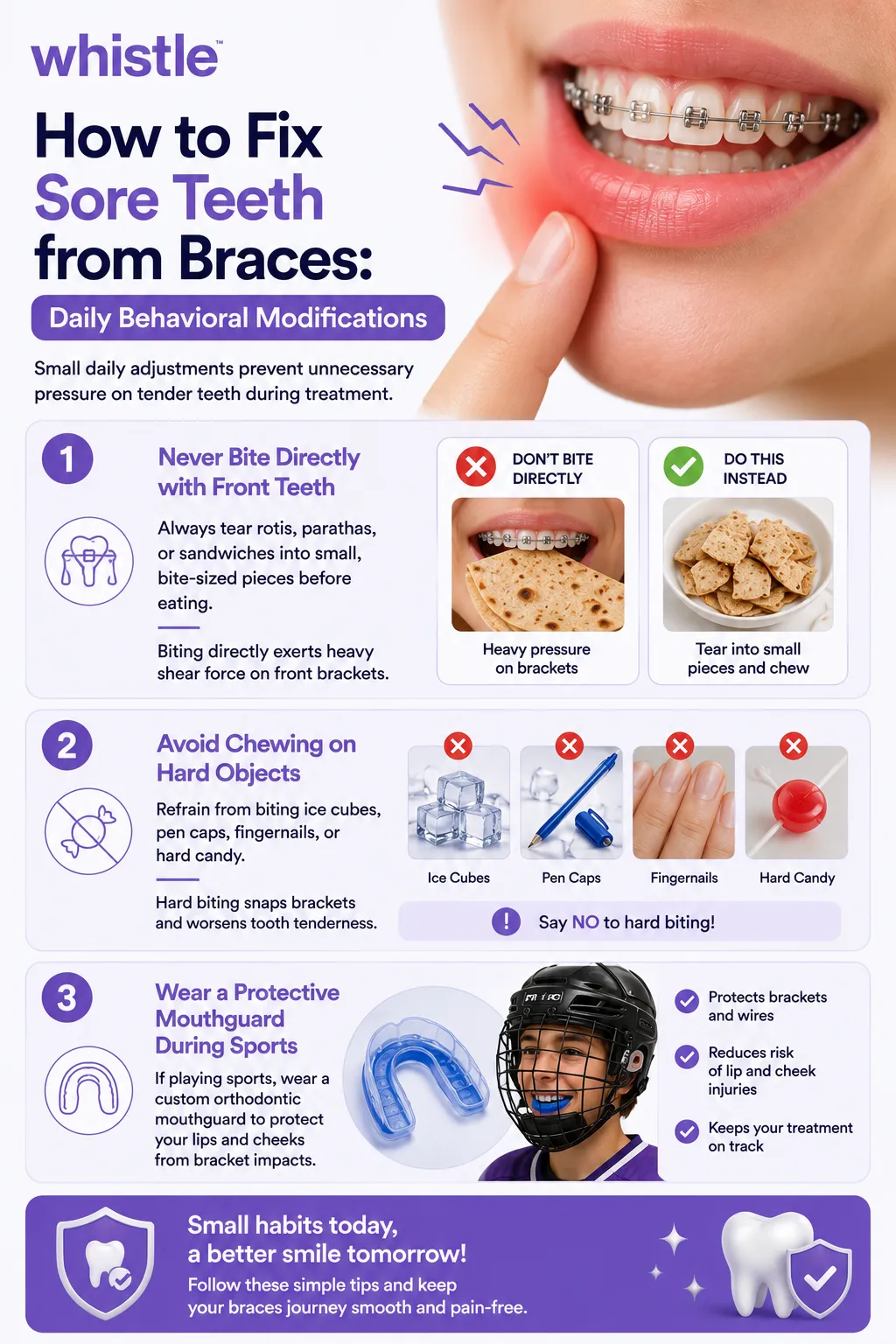
- Never Bite Directly with Front Teeth: Always tear rotis, parathas, or sandwiches into small, bite-sized pieces before eating. Biting directly exerts heavy shear force on front brackets.
- Avoid Chewing on Hard Objects: Refrain from biting ice cubes, pen caps, fingernails, or hard candy. Hard biting snaps brackets and worsens tooth tenderness.
- Wear a Protective Mouthguard During Sports: If playing sports, wear a custom orthodontic mouthguard to protect your lips and cheeks from bracket impacts.
Comparison Table: Braces Relief Options vs. Whistle Aligner Comfort
| Pain Management Area | Conventional Metal Braces | Power Chain Braces | Whistle Clear Aligners |
| Initial Soreness Window | 3 to 7 days after placement & tightening. | 2 to 4 days of sharp elastic pressure. | 1 to 2 days of mild pressure per new tray set. |
| Cheek & Lip Irritation | High; brackets and wires rub inner cheeks. | High; elastic links rub against lip linings. | Zero; laser-cut smooth polyurethane edges. |
| Dietary Freedom | Restricted; soft foods mandatory during soreness. | Restricted; no front-biting allowed. | 100% Unrestricted; trays remove for all meals. |
| Emergency Wire Pokes | Common; wire ends poke back cheeks. | Occasional; elastic links can snap loose. | Zero; no wires or metal brackets to poke cheeks. |
How Whistle Clear Aligners Deliver Pain-Free Orthodontics
Orthodontist Observation: Common Mistakes Orthodontists Often See
- Taking Aspirin for Braces Pain: Patients sometimes take aspirin for tooth pain. Aspirin thins blood and increases tissue bleeding during dental procedures. Use paracetamol or ibuprofen as directed by your doctor instead.
- Applying Wax on Wet Brackets: Trying to stick orthodontic wax onto a wet, saliva-covered bracket causes the wax to slip right off. Always dry the bracket with a tissue or cotton swab before applying wax.
- Picking Poking Wires with Fingernails: When a thin wire end pokes your cheek, digging with fingernails or tweezers bends the archwire and causes more severe poking. Cover the sharp end with wax and visit your clinic for a quick wire trim.
- Biting Hard Food to "Test" Soreness: Patients sometimes bite hard items like apples or nuts to check if teeth are still sore, triggering severe acute inflammation. Let sore teeth rest with soft foods.
- Skipping Elastic or Power Chain Appointments: Missing scheduled power chain replacements allows elastic links to lose tension irregularly, extending your overall treatment duration.
Daily Oral Hygiene Routine for Sore Teeth
- Use a Soft-Bristled Orthodontic Brush: Brush gently around brackets twice daily using light pressure to clean without irritating tender gums.
- Clean Interdental Spaces Daily: Slide a slim interdental brush under archwires to sweep away trapped food particles that cause localized pain.
- Rinse with Alcohol-Free Mouthwash: Swish with an alcohol-free fluoride mouthwash to keep oral tissues hydrated and clean.
- Clean Aligner Trays Regularly: If wearing Whistle aligners, clean trays with cool water and mild soap daily to keep them hygienic and fresh.
Your Next Steps: Managing Braces Pain for a Confident Smile
Braces pain is a temporary, normal part of tooth movement. By using cold therapy, OTC pain relievers as directed, orthodontic wax, and a soft Indian diet, you can comfortably manage soreness after adjustments. Soreness passes quickly as your mouth adapts.
If you want a treatment path free from metal wires, sharp brackets, and power chain soreness, explore modern clear aligner options. Book your 3D consultation at a Whistle partner clinic near you today and enjoy smooth, comfortable orthodontic alignment!
Also Read:
Book 3D Teeth Scan
Consult our experts and get a 3D preview of your smile transformation!
How to Reduce Braces Pain
Braces PainRelief
How to Stop Braces Pain Immediately
Braces Pain
How to get Rid of Braces pain
How to Get R.elief from braces pain
how to relieve Braces Pain
FAQ's
Q1.How to reduce braces pain quickly at home?
Sip ice-cold water or chilled lassi, take over-the-counter pain relievers as recommended by your doctor, apply orthodontic wax to sharp brackets, swish with warm saltwater, and stick to soft foods like dal khichdi and curd rice.
Q2.How do braces work to move teeth?
Braces apply continuous pressure on teeth through brackets and archwires. This pressure compresses the periodontal ligament, triggering bone remodeling where bone breaks down on the pressure side and builds up on the tension side, allowing teeth to shift into alignment.
Q3.How to relieve pain from power chain braces?
Power chain pain peaks during the first 48 hours due to continuous elastic traction. Manage soreness by drinking ice-cold water, eating soft foods, using OTC pain relievers as advised by your doctor, and avoiding hard biting. Never cut or stretch the power chain elastic.
Q4.How to deal with pain from braces after tightening?
Plan ahead by taking pain medication 30 minutes before your adjustment appointment if recommended by your doctor. Eat soft Indian foods for 3 to 5 days, use orthodontic wax over rubbing brackets, and rinse with warm saline water to reduce tissue inflammation.
Q5.Does lack of pain mean my braces stopped working?
No, lack of pain does not mean your braces stopped working. Tooth movement continues even when soreness fades because your periodontal ligament and jawbone adapt to continuous orthodontic pressure.
You May Also Like



 Medically Reviewed by Whistle Dental Team














 Medically Reviewed by Whistle Dental Team

 Medically Reviewed by Whistle Dental Team