

Types of Braces for Gap Teeth: Which One Is Right for You?
 Medically Reviewed by Whistle Dental Team
The primary types of braces for gap teeth include traditional metal braces, discreet ceramic braces, low-friction self-ligating systems, tongue-side lingual braces, and modern invisible braces for teeth gap (custom clear aligners).
When exploring teeth gap braces types, the ideal orthodontic appliance depends on the gap width, whether spacing involves front incisors or generalized dental arches, underlying bite alignment, and lifestyle preferences.
This clinical guide compares all appliance categories, biological closure mechanics, treatment durations, and lifelong retention strategies.
Key Takeaways
- Bodily Root Movement vs Cosmetic Masking: Braces for gap teeth move the entire tooth bodily through bone remodeling, unlike cosmetic dental bonding or veneers which merely widen the visible crown without closing root spaces.
- Comprehensive Appliance Spectrum: Patients can choose between durable metal braces, tooth-toned ceramic brackets, friction-free self-ligating systems, completely hidden lingual braces, and removable clear aligners.
- Invisible Braces Efficiency: Invisible braces for teeth gap (clear aligners) provide virtually invisible, removable space closure for mild to moderate gaps within 3 to 12 months without dietary limits.
- Predictable Treatment Timelines: The teeth gap braces time period averages 3 to 6 months for minor midline spacing (diastema) and 9 to 18 months for complex spacing involving bite discrepancies.
- Mandatory Retention to Prevent Relapse: Elastic gingival fibers between separated teeth possess strong biological memory; wearing bonded lingual retainers or clear Essix retainers is essential to prevent gaps from reopening.
In clinical orthodontics, braces for gap teeth close spaces by guiding tooth crowns and their roots bodily through alveolar bone, preventing teeth from tipping inward.
For patients curious about teeth gap braces time period, minor gaps (1 to 2 millimetres) typically close in 3 to 6 months, while moderate to complex generalized spacing requires 6 to 18 months under specialist supervision.
What Causes Gap Teeth?
In clinical dentistry, spaces or gaps between adjacent teeth are referred to as diastemas. While a midline gap between the upper two front teeth (maxillary midline diastema) is the most common presentation, generalized spacing can occur throughout upper and lower dental arches.
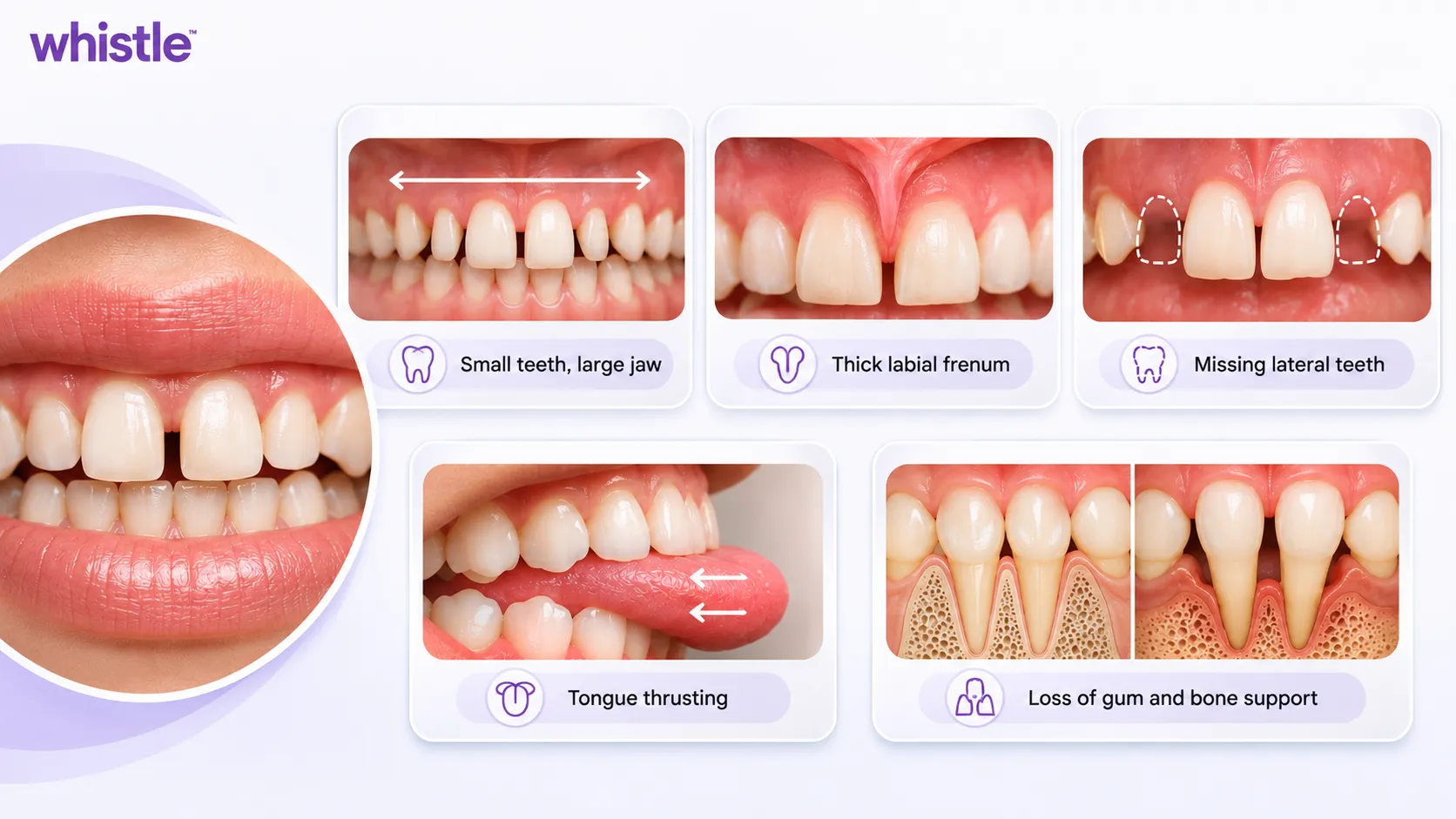
Diastemas rarely develop without an underlying biological cause. Orthodontists evaluate several primary etiologies:
- Tooth-to-Jaw Size Disproportion: Inheriting a broader jawbone combined with genetically smaller teeth (microdontia) leaves surplus arch perimeter, creating natural spaces between teeth.
- Hypertrophic Labial Frenum: A thick, fibrous band of gum tissue connecting the inner upper lip to the gumline can insert deeply between the two central incisors, physically barring them from coming together.
- Congenitally Missing Teeth (Hypodontia): When permanent lateral incisors fail to develop, adjacent central incisors drift outward into the empty space.
- Childhood Habits and Tongue Thrusting: Habitual tongue thrusting against front teeth during swallowing or prolonged thumb-sucking exerts outward hydraulic force, tipping front teeth forward and fanning them apart.
- Advanced Periodontal Disease: Untreated gum infection causes alveolar bone loss, weakening tooth support and allowing teeth to migrate and splay outward under normal chewing forces.
Why do gaps occur in the first place?
Are there different types of gaps? Well, yes! There are a variety of gap types in human teeth. Let’s take a look at which one you might have
| Type of Gap | Features | Reason |
| Midline Diastema | Space between the upper two front teeth. | Often genetic lip muscle has extra strength and attachment. |
| Generalized Spaces | Multiple gaps are present throughout the mouth. | Mismatch in size between teeth and jaw. |
| Single Tooth Gap (between any teeth) | A gap between any two teeth that are not the upper central incisors. | Missing tooth, smaller tooth, tooth shifting. |
| Gaps Due to Missing Teeth | Spaces are created when adjacent teeth drift after a tooth is lost. | Tooth extraction(removal), genetically missing tooth. |
| Gaps Caused by Habits | Spaces resulting from consistent pressure pushing teeth apart. | Thumb-sucking, tongue-thrusting. |
Read More : How much time does it take to fill tooth gaps? It depends on your case, but on average, treatment can take anywhere between 6 to 36 months.
Teeth Gap Braces Treatment Types: Evaluating Modern Orthodontic Options
Teeth Gap Braces Time Period: How Long Does Closure Take?
The teeth gap braces time period depends heavily on gap magnitude, whether gaps are localized to the front two incisors or distributed across the arch, and individual bone turnover rates:
- Minor Gaps (1 to 2 mm): Typically close within 3 to 6 months using clear aligners or targeted anterior brackets.
- Moderate Spacing (2 to 4 mm): Usually requires 6 to 12 months of structured tooth movement, ensuring root parallelism to prevent tipping.
- Severe or Generalized Gaps (>4 mm): Closing large spaces while coordinating overall arch bite harmony takes 12 to 18 months.
Orthodontists emphasize that closing visible crowns together is only half the battle. If teeth are tipped together rather than translated bodily, the roots remain angled, leading to rapid space reopening. The final finishing stage ensures roots stand completely parallel in dense alveolar bone.
Also Read:
- Braces Before and After Jawline: How Can an Orthodontist Change Your Jawline?
- Before and After Braces Change Lips: Do Braces Change Your Lips?
Health Risks of Leaving Gap Teeth Untreated
- Food trapping: Chronic plaque accumulation in gaps can lead to gingivitis and, if left longer, periodontitis.
- Gum disease risk: When gaps exist due to missing or shifted teeth, the remaining teeth may over-erupt or tilt, disrupting your bite and potentially causing jaw discomfort or TMJ issues.
- Bite problems: Larger front-tooth gaps can contribute to lisping or a whistling sound when speaking.
- Speech difficulties: Adjacent teeth naturally drift toward empty spaces. What starts as a small gap can widen over time.
- Teeth shifting: Fixing the gap early not only improves your smile - it protects your long-term oral health.
Conclusion: “coming a little closer!”
Closing gap teeth restores functional chewing balance, shields interdental gums from trauma, and creates a radiant, harmonious smile. Whether you choose the robust mechanical efficiency of traditional metal brackets, the cosmetic discretion of ceramic brackets, or the lifestyle freedom of invisible braces for teeth gap, modern orthodontics offers tailored, predictable solutions.
Take the first step toward closing your teeth gaps by scheduling an in-person clinical assessment with an orthodontic specialist at a Whistle partner dental clinic near you.
Also Read:
Book 3D Teeth Scan
Consult our experts and get a 3D preview of your smile transformation!
Types of Braces for Gap Teeth
braces for teeth gap
FAQ's
Q1.What causes gap teeth?
Gap teeth, also known as a diastema, can occur due to several factors. The most common cause is a difference between the size of the teeth and the size of the jaw. When the jaw is larger than the teeth, spaces may develop between them. Genetics often plays a significant role in this condition.
Q2.Are all gaps treated the same?
No, not all tooth gaps are treated the same way. The right treatment depends on the underlying cause, the size of the gap, the position of the teeth, and the patient's overall oral health.
For example:
- Gaps caused by tooth misalignment are often treated with braces or clear aligners.
- Small cosmetic gaps may be corrected with dental bonding or veneers.
- Gaps caused by a large labial frenulum may require a minor surgical procedure called a frenectomy before orthodontic treatment.
Q3.Can braces fix gap teeth at any age?
Yes. Braces are effective for both children and adults. The
process may take slightly longer for adults because the jawbone is fully
developed and less flexible, but results are equally successful. Adult
orthodontics has grown by nearly 40% over the past two decades globally.
Q4.What makes Whistle Aligners special?
Whistle Aligners use a 3-layer design for comfort and precision, at a more affordable price.
Q5.How long does braces treatment take to fix a teeth gap?
On average, 6–36 months depending on the type and severity of
the gap. Small single gaps can close in as little as 6–12 months with clear
aligners or self-ligating braces. More complex cases with multiple spaces or
bite issues may need up to 36 months.
You May Also Like




 Medically Reviewed by Whistle Dental Team






















 Medically Reviewed by Whistle Dental Team

 Medically Reviewed by Whistle Dental Team