Shortest time period for Braces: Minimum Duration & Timelines by Case
 Medically Reviewed by Whistle Dental Team
The minimum time braces treatment takes is around 6 months - but that applies only to the simplest cases: minor spacing or very mild crowding in a patient with good baseline alignment and healthy gums. For the majority of patients, braces treatment runs between 12 and 24 months. Complex cases involving significant bite correction or multiple extractions can extend to 30 months or more.
Key Takeaways:
- Braces treatment typically takes 12–24 months, though very mild cases may be completed in as little as 6–12 months, while complex cases can extend beyond 30 months.
- Treatment duration depends on factors such as case complexity, age, extractions, oral health, and patient compliance, making every orthodontic journey unique.
- Orthodontic treatment progresses through three stages: alignment and levelling, space closure, and finishing, each playing a critical role in achieving stable long-term results.
- Missing appointments, broken brackets, poor oral hygiene, and inconsistent elastic wear are some of the most common reasons treatment takes longer than expected.
- The best way to stay on schedule is to follow your orthodontist's instructions, attend appointments regularly, and wear retainers after treatment to maintain your new smile and prevent relapse.
The range exists because braces don't just move teeth cosmetically - they reposition them through living bone, and that biological process can't be rushed without causing harm. What can be managed is every variable within the patient's control.
This article explains what drives that range, breaks down expected timelines by case type and age, and answers the question every patient eventually asks: is there anything I can actually do to finish faster?
What Determines Braces Treatment Time?
Braces work through bone Remodelling - A biological process where sustained, controlled pressure on a tooth triggers the bone on one side to break down (resorption) while new bone builds up on the opposite side, allowing the tooth to migrate through the jaw. The rate of this process is the fundamental speed limit of orthodontic treatment.
No appliance however advanced moves teeth faster than bone can safely remodel. Force beyond the biological threshold doesn't accelerate movement; it causes root resorption, gum damage, and ultimately delays treatment by triggering inflammation. This is why responsible orthodontics takes the time it takes.
Beyond biology, several factors shape where in the range your treatment falls:
- Case complexity: The degree of crowding, spacing, rotation, and bite misalignment. A minor midline gap in an otherwise aligned mouth resolves in months. Significant overbite, underbite, or crossbite requires longer, more staged correction.
- Number of teeth that need to move: When all teeth need repositioning, treatment takes longer than when isolated movements are all that's needed.
- Extraction requirement: If premolars are removed to create space, the extraction gaps must close — a process that adds months regardless of how the teeth themselves are positioned.
- Age and bone density: Younger patients have less dense bone that remodels more readily. A 14-year-old and a 35-year-old with identical cases will typically see different treatment durations. Younger patients usually finish faster.
- Oral health baseline: Active gum disease, cavities, or bone loss must be treated before or alongside orthodontic treatment. Gum disease in particular compromises the bone that moves teeth - this slows and complicates progress.
- Patient compliance: This is the only factor almost entirely within the patient's control. Appointment consistency, bracket care, and for aligner patients - wear time directly affect how quickly treatment progresses.
So, Can Braces Really Work in 6 Months?
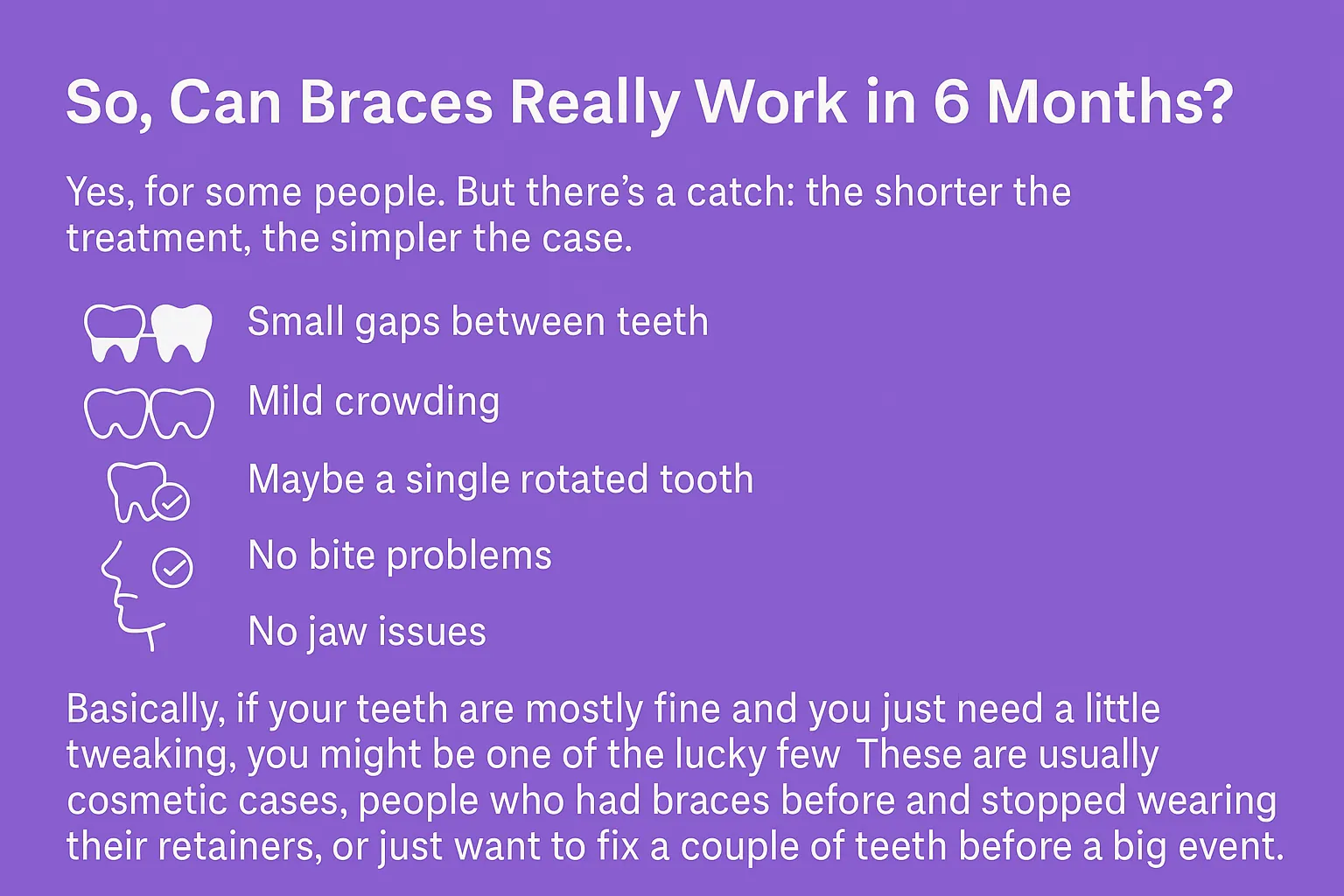
Yes, for some people. But there’s a catch: the shorter the treatment, the simpler the case.
We’re talking about:
- Small gaps between teeth
- Mild crowding
- Maybe a single rotated tooth
- No bite problems
- No jaw issues
Basically, if your teeth are mostly fine and you just need a little tweaking, you might be one of the lucky few. These are usually cosmetic cases, people who had braces before and stopped wearing their retainers, or just want to fix a couple of teeth before a big event.
Orthodontists see this a lot. And with newer systems, especially clear aligners like Whistle Aligners, the process can be streamlined even further.
Why Not Just Speed It Up for Everyone?
Simple answer: teeth don’t like to be rushed.
Underneath your gums, every tooth is held in place by a network of bone and ligaments. When you move a tooth, the bone has to break down on one side and rebuild on the other. Push too fast, and you can cause:
- Root damage
- Gum recession
- Bone loss
- Teeth that don’t stay in place
So even when treatment is “fast,” it still respects your body’s pace. That’s why 6 to 8 months is generally the shortest time considered safe and stable by professionals.
Minimum time required for braces
The minimum time required for braces varies depending on the severity of the alignment issue, the type of braces used, and how well patients follow their orthodontist's instructions. The overall teeth braces time period can range from 6 to 12 months for mild cases, while more complex orthodontic concerns may require a longer treatment duration. Regular appointments and proper oral care can help keep treatment on schedule and deliver the best results.
The Three Phases of Braces Treatment (And Why Timelines Feel Uneven)
Phase 1 - Alignment and Levelling (3–6 months)
Phase 2 - Space Closure (3–12 months depending on extraction and gap size)
Phase 3 - Finishing and Detailing (2–6 months)
Braces or Aligners - Which Is Quicker?
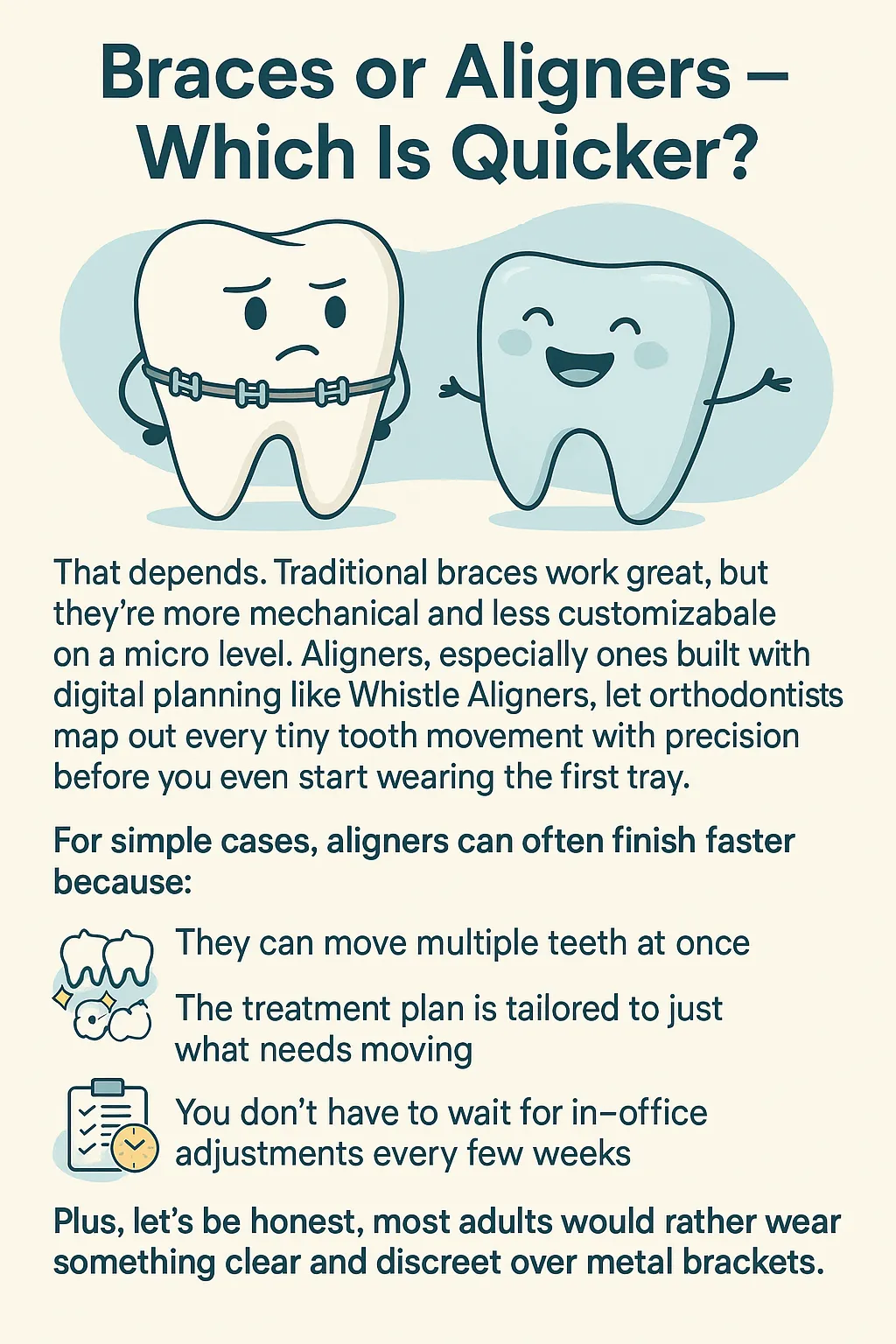
That depends. Traditional braces work great, but they’re more mechanical and less customizable on a micro level. Aligners, especially ones built with digital planning like Whistle Aligners, let orthodontists map out every tiny tooth movement with precision before you even start wearing the first tray.
For simple cases, aligners can often finish faster because:
- They can move multiple teeth at once
- The treatment plan is tailored to just what needs moving
- You don’t have to wait for in-office adjustments every few weeks
Plus, let’s be honest, most adults would rather wear something clear and discreet over metal brackets.
What Makes Whistle Aligners Good for Fast Treatment?
Whistle isn’t just another aligner brand. It’s designed for people who want fast, focused results, without cutting corners.
Here’s why it works well for short-term treatment:
- Personalized plans: The process starts with a digital scan, which helps create a precise map of where your teeth are and where they need to go. If your case is simple, the plan reflects that, no extra movements, no wasted time.
- Predictability: The tech behind it simulates the tooth movement from day one, so you’re not playing the waiting game or needing as many mid-course corrections.
- Less chair time: Since a lot of the process is remote or auto-guided, you don’t need to sit in the clinic every few weeks for tweaks.
Good compliance = Better speed - If you’re someone who can wear your aligners 20-22 hours a day without fail, the aligners do their job exactly on schedule.
Braces Treatment Time by Case Type
| Condition | Expected Treatment Duration | Key Variables |
|---|---|---|
| Very mild spacing or minor crowding | 6 – 12 months | Age, alignment baseline |
| Moderate crowding (no extractions) | 12 – 18 months | Number of teeth to move, bone density |
| Moderate crowding (with extractions) | 18 – 24 months | Extraction gap closure time |
| Midline diastema (isolated gap) | 6 – 12 months | Frenum status, other alignment needs |
| Significant overbite | 18 – 24 months | Bite correction mechanics needed |
| Underbite | 18 – 30 months | Skeletal component often involved |
| Crossbite | 12 – 24 months | Expansion phase may precede braces |
| Complex multi-issue cases | 24 – 36 months | Combination of the above |
Am I a Candidate for Fast Treatment?
Ask yourself this:
- Are you just looking to fix a few teeth in the front?
- Have you had braces before and just need a touch-up?
- Is your bite mostly okay?
- Are you willing to follow instructions, wear aligners properly, and not miss check-ins?
If you said yes to most of those, there’s a good chance you could qualify for a short-term plan. But only a consultation can tell you for sure. No two mouths are the same, and assuming you’re a fit without getting evaluated is like trying on someone else’s prescription glasses.
How Age Affects the Minimum Time Required for Braces
Age is one of the most consistent predictors of treatment duration because bone remodelling rate changes throughout life.
Children (8–12 years) - Phase 1 treatment:
Some children benefit from early orthodontic intervention (Phase 1 treatment) before all permanent teeth have erupted. This typically addresses jaw development, crossbites, or severe crowding issues during the growth phase. Phase 1 treatment is usually 9–18 months, followed by a rest period and then Phase 2 treatment once permanent teeth are in.
Teenagers (13–18 years) - Ideal window:
Adolescence is the most biologically favourable time for comprehensive orthodontic treatment. Most permanent teeth have erupted, jaw growth is still active enough to assist correction, and bone remodels more quickly than in adulthood. Most teenage cases finish in 12–24 months.
Adults (19–35 years):
Bone density is higher than in adolescence but not yet at the level that significantly extends treatment in most cases. Adults with good oral health in this age range typically see treatment times comparable to teens, perhaps 10–15% longer on average for equivalent cases.
Older adults (35+):
Denser bone can slow movement slightly, and pre-existing dental work (crowns, implants, root-treated teeth) may complicate mechanics. Oral health conditions like gum disease — more common with age — must be managed alongside treatment. Expect timelines toward the upper end of ranges for each case type.
| Age Group | Approximate Speed Adjustment | |
|---|---|---|
| Teen (13–18) | Fastest — full bone activity | |
| Young adult (19–30) | Standard reference point | |
| Adult (30–45) | 10–20% longer for equivalent cases | |
| Older adult (45+) | Case-specific; pre-assessment of bone health essential |
What Slows Braces Treatment Down and Why
Understanding why certain habits delay treatment helps patients take concrete action.
Missed or delayed appointments:
Archwires apply force that teeth respond to continuously. Between appointments, the wire's activation gradually dissipates as teeth move toward the wire's ideal position. If an appointment is delayed by even 2–3 weeks beyond schedule, the wire loses tension before reactivation - meaning those extra weeks produce little to no movement. Over 18 months, consistently late appointments can effectively add 2–4 months to treatment.
Broken brackets:
A dislodged bracket means the affected tooth receives no corrective force until it's rebonded. If the bracket stays off for weeks before the patient schedules a repair, the tooth can drift, requiring the orthodontist to correct backsliding before resuming forward progress. Each broken bracket incident, depending on timing, can add 4–8 weeks to treatment.
Poor oral hygiene:
When plaque accumulates heavily around brackets, the resulting gum inflammation affects the quality of the bone supporting the teeth. Bone under inflammatory conditions remodels less predictably, slowing tooth movement. In severe cases, the orthodontist may pause active treatment until gum health is restored. Prevention here is measured in months.
Broken dietary rules:
Hard foods (raw carrots, hard biscuits, ice) and sticky foods (chewing gum, toffee) are prohibited during treatment because they dislodge brackets and deform wires. A deformed wire pushes teeth in unintended directions until corrected — adding time to fix the deviation before progress can resume.
Non-compliance with elastics:
When your orthodontist prescribes inter-arch elastics (rubber bands worn between upper and lower brackets), they're addressing the bite relationship between upper and lower jaws. Inconsistent elastic wear means bite correction stalls while tooth alignment continues - creating a situation where the orthodontist cannot proceed with full finishing until the bite is corrected. This is one of the most common reasons treatment extends beyond the original estimate.
But I Don’t Want to Waste Time…
Totally fair. No one wants to wear braces longer than they have to. But trust this: going too fast just to save time will cost you later. It could mean:
- Redoing treatment later on
- Having teeth move back (relapse)
- Ending up with unhealthy gums or roots
The goal isn’t just straight teeth; it’s teeth that stay straight, look natural, and feel healthy.
Can You Speed Up Braces Treatment? What the Evidence Shows
This is a question almost every patient asks, and it deserves an honest answer.
Acceleration devices (vibration therapy):
Devices that deliver low-frequency vibrations to the teeth claim to stimulate bone remodelling and accelerate tooth movement. Clinical studies show mixed results — some show modest reductions in treatment time (weeks, not months), others show no statistically significant effect. These devices are not harmful but should be considered an optional supplement rather than a reliable shortener of treatment.
Surgical acceleration (PROPEL / micro-osteoperforation):
A procedure where small perforations are made in the bone near target teeth to stimulate localised bone remodelling. Evidence supports genuine acceleration in specific cases — particularly for localised movements like space closure. The effect is most pronounced in the weeks immediately after the procedure. This is a clinical procedure performed by your orthodontist and is not appropriate for all cases.
Photobiomodulation (low-level laser therapy):
Some clinics offer laser therapy to stimulate bone activity. Evidence is early-stage and results vary. Not widely validated for routine use as a treatment accelerator.
What consistently works:
The most reliable way to finish treatment on or ahead of schedule is also the simplest: attend every appointment on time, keep brackets intact by following dietary guidelines, wear elastics exactly as prescribed, and maintain excellent oral hygiene. Patients who do all of these consistently almost always finish within their original estimate. Those who don't almost always don't.
Braces vs Clear Aligners: Which Finishes Faster?
For mild to moderate cases, clear aligners and braces produce comparable treatment durations. For complex cases, braces may be faster because they offer more three-dimensional control of tooth movement.
| Case Type | Braces Duration | Aligner Duration |
|---|---|---|
| Mild crowding or spacing | 6 – 12 months | 4 – 9 months |
| Moderate crowding | 12 – 18 months | 12 – 18 months |
| Bite correction (overbite etc.) | 18 – 24 months | 18 – 24 months |
| Complex multi-issue | 24 – 36 months | Not always suitable |
The key distinction: aligner treatment duration assumes 22 hours of daily wear. Patients who wear aligners inconsistently will see their treatment timeline extend - sometimes by months. With fixed braces, the appliance is always working. With aligners, discipline substitutes for permanence.
Starting Treatment at Whistle
Every patient at Whistle receives a case-specific timeline estimate based on a 3D scan and clinical assessment - not a generic range. Knowing what phase you're in, what's being addressed at each appointment, and what you can do to stay on schedule is built into every Whistle treatment.
If you're considering braces or have questions about your expected treatment duration, a consultation gives you a precise, evidence-based answer for your specific situation.
So, what’s the shortest time someone has had braces? Realistically, 6 to 8 months- if they had a mild case, followed the rules, and used the right system.
The best part? That “someone” could be you. But only if your case fits the criteria. Talk to a pro. Don’t guess. Let them map out your options.
And if you’re eligible, systems like Whistle Aligners are built to deliver fast, focused, and no-drama results.
No hype. No shortcuts. Just smart, modern orthodontics - done right.
Also Read:
Book 3D Teeth Scan
Consult our experts and get a 3D preview of your smile transformation!
shortest time period for braces
FAQ's
Q1.What is the minimum time braces treatment can take?
The shortest realistic braces treatment is around 6 months, for very mild crowding or simple isolated spacing in an otherwise aligned mouth. This applies to a small minority of cases. Most patients are in treatment for 12–24 months. Only a thorough clinical assessment can tell you where your case falls.
Q2.How long do braces take for adults?
Adult braces treatment typically takes 12–24 months for moderate cases, potentially extending to 30 months for complex cases involving bite correction. Adult bone remodels slightly more slowly than teenage bone, but the difference for most cases is modest rather than dramatic. Adults who start treatment with good oral health and no complicating factors often finish well within standard timelines.
Q3.Can I do anything to make braces work faster?
Yes - keep appointments consistently, don't miss elastics, protect brackets from breakage, and maintain healthy gums. These patient-controlled factors have the most consistent impact on staying on schedule. Supplementary devices like vibration tools have limited and variable evidence. Surgical acceleration options exist for specific cases but are not routine.
Q4.How long do braces take for crowded teeth?
Mild crowding without extractions: 12–18 months. Moderate crowding with extractions: 18–24 months. Severe crowding requiring complex mechanics: 24–36 months. The extraction of premolars adds significant time because the resulting spaces must fully close before treatment can be considered complete.
Q5.Is there a phase of treatment where braces seem to stop working?
Yes, the finishing phase. After major alignment and space closure are complete, the final 2–6 months of treatment involve precise detailing that produces minimal visible change but is clinically essential. This is the phase patients most commonly feel frustrated by. Understanding that this phase is deliberate and important helps maintain compliance through to proper completion.
You May Also Like



 Medically Reviewed by Whistle Dental Team











 Medically Reviewed by Whistle Dental Team
 Medically Reviewed by Whistle Dental Team