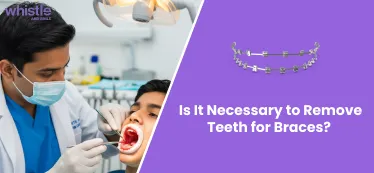
Is It Necessary to Remove Teeth for Braces?
 Medically Reviewed by Whistle Dental Team
It is probably the most common question in an orthodontic clinic. Patients walk in, look a little nervous, and ask:
Will you have to take out teeth before braces? Parents ask it for their children. Adults ask it for themselves. Some people even hesitate to start treatment because they assume the answer will be yes.
The truth is not one simple rule. Sometimes extractions are part of treatment. Often they are not.
Why Would Teeth Be Removed?
It may sound extreme to remove healthy teeth, yet there are cases where it is the right choice. Braces can only move teeth into better alignment if there is room to do so. If the jaws are too small for the number of teeth present, there is no space to move them into line.
Think of trying to fit twelve chairs into a row meant for ten. You can shuffle them, but some will always stick out. Orthodontic crowding works in the same way.
In patients with severe crowding, taking out a small number of teeth : often premolars or lower incisors , provides the space needed for stable, long-term alignment. It can also help with balance.
If the front teeth are sticking out too far, or the bite between upper and lower jaws is mismatched, creating space by removing teeth lets the orthodontist bring everything into harmony.
And here is something patients do not always realize: done correctly, extractions can actually improve facial balance rather than harm it.
When Teeth Can Stay
This is the part most patients want to hear. Extractions are not always needed. In fact, they are less common now than in the past.
Orthodontics has changed. With expanders, during childhood, the jaws can be widened during growth.
Mild crowding can often be solved by reshaping very small amounts of enamel between certain teeth.
Even modern braces and aligners sometimes create enough expansion that extractions are avoided.
So yes, many patients today complete braces without losing a single tooth. But in others, extraction is still the only way to achieve a stable result.
What Orthodontists Look Before Remving the teeth
The decision is not made on a guess. It follows a careful study of the whole case.
- How crowded are the teeth, really?
- How wide are the jaws compared with one another?
- What happens to the lips and profile if the teeth are pulled forward instead of balanced back?
- Is the patient still growing, or has growth finished?
- Would forcing alignment without space risk damaging gums and bone?
Orthodontists gather X-rays, scans, photographs, and then weigh all these factors. Many will present both options, a plan with extraction and one without, so patients can see the difference.
What Happens If Extractions Are Skipped When Needed
It is natural for people to prefer keeping every tooth. But sometimes avoiding extraction creates bigger problems.
Teeth may look straight for a while, but once braces are removed, they can drift back. This relapse is frustrating for patients who invested years in treatment. Crowding can also put pressure on gums, leading to recession or bone loss. Protruding front teeth that never had enough space may remain unstable and more prone to injury.
So while unnecessary extraction should never happen, ignoring it when it is truly needed can undermine the entire treatment.
The Way Orthodontics Has Shifted
Older generations often had teeth removed as a matter of routine. Today the profession has changed. The guiding philosophy is to preserve natural teeth whenever possible. Expansion, reshaping, and growth guidance are tried first.
Still, extraction remains a respected and sometimes essential tool. The difference now is that it is chosen deliberately, not automatically. If an orthodontist in today’s practice recommends removing teeth, it usually means every alternative was considered first.
The Patient Journey
The consultation process is where everything becomes clear. After records are taken, the orthodontist explains the findings. Parents often appreciate hearing that early visits, ideally around age seven, can reduce the need for extraction later by guiding growth in the right direction.
When removal is part of the plan, the teeth chosen are usually premolars. These are selected because their loss does not affect chewing efficiency. Once the braces close the spaces, the smile appears whole and balanced. Many patients, once afraid of extraction, later say the final result looked more natural than they imagined.
Different orthodontists may also vary slightly in their philosophy. Some lean toward conservative approaches whenever possible. Others may recommend extractions earlier if they believe stability will be improved. Patients should feel free to ask why a particular plan is being advised and what alternatives exist.
So, Must Teeth Always Be Removed for Braces?
The short answer: no. Many people complete treatment without any extractions. But the longer answer is that sometimes removal is the safest, most reliable way to achieve a bite that functions well, gums that remain healthy, and a smile that lasts.
It is worth repeating: extraction, when recommended, is not about loss. It is about creating balance and protecting long-term oral health.
Teeth Braces in Your City
Teeth Braces in Ahmedabad | Teeth Braces in Amritsar | Teeth Braces in Bengaluru | Teeth Braces in Bhiwadi | Teeth Braces in Chandigarh | Teeth Braces in Chennai | Teeth Braces in Derabassi | Teeth Braces in Dombivli | Teeth Braces in Faridabad | Teeth Braces in Ghaziabad | Teeth Braces in Greater Noida | Teeth Braces in Gurgaon | Teeth Braces in Hyderabad | Teeth Braces in Jaipur | Teeth Braces in Jalandhar | Teeth Braces in Kakinada | Teeth Braces in Ludhiana | Teeth Braces in Mohali | Teeth Braces in Navi Mumbai | Teeth Braces in New Delhi | Teeth Braces in Noida | Teeth Braces in Panchkula | Teeth Braces in Panvel | Teeth Braces in Pune | Teeth Braces in Secunderabad | Teeth Braces in Surat | Teeth Braces in Thane | Teeth Braces in Vadodara | Teeth Braces in Vijayawada | Teeth Braces in Vizag | Teeth Braces in Zirakpur
Book 3D Teeth Scan
Consult our experts and get a 3D preview of your smile transformation!
Remove Teeth for Braces
FAQ's
Q1.Is It Necessary to Remove Teeth for Braces?
Teeth removal for braces isn’t always necessary. It depends on your dental condition, jaw size, and severity of crowding. In some cases, extractions create space for proper alignment, while in others, modern techniques like expanders or clear aligners can fix issues without removing teeth. A dentist determines suitability.
You May Also Like




 Medically Reviewed by Whistle Dental Team


















 Medically Reviewed by Whistle Dental Team

 Medically Reviewed by Whistle Dental Team