
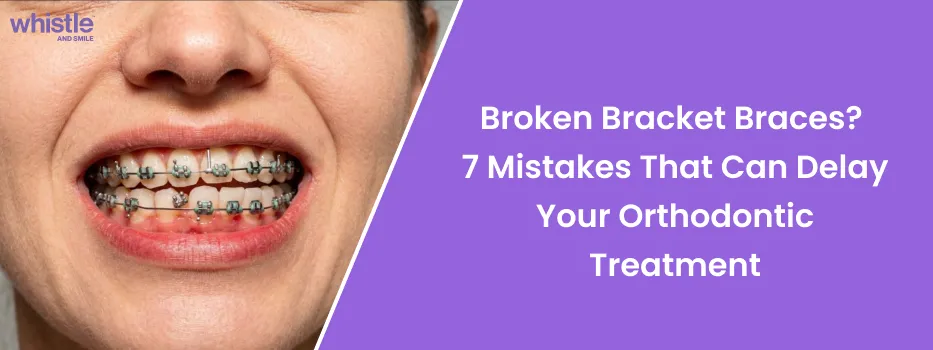
Broken Bracket Braces? 7 Mistakes That Can Delay Your Orthodontic Treatment
 Medically Reviewed by Whistle Dental Team
Experiencing broken bracket braces happens when an orthodontic bracket detaches from the enamel surface due to biting pressure, sticky foods, or physical contact. When this occurs, do not panic.
Carefully assess whether the bracket is loosely sliding along the wire or completely free, shield soft oral tissues with medical-grade orthodontic wax, and schedule an evaluation with your orthodontist within 24 to 48 hours.
At Whistle, in partnership with Clove Dental across 600+ physical locations nationwide, experienced MDS Orthodontists provide timely bracket re-bonding and precision clear aligner assessments to keep your tooth movement on track.
Key Takeaways:
- Immediate Action: Inspect the loose bracket in good light, position it gently with a clean cotton swab, and cushion sharp edges with orthodontic relief wax.
- Never Delay Repair: A disconnected bracket halts active tooth movement and can lead to minor rotational regression, potentially prolonging overall treatment duration if left unaddressed.
- Dangerous Home Fixes: Never use superglue, craft adhesives, or wire cutters; these substances cause enamel toxicity and soft tissue trauma.
- Professional Re-Bonding Protocol: Orthodontists clean residual adhesive with specialized carbide burs, re-condition enamel, and cure fresh biocompatible composite resin.
- Modern Wire-Free Alternatives: Patients with frequent bracket breakages or contact sport routines often evaluate smooth clear aligners, which eliminate brackets and emergency hardware visits entirely.
Dealing with a broken bracket is a common occurrence during orthodontic treatment, but many patients make the mistake of treating it as a minor cosmetic inconvenience. In reality, a broken bracket or shifting archwire should always be treated with medical urgency. Every single bracket serves as a critical structural anchor point.
The moment it breaks, the mechanical force moving that specific tooth drops to zero, stalling your progress and derailing your treatment plan. Even more concerning, a loose piece of hard metal or ceramic floating in your mouth presents a real physical danger.
Common Clinical Causes of Broken Bracket Braces
Step-by-Step Triage: How to Fix Broken Braces Temporarily at Home
Step 1: Thorough Visual Inspection
Step 2: Gentle Hardware Repositioning
Step 3: Managing a Protruding or Poking Wire
Step 4: Application of Medical-Grade Orthodontic Relief Wax
Step 5: Antiseptic Saltwater Rinses for Cheek Chafing
Step 6: Contact Your Orthodontic Clinic Promptly
What Happens During Professional In-Clinic Bracket Repair?
Repairing broken bracket braces requires a meticulous clinical sequence performed by a qualified dental surgeon or orthodontist. The appointment typically takes 20 to 30 minutes and follows these standardized clinical steps:
- Careful Archwire Disengagement: The orthodontist or assistant removes the elastomeric ligature ring or opens the self-ligating bracket door to release the archwire, isolating the affected tooth.
- Enamel Adhesive Polishing: Using a specialized slow-speed handpiece fitted with a smooth tungsten carbide bur, the clinician gently polishes away remaining composite resin from the enamel surface without removing natural tooth structure.
- Enamel Micro-Etching: The tooth is isolated with cotton rolls and saliva ejectors. A 37% phosphoric acid etching gel is applied for 15 seconds to create microscopic retention pores on the enamel surface, then rinsed and dried thoroughly.
- Primer and Resin Application: An unfilled resin bonding primer is applied, followed by high-strength, fluoride-releasing orthodontic composite adhesive onto the mesh base of the new or sanitized bracket.
- Precision Axis Placement & Light Curing: The orthodontist positions the bracket precisely along the long axis and facial axis of the clinical crown (FACC) to preserve programmed tipping and torque angles. The resin is polymerized with a high-intensity blue LED curing light for 20 seconds.
- Archwire Re-Engagement: The archwire is re-inserted and secured with a fresh ligature, restoring continuous, calibrated tooth movement.
Also Read:
Does a Broken Bracket Delay Your Total Treatment Time?
Hardware Realities: Fixed Braces vs Modern Clear Aligners
| Treatment Feature | Traditional Fixed Braces | Whistle Clear Aligners |
| Hardware Detachment Risk | Present; brackets and buccal tubes can dislodge under shear forces. | Zero; single-piece thermoformed multi-layer polymer trays without metal components. |
| Dietary Restrictions | Mandatory avoidance of hard, sticky, crunchy, and chewy foods. | Zero food restrictions; aligners are removed during meals and snacks. |
| Transparent Pricing Framework | Rs. 45,000 to Rs. 70,000 with flexible monthly EMI options | Rs. 60,000 to Rs. 2.5 Lakhs with flexible monthly EMI options. |
| Clinical Supervision | In-person adjustments every 4 to 6 weeks. | 100% in-person MDS Orthodontist supervision with scheduled progress check-ins. |
Professional Orthodontic Consultation Callout
Orthodontist Clinical Observation Layer: 5 Practical Emergency Insights
- The Myth of the 'Next Visit' Wait: Patients frequently delay reporting a broken bracket because their scheduled checkup is only 2 weeks away. That two-week delay allows unguided drift, forcing the clinician to step back to lighter wires and extending total treatment time.
- The Pre-Warmed Wax Technique: Many patients find orthodontic wax falls off easily. Wax sticks best when the tooth surface is completely dry and the wax pellet is rolled between warm fingers for several seconds before application.
- Save the Detached Bracket: If a bracket comes completely off the wire, do not throw it away. Clean it, place it in a clean zip pouch or plastic container, and bring it to your appointment. If undamaged, the orthodontist can sterilize and reuse it, saving equipment costs.
- Night-time Clenching (Bruxism) Factor: If you frequently wake up with broken posterior brackets without having eaten hard foods, mention this to your clinician. Nocturnal grinding exerts heavy vertical loads that can dislodge molar attachments.
- The Clear Aligner Transition Option: Patients who participate in high-intensity sports, perform public speaking, or struggle with hardware breakages can often transition smoothly from fixed braces to clear aligners after clinical review.
Conclusion: Managing Broken Brackets with Confidence and Care
Experiencing broken bracket braces is a common occurrence during fixed appliance treatment, but it does not need to compromise your smile transformation. By staying calm, protecting sensitive mucosal tissues with orthodontic wax, avoiding unsafe household DIY remedies, and notifying your clinic promptly, you protect your oral health and ensure steady alignment progress.
For individuals seeking orthodontic treatment without the hardware concerns of brackets and wires, modern clear aligners provide an aesthetic, comfortable, and predictable path to proper alignment. Contact a qualified MDS Orthodontist at a Whistle partner clinic near you to evaluate the most suitable treatment pathway for your individual smile.
Also Read:
Book 3D Teeth Scan
Consult our experts and get a 3D preview of your smile transformation!
Broken Bracket Braces
broken braces
FAQ's
Q1.What should I do if I accidentally swallow a broken bracket?
If you accidentally swallow a completely detached bracket while eating, try to remain calm. Orthodontic brackets are small, smooth, and entirely non-toxic, meaning they will typically pass safely through your digestive tract without causing internal harm. However, if you experience any sudden difficulty breathing, persistent coughing, chest pain, or any sort of pain in the stomach region, seek emergency medical care immediately, as this indicates the bracket may have entered your airway instead of your stomach.
Q2.Can I still brush my teeth normally with a loose bracket?
Yes, but you must be incredibly gentle around the damaged hardware. Use a soft-bristled toothbrush and slow, deliberate circular motions so you do not pull on the loose wire or accidentally dislodge neighboring brackets. Keeping the area clean is vital to prevent rapid bacterial pooling beneath the loose metal.
Q3.How long does it take for an orthodontist to fix a broken bracket?
The clinical repair process is very fast and entirely painless. Your orthodontist will safely slide the damaged bracket off the wire, gently clean the old composite resin off your tooth enamel, apply a fresh coat of medical-grade bonding adhesive, place a new bracket, and cure it under a specialized light. The entire process takes less than 10 to 15 minutes.
Q4.Why should I never try to adjust my archwires with household tools?
Household tools are completely unsterilized and lack the precise geometric design required to handle high-tensile orthodontic wires. Attempting to bend or cut wires at home can easily distort your entire archwire sequence, transferring uncontrolled, damaging forces to healthy teeth and causing severe, irreversible root damage. Always trust your dentist for the best, safest relief.
Q5.Is a broken bracket on braces considered an emergency?
In most instances, a broken bracket is not an acute medical emergency. As long as you are not experiencing airway distress, uncontrolled bleeding, or severe pain, you can safely stabilize the bracket using orthodontic wax and schedule an appointment with your orthodontic clinic within a few days.
Q6.How can I fix broken braces temporarily at home?
To stabilize broken braces temporarily, inspect the area in a bright mirror, use a clean cotton swab to slide the bracket into a neutral position, tuck any protruding wire end against the tooth using the rubber end of a clean pencil, and cover the entire assembly with a generous piece of medical-grade orthodontic wax.
You May Also Like
 Medically Reviewed by Whistle Dental Team




























 Medically Reviewed by Whistle Dental Team

 Medically Reviewed by Whistle Dental Team