
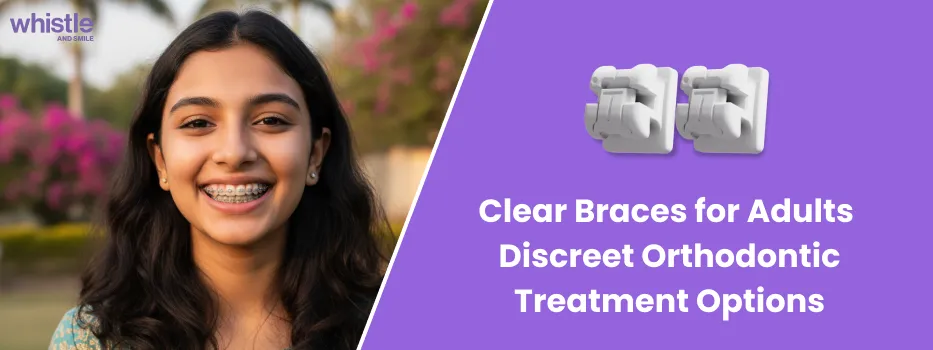
Clear Braces for Adults | Discreet Orthodontic Treatment Options
 Medically Reviewed by Whistle Dental Team
The idea that braces are only for teenagers is outdated. Adults make up a growing share of orthodontic patients in India and for good reason. A well-aligned smile isn't just cosmetic: it makes teeth easier to clean, reduces gum disease risk, and can significantly improve long-term oral health. The difference today is that adults no longer need to choose between effective treatment and a professional appearance.
Clear braces are the most popular discreet fixed-brace option for adults. They move teeth with the same precision as traditional metal braces but use tooth-coloured or transparent materials that blend in with your natural teeth.
Key Factors:
- Clear braces offer a discreet alternative to metal braces, making them ideal for adults who want effective orthodontic treatment without compromising their professional appearance.
- Self-ligating ceramic and zirconia braces are preferred by many adults because they reduce staining, require fewer appointments, and are generally more comfortable than conventional ceramic braces.
- Clear braces can successfully treat common orthodontic issues such as crowding, gaps, overbites, underbites, crossbites, and rotated teeth, delivering results comparable to metal braces in most cases.
- Treatment typically takes 12–24 months, and maintaining proper oral hygiene, avoiding hard foods, and wearing retainers after treatment are essential for long-term success.
- The cost of clear braces in India ranges from approximately ₹35,000 to ₹1,20,000 depending on the type of braces, case complexity, clinic location, and orthodontist expertise.
Over a period of time, people think that braces are only for teenagers. Adults usually avoid the metal braces because of an aesthetic look. Lately, many adults tend to make their teeth straighten in later parts of life due to they realize two important things:
- A good smile makes you confident.
- Helps to maintain oral hygiene easily
The positive news is that dental braces have come a long way with advanced treatment options. Nowadays, adults do not need to worry about metal braces.
Today, there are lots of discreet options available which are more comfortable, easy to handle, and look aesthetic. Among these, clear braces are the popular choices and they straighten the teeth just like metal braces, and it is a less noticeable option.
Why Adults Are Choosing Orthodontic Treatment Now
At a younger age, braces may have been skipped - sometimes due to cost, time, or simply not feeling it was necessary. Over the years, teeth shift. Gaps develop, crowding progresses, and what once seemed minor can become more noticeable.
Two things tend to drive adults to finally pursue orthodontic treatment:
- A well-aligned smile builds genuine confidence in social situations, professional settings, and increasingly, in the era of video calls and photographs that persist.
- Crowded or misaligned teeth are significantly harder to keep clean. Toothbrush bristles and floss can't reliably reach between overlapping teeth. Over time, this creates pockets where plaque accumulates, raising the risk of gum disease and cavities. Straightening teeth isn't just aesthetic - it's a functional, preventive investment.
The concern most adults bring to the first consultation isn't whether they should treat - it's whether treatment has to be visible.
Advantages of Clear Braces for Adults
Clear braces offer adults an effective way to straighten their teeth without the noticeable appearance of traditional metal braces. Designed with tooth-coloured or translucent brackets, they blend naturally with the smile while delivering the same reliable orthodontic results as conventional braces. Because they are fixed in place, clear braces work continuously without requiring the daily discipline associated with removable aligners.
Beyond aesthetics, they help improve oral health by making teeth easier to clean and reducing the risk of cavities and gum disease. As treatment progresses, patients often notice gradual improvements in both their smile and self-confidence, making clear braces a popular choice for adults seeking a discreet and dependable orthodontic solution.
1. Discreet throughout treatment
The most consistent reason adults choose clear braces. Tooth-coloured or translucent brackets are far less visible in photographs, video calls, and face-to-face conversations than metal braces. For professionals in client-facing roles, this matters daily for the entire duration of treatment.
2. Clinically equivalent outcomes
Clear braces produce the same orthodontic results as metal braces for the majority of adult cases. The mechanism is identical — the bracket material is different, not the clinical principles. There is no meaningful difference in outcome quality between well-executed ceramic and metal brace treatment for appropriate cases.
3. Fixed in place - no compliance required
Unlike clear aligners, which depend on 22 hours of daily wear discipline to stay on schedule, clear braces are permanently bonded for the duration of treatment. The appliance is always working, regardless of lifestyle or travel patterns.
4. Better oral health outcomes
Straightening crowded teeth removes the structural barriers to effective brushing and flossing. Patients who complete orthodontic treatment consistently find maintaining oral hygiene significantly easier — which translates to lower long-term risk of gum disease and cavities.
5. Boosts confidence progressively
Unlike waiting until braces come off to see a result, patients see incremental changes throughout treatment. Many adults report noticing a visible improvement in how they carry themselves well before the final appliance removal.
What are different types of braces?
Braces are categorized into Conventional and Self-Ligating types. Conventional braces are broadly classified into Metal and Ceramic braces, while Self-Ligating braces can be further classified into Metal, Ceramic, and Zirconia braces.
Metal Braces:
It is one of the traditional and most widely used types of braces in orthodontic treatment. These braces are made up of high-quality stainless steel brackets that are attached to the teeth surface and connected by thin wire. Sometimes elastic bands may also be used to hold the wire in place.It can be either a conventional or self-ligating variant.
Ceramic Braces:
Ceramic/Clear braces are almost similar to traditional metal braces like how they work and the only difference is their appearance. It is using tooth colored or transparent brackets that match with our natural teeth tone.Moreover, it is lighter in color shade which makes it less noticeable. It can be either a conventional or self-ligating variant.
Self-ligating braces:
These braces are the most advanced type of orthodontic system that does not require elastic or metal ties since it has a special clip system built in to hold the wire in place. It can be either a metal, ceramic/clear braces or zirconia braces variant. Zirconia braces are the latest ones that are made up of zirconium dioxide, combining strength, efficiency, and cosmetics that also use a self-ligating mechanism.
Types of Clear Braces
- Ceramic Brackets are tooth-coloured and aesthetically pleasing but can be slightly brittle under high pressure. They are best suited for mild to moderate orthodontic cases and are generally more affordable.
- Zirconia Brackets are made from high-strength zirconium oxide, offering superior durability, fracture resistance, and long-term aesthetics. They are less likely to chip or crack and maintain their translucency better throughout treatment.
Types of Clear Braces for Adults
Conventional ceramic braces: Conventional ceramic braces use tooth-coloured ceramic brackets bonded to the front of each tooth. An archwire threads through the brackets, and small elastic ties (ligatures) hold the wire in place.
The bracket material is stain-resistant. The elastic ties, however, can stain with regular consumption of coffee, tea, or turmeric — turning yellow or brown between adjustment appointments. Because the ties are changed at every adjustment (typically every 4–6 weeks), staining resets regularly. Patients who are attentive to their diet and hygiene find conventional ceramic braces maintain a reasonably clean appearance throughout treatment.
These are suitable for adults with mild to moderate crowding, spacing, or bite issues and represent the most affordable entry into clear fixed braces.
Self-Ligating Ceramic Braces: Self-ligating ceramic braces use the same tooth - coloured ceramic bracket material, but instead of elastic ties, the wire is held in place by a built-in sliding clip or hinged door on each bracket. This eliminates the elastic entirely.
- For adults specifically, this is the most practical upgrade from conventional ceramic
- No tie staining. The clip mechanism doesn't absorb pigments the way elastics do. Patients who drink coffee or tea daily will notice a dramatically cleaner appearance compared to conventional ceramic braces over the same treatment period.
- Fewer, shorter appointments. Without elastics to replace, adjustment appointments are faster. Many adult patients find appointments every 6–8 weeks instead of every 4–5 weeks — a meaningful benefit for a busy professional schedule.
- Less friction, more comfort. The wire can slide more freely through the clip mechanism, producing gentler, more continuous force rather than the higher-force bursts associated with tightly tied elastics. Many adults report noticeably less post-adjustment soreness.
- Easier cleaning. No elastic crevices means fewer plaque traps around the brackets. With the right brushing technique, hygiene maintenance is simpler than with conventional tied braces.
- Self-ligating ceramic braces are the most popular clear fixed-brace choice among adults in India, particularly working professionals who want discreet treatment with lower maintenance requirements.
Zirconia Self-Ligating Braces: Zirconia braces represent the most advanced clear fixed-brace option available. The brackets are made from zirconium oxide (ZrO₂) — the same high-performance ceramic used in premium dental crowns and implant components.
What makes zirconia different from regular ceramic:
Regular ceramic (alumina) brackets are aesthetically good but comparatively brittle under impact or high mechanical load. Zirconia has approximately 3–4 times the fracture toughness of alumina, which means zirconia brackets can handle the forces involved in more complex corrections without the same fragility risk.
For adults requiring moderate-to-complex bite correction cases that would stress regular ceramic - zirconia provides both the aesthetic discretion of clear brackets and the mechanical reliability closer to metal.
Zirconia brackets are also more optically stable - maintaining translucency and tooth-matching more consistently throughout treatment than alumina ceramic. Combined with a self-ligating mechanism, they offer the most stain-resistant, lowest-friction, and most durable clear fixed-brace option currently available.
What Conditions Can Clear Braces Treat in Adults?
Clear ceramic and zirconia braces are effective for the same range of orthodontic conditions as metal braces in most adult cases:
- Crowded teeth (mild to moderate)
- Gaps and spacing between teeth
- Mild to moderate overbite
- Mild to moderate underbite
- Crossbite
- Open bite
- Rotated teeth
- Generalised misalignment
For severe bite discrepancies involving significant jaw relationship issues, or for cases requiring very precise, high-force torque on multiple teeth simultaneously, metal braces may offer more reliable clinical control. Your orthodontist's assessment determines which appliance fits your anatomy - not just your preference.
Discreet orthodontic options
Apart from metal braces, the other discreet options are conventional and self-ligating ceramic braces, and Zirconia self-ligating braces.
Ceramic braces can be either Conventional or self-ligating variants:
Adults who are conscious of metal braces can choose ceramic braces since it give an aesthetic appearance. It is tooth-colored or clear brackets that can match the natural shade of teeth, and the wire can also be made tooth-colored to make it less visible.
Conventional Ceramic Braces: They use small elastic bands (ligatures) to hold the archwire in place. They need to regularly adjust and can experience more friction during tooth movement.
Self-Ligating Ceramic Braces: It has a built-in clip or sliding mechanism that holds the archwire, eliminating the need for elastic bands so that it can lead to less friction, easier cleaning, and ideally shorter treatment time.
Zirconia Self-ligating braces: These braces are the latest ones that are made up of zirconium dioxide, combining strength, efficiency, and cosmetically. It is a natural,l tooth-colored ceramic material that follows the same mechanism of self-ligating braces.
Clear Braces vs Metal Braces: How They Compare for Adults
| Factor | Clear Ceramic Braces | Zirconia Braces | Metal Braces |
|---|---|---|---|
| Visibility | Low — tooth-coloured | Very low — highly translucent | High — clearly visible |
| Strength | Moderate (brittle under impact) | High (near-metal fracture resistance) | Highest |
| Staining risk | Moderate (ties) / Low (self-ligating) | Very low | None |
| Comfort | Smooth bracket surface | Smooth bracket surface | Sharp initial edges |
| Suitable case complexity | Mild–Moderate | Mild–Moderately complex | All cases |
| Appointment frequency | Every 4–8 weeks | Every 6–8 weeks | Every 4–6 weeks |
| Cost in India (approx.) | ₹35,000 – ₹80,000 | ₹60,000 – ₹1,20,000 | ₹20,000 – ₹45,000 |
| Metal allergy suitability | Yes | Yes | Not ideal |
| Best suited to | Adults wanting aesthetic discretion | Adults wanting premium aesthetics + durability | Complex cases, budget-conscious |
Choosing the right option
The selection between ceramic, and self-ligating braces depends on many factors:
- Cost: Comparing ceramic and self-ligating braces, metal braces are the most affordable.
- Aesthetic appearance: Ceramic braces are less visible, and they are suitable for working professionals.
- Treatment Complexity: Difficult orthodontic cases are well treated by self-ligating and metal braces due to their high strength and efficiency.
- Oral hygiene: Self-ligating braces provide an easier cleaning option and reduced discomfort so that oral health maintenance is not compromised.
What to Expect: Clear Braces Treatment for Adults
Before treatment begins:
A clinical examination, dental X-rays, and typically a 3D intraoral scan form the basis of your treatment plan. Any active gum disease, cavities, or bone loss must be treated before braces are placed — orthodontic treatment on an unhealthy foundation compromises outcomes.
Placement appointment (1–1.5 hours):
Brackets are bonded to each tooth with dental adhesive and cured with a light. The archwire is threaded through and secured. Some initial tenderness and awareness for the first 2–3 days is normal and eases as the teeth settle.
Adjustment appointments (every 4–8 weeks):
The orthodontist changes the archwire to progressively thicker gauges, advancing tooth movement through the treatment sequence. Appointments are faster with self-ligating systems (no elastic replacement needed).
Treatment duration for adults:
Most adult cases with clear braces complete in 12–24 months. Complex bite correction or cases with extractions can extend to 30 months. Adults take slightly longer than teenagers for equivalent cases because bone density is higher — but the difference is modest for most patients.
After treatment:
Braces are removed and retainers are fitted. Retainers are essential — without them, teeth begin to drift. Most patients receive a permanent wire retainer for the lower teeth and a removable clear retainer for the upper.
The confidence of a better smile
Whistle offers conventional ceramic, self-ligating ceramic, and zirconia braces across our clinics, with all treatment plans designed by MDS-qualified orthodontists. Every patient begins with a 3D intraoral scan that feeds directly into digital treatment planning. If you're an adult considering clear braces and want a clear, case-specific recommendation rather than a generic overview, a free consultation and scan at your nearest Whistle clinic is the right place to start.
A straight, well aligned teeth smile is more than an aesthetic way - it is a doorway to improve self -confidence, good oral hygiene health, and even it will enhance the career aspects.
- With the help of today’s orthodontic options, achieving a confident smile is feasible at any stage of life.
- Modern Orthodontic treatment is no longer limited to teenage people.
- Adults are more likely to invest in their oral health and appearance and with the other discreet orthodontic options like clear braces which are more accessible and lookwise much better than others.
The best way to decide the braces is to visit an Orthodontist, who can evaluate your gums, teeth and jaw bone condition so that they can recommend the right braces type. At any age, investing in braces is not just for looks - it's about healthier teeth function and long-term confidence.
Book 3D Teeth Scan
Consult our experts and get a 3D preview of your smile transformation!
FAQ's
Q1.Are clear braces as effective as metal braces for adults?
Yes - for the vast majority of adult cases. Both apply force through the same archwire-and-bracket mechanics. The material is different, not the clinical principle. Very complex cases requiring maximum force control may still be better suited to metal, which your orthodontist will confirm after assessment.
Q2.Can adults get ceramic braces at any age?
Yes. There's no upper age limit for orthodontic treatment. The key requirement is healthy gums and adequate bone support for the teeth. Adults in their 30s, 40s, 50s, and beyond successfully complete treatment with clear braces. Your orthodontist evaluates your periodontal health at the initial assessment.
Q3.How long do clear braces take for adults?
Most adult cases complete in 12–24 months. This varies significantly by case complexity mild crowding can resolve in under 12 months; complex bite correction may require 24–30 months. Adults typically take 10–20% longer than teenagers for equivalent cases due to higher bone density.
Q4.Do clear braces hurt more than metal braces?
Not typically. The initial soreness after placement and after adjustment appointments is similar. Many patients find self-ligating ceramic systems somewhat more comfortable than conventional metal or ceramic braces because the lower-friction clip mechanism produces gentler force. The first few days after each adjustment involve some tenderness; this fades as the teeth settle.
Q5.How are clear braces cleaned differently from metal braces?
The cleaning technique is identical - soft brush, 45-degree angle, interdental brush under the wire, daily flossing. The key additional consideration for conventional ceramic braces is managing staining on elastic ties, which is largely resolved by self-ligating systems. The ceramic bracket surface is actually easier to wipe clean than metal because it's smoother.
You May Also Like
 Medically Reviewed by Whistle Dental Team



 Medically Reviewed by Whistle Dental Team




















 Medically Reviewed by Whistle Dental Team