
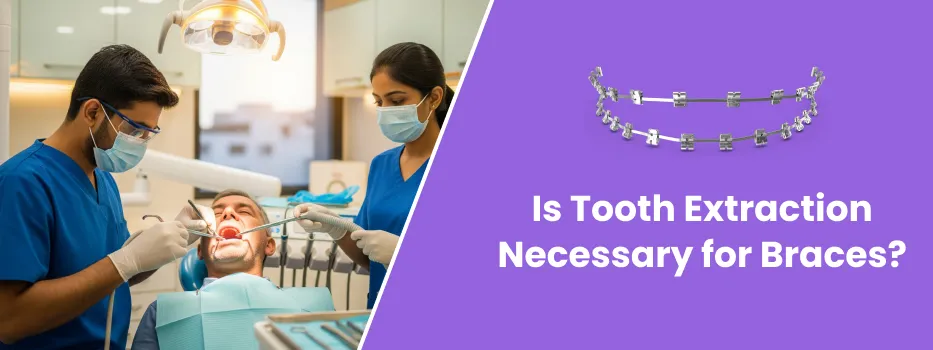
Is Tooth Extraction Necessary for Braces?
 Medically Reviewed by Whistle Dental Team
No, tooth extractions are not always necessary for braces. With advanced systems like Whistle’s self-ligating braces, extractions are rarely required.
A tooth extraction for braces is not mandatory for every orthodontic patient, but it remains a vital clinical tool for correcting severe dental crowding, flared buck teeth, and mismatched bite relationships.
For patients wondering why do you need to remove teeth for braces, orthodontists only recommend extractions when the physical jawbone perimeter is mathematically too small to house all 32 adult teeth safely.
Key Takeaways
- Why Extractions Happen: Extractions are reserved for severe crowding (greater than 7 mm arch mismatch), severe lip protrusion (bimaxillary flaring), and skeletal jaw discrepancies.
- The "4 Teeth" Question: Removing 4 bicuspids (one per quadrant) is only prescribed when symmetrical upper and lower front tooth retraction is required to balance facial harmony.
- Zero Visible Gaps at the End: Orthodontic mechanics guide your front teeth backward into the extraction space, closing the gap 100% so no empty spaces remain.
- Painless Clinical Procedure: Orthodontic extractions are performed swiftly under modern local anesthesia, with mild tenderness subsiding within 3 to 5 days.
Today, advanced digital orthodontics at Whistle partner clinics allows over 70% of mild to moderate misalignment cases to be treated completely without tooth removal using arch expansion, self-ligating brackets, and clear aligners.
When extractions are necessary, strategic premolar removal creates essential space, balances your facial profile, and protects your long-term gum bone health.
Why Is Tooth Extraction Sometimes Suggested for Braces?
Tooth extraction isn’t a standard part of orthodontic care, but it may be necessary in certain situations, particularly when there’s not enough space in the mouth to align teeth properly. Common reasons for recommending extraction include:
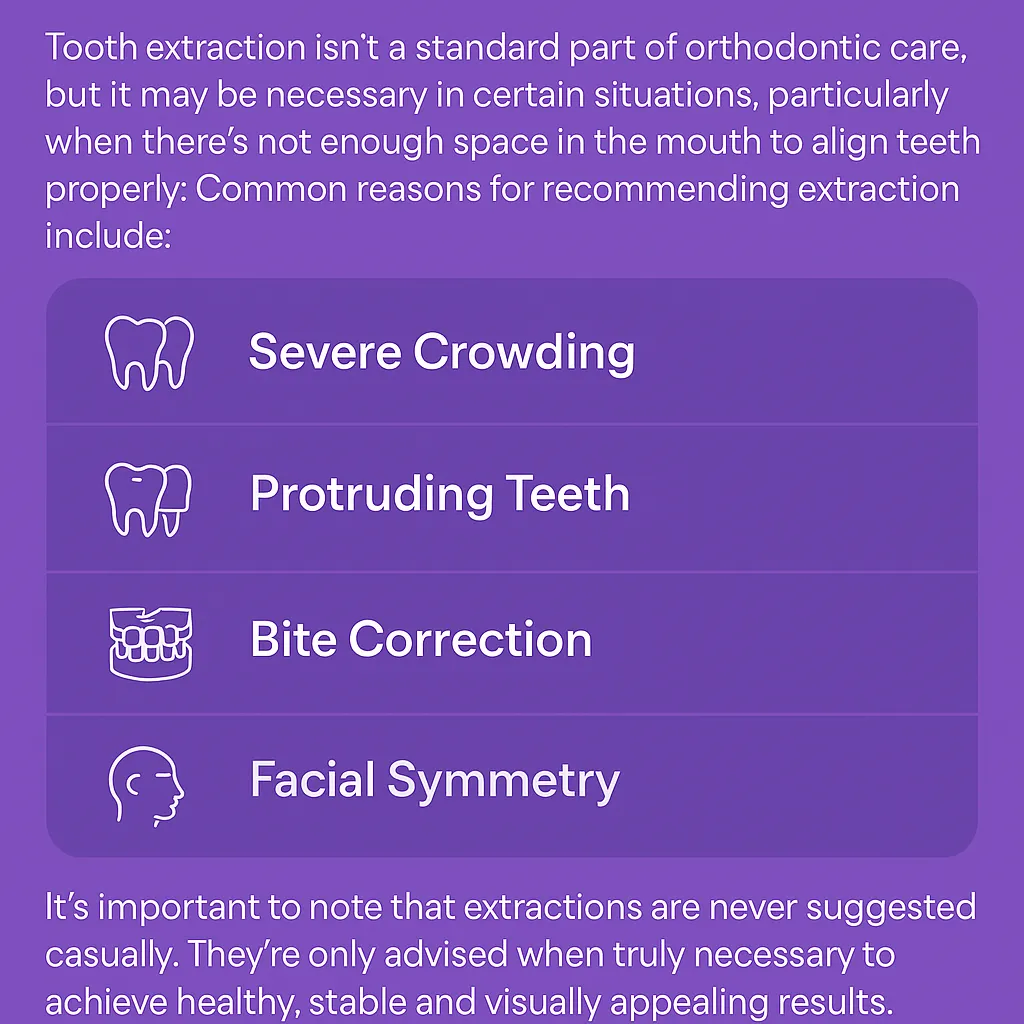
- Severe Crowding: If your teeth are too tightly packed, braces alone may not be able to reposition them without removing one or more teeth.
- Protruding Teeth: When front teeth stick out due to a lack of space, removing select teeth can create room for better alignment.
- Bite Correction: Overbite, underbite, or crossbite may sometimes require extractions to correct jaw and dental alignment.
- Facial Symmetry: In some cases, especially where teeth significantly affect the lip posture or jawline, extractions can enhance overall facial balance.
It’s important to note that extractions are never suggested casually. They're only advised when truly necessary to achieve healthy, stable, and visually appealing results.
Why Do You Need to Remove Teeth for Braces?
- Severe Arch Length Discrepancy (Severe Crowding): If your teeth overlap, twist, or erupt high in the gums by more than 7 to 8 millimeters, forcing them straight without creating space will push the tooth roots outside the protective alveolar bone envelope. This causes irreversible gum recession and root exposure.
- Bimaxillary Protrusion (Flared Buck Teeth and Lip Incompetence): When both upper and lower front teeth flare aggressively outward, patients cannot close their lips comfortably at rest without straining their chin muscles. Removing selected premolars creates space to retract all front teeth backward, flattening the facial profile and creating natural lip harmony.
- Severe Skeletal Bite Mismatch (Overbites and Underbites): In cases where the upper and lower jaws are mismatched, extracting two upper premolars (or two lower premolars) acts as orthodontic camouflage. This allows your orthodontist to align your bite functionally without requiring invasive orthognathic jaw surgery.
- Impacted or Heavily Damaged Teeth: If a premolar or molar has severe decay, a failed root canal, or is severely impacted against adjacent roots, your orthodontist may extract that compromised tooth rather than a healthy tooth to achieve orthodontic alignment.
Is It Necessary to Remove 4 Teeth for Braces?
One of the most frequent concerns patients have is whether it is standard practice to extract four teeth. The short answer is no, it is not an automatic standard for every smile.
Historically, extracting four premolars (the first bicuspid behind each canine tooth in the upper right, upper left, lower right, and lower left) was common practice to ensure absolute bilateral and vertical symmetry.
However, modern orthodontists customize extractions specifically to your unique facial profile:
Can We Put Braces Without Removing Teeth?
The Extraction Procedure: What to Expect Before, During, and After
- Digital Planning & Radiographs: Your orthodontist takes panoramic OPG X-rays and 3D scans to evaluate the exact angle, length, and root anatomy of the premolars scheduled for removal.
- Painless Local Anesthesia: The dental surgeon applies a topical numbing gel followed by local anesthesia. Your tooth and surrounding gums become completely numb within 2 minutes. You will feel light pressure, but zero pain.
- Simple Atraumatic Extraction: Orthodontic premolars are healthy teeth with straight roots. The dental surgeon gently eases the tooth out in 5 to 10 minutes per tooth.
- Hemostasis & Gauze Placement: A sterile cotton gauze pad is placed over the extraction site. You bite down gently for 45 minutes to form a clean protective blood clot.
- Braces / Aligner Fitting Timeline: In most cases, braces or clear aligners are placed 7 to 10 days after extraction once the initial gum tissue has comfortably healed.
Tooth Extraction After Braces: Why Does It Sometimes Happen?
Patients occasionally ask about tooth extraction after braces treatment has already concluded or during the final refinement phase. Here are the clinical reasons why late-stage extractions occur:
- Impacted Third Molars (Wisdom Teeth): Wisdom teeth erupt between ages 17 and 25, often after braces treatment has finished. While wisdom teeth do not exert enough mechanical force to push all front teeth crooked directly, an impacted or infected wisdom tooth can cause localized pain, cysts, or decay on adjacent second molars, requiring extraction.
- Orthodontic Relapse Due to Missed Retainers: If a patient fails to wear their retainers after braces, front teeth can drift back into severe crowding. In cases of severe adult relapse, an extraction may be required during second-phase alignment.
- Conversion of Non-Extraction Borderline Cases: If an initial attempt to align a borderline case non-extraction leads to undesirable lip flaring or gum thinning, the orthodontist may recommend late extractions to retract the teeth safely.
What If You Avoid Extraction When It’s Needed?
While avoiding extractions may seem appealing, doing so when they are clearly required can lead to long-term complications such as:
- Improper tooth alignment
- Incomplete bite correction
- Crowded teeth even after treatment
- Jaw discomfort or bite instability
In these cases, avoiding tooth removal may mean compromising the effectiveness of the entire orthodontic treatment.
5 Critical Rules for Extraction Healing
- Never Drink Through a Straw for 48 Hours: The suction pressure created when drinking through a straw dislodges the protective blood clot inside the tooth socket, leading to a painful condition called dry socket (alveolar osteitis). Always drink directly from a cup.
- Avoid Spitting Violently or Rinsing on Day 1: Swishing liquids vigorously or spitting forcefully creates negative oral pressure that restarts bleeding. Swallow saliva normally and gently wipe your lips.
- Stick to Soft, Cool Indian Foods: On the first 2 days, eat soft, room-temperature foods like chilled curd rice, khichdi, smoothies, dalia, or ice cream. Avoid hot chai, spicy sambar, crunchy papad, or hard nuts.
- Begin Warm Salt Water Rinses from Day 2: Starting 24 hours after extraction, gently rinse your mouth with warm salt water after meals to keep the socket clean and accelerate natural tissue healing.
- Do Not Touch the Socket with Fingers or Toothpicks: The white or yellowish tissue that forms inside the socket over Days 3 to 7 is healthy granulation tissue (new healing tissue), not food debris or infection. Do not poke it with toothpicks.
How Whistle’s Technology Minimizes Extractions
Decades ago, extractions were the default treatment for almost any crowding. Today, Whistle employs a highly conservative, patient-first approach.
We utilize self-ligating braces and advanced clear aligners that can gently expand the dental arch outward, creating millimeters of space that previously required an extraction.
Furthermore, using precise 3D software, we map out Interproximal Reduction (IPR) - a safe process of microscically polishing the sides of the teeth to generate just enough room to unravel the teeth without losing a single adult tooth. We only recommend extraction as a final, unavoidable clinical necessity.
Will Tooth Extraction Change My Face?
One major concern people have is whether removing teeth for braces will alter their facial appearance. The reality is:
- In well-planned treatments, extractions do not lead to negative facial changes
- In fact, they often help improve facial proportions by allowing the lips and jaw to align more naturally
- Changes, if any, are subtle and usually enhance your profile rather than distort it
Comparison Table: With vs Without Extraction in Braces
| Criteria | With Tooth Extraction | Without Tooth Extraction |
| Space Management | Space created by removing teeth | Space made using expanders, IPR, or distalizers |
| Treatment Duration | May be shorter if space issues are severe | May be slightly longer in complex cases |
| Facial Impact | Can improve lip and jaw alignment when planned well | Requires careful planning to avoid protrusion or imbalance |
| Used For | Severe crowding, protruding teeth, bite correction | Mild to moderate crowding or early-intervention cases |
| Common Techniques Used | Extraction + braces or aligners | Palatal expanders, IPR, Invisalign, molar distalization |
| Whistle Dental’s Approach | Used only when absolutely necessary | Prioritizes non-extraction planning with advanced diagnostics |
Also Read:
- Can Braces Fix Facial Asymmetry?
- How does Thumb Sucking affect the Bite?
- Braces Side Effects: Not What You Expect, But You’ll Love Them Anyway
- How Much Time Braces Take to Fill Teeth Gaps?
Talk to Your Orthodontist – The Right Plan for You
Ultimately, the decision to extract teeth should only be made by a qualified orthodontist after evaluating your specific needs. Each patient’s treatment plan is unique and must be based on:
- Jaw size
- Degree of crowding
- Tooth position
- Bite pattern
- Facial aesthetics
It’s perfectly okay to seek a second opinion if you’re unsure about the recommendation—it’s your smile, and you deserve to feel confident about your treatment path.
Normal Post-Extraction Healing vs. Red-Flag Complications
Understanding what is normal after an orthodontic tooth extraction ensures complete peace of mind:
| Symptom | Expected Normal Healing Response | Red-Flag Signal (Contact Your Clinic) |
| Bleeding & Oozing | Slight pinkish saliva for the first 12 to 24 hours | Continuous bright red active bleeding that fills the mouth after biting gauze for 1 hour |
| Post-Procedure Soreness | Mild, dull ache easily managed with prescribed paracetamol or ibuprofen for 2 to 3 days | Severe, throbbing pain radiating to ear and jaw on Day 3 or 4 (indicates dry socket) |
| Cheek Swelling | Mild puffiness that peaks on Day 2 and resolves by Day 4 | Rapidly worsening firm swelling, fever (>101°F), or difficulty swallowing |
Also Read:
Your Next Steps
Extracting a tooth is never the default starting point; it is a specialized clinical tool used to guarantee a safe, stable, and beautiful outcome for complex bites. Whether your treatment can be completed using the space-creating power of Whistle clear aligners, or requires a strategic extraction to balance your facial profile, modern orthodontics removes the guesswork.
Do not let fear delay your dream smile. Book a free consultation at your nearest Whistle Partner clinic today to receive a transparent, data-driven diagnostic report.
- How Long Does It Take to Close a 1mm Gap to Braces?
- Are Braces Getting Faster? What Parents Need to Know About Self-Ligating Braces in 2025
- Braces Explained: What They Actually Do to Your Teeth
- Can I Put Braces at the Age of 35?
- Why Does Braces Treatment Take So Long or Sometimes Not?
Book 3D Teeth Scan
Consult our experts and get a 3D preview of your smile transformation!
FAQ's
Q1.Will there be visible gaps if I get teeth extracted for braces?
No. The entire purpose of teeth extraction for braces is to use the empty space. As your treatment progresses, the braces or aligners will pull your front teeth back, completely closing the extraction gaps tightly so no one will ever know a tooth was missing.
Q2.Which teeth are usually removed for braces?
Orthodontists almost exclusively remove the first or second premolars (bicuspids). These teeth are located right behind your canines. Removing them provides excellent mechanical leverage to pull the front teeth backward without compromising your ability to chew.
Q3.Is it painful to get teeth extracted for braces?
The extraction itself is completely painless as it is performed under local anesthesia by a dental surgeon. You will experience mild soreness for a few days during the healing process, which is easily managed with standard over-the-counter pain medication.
Q4.How long after an extraction can I put my braces on?
Typically, your orthodontist will schedule your braces installation or deliver your first set of clear aligners within one to two weeks after the extraction. This gives the gum tissue enough time to close and begin healing safely.
Q5.Can I refuse tooth extraction for braces?
You have the right to refuse any medical procedure. However, if an orthodontist mandates an extraction due to severe crowding, refusing it means they likely cannot treat you safely. Forcing the teeth straight without space will permanently damage your jawbone and gums.
Q6.Do wisdom teeth need to be extracted before braces?
Not always, Wisdom teeth are located at the very back of the mouth and usually do not cause front-tooth crowding. However, if they are impacted (growing sideways) or infected, an oral surgeon will recommend their removal regardless of your orthodontic treatment.
Q7.Is tooth extraction necessary for braces in all cases?
No. Tooth extraction is only necessary in cases of severe crowding (greater than 7 mm), severe lip protrusion, or skeletal bite discrepancies. Over 70% of modern orthodontic cases are successfully treated without extractions using IPR and arch expansion.
Q8.Which teeth are usually removed for braces?
Orthodontists almost exclusively remove the first or second premolars (bicuspids). These teeth are located right behind your canines. Removing them provides ideal leverage to retract front teeth without affecting your ability to chew food comfortably.
You May Also Like
 Medically Reviewed by Whistle Dental Team


















 Medically Reviewed by Whistle Dental Team

 Medically Reviewed by Whistle Dental Team