How Long Does It Take to Close a 1mm Gap to Braces?
 Medically Reviewed by Whistle Dental Team
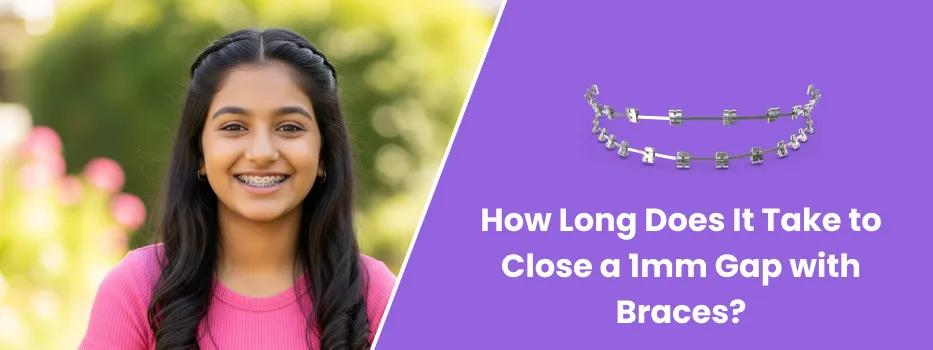
Closing a 1mm gap between teeth can take anywhere from 1 to 6 months with orthodontic treatments, depending on the treatment method and individual dental condition. Fixed braces may close an isolated gap in approximately 1–4 months, while clear aligners may take around 2–6 months.
For patients seeking immediate cosmetic results, dental bonding can close the gap in a single visit, usually within 30–60 minutes, whereas custom porcelain veneers may take approximately 2–3 weeks.
However, cosmetic treatments primarily improve appearance and may not address underlying alignment or bite issues. The actual treatment duration depends on the patient's dental condition and the orthodontist's assessment.
The process of closing a 1mm gap is a basic process but it involves steps more than just applying force for closure. Let’s dive into it.
The Process of Closing a 1mm Gap with Braces
When braces are bonded, the primary mechanism that plays a role is tooth movement via controlled pressure applied to the teeth. Here's a closer look at how this works:
- Through Brackets and Wires: Braces consist of metal or ceramic brackets bonded to the teeth. These brackets are connected by a wire, which is periodically adjusted and changed to apply pressure to the teeth. For a gap, the wire is adjusted in such a way that it gradually pulls the teeth together.
- Through Elastics or Rubber Bands: In some cases, elastics (small rubber bands) can be used in addition to the braces to apply more precise pressure, especially if the gap is more complex or there are other issues with the bite or tooth alignment.
How Long Does a 1mm Tooth Gap Take to Close with Braces?
For an isolated 1mm gap particularly one between the front teeth (called a diastema) in an otherwise well-aligned mouth - closure can happen relatively quickly. In these cases, 6 to 12 weeks is a realistic timeframe for the space itself to seal.
However, the total time you wear braces is a different question. If the 1mm gap is the only issue, treatment may conclude within a few months.
If it exists alongside crowding, rotations, bite problems, or generalised spacing across multiple teeth, braces will address all of those simultaneously and the overall treatment duration reflects the full scope of correction needed, not just the single gap.
A key point: orthodontists do not typically begin gap closure the moment braces are fitted. There is an alignment and levelling phase first, during which the wire works on straightening and coordinating your teeth before space closure begins.
This phase alone commonly takes 3–6 months, meaning you may not see the gap actively closing until several months into treatment.
Gap Closure Timeline by Size
| Gap Size | Estimated Closure Time (Gap Only) | Notes |
| 1mm | 6 weeks – 3 months | Fastest for isolated front tooth gaps |
| 2mm | 2 – 4 months | Slightly longer depending on gap location |
| 3mm | 3 – 6 months | May require power chains |
| 5mm | 6 months – 1 year | Patience required; bite correction often involved |
| Large extraction gap (4–6mm+) | 12 – 18 months or more | Bone density and anchor teeth key factors |
| Generalized spacing (multiple gaps) | 12 – 24 months overall | Total treatment, not individual gaps |
These are estimates for the gap closure phase specifically. Total treatment duration accounting for alignment, levelling, space closure, and detailing varies considerably.
The Two Phases Your Orthodontist Works Through
Phase 1 - Alignment and Levelling
Phase 2 - Space Closure
Why Gaps Reopen After Treatment (And How to Prevent It)
A closed gap is not automatically permanent. Teeth have a biological tendency to return toward their pre-treatment positions - a phenomenon called relapse. For midline diastemas in particular, relapse is a genuine risk, especially if the underlying cause (such as a thick frenum) was not addressed.
Retainers are the only reliable method for maintaining gap closure after braces are removed. Two main types are used:
- 1. Removable retainers: Worn full-time initially, then nights-only long-term. These must be worn consistently — skipping them is the leading reason gaps reopen.
- 2. Fixed (bonded) retainers: A thin wire bonded to the back surfaces of the front teeth. These are particularly well-suited for midline diastemas because they hold the specific teeth in contact continuously, without relying on the patient's compliance with wearing a removable retainer.
In cases where a thick frenum was the original cause of the gap, a frenectomy (a minor procedure to reduce or reposition the frenum tissue) is typically recommended before or after braces, to prevent the frenum from pulling the teeth apart again.
The commitment to your retainer protocol is as important as the treatment itself. Closing a gap precisely, only for it to partially reopen in the year after braces, is a preventable outcome.
Factors That Influence the time the of Teeth Gap closure
The time taken to close a gap of 1mm can be varied due to a lot of factors leading to different consequences and time for closure. Some important ones are as follows:
A. Type of Braces
- Traditional Metal Braces: Most effective for quickly closing gaps as they allow for more precise control of tooth movement.
- Ceramic Braces: Take slightly longer for specific adjustment compared to metal braces as they can be more delicate.
- Clear Aligners: Work by moving teeth gradually with a series of custom-made trays. It is a great option, but they are often slower at closing gaps, as the movement is less aggressive than traditional braces.
B. Age
- Younger Patients: Children and teenagers have faster tooth movement as their bones are still growing and are more flexible.
- Adults: They have slower tooth movement as the bone structure is more solid and dense.
C. Bone Density
- People with softer or less dense bone have faster movement,
- People with denser bones have slower tooth movement.
- Due to the same reasons we are able to see early results in younger patients than older individuals.
D. Severity and Location of the Gap
- The location and size of the gap also play a crucial role in closing a gap of 1mm.
- For instance if it’s located in a tricky position (like between molars or premolars), it might take a bit longer to close a gap of 1mm
- The angle and positioning at which tooth is located also affect the timeline.
Adjustments and Monitoring
For adjustment one need to have scheduled visits at orthodontist every once in a month (typically 4weeks to 6 weeks) for following work:
The orthodontist may also change the archwires periodically, shifting from wires with thinner diameter to thicker ones to progressively increase the amount of pressure applied to the teeth for gap closure.
It could be for adjusting the archwire to ensure proper pressure is being applied.
For Checking the progress and make any necessary changes if required to planned treatment plan
Ensuring that the teeth are shifting properly and that a gap of 1mm is gradually closing.
Also Read:
- 1 Year Braces Cost in India | Affordable Orthodontic Treatment Prices
- Teeth Braces Price in New Delhi: What to Expect & Why Whistle is Worth It
Common Factors That Can Delay Teeth Gap Closure
In some cases, certain challenges may slow down orthodontic treatment and affect the time required to close a gap.
1. Poor Treatment Compliance
Missing orthodontic appointments, not following the orthodontist's instructions, or failing to wear prescribed elastics can affect treatment progress.
For clear aligner users, not wearing the trays for the recommended duration may also delay planned tooth movement.
2. Oral Health Problems
Conditions such as gum disease, cavities, and other dental health issues may interfere with orthodontic treatment. Maintaining good oral hygiene is essential for supporting healthy tooth movement.
3. Irregular Follow-Up Visits
Skipping scheduled orthodontic appointments can delay necessary adjustments and prevent the orthodontist from monitoring treatment progress effectively.
Maintaining regular appointments and following the prescribed treatment plan can help ensure that teeth move safely and predictably.
Closing a gap of 1mm may vary with:
- Metal Braces: Typically takes 1 to 3 months, keeping case severity in consideration can vary a bit.
- Ceramic Braces: Might take a little bit longer than metal braces due to the delicate nature of the brackets.
- Aligners: It can take from 3 to 6 months to close a small gap of 1mm, as they have less aggressive movement, but they are more aesthetic as compared to braces
Also Read:
- Teeth Braces Price in India: What to Expect & Why Whistle is Worth It
- How to Use Dental Wax After Braces? | Step by Step Guide
- What Is a Permanent Retainer after Braces?
Starting Your Gap Closure Treatment
A 1mm gap is one of the more straightforward concerns in orthodontics and often one of the first things patients notice closing once active space closure begins. The process is predictable when the treatment is well-planned and the biology is supported by consistent care.
If you're looking at a gap in your smile and wondering whether braces or clear aligners are the right approach, a proper clinical assessment and 3D scan will give you an accurate, case-specific timeline - not just a range.
At Whistle, every treatment plan is designed by qualified orthodontists based on your exact gap type, size, and overall alignment needs. The answer to "how long will mine take?" starts with looking at your teeth, not just a general estimate.
Also Read:
- Braces for 2 Front Teeth Only? Why It’s Not That Simple
- How does Thumb Sucking affect the Bite?
- Braces Side Effects: Not What You Expect, But You’ll Love Them Anyway
- Can I Put Braces at the Age of 25?
Book 3D Teeth Scan
Consult our experts and get a 3D preview of your smile transformation!
FAQ's
Q1.Do Whistle aligners hurt when closing gaps?
When one switches to a new whistle aligner, one feels mild pressure or discomfort, but it usually fades gradually. It’s a good sign that treatment is in the right direction.
Q2.What happens if I don’t wear my whistle aligners according to the timeline?
Skipping aligner wear can delay the results as your teeth will not move to the appropriate position and even shift back thus delaying the result as planned.
Q3.Does the gap close faster with more frequent wear?
Yes, wearing aligners 20-22 hours a day helps close gaps faster.
Q4.How long does it take braces to close a 1mm gap exactly?
For an isolated 1mm gap in an otherwise well-aligned mouth, the space itself typically closes within 6–12 weeks of the space closure phase beginning. However, the space closure phase doesn't start the moment braces go on — alignment and levelling come first, usually taking 3–6 months. Total treatment time varies by case.
Q5.Will my 1mm gap close on its own without braces?
Teeth gaps do not close naturally on their own. In fact, without treatment, gaps tend to either remain stable or widen over time as adjacent teeth drift. Orthodontic treatment is the reliable method for closing a tooth gap permanently.
Q6.Can a gap reopen after braces?
Yes - especially midline gaps caused by a thick frenum. Without consistent retainer use, teeth can drift back toward their original positions over months or years. A fixed (bonded) retainer behind the front teeth is one of the most reliable ways to prevent midline diastema relapse long-term.
Q7.Is there anything I can do to make gap closure faster?
Not significantly beyond keeping your appointments and maintaining good oral health. Some practices offer supplementary methods such as high-frequency vibration devices (like AcceleDent) that claim to stimulate bone remodelling, though evidence for meaningful acceleration in routine cases is limited. Attending every scheduled appointment and avoiding soft food that deforms wires prematurely makes a more meaningful difference than any accessory.
You May Also Like




 Medically Reviewed by Whistle Dental Team





























 Medically Reviewed by Whistle Dental Team

 Medically Reviewed by Whistle Dental Team