
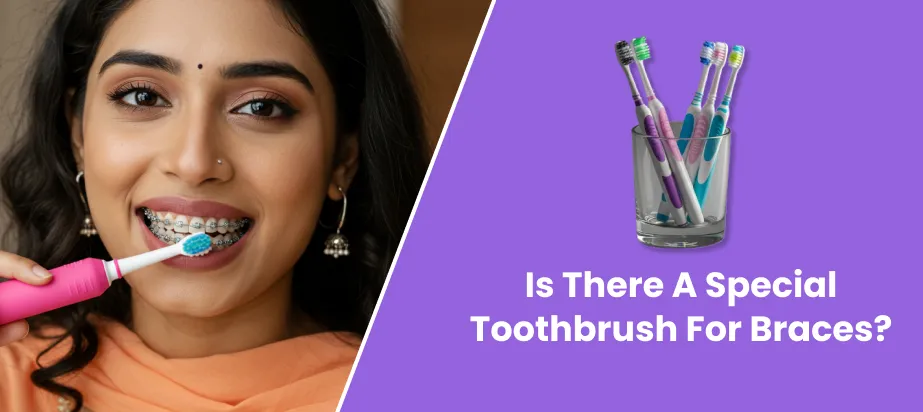
Is There a Special Toothbrush for Braces? Here’s What You Need to Know
 Medically Reviewed by Whistle Dental Team
Congratulations on getting your braces!
If you haven't got one, please go ahead-All the very best!
Either way, welcome to the wild world of orthodontics, where metal meets molar, spinach and sticky foods become your arch-nemesis.
- Having braces means having a mean food trap stationed in your mouth 24x7.
- It acts as a magnet for all possible plaque, and no crumb is spared from your last snack. If you are already wearing braces, you know what I am talking about-the real struggle.
Every month's appointment with the orthodontist is not the hardest part; the hardest part is getting cookie points from your dentist for maintaining good oral hygiene. It is merely impossible to get that with a regular toothbrush, hence here comes the superhero.
Special toothbrush for braces
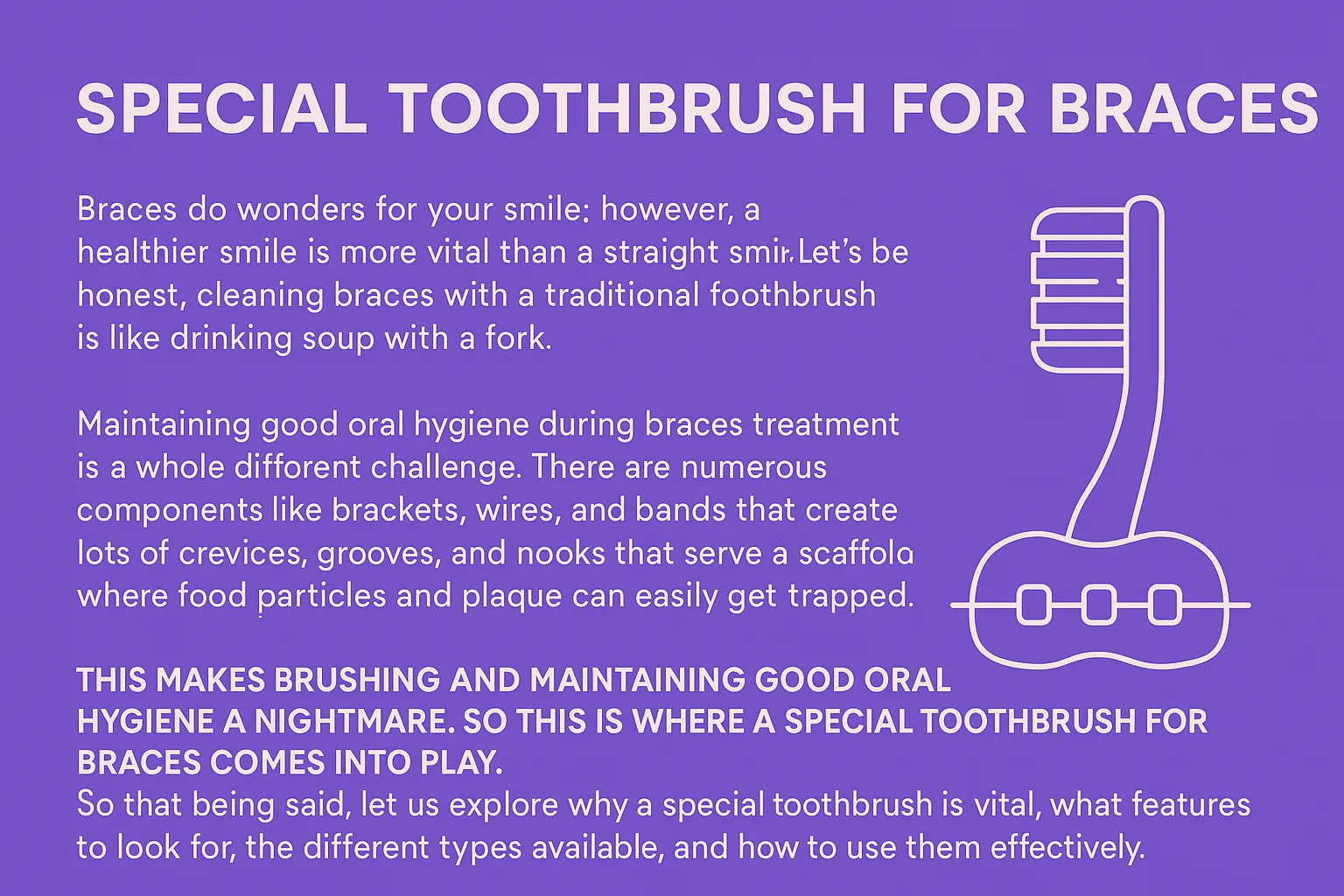
Braces do wonders for your smile; however, a healthier smile is more vital than a straight smile. Let's be honest, cleaning braces with a traditional toothbrush is like drinking soup with a fork.
You may think you are doing a good job, but trust me, there a millions of bacteria, aka plaque, under every single tooth and crevice beneath the braces and arch wire, plus the bristles wear out pretty soon in case of a regular tooth brush.
Maintaining good oral hygiene during braces treatment is a whole different challenge. There are numerous components like brackets, wires, and bands that create lots of crevices, grooves, and nooks that serve as a scaffold where food particles and plaque can easily get trapped.
This makes brushing and maintaining good oral hygiene a nightmare. So this is where a special toothbrush for braces comes into play. These specialized toothbrushes for braces help us navigate the complex architecture of braces and aid in maintaining good oral hygiene throughout your treatment.
So that being said, let us explore why a special toothbrush is vital, what features to look for, the different types available, and how to use them effectively.
Do You Need a Special Toothbrush for Braces?
Yes - but not for the reason most people assume.
Braces don't demand a completely different dental routine. What they do demand is a toothbrush that can reach places your old brush simply cannot. The brackets and wires running across your teeth create dozens of new surfaces, edges, and gaps where plaque accumulates and a standard brush, used the usual way, won't clear them consistently.
- Understanding what features actually matter, and why, takes the guesswork out of choosing the right brush for your treatment.
- Let us look into certain basic facts as to why a regular toothbrush may not be the best choice for patients undergoing braces treatment
- Regular tooth brushes have limited access under the archwire or around the brackets
- Regular toothbrush bristles often glide over plaque rather than removing it.
- Inadequate brushing can lead to plaque buildup, which significantly increases the risk of dental caries.
- It can also cause gum inflammation, leading to gingivitis and other periodontal issues.
Well, your mouth deserves better, your braces demands better!
What Makes a Toothbrush Right for Braces?
V-shaped or U-shaped: Toothbrushes with ‘V’ or ‘U’ shaped bristles are excellent for cleaning around braces. It has a shallow dip in the middle that helps clean the top and bottom of the braces in one stroke.
1. Soft bristles: Bristle firmness is the single most important feature to get right. During braces treatment, your gums are often slightly more sensitive because of the consistent mild pressure applied to your teeth. Firm or medium bristles can cause gum irritation, micro-damage to the gum margin, and over time gum recession.
Soft bristles are flexible enough to bend around brackets and curve under the archwire without snapping back against your gums. They reach into crevices that rigid bristles skip over. And despite the common assumption, soft bristles remove plaque just as effectively as firmer ones the technique matters far more than the bristle stiffness.
For braces, always choose soft. Not medium, not "medium-soft." Soft.
2. Compact Brush head size: A large brush head covers more surface area per stroke, which sounds efficient. With braces, it works against you. The brackets reduce the manoeuvrability available in your mouth, and a large head cannot angle into the spaces between and around individual brackets cleanly.
A compact or small head roughly 2–2.5 cm in length allows precise, targeted cleaning. You can work around each bracket individually rather than trying to sweep across several at once. Back molars, which are difficult to reach in any case, become considerably more manageable with a smaller head.
3. Bristle Shape and Cut: Standard toothbrushes typically have flat or slightly rounded bristle tops. Orthodontic toothbrushes often feature a V-shaped or W-shaped bristle pattern - a central trough running along the length of the brush head that sits over the bracket row while the outer rows clean the gum line above and below.
This specific cut allows the brush to straddle the brackets rather than skimming over them. It's not essential - good technique compensates for a flat cut but it does make correct positioning considerably more intuitive, especially for younger patients or those new to wearing braces.
4. Electric Toothbrush: Certain electric toothbrushes come with specific heads that improve cleaning efficiency.
Types of Orthodontic Toothbrush for Braces
Currently, there are broadly two types of specialized brushes that you can select based on your preferences and convenience
Manual Orthodontic Brush
They are very similar to traditional toothbrushes but have modified ‘V’ shaped or ‘U’ shaped bristles. The benefits of this include -budget friendly, effective, and widely prescribed by orthodontists.
But certain recoverable downsides are that it has a steep learning curve, and if not practiced properly, it might be time-consuming.
Electric Tooth Brush
Electric toothbrushes are extremely beneficial for people with braces as they come with pressure sensors, timers, and a specially designed head for braces. It has an added advantage over manual toothbrushes in effective plaque removal.
Additionally, built-in timers help in adequate brushing time. It is also quite easy for young users. Although it is a good investment when compared to a manual orthodontic toothbrush, it is slightly higher in price. (it's like a smartwatch for the mouth)
Other Oral Hygiene AIDS
This includes interdental brushes, which are super effective, especially between teeth and wires, and also in cases of tight spaces. They are portable and easy to carry.
Water flosser is also a great tool for braces wearers, it is easy to use and very efficient in cleaning plaque buildup
How to Brush Correctly with Braces?
Irrespective of whatever toothbrush you select, technique matters. Here is a simple guide on how to brush
STEP-1: Start with rinsing your mouth with normal water to loosen and dislodge food particles
STEP-2: Make sure your toothbrush is placed at a 45-degree angle to the gum line. Brush both above and below the gum line in small circular motions
STEP-3: Make sure to clean every surface of the tooth. In general, front teeth have outer and inner surfaces, back teeth have outer, inner, and biting or chewing surfaces. Make sure your toothbrush touches all the tooth surfaces for effective cleaning. Make sure all the brackets and surfaces under the archwire are cleaned
STEP-4: Spend some additional time using other oral hygiene aids like an Interdental brush or a water flosser
STEP-5: Finally, rinse your mouth with water
Well, TEAM WORK MAKES THE CLEAN WORK!
Recommended Toothbrush for Braces
Some popular and orthodontist-recommended toothbrush options are
- Oral-B Ortho brush
- Philips Sonicare Protective Clean 5100 Ortho edition
- Gum orthodontic tooth brush
- TePe interdental brushes
- Waterpik Aquarius water flosser
What mistakes to avoid with specialised toothbrush?
- A properly guided brushing technique is essential; neglecting the gum line might cost more later, as most of the plaque builds up quickly there
- Not brushing long enough
- Using a hard-bristle toothbrush brush which can damage your gums and braces
- Skipping to brush interdental space and over the brackets
Supporting Tools That Work Alongside Your Toothbrush
A toothbrush, however well chosen and correctly used, doesn't reach everywhere braces create. These tools fill the gaps:
1. Interdental brush (proxy brush):
A small, bottle-brush-shaped tool that fits under the archwire and between brackets. Used to dislodge food and plaque from the tight spaces a regular brush can't enter. Available in different diameter sizes — your orthodontist can recommend the right size for your bracket spacing.
2. Water flosser (oral irrigator):
A device that directs a controlled stream of water between teeth and around brackets, flushing out particles and reducing bacteria in areas that are difficult to clean by brushing alone. Not a substitute for mechanical brushing, but a genuinely useful addition during braces treatment.
3. Floss threader or orthodontic floss:
Standard floss cannot pass under an archwire easily. A floss threader a plastic needle-like loop - guides floss under the wire so you can floss between each tooth. Orthodontic floss with a stiff end does the same thing. Flossing remains important during braces treatment despite the added difficulty.
What Happens If You Don't Brush Well with Braces
This deserves direct attention, because the consequences aren't just cosmetic during treatment - some are permanent.
1. White spot lesions (Decalcification):
Permanent white or chalky marks on the enamel, appearing at bracket sites. They form when acid from plaque stays in contact with enamel for extended periods. They do not go away when braces are removed. Some can be partially treated, but prevention is the only reliable approach.
2. Gum inflammation (Gingivitis):
Plaque buildup along the gum margin triggers inflammation - redness, tenderness, and bleeding when brushing. Left unchecked, this can progress to gum disease, which complicates orthodontic treatment and affects long-term dental health.
3. Cavities:
The same plaque that causes white spots causes cavities. Tooth decay during braces treatment can require dental work mid-treatment, potentially delaying or complicating progress.
4. Extended treatment time:
Poor oral hygiene during braces can require your orthodontist to pause or slow treatment to allow dental work. In some cases, this adds months to your total treatment duration.
Invest In your health for better Tomorrow
Having braces doesn’t mean sacrificing your smile-it means you are leveling up and every level needs the right gear.
Brushing your teeth with braces doesn't always need to be a hassle; all it requires is the right tools and habits to maintain good oral hygiene.
A special toothbrush is not just a convenience but an absolute necessity. Choosing the right brush can prevent cavities, gum disease, and those dreaded white spots.
The investment you put in now will pay off with an amazing smile and a healthier mouth when the braces are off.
Hence, make an informed decision, pick the right toothbrush brush and make oral hygiene a priority throughout your life
Teeth Braces in Your City
Teeth Braces in Ahmedabad | Teeth Braces in Amritsar | Teeth Braces in Bengaluru | Teeth Braces in Bhiwadi | Teeth Braces in Chandigarh | Teeth Braces in Chennai | Teeth Braces in Derabassi | Teeth Braces in Dombivli | Teeth Braces in Faridabad | Teeth Braces in Ghaziabad | Teeth Braces in Greater Noida | Teeth Braces in Gurgaon | Teeth Braces in Hyderabad | Teeth Braces in Jaipur | Teeth Braces in Jalandhar | Teeth Braces in Kakinada | Teeth Braces in Ludhiana | Teeth Braces in Mohali | Teeth Braces in Navi Mumbai | Teeth Braces in New Delhi | Teeth Braces in Noida | Teeth Braces in Panchkula | Teeth Braces in Panvel | Teeth Braces in Pune | Teeth Braces in Secunderabad | Teeth Braces in Surat | Teeth Braces in Thane | Teeth Braces in Vadodara | Teeth Braces in Vijayawada | Teeth Braces in Vizag | Teeth Braces in Zirakpur
Book 3D Teeth Scan
Consult our experts and get a 3D preview of your smile transformation!
Is There a Special Toothbrush for teeth Braces
Toothbrush for teeth Braces
FAQ's
Q1.Is a soft toothbrush actually better for braces than a medium one?
Yes. Soft bristles are more flexible, reach further under wires and around brackets, and are less likely to irritate or damage already-sensitive gums during treatment. Medium and firm bristles are too stiff to clean effectively around orthodontic hardware.
Q2.Can I use a regular toothbrush with braces if I brush carefully?
Yes - a regular soft-bristled brush with a compact head and careful technique will maintain adequate hygiene. The advantage of an orthodontic brush is that it makes thorough cleaning easier, not that it's the only thing that works.
Q3.Should I brush before or after meals when wearing braces?
After. Brushing after eating removes food particles before they can interact with plaque and produce acid. Brushing before meals doesn't address the food you're about to eat.
Q4.Is flossing really necessary with braces, given how difficult it is?
Yes. Flossing reaches between teeth where no brush can go. The added difficulty of threading floss under an archwire is real, but floss threaders and water flossers make it manageable. Skipping flossing entirely during braces treatment increases cavity and gum disease risk significantly.
Q5.How often should I get a professional clean during braces treatment?
Every 6 months at minimum, and ideally every 3–4 months during active treatment. A professional cleaning removes tartar that builds up in areas a toothbrush cannot reach, and allows your dentist or hygienist to spot early signs of decalcification before they become permanent.
You May Also Like


 Medically Reviewed by Whistle Dental Team











 Medically Reviewed by Whistle Dental Team

 Medically Reviewed by Whistle Dental Team