
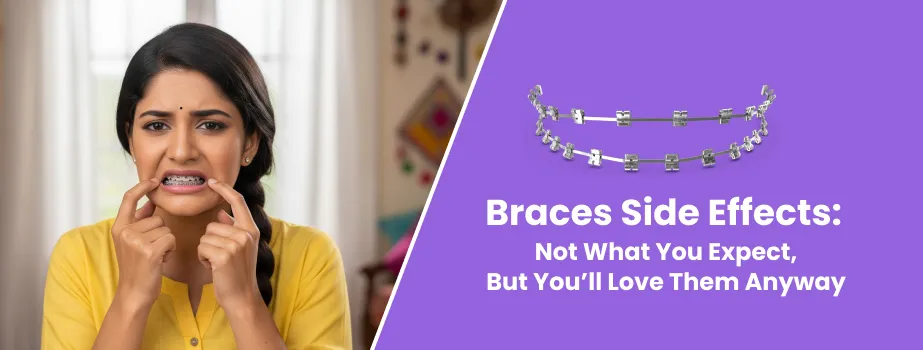
Braces Side Effects: Not What You Expect, But You’ll Love Them Anyway
 Medically Reviewed by Whistle Dental Team
Common braces side effects include mild tooth soreness, cheek and lip irritation, temporary speech lisping, and initial chewing discomfort. These short-term side effects typically peak within 24 to 48 hours after an adjustment and resolve completely within 3 to 5 days as your oral mucosa adapts.
While there are changes that come with wearing braces, most of them end up being not-so-bad. In fact, they’re downright life-improving. Especially when you're choosing Whistle Braces - India’s expert-led, self-ligating braces system that makes orthodontic treatment smoother, faster, and way more comfortable than the metal vs. ceramic vs. zirconia braces you might have heard about.
Long-term or permanent side effects, such as enamel demineralization (white spot lesions) or minor apical root resorption, occur primarily when oral hygiene is neglected or when treatment is unmonitored.
Key Facts:
- Temporary adaptation phase: Mild soreness and cheek abrasions last only 3 to 5 days after initial placement or tightening visits.
- Demineralization is preventable: White spot scars around brackets are caused by plaque accumulation, not the braces themselves, and can be avoided with proper interdental hygiene.
- Root resorption is monitored: Microscopic shortening of tooth root tips occurs in a small percentage of cases but is closely tracked with periodic digital X-rays.
- Adults experience unique changes: Denser adult bone structure requires lighter, continuous forces to prevent gum tissue recession and black triangles.
- DIY home straightening is dangerous: Attempting to straighten teeth at home using rubber bands or unverified kits causes permanent root strangulation and tooth loss.
Modern alternatives like Whistle clear aligners and self-ligating braces significantly reduce friction, pain, and tissue irritation under physical orthodontist supervision.
How Do Braces Cause Temporary Side Effects?
Common teeth braces side effects
Honestly, knowing what is normal helps you navigate your orthodontic journey without unnecessary anxiety.
1. Tooth Soreness and Tenderness
Feeling aching or pressure in your teeth after an adjustment visit is completely normal. The tenderness usually starts a few hours after your appointment, peaks on day two, and disappears by day five. Sticking to a soft food diet and drinking cool water helps soothe the ligament.
2. Soft Tissue Ulcers and Irritation
New metal or ceramic brackets can chafe against the inside of your lips and cheeks. This friction can form small, painful aphthous ulcers. Applying orthodontic wax over rough bracket edges acts as a protective buffer while your mouth adjusts.
3. Temporary Speech Lisping
When braces or internal bite ramps are first installed, your tongue needs a few days to navigate around the new hardware. You might notice a slight lisp or whistling sound when pronouncing "S" or "T" sounds. Your tongue muscle adapts quickly, and normal speech returns within a week.
4. Jaw Muscle Stiffness and Mild Headaches
As your lower jaw shifts to accommodate your new bite alignment, the surrounding masseter and temporal muscles may feel tight. This mild muscular fatigue can cause minor tension headaches, which resolve as your bite neutralizes.
Do Adults Experience Different Braces Side Effects?
Here's the thing. While adults achieve stunning, life-changing orthodontic results, adult biology introduces specific considerations during treatment.
Denser Alveolar Bone
Because adult jawbones are fully calcified and dense, tooth movement requires steady, lighter continuous pressure. Adults may experience slightly longer post-adjustment soreness than teenagers whose bone tissue is still growing and flexible.
Risk of Black Triangles (Gingival Recession)
When severely crowded adult teeth are straightened, small triangular gaps (called black triangles or gingival embrasures) can appear near the gumline. This occurs because adult gum tissue (interdental papilla) may not fully expand to fill the space where overlapping teeth once sat. Your orthodontist can perform minor interproximal reduction (IPR) to reshape the teeth and close these dark spaces cleanly.
Pre-existing Dental Work Interferences
Adults frequently have existing fillings, crowns, or previous root canal treatments. Braces must be customized around these restorations to prevent damaging existing dental work or dislodging porcelain caps.
Pro tip: Use a soft-bristle toothbrush for braces during this stage to avoid irritation.
Why is trying how to straighten teeth at home dangerous?
You may have seen viral social media trends recommending rubber bands, hair elastics, or mail-order DIY kits claiming to show you how to straighten teeth at home. We strongly warn you against these unverified methods.
Placing uncalibrated rubber bands around teeth creates uncontrolled, destructive force. The rubber band naturally slides upward toward the roots, embedding itself beneath the gumline.
This cuts off blood supply to the periodontal ligament, causing rapid destruction of the alveolar bone. The result is severe infection, excruciating pain, and permanent tooth loss.
Straightening teeth requires 3D diagnostic imaging, sterile medical materials, and continuous oversight by a licensed orthodontist at a physical Whistle partner clinic.
So yes, how fast can I get straight teeth? You’ll start seeing speech and bite improvements within the first few months.
What are the permanent side effects of braces?
While most side effects disappear after treatment, a few potential long-term changes require careful clinical management.
1. Enamel Demineralization (White Spot Lesions)
If plaque is allowed to sit around brackets for weeks, bacterial acids leach calcium and phosphate out of your tooth enamel. When braces are removed, chalky white square outlines remain on the teeth. These white spots are permanent early-stage cavities, but they are 100% preventable with diligent brushing and fluoride rinses.
2. Apical Root Resorption
During long-term tooth movement, the body may reabsorb tiny fractions of a millimeter from the tip of the tooth root (apical root resorption). In vast majority of patients, this root shortening is negligible and does not affect the lifespan of the tooth. Physical orthodontists at Whistle partner clinics monitor root lengths using periodic digital X-rays to ensure root stability.
3. Orthodontic Relapse
If you do not wear your custom retainers after your braces are removed, your teeth will slowly drift back toward their original misaligned positions. Relapse is the single most common permanent side effect of unmaintained orthodontic care.
These benefits are just part of the story you’ll experience in life after braces.
Difference in side effects across orthodontic systems?
| Side Effect Parameter | Traditional Metal Braces | Ceramic Braces | Self-Ligating Braces | Whistle Clear Aligners |
|---|---|---|---|---|
| Initial Tooth Soreness | Moderate (3–5 days) | Moderate (3–5 days) | Mild (1–3 days) | Very mild (1–2 days) |
| Cheek & Lip Irritation | Common due to metal brackets | Moderate due to thicker ceramic brackets | Low because of smoother sliding clips | Minimal to none, thanks to smooth, rounded aligners |
| White Spot Lesion Risk | Higher, food can collect around elastic ties | Higher, food can collect around elastic ties | Moderate, fewer elastic ties make cleaning easier | Very low, aligners are removable for brushing and flossing |
| Root Resorption Risk | Standard risk with controlled orthodontic forces | Standard risk with controlled orthodontic forces | Lower risk due to lighter, continuous forces | Very low with precisely planned, staged tooth movement* |
| Speech Changes | Minimal, usually resolves within 1–3 days | Minimal, usually resolves within 1–3 days | Minimal, usually resolves within 1–3 days | Slight lisp may occur for the first 24–48 hours before adapting |
Using the right toothbrush for braces will make cleaning easier.
What happens during treatment with Whistle clear aligners?
Your Whistle treatment begins with a high-definition 3D intraoral scan of your teeth and jaws. Advanced digital treatment software maps out the exact micro-movements required, ensuring light, uniform forces are applied to each individual tooth.
Throughout your journey, you wear custom 3-layer polyurethane aligners. Because Whistle aligners have zero metal brackets or sharp archwires, they eliminate cheek ulcers, metal punctures, and emergency repair visits completely. Furthermore, because aligners are removable, you can brush and floss normally, virtually eliminating the risk of white spot lesions and plaque buildup.
But the upside? Healthier skin, better digestion, and fewer dental emergencies. (And remember - how to relieve braces pain during treatment starts with what you eat.)
Common Mistakes Orthodontists Often See
In clinical practice, orthodontists frequently observe patient habits that trigger preventable side effects. Here are five common mistakes to avoid:
- Using Household Tools to Trim Poking Wires: Attempting to cut archwires with nail clippers can snap the wire, causing sharp edges to puncture cheeks or become accidentally swallowed.
- Neglecting Interdental Brushing: Skipping interdental brushes leaves food debris trapped under archwires, leading to swollen gums and permanent enamel demineralization.
- Chewing Hard, Crunchy Foods: Biting into hard nuts, ice, or crusty bread breaks bracket bonds, causing loose brackets to scratch soft oral tissue.
- Ignoring Persistent Sharp Edges: Suffering through cheek ulcers without applying orthodontic wax causes deep, slow-healing mucosal wounds.
- Ordering DIY Direct-to-Consumer Trays: Using mail-order kits without physical clinic X-rays leads to undetected root damage and bite misalignments.
Still wondering how much time braces take to fill tooth gaps? It depends on case complexity, but Whistle’s system might shorten that timeline significantly.
How to manage and prevent braces side effects at home
Braces don’t just move teeth—they can subtly reshape your jawline and overall facial harmony. Especially in braces before and after jawline transformation cases involving overbites, underbites, or asymmetry.
Taking control of your daily oral care routine ensures your orthodontic journey remains comfortable and safe:
- Use Orthodontic Relief Wax: Roll a tiny ball of clean wax and press it over any sharp bracket or wire end to give your cheeks time to heal.
- Adopt a Soft Food Diet Post-Tightening: Stick to soups, smoothies, yogurt, mashed potatoes, and scrambled eggs for 48 hours after adjustment visits.
- Brush with Fluoride Toothpaste: Use a soft-bristled orthodontic toothbrush and daily fluoride mouthwash to strengthen enamel against demineralization.
- Rinse with Warm Salt Water: Dissolve half a teaspoon of salt in warm water and swish for 30 seconds to soothe inflamed gums and heal mouth sores quickly.
Expected vs. Red-Flag Emergency Signals
| Symptom | Normal & Expected | Contact Your Orthodontist or Whistle Partner Clinic Immediately If… |
|---|---|---|
| Tooth Pain | Mild aching or tenderness for 3–5 days after braces are tightened or adjusted is normal. | You experience severe, persistent pain that lasts longer than 7 days or becomes progressively worse. |
| Cheek & Lip Irritation | Mild redness, friction spots, or small sores caused by brackets or wires usually settle within a few days. | You develop large, deep bleeding ulcers, significant facial swelling, or signs of infection. |
| Tooth Mobility | Slight tooth looseness is expected as the bone remodels and teeth gradually move into position. | A tooth feels extremely loose, unstable, or appears to be dislodged. |
| Appliance Status | An elastic band slipping off a bracket or minor discomfort from the appliance may occur occasionally. | A sharp broken wire is poking your cheeks or gums, a bracket becomes loose or detached, or any part of the appliance breaks. |
How Whistle Makes Braces Treatment More Comfortable
Your orthodontist will guide you through every stage of treatment, from managing the initial discomfort after braces to choosing the right retainer once your treatment is complete. Wearing the recommended retainer is essential to keep your teeth in their new position and prevent them from shifting back.
If you're considering self-ligating braces, they offer several advantages over traditional braces, including:
- No elastic rubber bands
- Fewer adjustment appointments
- Reduced discomfort
- Smoother tooth movement
- Easier cleaning and better oral hygiene
At Whistle, we combine advanced self-ligating braces with digital treatment planning, AI-powered progress tracking, and expert orthodontic supervision to make your treatment as efficient and comfortable as possible.
Your Next Steps
Experiencing mild braces side effects is a normal, temporary part of shifting your teeth into a healthy, beautiful smile. From short-term sore teeth to minor cheek friction, almost all common side effects are temporary and easily managed with proper care, orthodontic wax, and good oral hygiene.
Ready to see how comfortable your smile journey can be? Book a free Smile Assessment at your nearest Whistle partner clinic today.
Also Read:
- Can Braces Fix Facial Asymmetry?
- How Long Does It Take to Close a 1mm Gap to Braces?
- How Much Time Braces Take to Fill Teeth Gaps?
Book 3D Teeth Scan
Consult our experts and get a 3D preview of your smile transformation!
Braces side effects
side effects of braces for adults
FAQ's
Q1.Are braces side effects permanent?
No, the vast majority of braces side effects - such as soreness, cheek irritation, and speech changes—are temporary and resolve within a few days. Permanent issues like white spot lesions only occur if oral hygiene is severely neglected.
Q2.How long do braces side effects last after an adjustment?
Post-adjustment soreness and tightness typically peak within 24 to 48 hours and completely disappear within 3 to 5 days.
Q3.Why do adults experience more side effects from braces?
Adults experience slightly more soreness because adult jawbones are fully calcified and dense. Adults also have a higher likelihood of minor gum recession or pre-existing restorations that require careful management.
Q4.What happens if you try to straighten teeth at home without a doctor?
Attempting DIY tooth movement with rubber bands or unverified kits causes root strangulation, severe bone destruction, gum infection, and permanent loss of your teeth.
Q5.Are clear aligners safer than traditional braces for side effects?
Yes, custom clear aligners like Whistle aligners significantly reduce side effects because they have smooth edges, zero metal wires to puncture cheeks, and can be removed for thorough brushing and flossing.
You May Also Like
 Medically Reviewed by Whistle Dental Team









 Medically Reviewed by Whistle Dental Team

 Medically Reviewed by Whistle Dental Team