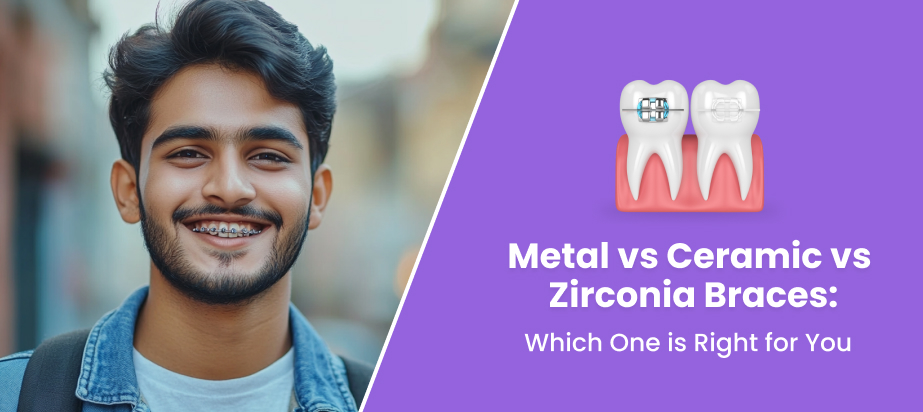
Metal Ceramic vs Zirconia Braces: Which One is Right for You?
 Medically Reviewed by Whistle Dental Team
Choosing the right braces depends on your dental needs, budget, and personal preference. Consult an orthodontist to determine the best option for your smile!
Thinking about straightening your teeth but unsure which braces to choose? You're not alone!
When someone says "braces," most people picture a mouth full of metal. But modern orthodontics offers three distinct fixed brace materials - metal, ceramic, and zirconia each with different properties, aesthetics, and clinical applications.
All three move teeth using the same fundamental mechanism: brackets bonded to teeth, connected by an archwire that applies graduated force. What differs is what those brackets are made of, and that difference affects durability, appearance, staining tendency, comfort, treatment suitability, and cost.
Key Takeaways
Myth: 'Zirconia braces are just for aesthetics.' – False! They are stronger and more durable than ceramic braces.
- Metal braces - Most affordable, highly effective, but visible
- Ceramic braces – Less noticeable but require extra care
- Zirconia braces – Best balance of strength, aesthetics, and hygiene
Braces not only align your teeth but also enhance your bite and boost your confidence. Let’s compare these three popular options so you can make an informed decision.
Understanding those differences properly - Not just which one looks better is what leads to the right choice for your specific case.
Metal Braces: The Clinical Benchmark
Metal braces are the original fixed orthodontic appliance and remain the most widely used type globally. The brackets are made from high-grade stainless steel — sometimes with a small titanium and molybdenum alloy component — and the archwire running through them is also typically stainless steel or nickel-titanium.
The reason metal braces remain common despite being the most visible option comes down to their mechanical properties. Steel brackets are exceptionally strong and can be made smaller without losing structural integrity. They don't chip, crack, or lose their shape under the forces applied during complex tooth movement. They tolerate adjustment appointments — where the archwire is swapped for a progressively thicker one — without any risk of fracture.
From a clinical standpoint, metal braces offer the orthodontist the most reliable control over tooth movement, particularly for severe crowding, significant bite correction, large gap closure, and cases requiring precise torque on individual teeth.
Advantages:
- Strongest and most durable bracket material
- Handles complex and severe cases most reliably
- Most affordable type of fixed brace
- No staining risk — maintain appearance throughout treatment
- Coloured band customisation (popular with teens and children)
- Smallest bracket profile possible without structural compromise
Considerations:
- Most visible orthodontic option - clearly apparent when you speak or smile
- Metal edges can initially cause minor cheek and lip irritation before soft tissue adapts
- Not preferred by adults or professionals in client-facing roles due to visibility
- Brackets can feel bulky initially
Best for: Complex cases, children and teenagers, patients prioritising clinical effectiveness over aesthetics, budget-conscious patients.
Ceramic Braces: The Aesthetic Middle Ground
Ceramic braces use the same archwire mechanics as metal braces, but the brackets are made from a ceramic material — typically polycrystalline alumina — that is either tooth-coloured or clear. This makes them significantly less visible than metal, as the bracket blends with the natural shade of your enamel.
There are two types of ceramic bracket material used in practice:
Polycrystalline alumina (PCA): The most common ceramic bracket material. Tooth-coloured or slightly translucent. Good aesthetics, effective for most cases, but more prone to surface staining over time because PCA has a slightly porous microstructure that absorbs pigments from food and beverages.
Monocrystalline alumina (sapphire): Manufactured from a single crystal structure rather than multiple fused particles. More optically clear and significantly less porous than PCA — meaning less staining tendency. Often referred to as "sapphire braces." Slightly more expensive than standard ceramic but offer better clarity across the treatment period.
The key mechanical distinction between ceramic and metal: Ceramic brackets are harder in compression but more brittle under sudden impact or torque stress. They are more likely to fracture under extreme forces, which is why certain highly complex cases or patients with significant bite problems may be better served by metal brackets.
Advantages:
- Considerably less visible than metal - blend with tooth colour
- Effective for mild to moderate orthodontic cases
- Available in both standard (PCA) and sapphire (monocrystalline) grades
- Smoother bracket surface than metal - less initial soft tissue irritation
- A well-established, clinically proven material with decades of use
Considerations:
- More expensive than metal braces
- PCA brackets can stain from coffee, tea, turmeric, and certain foods
- Ligature ties (the elastic bands holding the wire to the bracket) stain even faster than the brackets themselves this is often what patients notice, not bracket staining alone
- More fragile than metal under severe mechanical stress - not suited for very complex cases
- Bracket bonding (adhesion to enamel) can be slightly less reliable than metal in some applications
- At debonding (removal), ceramic brackets require more careful technique to prevent enamel damage
Best for: Adults and teens who want reduced visibility, mild to moderate cases, professional and social environments where visible braces are a concern.
Zirconia Braces: The Premium Fixed Option
Zirconia braces represent the newest and most advanced category of fixed bracket material. The brackets are made from zirconium oxide (ZrO₂) — a ceramic compound engineered to have exceptional strength while maintaining high aesthetic quality.
This is the key difference that neither of the other two bracket types achieves simultaneously: zirconia combines near-metal strength with near-tooth-coloured translucency.
Standard ceramic (alumina) is aesthetically good but mechanically limited. Metal is mechanically excellent but aesthetically obvious. Zirconia occupies the intersection — brackets that can handle the clinical forces required for complex tooth movement without the fragility concerns of alumina ceramic, while remaining substantially less visible than metal.
The material properties that make this possible: zirconia has significantly higher fracture toughness than alumina ceramic — roughly 3–4 times stronger — because its crystal structure undergoes a stress-induced phase transformation under mechanical load that actually reinforces the material (transformation toughening). This is the same material used in high-performance dental crowns, implant components, and surgical instruments.
Advantages:
- Strongest ceramic bracket material - handles complex cases that would fracture alumina ceramic brackets
- Excellent translucency and natural tooth-matching aesthetics
- Significantly less prone to staining compared to polycrystalline alumina ceramic
- Biocompatible - preferred for patients with metal sensitivities or allergies
- More optically stable over the full treatment duration than standard ceramic
- Less abrasive against opposing teeth compared to standard ceramic
- Lower bracket-enamel friction coefficient in many systems potentially smoother tooth movement
Considerations:
- Most expensive fixed bracket option
- Not as universally available as metal or standard ceramic requires a clinic offering zirconia bracket systems
- Zirconia's hardness can be more abrasive against opposing teeth in certain bite situations - orthodontist assessment required
- Not all bracket manufacturers offer zirconia systems with equal quality; the clinical outcome depends on bracket system quality
Best for: Adults seeking the most aesthetic fixed brace that can handle moderate-to-complex cases; patients with metal allergies; patients who want reduced staining risk over a longer treatment period; anyone who wants the aesthetic benefits of ceramic without the fragility compromise.
Which Braces Type Is Suitable for Which Case?
Metal braces are clinically preferred when:
- Significant crowding requires complex 3D tooth movement
- Severe bite correction (deep bite, crossbite, underbite)
- Multiple tooth extractions are part of the treatment plan
- Long treatment duration is expected (18–30 months)
- Budget is a primary consideration
- Patient is a child or younger teen who doesn't mind visibility
Ceramic braces are a good fit when:
- Alignment needs are mild to moderate
- Aesthetics during treatment matter more than cost
- The patient is a teenager or adult who wants less visibility
- Treatment duration is expected to be 12–18 months
- Patient can maintain dietary habits to reduce staining
Zirconia braces are the best option when:
- Patient wants the aesthetic discretion of ceramic with superior durability
- Case complexity is moderate to moderately complex
- Patient has a known or suspected metal sensitivity
- Long treatment duration would expose regular ceramic to cumulative staining
- Patient wants a professional appearance maintained throughout treatment
Feature Comparison: Which One Suits You Best?
| Feature | Metal Braces | Ceramic Braces | Zirconia Braces |
| Material | Stainless Steel | Ceramic | Zirconium Oxide |
| Visibility | Noticeable | Blends with teeth | Nearly invisible |
| Durability | High | Medium (can break) | Very high |
| Comfort | May irritate cheeks | Smoother than metal | Extremely smooth |
| Stain Resistance | No stains | Can stain over time | Stain-resistant |
| Treatment Time | Fast | Similar to metal | Similar to metal |
| Maintenance | Standard care | Extra cleaning needed | Low maintenance |
| Cost | Most affordable | Higher than metal | Premium pricing |
Pros & Cons of Each Type
Metal Braces
| Pros | Cons |
| Highly durable, effective for all cases, including severe misalignment. Most affordable option, Faster results for complex cases, No risk of staining, Widely available | Highly visible. May cause irritation in the initial weeks. Requires avoiding hard/sticky foods. Regular adjustments may cause discomfort |
| Pros | Cons |
| Less noticeable than metal braces, Smoother and more comfortable. Ideal for mild to moderate cases. Does not interfere with X-rays | More expensive than metal braces. Can break or chip easily. Requires extra care to prevent staining. Slightly longer treatment time |
Zirconia Braces
| Pros | Cons |
| Superior strength - more durable than ceramic braces. Stain-resistant and nearly invisible. More hygienic, reducing plaque buildup. Comfortable with a smoother surface, Hypoallergenic and biocompatible, Long-lasting strength over time | Higher cost than metal and ceramic braces. Limited availability in some areas. Requires orthodontists trained in handling zirconia materials |
Which Braces Should You Choose?
Choose Metal Braces If:
- You need an affordable, effective solution
- You don’t mind visible braces
Choose Ceramic Braces If:
- You want a discreet option. You have a mild to moderate case
- You’re okay with extra maintenance to prevent stains
Choose Zirconia Braces If:
- You want the best balance of strength, aesthetics, and hygiene
- You prefer stain-resistant, long-lasting braces
- You prioritize comfort
Why Braces Are Worth the Investment
Braces are more than just an aesthetic upgrade - they improve long-term oral health by:
- Preventing tooth decay & gum disease by making cleaning easier
- Reducing jaw problems like TMJ disorders
- Preventing costly future dental treatments
- Bo
- osting self-confidence and enhancing social interactions
Exploring an Advanced Option: Self-Ligating Braces by Whistle
(Scientific Insight: Zirconia is highly biocompatible, reducing irritation compared to metal braces.)
For those seeking the most advanced orthodontic solution, Whistle’s Self-Ligating Zirconia Braces offer superior benefits. Unlike traditional braces, self-ligating braces use specialized clips instead of elastic bands, allowing smoother tooth movement with less friction.
- Faster Treatment – Moves teeth more efficiently
- Less Discomfort – No elastic ties, reducing pressure
- Easier Cleaning – Fewer food traps for better hygiene
- Fewer Orthodontist Visits – Requires fewer adjustments
Essential Care Tips for Braces
To ensure a smooth treatment experience:
- Brush & Floss Properly – Use an orthodontic toothbrush and water flosser
- Avoid Certain Foods – Stay away from hard, sticky, and sugary foods
- Attend Regular Check-Ups – Monitor progress and make necessary adjustments
- Manage Discomfort – Use orthodontic wax and saltwater rinses
(Orthodontist's Advice: Regular professional cleanings ensure your braces stay in optimal condition.)
Making the Decision
The choice between metal, ceramic, and zirconia braces isn't about which looks best in isolation it's about which material aligns with the complexity of your case, your lifestyle, and what you want your experience during treatment to feel like.
Metal gives you the most clinical control at the lowest cost. Ceramic gives you aesthetic discretion with a durability trade-off. Zirconia gives you both at a higher price point.
At Whistle, your orthodontist assesses your case with a 3D scan before recommending any bracket type. That assessment the degree of crowding, the nature of your bite, the expected treatment duration is what drives the recommendation, not a default preference for one material over another.
Also Read:
Book 3D Teeth Scan
Consult our experts and get a 3D preview of your smile transformation!
Metal vs. Ceramic vs. Zirconia Braces
Metal vs Ceramic braces
FAQ's
Q1.What makes zirconia braces better than regular ceramic?
Zirconia (zirconium oxide) has significantly higher fracture toughness than polycrystalline alumina ceramic — the most common ceramic bracket material. This means zirconia brackets are less likely to crack during treatment and can handle moderately complex cases that might risk fracturing a standard ceramic bracket. Zirconia also stains less than PCA ceramic over time.
Q2.Do ceramic braces always stain?
Not always - but the elastic ties holding the wire to the bracket do stain with regular coffee, tea, and turmeric consumption. The bracket itself, especially in sapphire or zirconia systems, is more stain-resistant. Self-ligating bracket systems (which use a built-in clip instead of elastic ties) eliminate tie-staining entirely.
Q3.Which braces are best for adults in India?
Adults who prioritise aesthetics typically choose ceramic or zirconia. Zirconia offers the best combination of discreet appearance and durability for working professionals. Those with complex bite correction needs or tighter budgets often opt for metal. The right choice depends on case complexity - which only a clinical assessment can determine.
Q4.How do I clean ceramic or zirconia braces without staining them?
Brush after every meal, limit prolonged exposure to intensely pigmented drinks, rinse with water after consuming coffee or tea, and use a soft-bristle brush. The bracket surface itself is relatively stain-resistant; the main target for cleaning is the ligature tie area, which gets changed at each adjustment appointment anyway.
Q5.Do braces cause enamel damage when removed?
With proper technique, all three types can be removed without enamel damage. Ceramic and zirconia brackets require slightly more careful debonding because the materials bond differently to enamel than metal. An experienced orthodontist using the correct instrument and technique minimises this risk across all bracket types.
You May Also Like
 Medically Reviewed by Whistle Dental Team
































 Medically Reviewed by Whistle Dental Team

 Medically Reviewed by Whistle Dental Team