
Uneven Smile? Here Are 8 Surprising Reasons Your Smile Looks Asymmetrical
 Medically Reviewed by Whistle Dental Team
An uneven smile (or lopsided smile) occurs when the lips, teeth, or jaw appear asymmetrical when expressing emotion. While many assume asymmetry is purely cosmetic, it is primarily caused by structural dental crossbites, off-center dental midlines, uneven tooth wear, TMJ jaw shifts, or unilateral muscle dominance.
Learning how to fix uneven smile concerns requires identifying whether the root cause is dental, skeletal, muscular, or gingival. For dental and mild-to-moderate skeletal asymmetries, Whistle Clear Aligners (starting at Rs. 60,000 to Rs. 1.75 Lakhs) and Whistle Self-Ligating Braces (from Rs. 45,000 to Rs. 70,000) provide doctor-supervised correction with flexible EMI options across 600+ partner clinics.
Key Takeaways
- Four Distinct Asymmetry Types: An asymmetrical smile can be dental (crooked or tilted teeth), skeletal (uneven jaw growth or crossbite), muscular (one-sided chewing habit), or gingival (uneven gum line exposure).
- Dental Midline and Canting: If your upper dental midline does not align with your facial center, or if your teeth tilt on a slanted plane (occlusal cant), your entire smile looks crooked in photos.
- Why Face Yoga Fails: DIY smile exercises, face rolling, or chewing rubbers cannot remodel jawbones or shift tooth roots. They often aggravate temporomandibular joint (TMJ) strain.
- Modern Orthodontic Correction: Whistle Clear Aligners utilize 3-layer shape-memory polyurethane to level tilted arches and realign shifted midlines predictably without metal visibility.
- Transparent All-Inclusive Pricing: Whistle Clear Aligners range from Rs. 60,000 to Rs. 1.75 Lakhs, while Whistle self-ligating braces range from Rs. 45,000 to Rs. 70,000, both backed by flexible monthly EMI options.
In reality, smile symmetry is dictated by a highly complex matrix of dental placement, skeletal jaw alignment, and facial muscle habits.
If you are trying to understand why your smile lacks balance, let’s explore 8 surprising reasons behind an asymmetrical smile and look at the most effective, clinically backed ways to restore facial harmony.
What is an Uneven Smile? Understanding Smile Symmetry
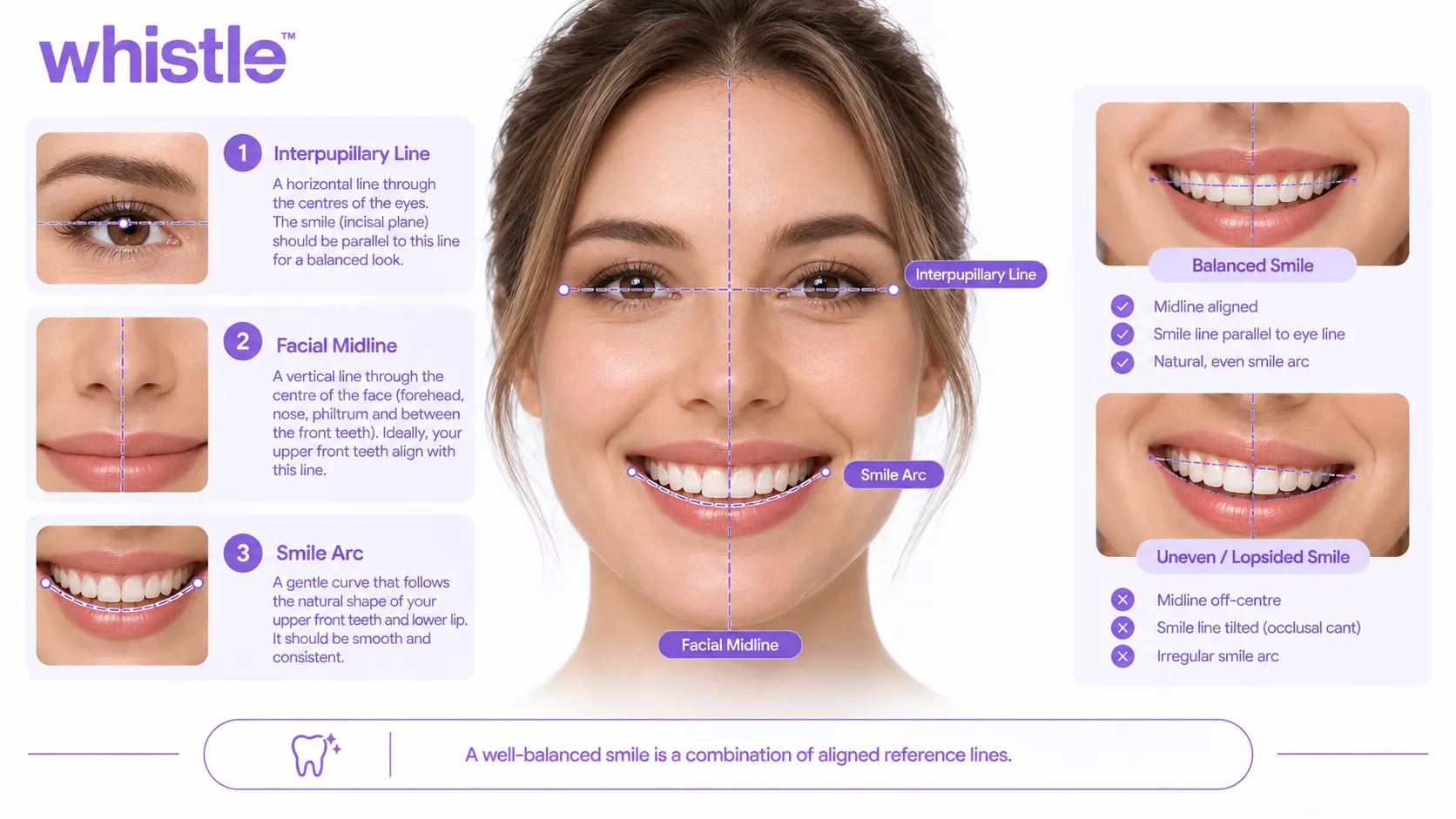
- The Interpupillary Line: The horizontal line passing through the centers of your eyes. Your smile line (incisal plane) should remain parallel to this line. When it slopes at an angle, it is clinically called an occlusal cant.
- The Facial Midline: The vertical line passing down the center of your forehead, nose bridge, and philtrum (cupid's bow). Your central incisor contact point should match this vertical line.
- The Smile Arc: The curvature of your upper front teeth following the natural curve of your lower lip when smiling.
| Asymmetry Classification | Primary Root Cause | Visual Manifestation in Smile | Recommended Whistle Solution |
| Dental Asymmetry (Uneven Teeth Smile) | Crowding, unilateral tilting, shifted midline, or uneven enamel wear. | One side of teeth tilts inward/outward; front teeth off-center from nose. | Whistle Clear Aligners (Rs. 60,000 to Rs. 1.75 Lakhs) |
| Skeletal Asymmetry | Unilateral crossbite or uneven lower jaw (mandibular) growth. | Lower jaw physically shifts sideways to bite; chin appears deviated. | Whistle Self-Ligating Braces (Rs. 45,000 to Rs. 70,000) / Orthognathic consult |
| Muscular Asymmetry | One-sided chewing habit, chronic stress, or facial nerve tone variation. | One corner of the mouth pulls higher during laughter while teeth are straight. | Myofunctional rehabilitation + Aligner bite leveling |
| Gingival (Gum Line) Asymmetry | Uneven gum display, delayed passive eruption, or localized gum recession. | Teeth appear different in height due to excess gum tissue on one side. | Laser gingivoplasty + Aligner intrusional leveling |
8 Surprising Reasons Behind Your Asymmetrical Smile
1. Unilateral Chewing Habits (Chewing on One Side)
Just like being left-handed or right-handed, most people have a preferred side of the mouth for chewing food. However, if you have spent years chewing almost exclusively on one side, often due to an old painful tooth or a missing molar on the opposite side, you have effectively "bulk-trained" those specific facial muscles. The masseter and lip muscles on your dominant side become stronger and tighter, pulling that corner of your mouth higher when you smile.
2. A Structural Dental Crossbite
A crossbite occurs when your upper teeth sit inside your lower teeth when you close your mouth. If a crossbite only affects one side of your mouth (a unilateral crossbite), your lower jaw is forced to physically shift to the left or right just to allow your back teeth to touch. This constant, uncorrected lateral shift forces your entire lower face to look asymmetrical.
3. Misaligned Facial Midlines
Draw an imaginary vertical line directly down the center of your face, passing through the bridge of your nose and the cupid's bow of your lips. In a perfectly symmetrical smile, the space between your two upper front teeth should align precisely with that line. If genetics or early tooth loss caused your teeth to drift laterally, an off-center dental midline creates the stark visual illusion of an uneven smile.
4. Severe Dental Crowding, Gaps, and Tilting
When there isn't enough room in your jaw for adult teeth to emerge straight, they twist and push past one another. If crowding hits one side of your dental arch harder than the other, those teeth may tilt inward or outward. When light hits your teeth as you smile, the shadowed, tilted teeth make that side of your mouth look collapsed or uneven. Tooth and jaw size discrepancies also lead to uneven gaps between the teeth which creates an uneven smile.
5. TMJ Disorder and Jaw Joint Tension
Your temporomandibular joints (TMJ) connect your lower jaw to your skull on either side of your face. If you suffer from TMJ dysfunction, inflammation, or clench your teeth due to stress, the joint disk on one side can become compressed or displaced. This imbalance restricts how far that side of your jaw can open, leading to a visibly crooked smile line.
6. Natural Facial Aging and Loss of Elasticity
As we grow older, our skin and soft tissues naturally lose collagen and elasticity. Because the two sides of our faces do not age at the exact same rate, minor muscular or tissue differences that were invisible in your youth can become much more pronounced over time, causing one side of the lower lip to droop slightly lower.
7. Missing Teeth or Uneven Dental Wear
If you lost a tooth on one side of your mouth years ago and never replaced it, the neighboring teeth will slowly tilt into that empty space, collapsing the dental arch on that side. Similarly, if your bite forces are unbalanced, you may grind down the enamel on one side much faster, creating an uneven smile line over time.
8. Historical Facial Injury or Nerve Issues
Minor trauma to the jaw during childhood sports, old dental infections, or conditions like Bell's Palsy (even temporary cases) can alter how facial nerves communicate with your smile muscles. If a nerve pathway is slightly compromised, the muscle response on that side will be weaker, resulting in an asymmetrical pull when you express emotion.
Why DIY "Face Yoga" and Natural Smile Exercises Usually Fail
Facial exercises only affect superficial muscular tone. They cannot move tooth roots through alveolar bone, correct a dental crossbite, or eliminate an off-center midline. In fact, aggressively chewing rubber exercisers or clenching one side of your mouth can overload your TMJ joints, leading to painful jaw clicking, chronic tension headaches, and accelerated enamel damage. True symmetry requires orthopedic and orthodontic alignment of the underlying dental foundation.
Modern Clinical Options to Straighten an Uneven Smile
Achieving true facial balance requires correcting the underlying dental or skeletal framework. Modern orthodontics provides exceptional, highly predictable tools to resolve asymmetry discreetly.
1. Whistle Clear Aligners (Precision Dental Balancing)
If your asymmetry is caused by crowded arches, a tilted smile line, or a misaligned midline, advanced clear aligners offer an exceptional solution.
At Whistle, we engineer premium clear aligners designed to handle complex structural movements:
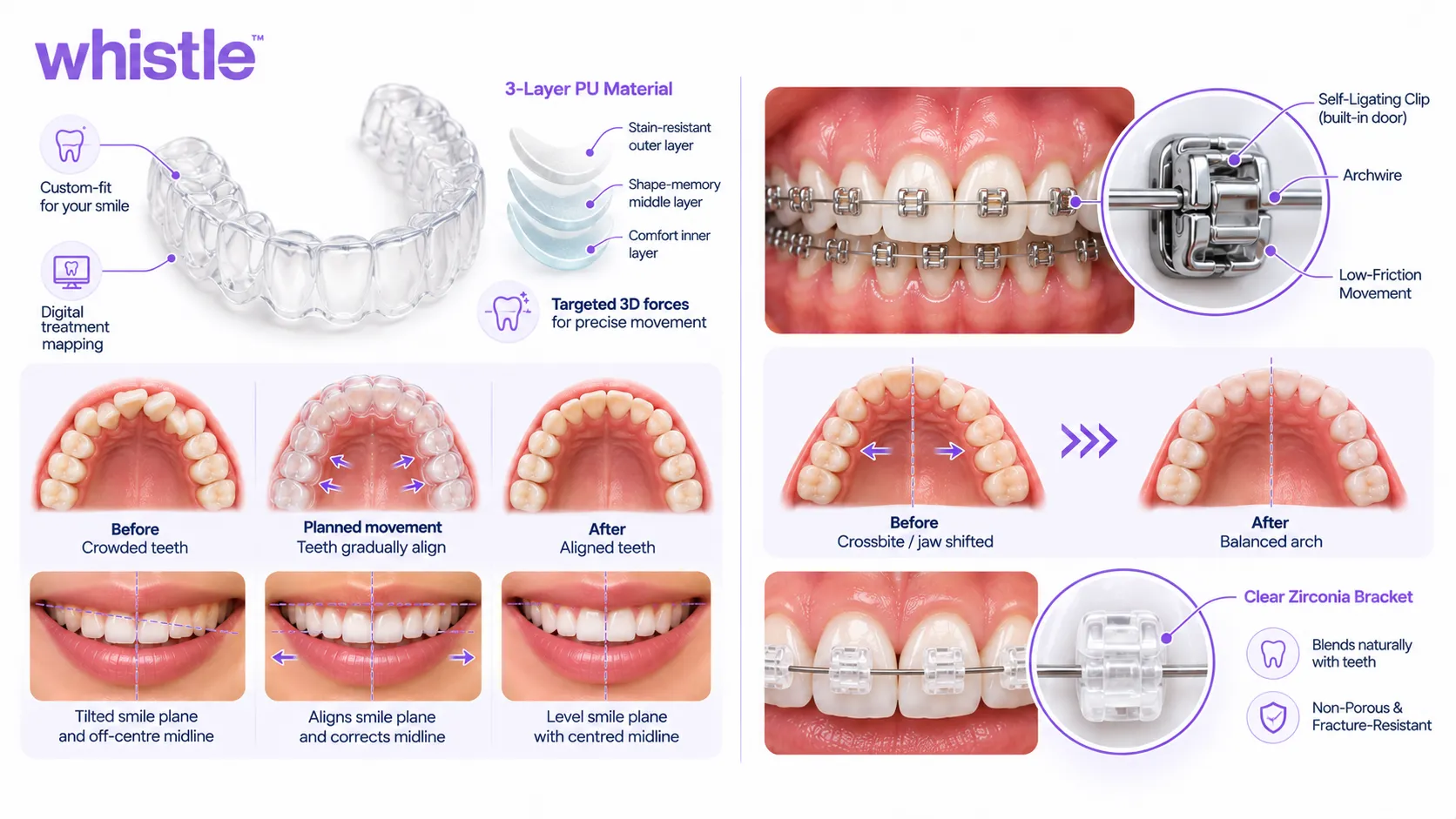
- Proprietary 3-Layer Polyurethane (PU) Material: Standard clear plastic aligners can lose their grip when trying to move an entire side of the dental arch laterally. Whistle aligners utilize a highly resilient, multi-layer material that maintains its shape memory, applying the continuous, highly targeted forces needed to correct midlines and broaden collapsed arches smoothly.
- Predictable Digital Mapping: Every tray sequence is programmed to orchestrate your alignment up to 33% faster, gradually balancing the visual plane of your smile.
2. Whistle Self-Ligating Braces (Heavy-Duty Power for Crossbites)
If your uneven smile stems from a severe skeletal crossbite or structural jaw shift, fixed hardware may be required to deliver maximum mechanical leverage.
- Frictionless Engineering: Whistle Braces feature an advanced self-ligating design. By replacing tight elastic bands with built-in sliding doors to hold the archwire, our braces apply constant, gentle rebalancing forces with significantly less discomfort.
- Stain-Proof Zirconia: If you want the structural power of braces without the metal appearance, Whistle offers crystal-clear Zirconia brackets that are completely non-porous and fracture-resistant, ensuring your treatment moves forward seamlessly.
Common Mistakes Orthodontists Often See in Uneven Smile Cases
Daily Care and Lifestyle Guide for Maintaining Smile Balance
- Practice Bilateral Chewing: Consciously distribute chewing forces evenly across both the left and right sides of your mouth to balance masseter muscle tone.
- Wear Your Aligners for 20 to 22 Hours Daily: Consistent wear ensures steady biological pressure to level the incisal plane and center your dental midline.
- Manage Nighttime Teeth Grinding: If you clench or grind your teeth, wear a custom nightguard or your orthodontic aligners to prevent uneven enamel wear.
- Maintain Proper Head and Neck Posture: Chronic forward-head posture and phone-cradling tilt your jaw alignment and create asymmetric neck and facial muscle strain.
- Wear Your Retainers Consistently Post-Treatment: Protect your balanced smile by wearing your custom retainers nightly to lock your new symmetrical alignment in place.
Rebalance Your Smile with absolute Confidence
You don't have to navigate photo angles or feel self-conscious about an asymmetrical smile anymore. Whether your teeth need the advanced, invisible engineering of Whistle clear aligners or the robust rebalancing power of our premium Zirconia braces, a balanced, beautifully aligned smile is entirely within reach.
Take the first step toward true facial harmony today. Take our quick assessment and book a clinical consultation with a certified Whistle partner clinic near you!
Also Read:
- What Is the Correct Teeth Alignment?
- Can Braces Fix Facial Asymmetry
- How Much Time Braces Take to Fill Teeth Gaps
- Shortest Time Period for Braces
Book 3D Teeth Scan
Consult our experts and get a 3D preview of your smile transformation!
uneven smile
smile treatment
FAQ's
Q1.Can an uneven smile be fixed without surgery?
Yes, the vast majority of uneven smiles can be fully corrected without surgery using premium clear aligners or braces. Surgical jaw correction (orthognathic surgery) is only reserved for severe, purely skeletal deformities where the adult jawbones are vastly different in size due to genetic development.
Q2.Will fixing my uneven smile change the shape of my face?
Yes, in a highly positive, balanced way. When you correct an off-center midline or resolve a crossbite that is forcing your jaw to shift sideways, your lower jaw will naturally settle into its true, relaxed center. This directly relieves uneven facial tension and creates a more harmonious, symmetrical jawline profile.
Q3.How long does it take to correct an asymmetrical smile?
Depending on whether the asymmetry is purely dental or involves a crossbite, treatment typically takes between 12 to 24 months. Because moving an entire dental arch to align a facial midline must be done carefully to protect root health, your certified Whistle partner doctor will map out an exact biological timeline for your specific case.
Q4.What should I do if my uneven smile is accompanied by jaw clicking?
If your asymmetrical smile occurs alongside jaw clicking, popping, or chronic headaches, it is a strong indicator of underlying TMJ dysfunction. You should avoid all DIY facial exercises and schedule an in-person evaluation with a Whistle partner orthodontist immediately. They can take the necessary diagnostic images to protect your joints while designing your alignment plan.
Q5.Can chewing on one side cause an uneven smile?
Yes. Chronic unilateral chewing strengthens and enlarges the masseter and facial elevator muscles on that side, causing that corner of the mouth to pull higher and creating a noticeable muscular asymmetry when smiling.

 Medically Reviewed by Whistle Dental Team


 Medically Reviewed by Whistle Dental Team

 Medically Reviewed by Whistle Dental Team