Teeth Crowding Treatment: Options, Braces vs. Aligners & Before and After Expectations
 Medically Reviewed by Whistle Dental Team
Effective teeth crowding treatment options include clear aligners, self-ligating metal or zirconia braces, interproximal reduction (IPR enamel polishing), and arch expansion. Teeth crowding occurs when a space mismatch forces teeth to overlap, twist, or erupt behind adjacent teeth.
Mild crowding teeth (1 to 3 mm space deficit) can be completely straightened using invisible clear aligners in 3 to 6 months without extractions. Moderate to severe crowding (4 to 8+ mm space deficit) utilizes self-ligating crowded teeth braces to widen the arch perimeter or realign blocked-out teeth safely. Early clinical treatment restores bite function, prevents interproximal decay, and delivers a balanced, easily cleanable smile.
Key Takeaways:
- Treatment Severity Grading: Mild crowding (1 to 3 mm) responds quickly to clear aligners, while moderate to severe crowding requires structured arch expansion or self-ligating braces.
- Clear Aligner Advantage: Whistle 3-layer polyurethane aligners apply continuous multi-directional force to untwist rotated teeth up to 33% faster than standard plastic.
- Non-Extraction Strategies: Modern techniques like IPR (micro-polishing enamel contact points) and arch expansion eliminate the need for tooth extractions in most mild to moderate cases.
- Before and After Progress: Patients notice visible untwisting within 6 to 8 weeks, with full arch alignment achieved between 4 and 14 months.
- Physical Orthodontist Oversight: In-person clinical scans and 3D X-rays across Whistle partner clinics protect bone density and prevent root damage during crowding realignment.
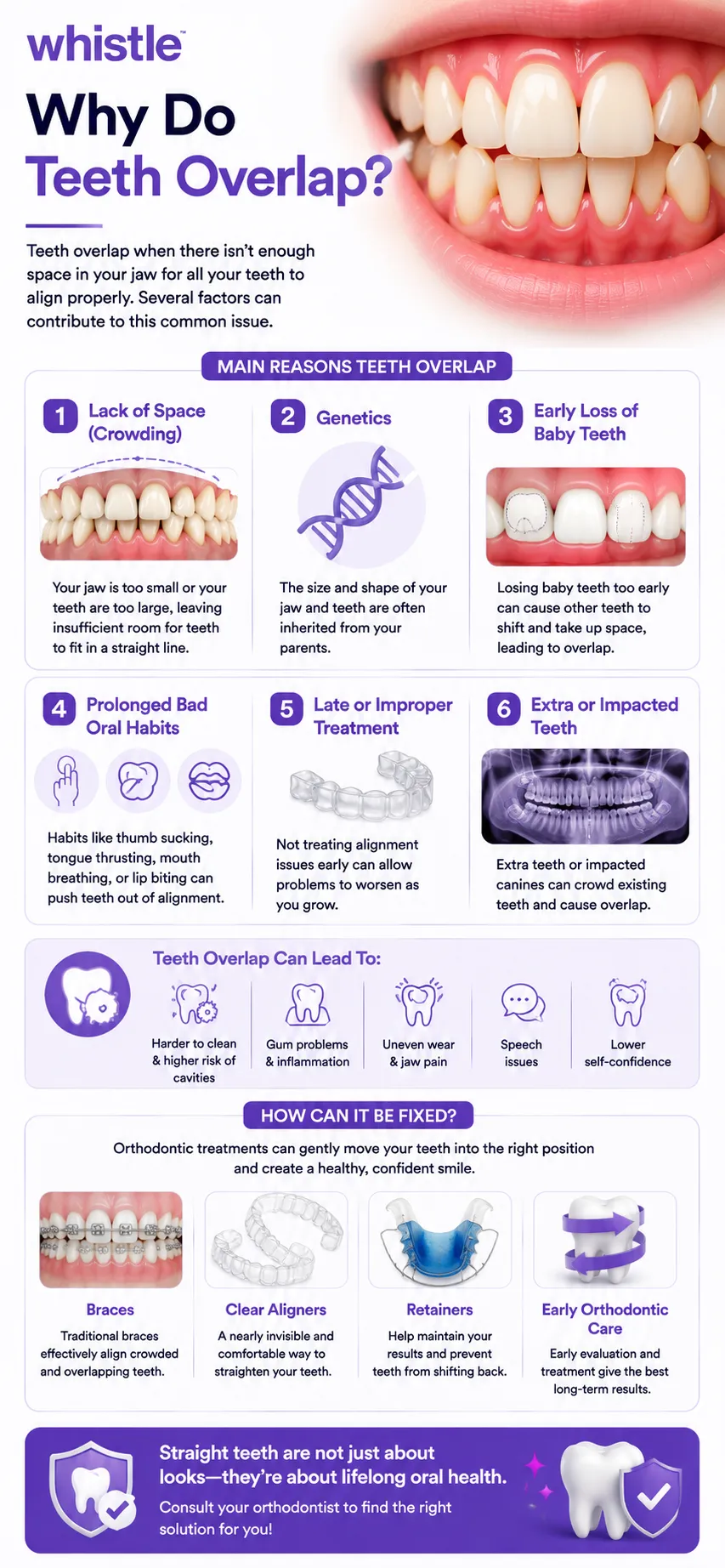
Below the surface, crowded teeth represent a fundamental mechanical issue: a space mismatch. It simply means your teeth collectively require more physical real estate than your jaw arch provides. When teeth are forced to overlap, twist, or stack to fit into a tight space, creating what orthodontists describe as crooked teeth, it alters the ecosystem of your entire mouth.
At Whistle, we engineer premium orthodontic products designed to restore harmony and functionality to your bite. Let’s explore how you can evaluate your crowding at home, the seven hidden health risks that uncorrected crowding can cause over time, and the smart engineering options available to solve it safely.
Understanding Dental Crowding: Why Do Teeth Overlap?
7 Hidden Problems Crowded Teeth Cause Beyond Looks
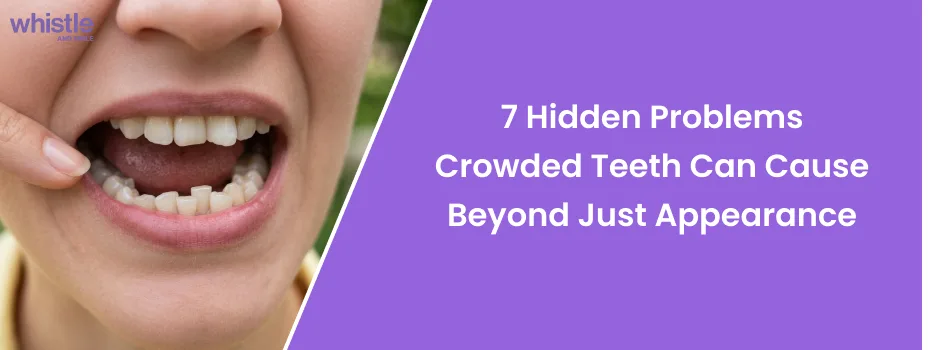
Leaving crowded teeth unaddressed is like driving a car with a slightly bent frame. You can still drive it, but certain parts are going to wear out long before they should. Here are seven ways dental crowding quietly compromises your health:
1. Hard-to-Reach Plaque Traps:
The presence of twisted or overlapped teeth creates tight, wedge-shaped corners and junctions between the teeth. This creates surfaces that are difficult to be cleaned by toothbrush bristles or dental flosses, as they are designed to work on smooth, even surfaces.
It doesn’t matter how thorough you are with your brushing and flossing techniques, plaque and food debris will always find places to be trapped in.
2. Stubborn Bad Breath (Halitosis):
Chronic bad breath is often a reflection of your mouth’s architecture, not your hygiene. Trapped food particles and bacterial colonies deep within overlapping teeth emit volatile sulfur compounds. Because these deep pockets are shielded from saliva and mouthwash, the odor is incredibly stubborn and cannot simply be rinsed away.
3. Gum Disease and Systemic Health Risks:
Trapped plaque quickly hardens into tartar, leading to bleeding gums, recession, and gum disease (periodontitis). Because your mouth is the gateway to your body, chronic gum inflammation is clinically linked to a higher risk of systemic conditions like heart disease and diabetes, placing an unnecessary inflammatory burden on your entire system.
4. Cavities Between the Teeth (Interproximal Decay):
As the crowded tooth areas are pretty much impossible to clean completely, the bacterias get a chance to stay in for longer periods of time. They keep feeding onto the sugars from your food as they secrete acidic by products that cause silent cavities.
These cavities are harder to detect in initial stages are they are generally found on the hidden side walls where the teeth touch. Repairing these often requires a dentist to drill through healthy enamel just to reach the decay.
5. Premature Enamel Wear and Chipping:
Your teeth are engineered to meet in a balanced pattern. When crowding twists them out of position, they clash against opposite teeth at sharp, unnatural angles during chewing. This uneven mechanical stress causes rapid enamel erosion, leading to chipped edges, micro-fractures, and painful temperature sensitivity.
6. Worsening Alignment Over Time:
Dental crowding is a progressive condition that doesn't fix itself. As we age, our teeth naturally experience a subtle forward pressure called "mesial drift." If your jaw is already crowded, this forward shifting forces teeth to stack and twist even further, turning a mild overlap in your twenties into a severe issue by your forties.
7. Chronic Jaw Pain and Tension Headaches:
When your bite doesn't line up cleanly, your jaw joint (TMJ) and facial muscles have to work overtime. Every time you chew or swallow, your muscles micro-shift your jaw to find a stable resting spot. This constant overcompensation triggers facial fatigue, jaw clicking, and stubborn morning headaches.
Severity Classification: Mild, Moderate & Severe Crowding
1. Mild Crowding Teeth (1 to 3 mm Space Deficit)
2. Moderate Crowding Teeth (4 to 7 mm Space Deficit)
3. Severe Crowding Teeth (8+ mm Space Deficit)
Modern Teeth Crowding Treatment Options
1. Whistle Clear Aligners (Invisible Tray Therapy)
2. Crowded Teeth Braces (Advanced Self-Ligating Technology)
3. Interproximal Reduction (IPR Enamel Polishing)
4. Arch Expansion
Crowded Teeth Before and After Braces & Aligners: What to Expect
Understanding your treatment transformation timeline builds confidence throughout your smile journey. Here is a typical crowded teeth before and after progress timeline:
- Before Treatment: Teeth present visible overlapping, jagged lower arch line, flossing difficulty, and tight plaque corners.
- Weeks 1 to 4: Initial tender feeling as periodontal ligaments adapt. Minor spaces begin forming as tight contact points release.
- Months 2 to 4: Noticeable visual untwisting. Overlapped front incisors move into line, making flossing noticeably smoother.
- Months 6 to 12: Complete arch alignment. Rotated teeth sit flush within the arch perimeter, establishing a balanced, harmonious bite.
- After Treatment: Perfectly aligned teeth, effortless brushing and flossing, zero plaque traps, and locked-in stability with custom retainers.
Comparison Table: Teeth Crowding Treatment Options Compared
| Treatment Parameter | Whistle Clear Aligners | Self-Ligating Metal Braces | Whistle Zirconia Braces |
| Best Suited Severity | Mild to moderate crowding (1 to 7 mm). | Moderate to severe crowding (4 to 8+ mm). | Moderate to severe crowding with discreet aesthetic needs. |
Aesthetic Appearance | 100% Invisible transparent trays. | Visible metallic brackets. | Crystal clear, stain-proof zirconia brackets. |
| Hygiene Maintenance | Removable for normal brushing & flossing. | Fixed brackets; requires interdental brushes. | Fixed brackets; clip mechanism reduces plaque traps. |
| Typical Treatment Duration | 3 to 12 months (up to 33% faster). | 8 to 18 months. | 8 to 16 months. |
Transform Your Crowded Smile with Whistle Clear Aligners
Say goodbye to overlapped teeth and difficult flossing. Whistle clear aligners deliver fast, invisible crowding correction under the hands-on care of certified partner orthodontists.
Book Your Whistle 3D Consultation Today across 600+ physical partner clinics nationwide.
Conclusion: Achieving a Straight, Easily Cleanable Smile
Teeth crowding treatment is one of the most effective investments you can make for your long-term dental health. Resolving overlapped teeth eliminates hidden plaque traps, protects enamel from uneven wear, and relieves strain on your jaw joints.
Whether you choose invisible Whistle clear aligners or advanced self-ligating braces, modern orthodontics makes crowding correction safe, fast, and comfortable. Book your 3D consultation at a Whistle partner clinic near you today and start your smile transformation on your own terms!
Also Read
Book 3D Teeth Scan
Consult our experts and get a 3D preview of your smile transformation!
Crowded Teeth
Teeth Crowding
Dental Crowding
Crowded Teeth Treatment
Crowded Teeth Aligners
Crowded Teeth Braces
Oral Health
Gum Disease
Teeth Alignment
Clear Aligners
Orthodontic Treatment
Jaw Pain
FAQ's
Q1.Can clear aligners really fix severely crowded teeth?
Yes, modern clear aligners are highly effective at correcting dental crowding. However, the success of the treatment depends heavily on the engineering of the aligner material and professional supervision. Whistle aligners utilize a proprietary 3-layer polyurethane material that delivers the precise, continuous force vectors needed to rotate twisted teeth and expand the dental arch, making them an excellent choice for crowding when managed by our partner doctors.
Q2.Is it ever too late to fix crowded teeth?
It is never too late! Healthy teeth can be structurally moved at almost any age. Whether you are in your twenties or your sixties, resolving dental crowding will immediately make your teeth easier to clean and relieve uneven bite pressure. As long as your supporting bone structure and gums are healthy, orthodontic products can safely realign your smile.
Q3.Will my crowded teeth get worse if I don't treat them?
Yes. Teeth naturally tend to drift forward as we age (a process called mesial drift). If your jaw is already crowded, this progressive movement will compress your teeth even further, causing mild overlaps to twist deeper and become more severe over time. Early intervention is always the best way to prevent complex dental issues later in life.
Q4.Do I need to have teeth extracted to fix crowding?
Not necessarily. In the past, extracting teeth was very common to create space. Today, however, advanced products like Whistle clear aligners allow your provider to gently expand the width of your dental arch or perform minor enamel reshaping (IPR) to create the required space naturally, avoiding extractions in many moderate crowding cases.
Q5.Why shouldn't I use a direct-to-consumer "at-home" aligner kit for crowding?
Crowded teeth are packed tightly together, meaning their roots are often in unusual, delicate positions. Moving them without a physical, in-person clinical exam, X-rays, and ongoing orthodontist supervision can result in serious permanent damage, including gum recession or loose teeth. Whistle protects your smile by providing premium products exclusively through hands-on, certified dental professionals.
 Medically Reviewed by Whistle Dental Team
 Medically Reviewed by Whistle Dental Team

 Medically Reviewed by Whistle Dental Team