
How to Fix Twisted Teeth | Causes, Treatments & Cost
 Medically Reviewed by Whistle Dental Team
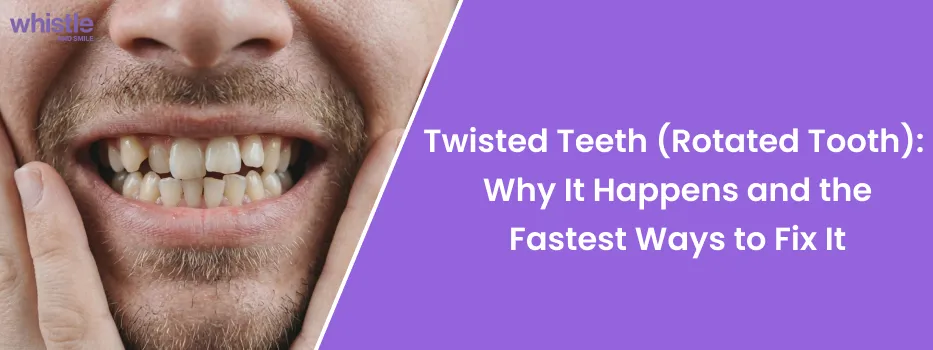
Twisted teeth, clinically referred to as rotated teeth or tooth rotation, occur when a tooth spins on its vertical axis inside the jawbone rather than facing straight forward. Rotated front teeth commonly result from severe dental crowding, premature loss of baby teeth, jaw-size mismatch, or childhood thumb-sucking.
Fixing a rotated tooth requires precise 3D mechanical force using either Whistle clear aligners engineered with custom composite attachments for rotational leverage or self-ligating braces. Unwinding a twisted tooth typically takes 6 to 18 months under physical orthodontist supervision across physical Whistle partner clinics to prevent root resorption, tracking failure, and rotational relapse.
Key takeaways:
- Rotated teeth turn on a vertical axis: A rotated tooth spins on its central axis, turning anywhere from 5 degrees to 90 degrees sideways inside the dental arch.
- Arch crowding is the primary cause: When the jawbone lacks space for all permanent adult teeth, emerging teeth twist sideways like books packed too tightly on a crowded shelf.
- Aligners require composite attachments to rotate teeth: Because smooth aligners can slip on rounded tooth surfaces, tooth-colored attachments are bonded to teeth to provide rotational leverage.
- Rotated teeth carry high relapse risk: Elastic supracrestal fibers in the gums remember the tooth's original twisted position, making long-term retainer wear essential.
- Physical orthodontist care prevents root damage: Unwinding a rotated tooth requires precise biomechanical torque monitored at a physical Whistle partner clinic.
If you are dealing with a rotated tooth, you're not alone, it's one of the most common orthodontic complaints we see across Whistle's network of 800+ certified partner clinics. And while twisted teeth are very fixable, the mechanics behind correcting them are more nuanced than most people expect.
Let's break down exactly why teeth rotate out of alignment, what separates a good treatment from a rushed one, and which modern solutions straighten them most safely and permanently.
What Is a Rotated Tooth?
A rotated tooth (also called a twisted tooth or micro-rotation) is a dental condition in which a tooth has turned on its vertical axis inside the jaw. Rather than facing forward like its neighbours, the tooth is partially or fully spun, sometimes just a few degrees, sometimes as much as 90 degrees sideways.
Rotated teeth can affect any tooth but are especially common with upper canines, premolars, and front incisors, teeth that experience the most crowding pressure during development.
What clinical factors cause twisted teeth to develop?
Teeth don't rotate without a biological reason. A rotated tooth is almost always the result of physical forces acting during childhood or the teenage years, when the jaw is still developing. The most common causes include:
- Severe arch crowding - This is the primary culprit. If your jawbone doesn't have enough physical space to accommodate all your adult teeth as they emerge, incoming teeth squeeze against each other. To fit into the cramped space, a tooth will often twist sideways, much like books packed too tightly on a shelf.
- Premature loss of baby teeth - If a child loses a baby tooth early due to decay or an accident, surrounding teeth naturally drift into the empty gap. When the permanent adult tooth finally tries to grow in, its path is blocked, forcing it to rotate as it pushes through the gums.
- Genetics and jaw size - Sometimes you simply inherit a smaller jaw from one parent and larger teeth from the other. This mismatch makes crowding, and subsequent tooth rotation highly likely.
- Childhood habits - Extended thumb-sucking, heavy pacifier use, or chronic tongue-thrusting applies continuous, uneven pressure to developing teeth, often pushing them outward or causing them to rotate.
Can a rotated tooth get worse over time? Yes. Teeth naturally drift forward with age. If your dental arch is already crowded, this ongoing pressure will continue to squeeze the rotated area, often causing a mildly twisted tooth to rotate even further over the years. Early treatment is always easier than late treatment.
Why do twisted front teeth happen?
The Biomechanics: How do orthodontists unwind a rotated tooth?
The Role of Periodontal Ligament (PDL) Fibers
Treatment Options: Braces for Twisted Teeth vs. Clear Aligners
So, can braces fix twisted teeth? Yes, and so can advanced clear aligners. The right choice depends on the severity of your rotation. Here is how each option performs:
1. Clear aligners: for mild to moderate rotations
There is a common myth that clear aligners cannot handle twisted teeth. This is true of cheap, single-layer plastic trays. Advanced aligner systems, however, have closed this gap entirely.
How Whistle clear aligners handle rotation:
- 3-layer polyurethane (PU) material - Standard aligners stretch and lose their grip when twisting a tooth. Whistle aligners use a highly resilient multi-layer material that retains its elastic shape-memory, exerting the steady, continuous force needed to spin a root safely over time.
- Smart attachments (bridges) - To rotate a tooth smoothly, your Whistle partner doctor places tiny tooth-coloured composite shapes, called attachments directly onto the twisted tooth. The aligner clicks securely over these shapes and uses them as structural handles to apply precise, dual-directional leverage. This approach can align rotated teeth up to 33% faster than older orthodontic plastics.
- Auxiliaries: for moderate derotations, whistle aligners plan auxiliaries for a more predictable treatment outcome.
- Step-by-step doctor monitoring - Every Whistle aligner case is overseen by a certified orthodontist at one of our 800+ partner clinics, who tracks root movement at every stage.
Best for: Rotations of up to approximately 45 degrees, patients who want a discreet, removable option.
2. Self-ligating braces: for severe rotations
For severe rotations, such as a tooth that has spun a full 90 degrees sideways, fixed braces remain the most mechanically powerful option. And modern self-ligating braces are a very different experience from the traditional metal braces most people remember.
How Whistle self-ligating braces work:
- Frictionless wire sliding - Instead of tight elastic bands that create heavy friction, Whistle brackets feature built-in doors that hold the archwire loosely. This allows the wire to slide smoothly, applying constant untwisting pressure with significantly less soreness after each appointment.
- Premium zirconia brackets - For patients who want the mechanical power of braces without the "metal-mouth" appearance, Whistle offers crystal-clear zirconia brackets, completely stain-proof and far more fracture-resistant than older ceramic lines.
Best for: Severe rotations over 45–90 degrees, complex cases involving multiple rotated teeth or significant bite correction alongside rotation.
Comparison: Which is right for you?
| Treatment System | Rotational Precision | Attachment Requirement | Aesthetics | Daily Cleaning Ease | Physical Clinic Visits |
| Whistle Clear Aligners | High (Engineered 3D Torque) | Mandatory (Composite Attachments) | Virtually Invisible | 100% Removable (Easy) | Periodic Progress Checks |
| Whistle Self-Ligating Braces | Exceptional (Continuous Couples) | Built-In Sliding Doors | Subtle Metal / Ceramic | Requires Interdental Brushes | Bi-Monthly Progress Checks |
| Traditional Metal Braces | High | Elastic Ligatures | Highly Visible | Difficult (Plaque Traps) | Monthly Tightening Visits |
| Cosmetic Veneers / Bonding | Zero Root Movement | Enamel Shaving Required | Instant Visual Masking | Standard | Irreversible Enamel Removal |
Wondering which alignment method fits your rotated tooth profile best? Book a free 3D scan evaluation at your nearest Whistle partner clinic (no commitment required).
How do Whistle clear aligners unwind rotated teeth using precision attachments?
Does Fixing a Twisted Tooth Require Pulling Teeth Out?
Common Mistakes Orthodontists Often See
In clinical practice, orthodontists frequently observe patient mistakes that compromise rotated tooth correction. Here are five common mistakes to avoid:
- Masking Severe Rotations with Veneers: Shaving down healthy natural enamel to place a veneer over a severely rotated tooth, exposing sensitive dentin and risking nerve root death.
- Using Direct-to-Consumer DIY Aligners: Attempting to fix rotated teeth using mail-order aligners without physical 3D attachments, leading to complete tracking failure and wasted money.
- Stopping Retainer Wear Early: Discontinuing nighttime retainers after treatment, allowing stretched supracrestal fibers in the gums to pull the tooth back into its original twisted position.
- Ignoring Plaque Build-Up in Rotated Nooks: Brossing only front surfaces while neglecting the overlapping crevices of a twisted tooth, causing calculus deposits and cavities.
- Attempting DIY Elastic Hacks: Wrapping small rubber bands around a twisted tooth at home, which can slide under the gums, destroy the periodontal ligament, and cause complete tooth loss.
How Long Does It Take to Fix a Rotated Tooth?
Depending on how many degrees the tooth has rotated, it typically takes 6 to 18 months to fully untwist an individual tooth and stabilize the root structure, though your overall treatment plan may take longer if other bite issues need correcting alongside the rotation.
Factors that affect treatment time:
- Degree of rotation (mild = faster, severe = longer)
- Whether space needs to be created first
- Patient compliance (with aligners, wearing them 20–22 hours a day matters significantly)
- Age (younger patients tend to respond faster)
Why Professional Oversight Matters for Rotated Teeth
Straightening a rotated tooth changes the physical dynamics of your entire bite. If a tooth is rotated too quickly or without precise root mapping, the excessive forces can permanently shorten the tooth root, a condition called root resorption, which can eventually lead to tooth loss.
This is exactly why Whistle does not support direct-to-consumer impression kits or at-home treatment. Every Whistle case begins with a certified partner orthodontist physically examining your mouth, taking precise 3D digital scans and X-rays to confirm root health, and personally monitoring your rotation step by step. The materials we manufacture are premium, but the professional partnership is what makes treatment safe.
Why should you avoid unmonitored mail-order aligners for rotated teeth?
You may have seen online advertisements for direct-to-consumer mail-order aligners claiming to straighten teeth without visiting an orthodontist. We strongly warn you against using unmonitored mail kits for rotated teeth.
Unwinding a rotated tooth root requires precise rotational torque supported by physical composite attachments and physical 3D intraoral diagnostic planning. Without attachments, smooth plastic trays simply slide over rotated crowns without moving the root.
Applying uncontrolled force without physical doctor oversight can cause root resorption, tracking failure, and permanent bone loss. Safe rotation requires physical doctor supervision at a Whistle partner clinic.
Your Next Steps
Understanding the biomechanics behind twisted teeth empowers you to choose the safest, most effective treatment option. Whether your rotated tooth stems from severe crowding, premature baby tooth loss, or genetics, attempting quick cosmetic cover-ups or unmonitored home kits risks long-term root and enamel damage.
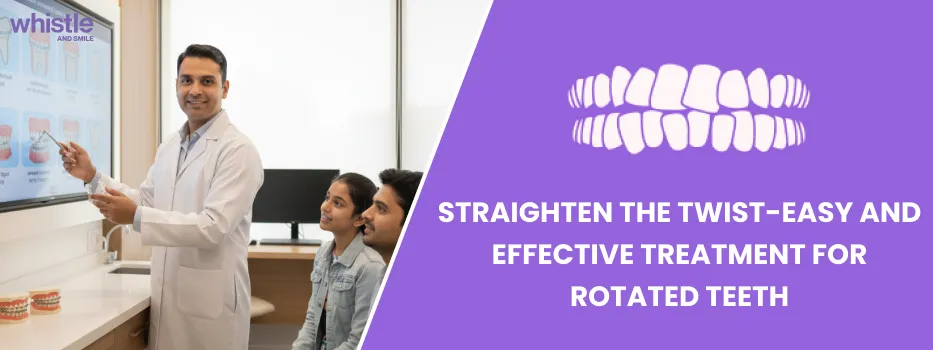
By choosing doctor-supervised Whistle clear aligners with precision 3D attachments or Whistle self-ligating braces at a physical clinic, you receive comprehensive 3D scanning, expert rotational force planning, and long-lasting smile stability.
Ready to see how fast your rotated tooth can be straightened? Book a free 3D scan consultation at your nearest Whistle partner clinic today.
Also Read:
Book 3D Teeth Scan
Consult our experts and get a 3D preview of your smile transformation!
Twisted teeth
Rotated Teeth
FAQ's
Q1.Can a twisted tooth get worse if left untreated?
Yes. Natural forward drift combined with existing crowding will typically worsen the rotation over time. A minor twist at 20 can become a significant rotation by 35.
Q2.Can clear aligners fix a severely rotated tooth?
Yes, Whistle clear aligners can fix rotated teeth when combined with custom composite attachments. Attachments provide the necessary leverage for the aligner tray to apply continuous rotational force.
Q3.How long does it take to unwind a rotated tooth?
Unwinding a rotated tooth typically takes 6 to 18 months, depending on the degree of rotation, patient compliance, and whether braces or clear aligners with attachments are used.
Q4.How long does it take to fix a twisted tooth with braces or aligners?
Typically 6 to 18 months for the rotation itself, though overall treatment (including bite correction) may be longer.
Q5.Are clear aligners or braces better for twisted teeth?
It depends on severity. Mild to moderate rotations respond well to advanced clear aligners with attachments. Severe rotations (over 45–90 degrees) often benefit from the greater mechanical power of self-ligating braces. A Whistle partner doctor can assess which path is right for your specific case.
Q6.Is tooth extraction required to fix twisted teeth?
Tooth extraction is not always required. In many cases, non-extraction methods like interproximal reduction (IPR) or dental arch expansion create enough space to rotate the tooth back into alignment.

 Medically Reviewed by Whistle Dental Team



 Medically Reviewed by Whistle Dental Team






 Medically Reviewed by Whistle Dental Team