Proclined vs Retroclined Teeth: Causes, Differences, and How to Fix Them
 Medically Reviewed by Whistle Dental Team
You look in the mirror and notice something about your smile feels slightly off-balance. Maybe your upper front teeth seem to stick out, pushing against your lips. Or perhaps they lean inward, making your smile look crowded or hidden. These angles matter. They affect how your lips rest, how you speak, and how comfortably you chew your food. It is not just about aesthetics. Tooth angulation plays a massive role in your overall oral health. The good news is that correcting the angle of your teeth is entirely possible, no matter your age.
If that sounds familiar, there's a good chance you're dealing with either proclined or retroclined teeth - two of the more common (and often misunderstood) dental alignment issues.
Key Takeaways:
- Proclined teeth increase your risk of dental trauma, while retroclined teeth often lead to deep bites and enamel wear.
- Childhood habits like thumb sucking frequently cause proclination, but genetics play a major role in both conditions.
- At-home aligner kits lack the torque control needed to fix severe angulation safely.
- Whistle's clear aligners use self-ligating principles and 3D torque planning to safely move roots, not just crowns.
- Treatment is possible at any age, whether through braces or orthodontist-supervised clear aligners.
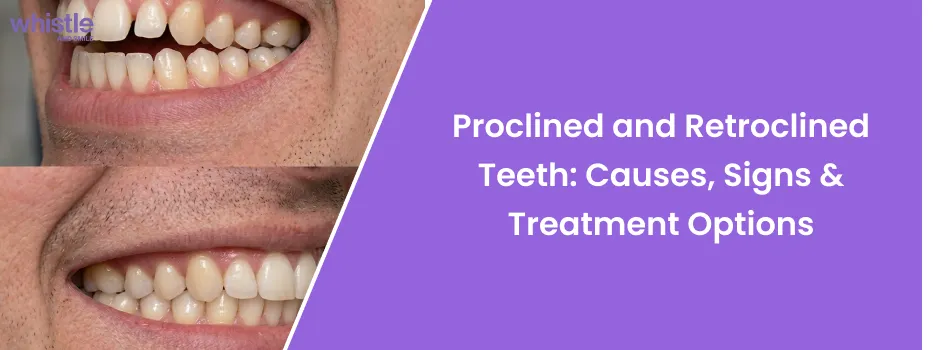
Proclined teeth are teeth that flare outward toward the lips, often called "buck teeth." Retroclined teeth tilt backward toward the tongue or roof of the mouth. Both are forms of malocclusion (when your upper and lower teeth don't meet properly when you bite). While proclined teeth are visually prominent, retroclined teeth often cause hidden functional issues. Both conditions require professional orthodontic correction to align the teeth and stabilize the bite.
What Are Proclined and Retroclined Teeth?
Have you ever looked at your smile in the mirror and felt something was just... off? Maybe your front teeth seem to stick out more than they should, or perhaps they lean a bit too far inward, making your lips feel crowded. If that sounds familiar, there's a good chance you're dealing with either proclined or retroclined teeth - two of the more common (and often misunderstood) dental alignment issues.
These aren't just cosmetic concerns. Yes, they can affect how your smile looks, but they also influence how you chew, how you breathe, even how you hold your jaw. The good news? Both conditions are very treatable. Let's break it all down - clearly, honestly, and without the jargon overload.
What Are Proclined Teeth?
Proclined teeth sometimes called "flared teeth" are teeth that tilt or angle forward beyond their ideal position. This is most commonly seen in the upper front teeth (maxillary incisors), which protrude outward toward the lips rather than sitting at a near-vertical angle.
Think of it like a fence post that's leaning forward instead of standing straight. The teeth are technically there and functioning, but the angle is off and over time, that tilt causes real problems.
In clinical terms, proclination refers to a labial (toward the lip) inclination of the tooth axis beyond the accepted norm. The upper incisors, ideally, sit at roughly a 22-degree angle from vertical. When that angle increases significantly, we classify it as proclination.
What Are Retroclined Teeth?
Retroclined teeth are the opposite - they tilt inward, toward the tongue or palate. Instead of a forward lean, the teeth pitch backward. This is less visually dramatic than proclination, but it can be just as problematic for your bite and oral health.
In some cases, retroclination makes the lower jaw appear more prominent (even if it isn't structurally), and it can create a situation where the upper and lower teeth don't meet properly - affecting speech, chewing, and even digestion.
Which Treatment is Right for You?
| Feature | Clear Aligners | Traditional Braces |
| Best Suited For | Mild to moderate proclination/retroclination | Moderate to severe angulation and complex cases |
| Comfort and Visibility | Virtually invisible, smooth plastic, highly comfortable | Visible brackets, can cause slight cheek friction |
| Typical Timeline | 6 to 18 months | 12 to 24 months |
Key Differences: Proclined vs. Retroclined Teeth
While both involve abnormal tooth angulation, they move in opposite directions and often present differently:
| Feature | Proclined Teeth | Retroclined Teeth |
|---|---|---|
| Direction of tilt | Forward (toward lips) | Backward (toward tongue/palate) |
| Commonly affected teeth | Upper front teeth | Upper or lower front teeth |
| Visible appearance | Prominent, protruding smile | Teeth appear set back, retrusive |
| Bite impact | Overjet/open bite | Deep bite or crossbite |
| Speech effects | Possible lisp or air escape | Difficulty with certain sounds |
What Causes Proclined and Retroclined Teeth?
Tooth angulation doesn't happen randomly there's almost always a reason behind it. Sometimes it's something you were born with; other times, it's a habit that developed in childhood. Here are the most common culprits:
1. Genetics and Jaw Structure
The shape and size of your jaw, and how your upper and lower arches relate to each other, are largely determined by genetics. If your parents had protruding or retruded teeth, there's a reasonable chance you might too. Discrepancies between the upper and lower jaw (skeletal malocclusions) can force teeth into tilted positions simply because there isn't enough room - or there's too much.
2. Thumb Sucking and Oral Habits
This is a big one, especially for kids. Prolonged thumb sucking - particularly past the age of four or five applies consistent forward pressure on the upper front teeth. Over time, this pressure can cause the teeth to procline. Similarly, persistent pacifier use, pen/pencil chewing, and nail biting can all contribute to abnormal tooth angulation.
3. Tongue Thrusting
The tongue is surprisingly powerful. When someone has a tongue thrusting habit - where the tongue pushes against the front teeth during swallowing rather than resting against the palate — it can slowly push the upper incisors forward. This is one of the more underdiagnosed causes of proclination, and it often requires myofunctional therapy alongside orthodontic treatment.
4. Crowding and Spacing Issues
When there isn't enough space in the dental arch, teeth can tip and tilt to fit — some forward, some backward. A tooth that's trying to erupt into a crowded space may end up proclined or retroclined simply because that's the only direction available.
5. Early Tooth Loss
Losing baby teeth too early - whether due to decay or injury can allow neighboring teeth to drift or tilt into that empty space. Over time, this can alter the angulation of permanent teeth as they erupt.
6. Abnormal Muscle Pressure
The soft tissues around the mouth lips, cheeks, and tongue - exert constant forces on teeth. When there's an imbalance (for example, a very tight or short upper lip), it can gradually push teeth into retroclined positions over time.
What Problems Do Proclined Teeth Cause?
Proclined teeth are heavily exposed. Research shows that upper front teeth protruding more than 5 millimeters have a significantly higher risk of dental trauma. A simple fall or sports impact can easily chip or break them. Additionally, the severe angle can cause lip incompetence (inability to close the lips naturally), leading to dry mouth and an increased risk of cavities.
What Problems Do Proclined Teeth Cause?
Signs and Symptoms to Watch For
Not everyone with proclined or retroclined teeth is aware of the problem. Some people simply notice something looks "different" in photos. Others experience more physical symptoms. Here's what to look out for:
• Visible protrusion or retrusion of the front teeth
• Difficulty fully closing lips without strain (common in proclination)
• Gaps between upper and lower teeth when the mouth is at rest
• Increased overjet (horizontal gap between upper and lower front teeth)
• Gum recession or exposed tooth roots near affected teeth
• Chipping or wear on tooth edges due to improper bite contact
• Lisp or airflow issues when speaking certain sounds
• Jaw discomfort or TMJ-related pain over time
• Self-consciousness about the appearance of your smile
Why You Shouldn't Ignore This
It's tempting to brush off a tooth alignment issue, especially if it's not causing obvious pain right now. But the reality is that proclined and retroclined teeth create a ripple effect across your oral health and even your general wellbeing.
Proclined upper teeth, for instance, are more exposed and vulnerable to trauma - a fall or sports injury can chip or knock out teeth that would have been protected in a proper position. Retroclined teeth can contribute to deep bite issues, where the upper teeth overlap the lower teeth excessively, wearing down enamel faster than normal.
Beyond the physical - There's the confidence factor. Many people with significant proclination or retroclination feel self-conscious in social and professional settings. A smile that you're comfortable with genuinely affects how you carry yourself.
Treatment Options for Proclined and Retroclined Teeth
Treatment depends on the severity of the inclination, the patient's age, jaw structure, and whether any underlying skeletal discrepancy is involved. Here's a look at the main approaches:
1. Fixed Braces (Metal or Ceramic)
Traditional braces remain the gold standard for correcting tooth inclination, particularly in moderate to severe cases. Through a combination of brackets, wires, and precise torque mechanics, orthodontists can systematically move teeth into better angulation - not just position them horizontally, but control their angle as well. Braces are especially effective when both arch length changes and torque correction are needed simultaneously.
2. Clear Aligners (Invisible Aligners)
For mild to moderate proclination or retroclination, clear aligners like Invisalign or their equivalents can be effective. They're removable, virtually invisible, and generally more comfortable than traditional braces. That said, achieving precise torque control with aligners requires careful treatment planning, and not all cases are suitable for aligner-only treatment. Your orthodontist will assess whether your case is a good candidate.
3. Extraction-Based Orthodontics
In cases where crowding has caused the proclination, extracting one or more premolars may be recommended. This creates space in the arch, allowing proclined teeth to be retracted and properly upright. This sounds drastic — patients often worry about gaps - but when performed by an experienced orthodontist, the final result is a well-aligned, natural-looking smile.
4. Functional Appliances and Growth Modification
In growing children and teenagers, functional appliances (like Twin Block, Frankel, or Clark Twin Block devices) can be used to address underlying skeletal discrepancies that are driving the inclination. These appliances use the forces of jaw growth to modify bone development - something that isn't possible once growth has stopped.
5. Orthognathic Surgery
For adult patients with a significant underlying jaw discrepancy driving severe proclination or retroclination, orthodontic treatment alone may not be sufficient. In such cases, orthognathic surgery (jaw surgery) may be recommended in combination with braces to achieve both skeletal and dental correction. This is typically reserved for the most complex cases.
6. Retainers (Post-Treatment)
Once active treatment is complete, retainers are essential to maintain the corrected position. Teeth have a natural tendency to drift back toward their original position - especially incisors that were significantly inclined. Retainers (fixed or removable) hold everything in place while the surrounding bone remodels and stabilizes.
Can Proclined or Retroclined Teeth Be Prevented?
Not all cases are preventable - genetics plays a significant role. But there are steps you can take, especially for children, to reduce the risk:
• Discourage thumb sucking and pacifier use after age 3–4
• Address tongue thrusting early with myofunctional therapy
• Schedule regular dental check-ups from the time the first tooth appears
• Replace lost baby teeth with space maintainers to prevent drifting
• Watch for early signs of crowding or irregular tooth eruption
• If orthodontic intervention is recommended, don't delay - early treatment is often simpler and more effective
When Should You See a Dentist or Orthodontist?
Ideally, children should have an orthodontic assessment by age 7 - not because treatment begins that early, but because an orthodontist can spot developing problems and plan intervention at the right time. For adults, it's never too late to address these issues. Many adults in their 30s, 40s, and beyond are successfully treated for proclination and retroclination.
Book a consultation sooner rather than later if you notice:
• Your front teeth noticeably protrude or appear set far back
• You struggle to close your lips comfortably
• You experience clicking, discomfort, or pain in your jaw
• Your teeth are chipping or wearing unevenly
• You feel self-conscious about your smile
Read More:-
A Final Word
Proclined and retroclined teeth are not life-threatening - but they do matter. They affect how your teeth function, how they age, and how you feel about your smile every single day. And the encouraging reality is that modern orthodontics has excellent tools to address both conditions, regardless of your age.
Whether it's a set of braces at 14 or clear aligners at 42, getting your teeth properly aligned is one of the best long-term investments you can make in your health and your confidence. Talk to your dentist or orthodontist, get a proper assessment, and take that first step.
Your smile is worth it. Book your consultation at your nearest Whistle Partner Clinic!
Book 3D Teeth Scan
Consult our experts and get a 3D preview of your smile transformation!
FAQ's
Q1.What Is the Difference Between Retroclined and Proclined Teeth?
Retroclined teeth and proclined teeth refer to the angle at which teeth are positioned. Proclined teeth tilt forward toward the lips, making the teeth appear more prominent or protruded. Retroclined teeth tilt backward toward the tongue, often causing a deep bite or crowded appearance. Both conditions can affect smile aesthetics, bite alignment, and oral health. Orthodontic treatments like braces or clear aligners can help correct both proclined and retroclined teeth.
Q2.What Is the 3 3 3 Rule for Oral Hygiene?
- Brush your teeth 3 times a day
- Brush for at least 3 minutes
- Avoid eating or drinking for 3 minutes after brushing
Following this oral hygiene routine can help reduce plaque buildup, prevent cavities, maintain fresh breath, and improve overall dental health. Dentists also recommend flossing daily and visiting a dental clinic regularly for check-ups and teeth cleaning.
Q3.Can thumb sucking cause proclined teeth?
Yes. The constant physical pressure against the palate and upper incisors pushes them forward. In India, parents often seek interceptive orthodontics early to break this habit before permanent teeth flare.
Q4.Can Braces Fix Retroclined Teeth?
Yes, braces can effectively fix retroclined teeth by gradually moving them into the correct position. Orthodontic braces apply controlled pressure on the teeth to improve alignment, bite function, and smile appearance. Depending on the severity of the retroclination, treatment may take several months to a few years. Both metal braces and clear aligners are commonly used to treat retroclined front teeth and related bite problems.
Q5.How to Fix Proclined Teeth?
Proclined teeth can be fixed with orthodontic treatments such as braces, clear aligners, or in some cases, tooth extraction followed by braces treatment. The treatment works by gently shifting forward-tilted teeth into proper alignment. The best treatment option depends on the severity of the proclination, jaw structure, and age of the patient. Early orthodontic evaluation can help prevent worsening of protruding teeth and improve smile aesthetics and bite function.
Q6.What Is Stage 4 of Braces?
Stage 4 of braces is usually the retention phase, which begins after the braces are removed. During this stage, patients wear retainers to keep the teeth in their new positions and prevent them from shifting back. Retainers may be removable or fixed, depending on the orthodontist’s recommendation. The retention stage is very important for maintaining long-term braces results and ensuring a stable, straight smile.
Q7.Will my teeth move back after treatment?
They can, which is why retention is mandatory. We provide retainers that stabilize the periodontal ligament (the elastic tissue holding your tooth in the bone) so your straight smile lasts a lifetime.
 Medically Reviewed by Whistle Dental Team
 Medically Reviewed by Whistle Dental Team

 Medically Reviewed by Whistle Dental Team