How to Fix an Overbite Naturally: What Actually Works, What Doesn't, and When to See a Doctor
 Medically Reviewed by Whistle Dental Team
- Adult bone remodeling requires continuous force: Tooth movement relies on osteoclast and osteoblast activity, which requires continuous 20+ hour daily force from aligners or braces.
- Home exercises cannot shift adult jawbone: Jaw exercises and facial stretches work muscles, but they cannot reshape mineralized jawbone or realign adult tooth roots.
- Myofunctional therapy helps growing children: Tongue posture and swallowing exercises can guide palatal expansion in children under 12 under clinical supervision.
- Chewing blocks and DIY hacks cause TMJ damage: High-resistance chewing tools strain the temporomandibular joint (TMJ), causing chronic jaw clicking, pain, and headaches.
- Aligners provide non-surgical overbite correction: Whistle clear aligners equipped with precision bite ramps level the dental arch and reduce deep overbites comfortably.
What biological mechanics govern overbite correction?
Look, to understand why natural home remedies fail to correct an overbite in adults, you have to look at the cellular biology of your jawbone.
Teeth are not stuck in concrete, but they are anchored into living alveolar bone by the Periodontal Ligament (PDL).
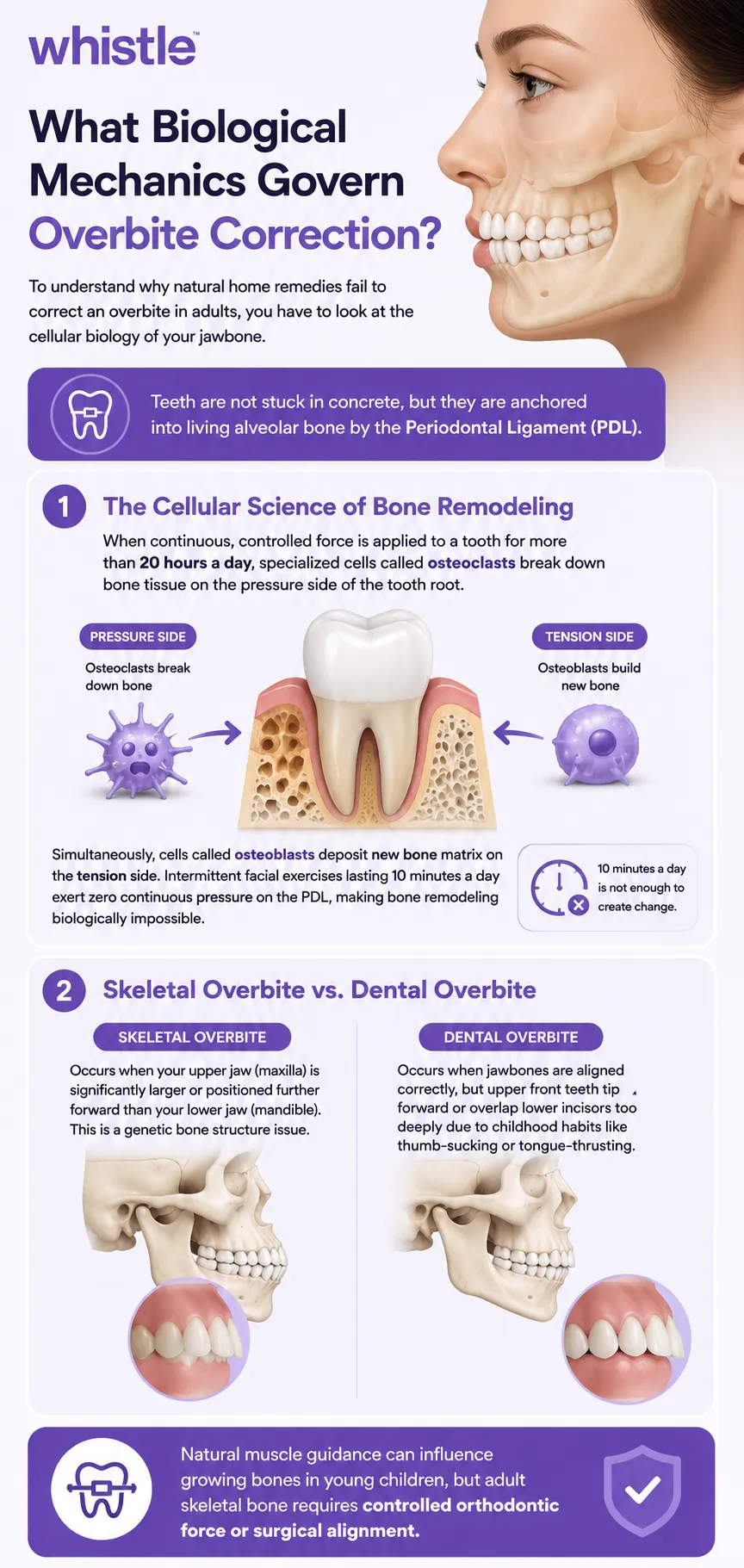
Correcting an overbite requires two critical physiological mechanisms:
1. The Cellular Science of Bone Remodeling
When continuous, controlled force is applied to a tooth for more than 20 hours a day, specialized cells called osteoclasts break down bone tissue on the pressure side of the tooth root. Simultaneously, cells called osteoblasts deposit new bone matrix on the tension side. Intermittent facial exercises lasting 10 minutes a day exert zero continuous pressure on the PDL, making bone remodeling biologically impossible.
2. Skeletal Overbite vs. Dental Overbite
- Skeletal Overbite: Occurs when your upper jaw (maxilla) is significantly larger or positioned further forward than your lower jaw (mandible). This is a genetic bone structure issue.
- Dental Overbite: Occurs when jawbones are aligned correctly, but upper front teeth tip forward or overlap lower incisors too deeply due to childhood habits like thumb-sucking or tongue-thrusting.
Natural muscle guidance can influence growing bones in young children, but adult skeletal bone requires controlled orthodontic force or surgical alignment.
Can an overbite be fixed naturally without braces or aligners?
Honestly, the short answer is no for adults, and a qualified maybe for young children under professional guidance.
In adults, once jaw growth plates (epiphyseal plates) have fused around age 16 to 18, jawbone size and tooth positions are permanently locked. No amount of jaw stretching, gum chewing, or tongue pressing can alter adult bone dimensions or shift tooth root positions.
In children under age 12, early intervention by an orthodontist using myofunctional appliances can guide erupting teeth and encourage lower jaw growth before bone fusion occurs.
The Truth About Fixing an Overbite at Home: Debunking Viral Trends
Social media trends often promise quick, zero-cost jaw transformations. Here is the clinical truth behind popular internet hacks:
1. Mewing (Resting Tongue on the Palate)
Mewing involves pressing your tongue flat against the roof of your mouth to reshape your jawline. While proper tongue posture is healthy for nasal breathing, clinical studies show that adult tongue pressure cannot alter fused jaw bones or reduce an adult overbite.
2. Jaw Exercisers and Chewing Blocks
Rubber chewing devices claim to strengthen jaw muscles and align teeth. In reality, biting down repeatedly on hard rubber tools exerts excessive, uncontrolled vertical force on molars. This frequently leads to acute TMJ disc displacement, severe jaw joint popping, facial muscle spasms, and cracked tooth enamel.
3. Facial Straps and Chin Cups
Wearing elastic chin straps at night cannot pull an overextended upper jaw back or move lower teeth forward in adults.
The Medical Truth Behind Overbite Correction Exercises
To understand what natural fixes can and can't do, you need to know how teeth actually move. It isn't about muscle strength, it's a biological process called bone remodelling.
Here's how it works - When steady pressure is applied to a tooth for more than 20 hours a day, your body responds. On the pressure side, cells called osteoclasts slowly dissolve a tiny amount of bone. On the other side, cells called osteoblasts build new bones to hold the tooth in place. Repeated over months, this is how braces and aligners safely shift teeth through solid jaw bone.
The key word is steady - Jaw exercises for 10 or 15 minutes a day work your facial muscles. They do not touch your teeth or the bone around their roots. Without constant, round-the-clock pressure, bone remodelling cannot happen.
This is why exercises alone can't fix a moderate or severe overbite in an adult. But it doesn't mean natural methods are worthless, it just means they have a specific job.
What Natural Methods Can Actually Do
1. Myofunctional therapy: the most evidence-backed option
Myofunctional therapy is structured exercise for the tongue, lips, and facial muscles. It's done with a trained specialist, an orofacial myologist or a speech-language pathologist. It is not the same as jaw exercises you find on social media.
A proper programme focuses on:
- Where your tongue rests when your mouth is closed
- How you swallow (poor patterns put pressure on your teeth)
- Lip strength and nasal breathing
- Muscle coordination when you chew
What research shows - Myofunctional therapy has real clinical studies behind it. In children and teens, it can reduce overbite relapse after treatment and support better jaw growth. In adults, it works best alongside professional orthodontic treatment, not instead of it. It won't move teeth on its own, but it fixes the muscle habits that caused the overbite and helps stop it coming back.
2. Breaking bad habits: stops things getting worse
Some habits make an overbite worse over time, especially in children. The main ones are thumb-sucking, long-term pacifier use past age 3, and mouth breathing.
Stopping these habits won't reverse an overbite. But it will stop it from getting worse. For children under 7, breaking these habits early can cut down how much treatment they need later. In mild cases, habit-breaking paired with myofunctional therapy can sometimes resolve a developing overbite before it becomes permanent.
3. Tongue posture: low effort, real benefit
4. Jaw exercises: for pain relief, not bite correction
- TMJ tension - An overbite pushes the lower jaw back, which makes the jaw muscles overwork and tighten. Gentle stretches can ease this soreness.
- Joint stiffness - Slow opening and closing movements improve blood flow and reduce clicking or stiffness.
- Headaches - Many people with deep bites get tension headaches from overworked jaw muscles. Regular gentle movement can reduce how often this happens.
Think of jaw exercises as physiotherapy for overbite symptoms, not a fix for the overbite itself.
Also Read:
The Trends to Avoid: Mewing and Chewing Blocks
Two popular trends are worth a direct warning.
Mewing, i.e., pressing your tongue hard against the roof of your mouth to reshape your jaw has some basis in the idea of correct tongue posture for children. But the viral version, where adults apply heavy tongue pressure hoping to reshape bone, has no solid clinical evidence. Done aggressively, it risks uneven pressure on the palate.
Hard rubber chewing blocks are sold as jawline trainers. They can cause serious harm. Repeated heavy biting on a rigid object puts a huge strain on your temporomandibular joints (TMJ). This leads to chronic headaches, jaw clicking, locked jaw, and chipped enamel. Several orthodontic bodies have warned against them.
The problem with both trends isn't the general idea of jaw awareness. It's applying heavy, unguided force without any professional assessment.
Can Children Fix an Overbite Naturally?
This is where the picture changes.
A child's jaw is still growing. It responds to guidance in ways that an adult jaw simply cannot. During this window, several approaches can produce real structural results:
- Growth modification appliances, such as functional appliances or headgear can guide the lower jaw forward to meet the upper jaw. This can intercept a skeletal overbite before it fully sets.
- Myofunctional therapy can fix the muscle habits driving a dental overbite while the jaw is still forming.
- Habit elimination before age 7 can stop a mild overbite from becoming a structural problem at all.
This is why most orthodontic associations recommend a first assessment around age 7. The same overbite that takes 18 months of aligner treatment in an adult might be largely preventable in a 9-year-old.
Once the jaw fully matures usually in the late teens exercise-based changes to bone are no longer possible. At that point, braces or clear aligners are needed.
When You Need Professional Treatment How to correct an overbite safely: Non-surgical orthodontic options
If your overbite is moderate to severe, or if you're an adult, professional treatment is the only way to actually correct the bite, not just manage the symptoms.
| Treatment System | Biological Force Mechanism | Overbite Correction Ability | Aesthetics | Adult Suitability | Risk Level |
| Whistle Clear Aligners | 20+ Hour Continuous Torque + Bite Ramps | Excellent for Mild to Deep Bites | Virtually Invisible | Highly Suitable | Minimal (Doctor-Led) |
| Whistle Self-Ligating Braces | Shape-Memory Archwires + Precision Elastics | Excellent for Complex Skeletal Bites | Subtle Metal / Ceramic | Highly Suitable | Minimal (Doctor-Led) |
| Myofunctional Therapy | Muscle Retraining (No Bone Force) | Supportive Only (Pediatric Growth) | N/A (Exercises) | Low (Supportive Only) | Safe under specialist care |
| DIY Mewing / Chewing Blocks | Uncontrolled Intermittent Biting | ZERO (Clinically Unproven) | None | Unsuitable | HIGH (TMJ & Tooth Damage) |
| Corrective Jaw Surgery | Surgical Bone Realignment | Severe Skeletal Cases | N/A (Surgical) | Suitable for Severe Cases | Surgical Risks |
Whistle clear aligners: mild to moderate overbites
Whistle clear aligners are built to deliver the steady, precise force needed to fix an overbite invisibly and comfortably. Two features make them especially effective for bite correction:
3-layer polyurethane (PU) material - Standard single-layer aligners stretch under biting pressure and lose their grip within weeks. Whistle's multi-layer material holds its shape, so it keeps the right pressure on your teeth throughout your treatment.
Optimised Attachments: Which aid in desired tooth movement as well as retention of aligners.
Built-in bite ramps - For overbite cases, Whistle aligners can be fitted with small ledges behind your upper front teeth. These stop your lower teeth from closing too far, let your back molars come together properly, and help your jaw muscles relax, speeding up correction by up to 33% compared to older aligner plastics.
Whistle self-ligating braces: moderate to severe overbites
For deeper bites, especially those with a skeletal element, Whistle self-ligating braces give more mechanical control with less friction than standard fixed braces. Clear zirconia brackets are available if you want the power of braces without the metal appearance.
TAD(Temporary Anchorage Device): Orthodontic implants that can be used in conjunction with Aligners as well as braces to correct moderate to severe overbite.
When is surgery needed?
For severe skeletal overbites, where the jaw bones are significantly out of position, jaw surgery (orthognathic surgery) may be the only complete solution, usually combined with braces. This isn't common, but it is the right answer in some cases. A Whistle partner orthodontist can tell you whether your case falls into this category after a 3D scan.
Common Mistakes Orthodontists Often See
In clinical practice, orthodontists frequently observe patient mistakes when trying to address an overbite. Here are five common mistakes to avoid:
- Using High-Resistance Chewing Blocks: Biting down hard on commercial jaw exercisers, leading to acute TMJ joint inflammation, ear pain, and cracked enamel.
- Attempting DIY Rubber Band Hacks: Wrapping household elastics around front teeth to pull them back, causing bands to slide into gums and destroy periodontal bone.
- Confusing a Normal Overbite with a Deep Overbite: Panicking over a normal 2 to 3 millimeter upper tooth overlap, which is anatomically healthy and functional.
- Delaying Pediatric Interceptive Care: Waiting until age 18 to seek treatment for a child with severe thumb-sucking habits, missing the window for easy growth guidance.
- Wearing Aligners Less Than 20 Hours Daily: Taking aligners out for extended periods, halting osteoclast bone remodeling and causing treatment tracking failure.
Managing childhood habits to prevent overbite development
- Eliminate Thumb-Sucking by Age 4: Gentle encouragement and behavioral reward charts prevent constant thumb pressure from distorting the upper jaw arch.
- Discontinue Pacifiers Early: Transition children away from pacifiers by 18 to 24 months to support normal palatal development.
- Treat Chronic Nasal Congestion:Treat Chronic Nasal Congestion:tonsils promptly so children do not become chronic mouth breathers.
- Schedule an Orthodontic Check by Age 7: The American Association of Orthodontists recommends an initial orthodontic evaluation by age 7 to catch jaw growth mismatches early.
Final Takeaway
Understanding the biological reality of how to fix an overbite naturally empowers you to avoid dangerous viral trends while seeking safe, proven care. While muscle exercises cannot move adult bone, doctor-supervised orthodontic treatment shifts teeth predictably while protecting your jaw joints.
By choosing doctor-supervised Whistle clear aligners with precision bite ramps or self-ligating braces at a physical Whistle partner clinic, you receive 3D digital scanning, transparent zero-cost EMI plans, and expert orthodontist guidance.
Ready to see how easy non-surgical overbite correction can be? Book a free 3D scan consultation at your nearest Whistle partner clinic today.
Also Read:
Book 3D Teeth Scan
Consult our experts and get a 3D preview of your smile transformation!
How to Fix an Overbite Naturally
Overbite treatment
FAQ's
Q1.Can an overbite be fixed naturally without seeing a professional?
For adults, no. Natural methods like myofunctional therapy, tongue posture work, jaw exercises, and habit-breaking can ease symptoms and stop things getting worse, but they can't move teeth or reposition jaw bone on their own. For children still in the growth phase, early professional intervention can sometimes achieve results that would need full orthodontic treatment later.
Q2.Is mewing a real fix for an overbite?
The core idea of correct tongue posture has some clinical basis for children still developing. But the viral version, where adults apply heavy tongue pressure to reshape bone, has no solid evidence and carries a real risk of TMJ strain.
Q3.Is an overbite just a cosmetic issue?
No. It does affect how your smile looks, but the health consequences are real: early wear on your front teeth, gum damage from lower teeth pressing on the palate, TMJ pain, and tension headaches. Left untreated, moderate to severe overbites tend to get worse.
Q4.How long does overbite treatment take?
Bite correction needs to happen slowly to protect your roots and jaw joints. Most cases take 12 to 24 months. Your Whistle partner doctor will give you an exact timeline at your first scan appointment.
Q5.Will fixing my overbite change my face?
Yes, usually in ways people feel good about. Bringing the lower jaw forward can soften a recessed chin, reduce the look of a short lower face, ease visible jaw muscle tension, and create a more balanced profile overall.
Q6.Does mewing fix an overbite in adults?
No, clinical evidence shows that mewing (tongue posture exercises) cannot reshape adult jawbone or reduce an established overbite in adults once bone growth plates have fused.
Q7.How long does it take to fix an overbite with Whistle clear aligners?
Fixing an overbite with Whistle clear aligners typically takes 12 to 18 months, depending on bite complexity and wearing your aligners for 20 to 22 hours daily.
 Medically Reviewed by Whistle Dental Team
 Medically Reviewed by Whistle Dental Team

 Medically Reviewed by Whistle Dental Team