Extra teeth growing in gums
General Orthodontist

Extra Teeth Growing in Gums: Causes, Symptoms, and Treatment Options

Dr ShreyaMedically Reviewed by Whistle Dental Team
Written by Dr Shreya
· 16 min read
Extra teeth growing in gums, clinically known as hyperdontia, is a dental condition where one or more additional teeth (supernumerary teeth) develop beyond the standard 20 primary baby teeth or 32 permanent adult teeth.

Commonly emerging in the upper jaw between front teeth as a mesiodens, extra teeth in gums can erupt through mucosal tissue or remain deeply impacted within the alveolar bone.

Key Takeaways

  • Clinical Definition of Hyperdontia: Extra teeth growing in gums represent supernumerary teeth exceeding the standard 32 adult or 20 primary teeth, affecting approximately 1 to 4 percent of the population.
  • Most Common Anomaly (Mesiodens): Over half of all extra teeth emerge in the maxillary midline between or palatal to the upper central incisors, frequently presenting as conical or peg-shaped crowns.
  • Diagnostic Precision with 3D CBCT: While routine panoramic X-rays detect presence, 3D Cone Beam Computed Tomography (CBCT) is essential to map exact root relationships, bone thickness, and proximity to nerve canals.
  • Selective Surgical Extraction: Not every extra tooth requires removal; asymptomatic deeply impacted teeth can be monitored, while teeth blocking adult eruption or causing cyst formation require minor surgical extraction.
  • Post-Removal Orthodontic Alignment: Removing an extra tooth eliminates the physical obstruction, but clear aligners or fixed braces are typically required to close resulting gaps and correct neighboring tooth displacement.


Caused primarily by hyperactivity of the dental lamina or genetic predispositions, hyperdontia requires radiographic diagnosis, clinical monitoring, or surgical extraction, often followed by orthodontic alignment with clear aligners to prevent severe dental crowding.

What Is Hyperdontia? (Extra Teeth Growing in Gums)
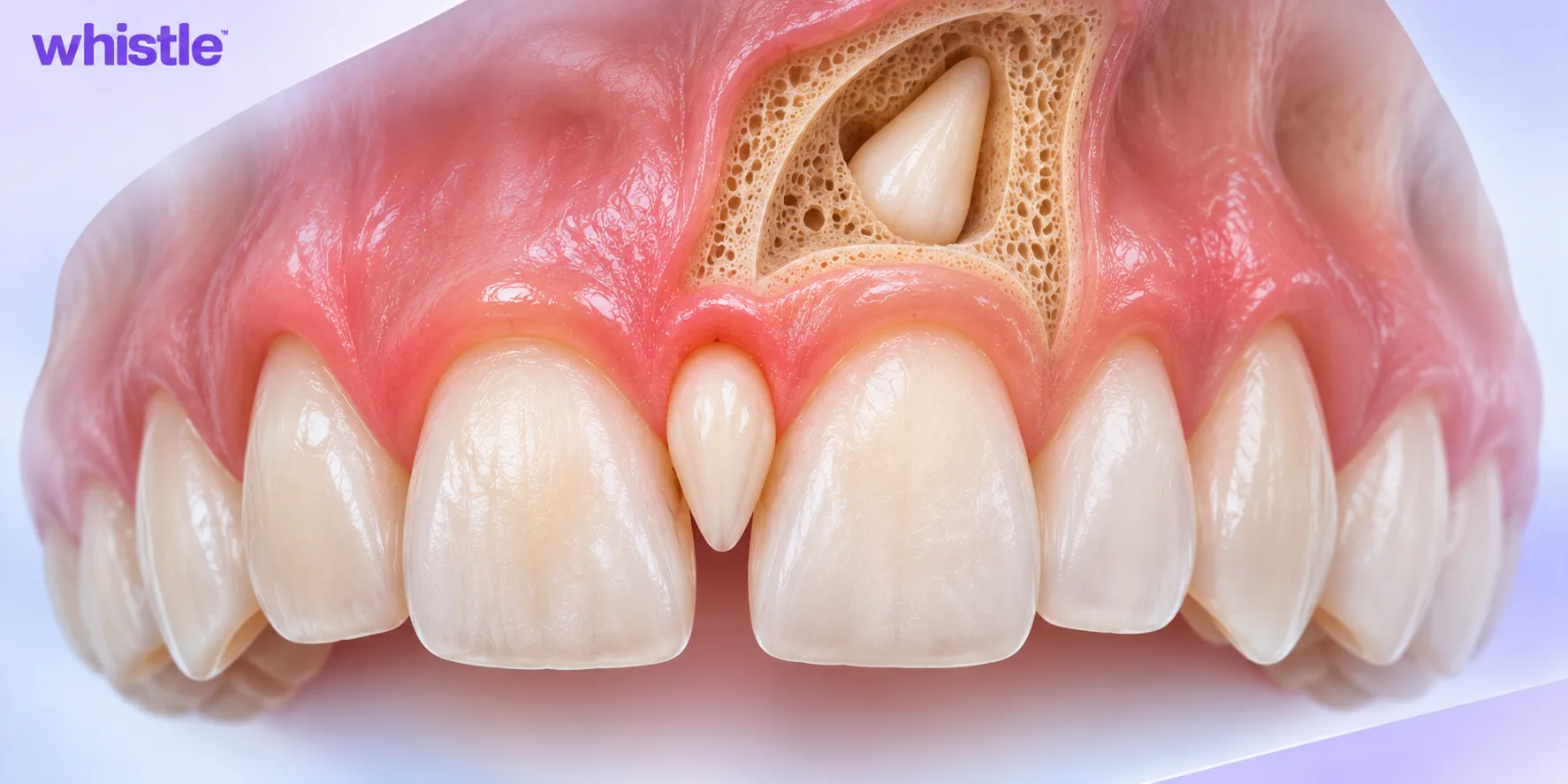
Under normal human dentofacial development, an individual develops two distinct sets of teeth: primary dentition comprising 20 deciduous teeth, followed by permanent dentition comprising 32 adult teeth including wisdom teeth.

Hyperdontia is the clinical classification applied when one or more additional tooth structures form within the jaw arches. The additional teeth themselves are termed supernumerary teeth.


Hyperdontia affects approximately 1 to 4 percent of the global population, demonstrating a male predilection with males affected roughly twice as frequently as females. The condition manifests far more commonly in permanent dentition than in primary baby teeth.

Furthermore, over 90 percent of supernumerary teeth develop in the upper jaw (maxilla), with the anterior incisor region being the most frequent site of presentation.

An extra tooth in gums can exhibit two clinical behaviors: it may successfully pierce the mucosal gum tissue and erupt into the oral cavity, or it can remain completely buried (impacted) inside the jawbone, remaining undetected for years until picked up during routine radiographic screening.

Classification: Types and Anatomical Locations of Extra Teeth

Dental specialists categorize extra teeth by two key attributes: their anatomical position in the dental arch and their anatomical morphology (shape):

Classification by Anatomical Location


  • Mesiodens: The single most common supernumerary tooth, accounting for 50 to 80 percent of all cases. It occurs exclusively in the maxillary midline between or directly behind the two upper central incisors.
  • Paramolar: A supernumerary molar that develops alongside normal maxillary or mandibular molars, typically situated on the buccal (cheek) or lingual (tongue) side.
  • Distomolar (Fourth Molar or Distodens): An extra tooth situated directly behind the third molar (wisdom tooth), usually presenting as a microdontic (undersized) structure.
  • Parapremolar: An additional tooth located within the bicuspid (premolar) region of either jaw, often closely mimicking normal premolar anatomy.


Classification by Crown Morphology


  • Conical (Peg-Shaped): Small, pointed, peg-like teeth that frequently develop fully formed roots. These represent the classic shape of a mesiodens and often displace adjacent central incisors.
  • Tuberculate (Barrel-Shaped): Larger, multi-cusped, barrel-shaped teeth that possess rudimentary roots. They rarely erupt into the mouth and are the primary cause of delayed eruption of normal permanent incisors.
  • Supplemental (Eumorphic): Extra teeth that duplicate the normal anatomical shape, size, and appearance of adjacent natural teeth, most commonly resembling lateral incisors or premolars.
  • Odontoma: A disorganized, hamartomatous dental growth composed of jumbled enamel, dentin, and cementum, categorized as either compound (orderly miniature tooth-like structures) or complex (irregular calcified masses).


Root Causes: Why Do Extra Teeth Grow in the Gums?

While dental embryology continues to investigate the exact genetic pathways, clinical science supports several interrelated etiologies:

  • Hyperactivity of the Dental Lamina: The leading biological explanation is the Dental Lamina Dichotomy Theory. During fetal dental development, localized dental epithelial bands proliferate abnormally or split into two buds, causing an accessory tooth to develop alongside the normal tooth germ.
  • Genetic and Hereditary Predisposition: Hyperdontia frequently displays familial clustering, suggesting autosomal dominant or autosomal recessive inheritance patterns with variable penetrance.
  • Associated Genetic Syndromes: While most extra teeth appear as isolated non-syndromic occurrences, multiple supernumerary teeth are strongly linked to specific congenital and systemic conditions:
  • Cleidocranial Dysplasia (CCD): A rare congenital skeletal condition characterized by absent or hypoplastic clavicles, delayed cranial suture closure, and dozens of impacted supernumerary teeth throughout both jaws.
  • Gardner Syndrome: A genetic condition associated with multiple intestinal polyps, osteomas of the skull and facial bones, epidermal cysts, and multiple impacted supernumerary teeth.
  • Cleft Lip and Palate: Disruption of the embryological dental lamina along the bony alveolar cleft frequently results in missing teeth, duplicate lateral incisors, or supernumerary teeth bordering the surgical cleft.


Clinical Signs and Symptoms of Extra Teeth in Gums


Because many extra teeth remain asymptomatic and hidden beneath intact mucosal tissue, parents and adult patients often overlook their presence. However, when an extra tooth interferes with oral architecture, specific warning signs emerge:

  • Delayed Eruption of Adult Teeth: The most frequent clinical presentation in children aged 6 to 9 is failure of an upper front adult incisor to erupt months after its contralateral partner has appeared.
  • Persistent Over-Retained Baby Teeth: A primary baby tooth that fails to loosen naturally because an underlying supernumerary tooth prevents normal root resorption.
  • Severe Dental Crowding and Rotation: An extra tooth pushes adjacent tooth roots, causing severe crowding, angular tilting, or complete bodily displacement of erupted teeth.
  • Midline Diastema (Unusual Gaps): An unerupted mesiodens wedged between the roots of the upper central incisors forces the teeth apart, creating a stubborn, widening gap.
  • Palpable Gum Bump or Visible Ectopic Crown: A firm, painless protrusion felt on the palate behind the front teeth or an extra crown emerging high above the normal gumline.
  • Dentigerous Cyst Formation: The developmental sac (follicle) surrounding an impacted extra tooth can accumulate fluid, forming an expanding benign cyst that hollows out adjacent jawbone.


Diagnostic Protocol: Detecting Hidden Extra Teeth

Accurately diagnosing extra teeth growing in gums requires progressive diagnostic imaging:

  • Clinical Visual and Palpatory Exam: The dental surgeon inspects mucosal contours and gently palpates the alveolar bone along both the labial and palatal aspects to detect bony bulges.
  • Panoramic Radiography (OPG): A full-jaw 2D screening radiograph that provides a broad overview of tooth numbers, eruption sequences, and generalized jaw architecture.
  • Periapical and Occlusal X-Rays: Targeted intraoral films that reveal localized root anatomy and vertical relationships using the parallax (tube-shift) technique to determine if a tooth lies labially or palatally.
  • 3D Cone Beam Computed Tomography (CBCT): The gold standard in modern surgical planning. CBCT produces high-resolution, three-dimensional spatial cross-sections, revealing the exact millimeter distance between the supernumerary tooth, adjacent permanent roots, cortical bone plates, and the incisive nerve canal.


Management Strategies Across Clinical Scenarios

Clinical ScenarioPresentation & LocationKey Diagnostic FindingPrimary Clinical RiskRecommended Treatment Pathway
Erupted MesiodensVisible extra peg-shaped tooth between upper incisorsCrown visible in oral cavity, causing midline gapSevere crowding, aesthetic compromise, plaque buildupSimple surgical extraction followed by aligner space closure
Impacted Inverted MesiodensBuried upside down in palatal bone above incisorsDiscovered on CBCT, permanent incisor blockedFailure of central incisor eruption, root resorptionSurgical exposure and removal, orthodontic traction of adult tooth
Asymptomatic Deep SupernumeraryDeeply embedded in posterior jaw without crowdingStable on sequential yearly OPGs, no cystic changeSurgical trauma to adjacent roots or inferior alveolar nerveWatchful waiting with annual radiographic monitoring

Treatment Options for Extra Teeth: Extraction vs Monitoring

The management of hyperdontia depends on the patient's biological age, dental development stage, and whether the extra tooth is actively disrupting neighboring structures:

1. Watchful Waiting and Radiographic Monitoring
Not every extra tooth requires immediate surgical removal. If an extra tooth is deeply embedded, completely asymptomatic, poses no risk to adjacent tooth roots, and shows no cystic enlargement on serial radiographs, monitoring is often the safest approach. Removing deeply placed teeth in young children can risk iatrogenic trauma to adjacent developing root apices.

2. Surgical Extraction Protocol
When an extra tooth impedes normal eruption, causes root resorption, promotes cyst formation, or generates aesthetic malocclusion, surgical extraction is indicated. For fully erupted teeth, a straightforward dental extraction under local anesthesia is performed. For impacted or palatally placed supernumerary teeth, an oral surgeon performs minor outpatient surgery, raising a conservative mucoperiosteal flap, removing a minimal window of overlying bone, and gently elevating the tooth.

3. Critical Timing Considerations in Children
Timing extraction in pediatric patients requires careful balance: early extraction (before age 6 or 7) often allows a blocked adult central incisor to erupt spontaneously without needing orthodontic surgery. However, operating too early can damage immature, open root apices of adjacent incisors. A specialist orthodontist evaluates 3D imaging to determine the exact optimal window.

Post-Extraction Orthodontic Alignment with Clear Aligners


Removing a supernumerary tooth eliminates the physical obstacle, but displaced neighboring teeth rarely drift back into correct anatomical alignment on their own. Once healing is complete, orthodontic intervention is essential to close resulting gaps, correct severe dental rotations, and harmonize the dental arch.

For mild to moderate crowding, midline diastemas, and spacing following extra tooth extraction, Whistle Clear Aligners provide an ideal, virtually invisible solution. Custom-engineered using advanced digital dental scans, clear aligners apply gentle, sequential mechanical forces to guide migrated teeth back into their proper positions. Because aligners are completely removable, patients maintain superior gumline hygiene, preventing plaque accumulation around healing surgical sites.

For complex impactions where an adult tooth remains stuck high in the palate, a combined approach is utilized: an oral surgeon places an orthodontic bracket with a delicate gold chain onto the buried adult tooth, and fixed appliances or hybrid aligners gently guide the tooth down into the dental arch.

Not Sure What's Going On in Your Gums?

Extra teeth growing in gums, or hyperdontia, are manageable developmental anomalies that require thoughtful clinical diagnosis and tailored therapy.

Whether identified as an erupted midline mesiodens or a deeply impacted paramolar discovered on a routine X-ray, modern 3D imaging, gentle outpatient surgery, and advanced clear aligner orthodontics ensure complete aesthetic and functional recovery.

By scheduling regular dental checkups and addressing eruption delays early, patients can safeguard their dental health and achieve a beautifully aligned, lifelong smile.

An extra tooth is much easier to manage when it's caught early. Book a 3D teeth scan at a Whistle partner clinic and let an orthodontist take a look.

Also Read:-


Book 3D Teeth Scan

Consult our experts and get a 3D preview of your smile transformation!

I give my consent to receive information about products and services from Whistle, its affiliates and business partners, by telephone / emails / messages, or other digital means.
Tag Cloud

Extra Teeth Growing in Gums

Hyperdontia

FAQ's

Q1.Can adults develop new extra teeth growing in their gums?

No. Extra teeth in adults do not suddenly generate anew. They were formed during early dental development in childhood, but remained impacted and asymptomatic beneath the gumline until shifting bone density, orthodontic tooth movement, or a routine adult X-ray revealed them.

Q2.Is a hard bump on the gum always an extra tooth?

No. A hard gum bump can also be an erupting normal permanent tooth, a wisdom tooth, a benign bony outgrowth (torus), a dental cyst, or an infected gum boil (abscess). A clinical dental examination and X-ray are essential to confirm the diagnosis.

Q3.Is removing an extra tooth from the gums painful?

No. Surgical extractions are performed under effective local anesthesia, ensuring you feel pressure but zero sharp pain during the procedure. Post-operative discomfort and minor swelling are completely normal and easily managed with prescribed anti-inflammatory medications for a few days.

Q4.Is hyperdontia a genetic condition?

Yes, genetics play a significant role. Hyperdontia frequently runs in families, and while most isolated cases occur without systemic disease, multiple extra teeth are strongly correlated with genetic syndromes such as Cleidocranial Dysplasia and Gardner Syndrome.

Q5.At what age should children be screened for extra teeth?

Children should receive their first comprehensive radiographic orthodontic screening around age seven. At this stage, dental specialists can easily spot unerupted mesiodens and plan timely intervention before permanent incisors are blocked.

Q6.What happens if an extra tooth is left untreated in a child?

An untreated extra tooth can block adjacent adult teeth from erupting, force teeth out of alignment, resorb the roots of healthy permanent teeth, or form a fluid-filled dentigerous cyst that damages the surrounding jawbone.

You May Also Like

Orthodontics Isn’t Just About Straight Teeth
General Orthodontist
Dr. Wynne VelazquezMedically Reviewed by Whistle Dental Team

Written by Dr. Wynne Velazquez
Jan 15, 2026 · 5 min read
Read More
What are Buck Teeth?
General Orthodontist
Dr. Wynne VelazquezMedically Reviewed by Whistle Dental Team

Written by Dr. Wynne Velazquez
Oct 31, 2026 · 17 min read
Read More
What Happens If You Keep Delaying Braces or Aligners
General Orthodontist
Dr ShreyaMedically Reviewed by Whistle Dental Team

Written by Dr Shreya
Jan 15, 2026 · 12 min read
Read More
Biting Teeth in Sleep: Causes, Symptoms and Treatments
General Orthodontist
Dr. Priya SwamiMedically Reviewed by Whistle Dental Team

Written by Dr. Priya Swami
Jan 23, 2026 · 8 min read
Read More
treat Crooked Teeth
General Orthodontist
Dr. Priya SwamiMedically Reviewed by Whistle Dental Team

Written by Dr. Priya Swami
Oct 16, 2026 · 21 min read
Read More
How to Reduce Gap Between Teeth Naturally
General Orthodontist
Dr. Wynne VelazquezMedically Reviewed by Whistle Dental Team

Written by Dr. Wynne Velazquez
Aug 01, 2026 · 11 min read
Read More
Overbite vs Deep Bite
General Orthodontist
Dr. Wynne VelazquezMedically Reviewed by Whistle Dental Team
Written by Dr. Wynne Velazquez
Jun 29, 2026 · 24 min read
Read More
What is Crooked Teeth
General Orthodontist
Dr. Priya SwamiMedically Reviewed by Whistle Dental Team

Written by Dr. Priya Swami
Jun 29, 2026 · 21 min read
Read More
Correct Teeth Alignment
General Orthodontist
Dr ShreyaMedically Reviewed by Whistle Dental Team
Written by Dr Shreya
Nov 07, 2026 · 21 min read
Read More
What is teeth gap
General Orthodontist
Dr. Wynne VelazquezMedically Reviewed by Whistle Dental Team
Written by Dr. Wynne Velazquez
Aug 17, 2026 · 18 min read
Read More
TREATMENT FOR ROTATED TEETH
General Orthodontist
Dr. Wynne VelazquezMedically Reviewed by Whistle Dental Team
Written by Dr. Wynne Velazquez
Jun 29, 2026 · 22 min read
Read More
Best Options to Close Teeth Gaps
General Orthodontist
Dr. Priya SwamiMedically Reviewed by Whistle Dental Team
Written by Dr. Priya Swami
Jun 09, 2026 · 12 min read
Read More
Ideal Teeth Alignment
General Orthodontist
Dr. Divya ChawlaMedically Reviewed by Whistle Dental Team
Written by Dr. Divya Chawla
Nov 04, 2026 · 18 min read
Read More
Does Mewing Actually Reshape Your Jaw
General Orthodontist
Dr ShreyaMedically Reviewed by Whistle Dental Team

Written by Dr Shreya
Oct 29, 2026 · 18 min read
Read More
Mouth Ulcers
General Orthodontist
Dr ShreyaMedically Reviewed by Whistle Dental Team

Written by Dr Shreya
Oct 30, 2026 · 18 min read
Read More
How to Cure Mouth Ulcers
General Orthodontist
Dr. Wynne VelazquezMedically Reviewed by Whistle Dental Team

Written by Dr. Wynne Velazquez
Oct 30, 2026 · 22 min read
Read More
Open Bite causes
General Orthodontist
Dr. Wynne VelazquezMedically Reviewed by Whistle Dental Team

Written by Dr. Wynne Velazquez
May 19, 2026 · 10 min read
Read More
Proclined and Retroclined Teeth
General Orthodontist
Dr. Wynne VelazquezMedically Reviewed by Whistle Dental Team

Written by Dr. Wynne Velazquez
Jun 19, 2026 · 19 min read
Read More
Crowded Teeth Problems
General Orthodontist
Dr ShreyaMedically Reviewed by Whistle Dental Team

Written by Dr Shreya
Aug 18, 2026 · 14 min read
Read More
Deep Bite Symptoms
General Orthodontist
Dr ShreyaMedically Reviewed by Whistle Dental Team

Written by Dr Shreya
Jun 11, 2026 · 12 min read
Read More
How to Fix an Overbite Naturally
General Orthodontist
Dr ShreyaMedically Reviewed by Whistle Dental Team
Written by Dr Shreya
Aug 05, 2026 · 21 min read
Read More
Twisted teeth
General Orthodontist
Dr ShreyaMedically Reviewed by Whistle Dental Team

Written by Dr Shreya
Aug 04, 2026 · 19 min read
Read More
uneven smile
General Orthodontist
Dr ShreyaMedically Reviewed by Whistle Dental Team

Written by Dr Shreya
Oct 29, 2026 · 18 min read
Read More
Can Teeth Alignment Affect Speech
General Orthodontist
Dr ShreyaMedically Reviewed by Whistle Dental Team

Written by Dr Shreya
Aug 01, 2026 · 6 min read
Read More
Effect of Improper Alignment of Each Tooth
General Orthodontist
Dr ShreyaMedically Reviewed by Whistle Dental Team

Written by Dr Shreya
Oct 09, 2026 · 19 min read
Read More
Abnormal Eruption of Teeth
General Orthodontist
Dr ShreyaMedically Reviewed by Whistle Dental Team
Written by Dr Shreya
Oct 09, 2026 · 18 min read
Read More
Does Flossing Create Gaps in Teeth
General Orthodontist
Dr ShreyaMedically Reviewed by Whistle Dental Team
Written by Dr Shreya
Oct 12, 2026 · 16 min read
Read More
Perfect Teeth Smile
General Orthodontist
Dr. Wynne VelazquezMedically Reviewed by Whistle Dental Team
Written by Dr. Wynne Velazquez
Nov 03, 2026 · 18 min read
Read More
What Is an Overbite in Teeth
General Orthodontist
Dr. Wynne VelazquezMedically Reviewed by Whistle Dental Team

Written by Dr. Wynne Velazquez
Nov 03, 2026 · 16 min read
Read More
What is an Overbite in Teeth
General Orthodontist
Dr. Wynne VelazquezMedically Reviewed by Whistle Dental Team

Written by Dr. Wynne Velazquez
Oct 03, 2026 · 20 min read
Read More
Mouth Care Procedure
General Orthodontist
Dr ShreyaMedically Reviewed by Whistle Dental Team

Written by Dr Shreya
Nov 02, 2026 · 20 min read
Read More
White Spots on Teeth
General Orthodontist
Dr ShreyaMedically Reviewed by Whistle Dental Team

Written by Dr Shreya
Nov 02, 2026 · 15 min read
Read More
Do Wisdom Teeth Change Face Shape
General Orthodontist
Dr ShreyaMedically Reviewed by Whistle Dental Team

Written by Dr Shreya
Nov 03, 2026 · 17 min read
Read More
Front Teeth Coming Forward
General Orthodontist
Dr. Wynne VelazquezMedically Reviewed by Whistle Dental Team

Written by Dr. Wynne Velazquez
Nov 05, 2026 · 16 min read
Read More
Underbite
General Orthodontist
Dr. Wynne VelazquezMedically Reviewed by Whistle Dental Team

Written by Dr. Wynne Velazquez
Nov 05, 2026 · 18 min read
Read More