
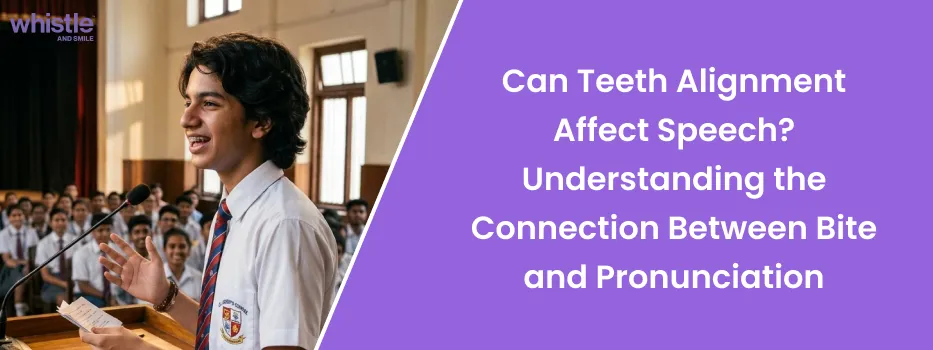
Can Teeth Alignment Affect Speech? Understanding the Connection Between Bite and Pronunciation
 Medically Reviewed by Whistle Dental Team
hink about common speech difficulties. A persistent lisp. Slurred words. A slight whistle when speaking quickly. Most of us assume these are habits from childhood. Many people spend years trying to fix their pronunciation through willpower or speech therapy. They never realize the root cause might be sitting right inside their mouth.
The short answer: yes, teeth alignment can affect speech. When teeth are gapped, crowded, or your bite doesn't close properly, air escapes where it shouldn't. This can cause lisps, whistling sounds, and slurred words. It can even leave your jaw muscles tired after long conversations.
Key Takeaways:
- Teeth alignment plays an important role in speech by controlling airflow and providing proper tongue placement for clear pronunciation.
- Bite issues such as an open bite, overbite, underbite, gaps, and crowding can contribute to lisps, slurred speech, whistling sounds, and jaw fatigue.
- Correcting a structural bite problem with clear aligners or braces can improve speech clarity, reduce speech-related strain, and support better oral function.
- Modern clear aligners may cause only a brief adjustment period, with any temporary speech changes typically improving within a few days as the tongue adapts.
- A professional orthodontic evaluation is essential to identify whether speech difficulties are caused by teeth alignment and to recommend the most suitable treatment option.
Your mouth works like a precise wind instrument. Your lungs push air upward. Your lips, vocal cords, and tongue shape that air into words. And your teeth? They act as the physical walls that direct the airflow. If those walls are out of place, air escapes the wrong way, and your speech changes with it.
Let's look at exactly how this works, and how fixing your bite can clear up your voice.
The Physics of Sound: How Your Tongue Relies on Your Teeth
Try a quick experiment. Say this sentence out loud: "Singing simple songs on Sunday."
Pay attention to your tongue on every "S" sound. Notice how the tip rises up? It hovers just a millimeter away from the back of your top front teeth. This creates a tiny, precise channel. Air is forced out in a sharp, hissing stream.
If your teeth are straight and interlock well, that airflow is tightly controlled. But what if your teeth are crowded, gapped, or pushed too far forward? The air leaks out of the wrong spaces. A sharp "S" turns into a soft, slushy lisp, or a high-pitched whistle.
4 Common Bite Issues and How They Change Your Voice
Different alignment problems change the shape of your mouth's air chamber. Each one causes its own specific speech issue.
1. Open Bite: The Most Common Cause of a Lisp
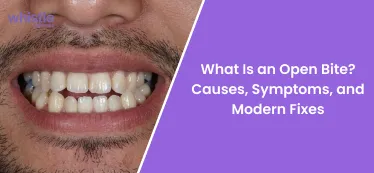
In an open bite, your back teeth touch when you close your mouth. But your front teeth don't meet at all. There's a visible gap right at the front of your smile.
Because of this permanent window, your tongue cannot seal the mouth to block air. People with an open bite almost always develop a structural lisp. "S" and "Z" sounds come out as a soft "Th."
2. Severe Overbite: Why Words Sound Slurred
In a severe overbite, the top front teeth overlap the bottom ones by a large margin. This shrinks the space your tongue has to move inside your lower jaw.
Sounds like T, D, N, L, and R need the tongue to hit precise targets. With less room, the tongue has to stretch unnaturally far. Speech can end up sounding muffled, slurred, or heavy.
3. Underbite: Why F and V Sounds Get Distorted
In an underbite, the lower jaw closes forward to the upper jaw. The lower front teeth sit in front of the upper ones. This flips the normal layout of your mouth.
To pronounce F and V, your lower lip must touch your upper front teeth cleanly. An underbite makes that contact difficult. These letters often sound distorted, or get dropped entirely.
4. Gaps and Crowding: Whistling and Tired Speech
Large gaps between front teeth let air whistle through the spaces. Crowding causes the opposite problem. Severely overlapping teeth can push your tongue backward, changing how your voice sounds and making fast speech feel clumsy or exhausting.
The Hidden Symptom: Speech Fatigue and Jaw Soreness
Can teeth alignment affect speech beyond pronunciation? Absolutely. Many people with a misaligned bite experience speech fatigue.
Their tongue and jaw muscles must work much harder to compensate for poorly placed teeth. So the muscles burn out faster. Does your jaw feel sore, tight, or achy after a long presentation or work call? A misaligned bite may be straining your jaw muscles.
Clinical Safety First: Always Consult an Expert
Changing your teeth alignment changes how your upper and lower jaws fit together. That's why you should never trust your smile to unverified home remedies.
Whistle products are only fitted through certified dental partners. We never sell direct-to-consumer mail-order kits. A blind at-home impression can't examine your jaw joints. It can't take X-rays to check your root health. Getting it wrong can cause irreversible dental damage.
We partner with a network of 2,500+ certified dental clinics. When you choose Whistle, an expert doctor evaluates your facial structure and bite mechanics in person. Then they create a precise, safe treatment plan for your smile, and your voice.
Speak with Clarity and Confidence
Your voice is how you connect with the world. You shouldn't have to struggle with tired jaws, muffled words, or a lisp because of a misaligned bite. When your teeth move into their proper position, your tongue finally gets the space it needs to work, clearly and comfortably.
Take our quick online smile assessment today. Then book a consultation with a certified Whistle partner doctor near you.
Also Read:-
Book 3D Teeth Scan
Consult our experts and get a 3D preview of your smile transformation!
FAQ's
Q1.Will clear aligners give me a lisp when I first wear them?
A brand-new aligner feels like a foreign object to your tongue. This can cause a very mild lisp for the first 24 to 48 hours. But Whistle aligners are ultra-thin, so your tongue adapts quickly. Within a couple of days, your normal speech returns.
Q2.Can fixing my teeth alignment cure a lisp?
If your lisp is structural, caused by an open bite, large gaps, or an overbite letting air escape, correcting your alignment gives your tongue the physical foundation it needs. Many structural lisps improve dramatically or resolve once the gap closes. If the lisp has also become a long-standing muscle habit, a short round of speech therapy afterward helps your tongue learn to use its newly aligned space.
Q3.Can braces fix a lisp?
Yes, when the lisp has a structural cause. Braces can close an open bite, reduce a severe overbite, and correct jaw-level problems that aligners can't always handle. Your orthodontist will tell you whether aligners or braces suit your specific bite.
Q4.Can crooked teeth affect a child's speech development?
Yes. Children learning to speak rely on their emerging teeth to form words. A child with severe crowding or a developing crossbite may form poor tongue habits to compensate. These habits can lead to speech delays or pronunciation issues that follow them into adulthood. Early dental checkups help catch this.
Q5.How long does it take to see speech improvements during treatment?
It varies from person to person. As teeth move into place and gaps close, many people notice their speech feels sharper and takes less effort, often well before treatment is complete. Reduced jaw fatigue is usually one of the first changes people report.
 Medically Reviewed by Whistle Dental Team
 Medically Reviewed by Whistle Dental Team


 Medically Reviewed by Whistle Dental Team