

Front Teeth Coming Forward: Causes, Proclination, and Modern Correction
 Medically Reviewed by Whistle Dental Team
Noticing your front teeth gradually tilting or pushing outward isn’t just a cosmetic annoyance; it’s a real orthodontic change with measurable causes and, in some cases, underlying dental or periodontal issues that deserve attention.
Upper front teeth coming forward is commonly known as overjet or protruding teeth (buck teeth). It can result from genetics, jaw structure, childhood habits, crowded teeth, or shifting after orthodontic treatment.
Treatment depends on the cause and severity. Options include braces, clear aligners, space creation through IPR or extractions, growth-modifying appliances for children, and jaw surgery in severe skeletal cases.
Retainers help maintain the results after treatment. An orthodontist can evaluate your teeth and jaw to recommend the most suitable treatment.
Key Takeaways
- Dynamic Proclination vs Static Overjet: Front teeth coming forward represents active labial tipping or migration of incisors, distinct from static genetic overjet, and can develop at any stage of life.
- The Periodontal Health Prerequisite: In adults, sudden forward tooth flaring is frequently driven by Pathologic Tooth Migration (PTM) from bone loss; active gum infection must be completely stabilized before applying orthodontic forces.
- Habitual and Mechanical Drivers: Unconscious oral habits like tongue thrusting, mouth breathing, missing back support molars (posterior bite collapse), and skipped retainer wear create constant forward forces on front teeth.
- Modern Staged Retraction: Flared incisors can be retracted discreetly using Whistle Clear Aligners paired with composite attachments and gentle Interproximal Reduction (IPR), avoiding invasive surgery in non-skeletal cases.
- Lifelong Dual Retention: Because retracted anterior teeth have a high biological tendency to relapse forward, wearing custom night retainers or bonded lingual wires is essential to preserve long-term alignment.
Treatment involves identifying the root cause, achieving periodontal health, and executing controlled orthodontic retraction using custom clear aligners or fixed braces to guide teeth back into stable bone support under specialist orthodontist supervision.
What Does It Mean When Front Teeth Come Forward?
When patients describe their front teeth coming forward, they are observing an active change in dental position. Orthodontically, this phenomenon encompasses two interrelated clinical concepts: dental proclination and increased overjet.
Dental proclination refers specifically to the labial tipping (outward angling) of the anterior tooth crowns relative to their basal bone housing. In contrast, overjet measures the linear horizontal distance between the cutting edge of the upper incisors and the facial surface of the lower incisors.
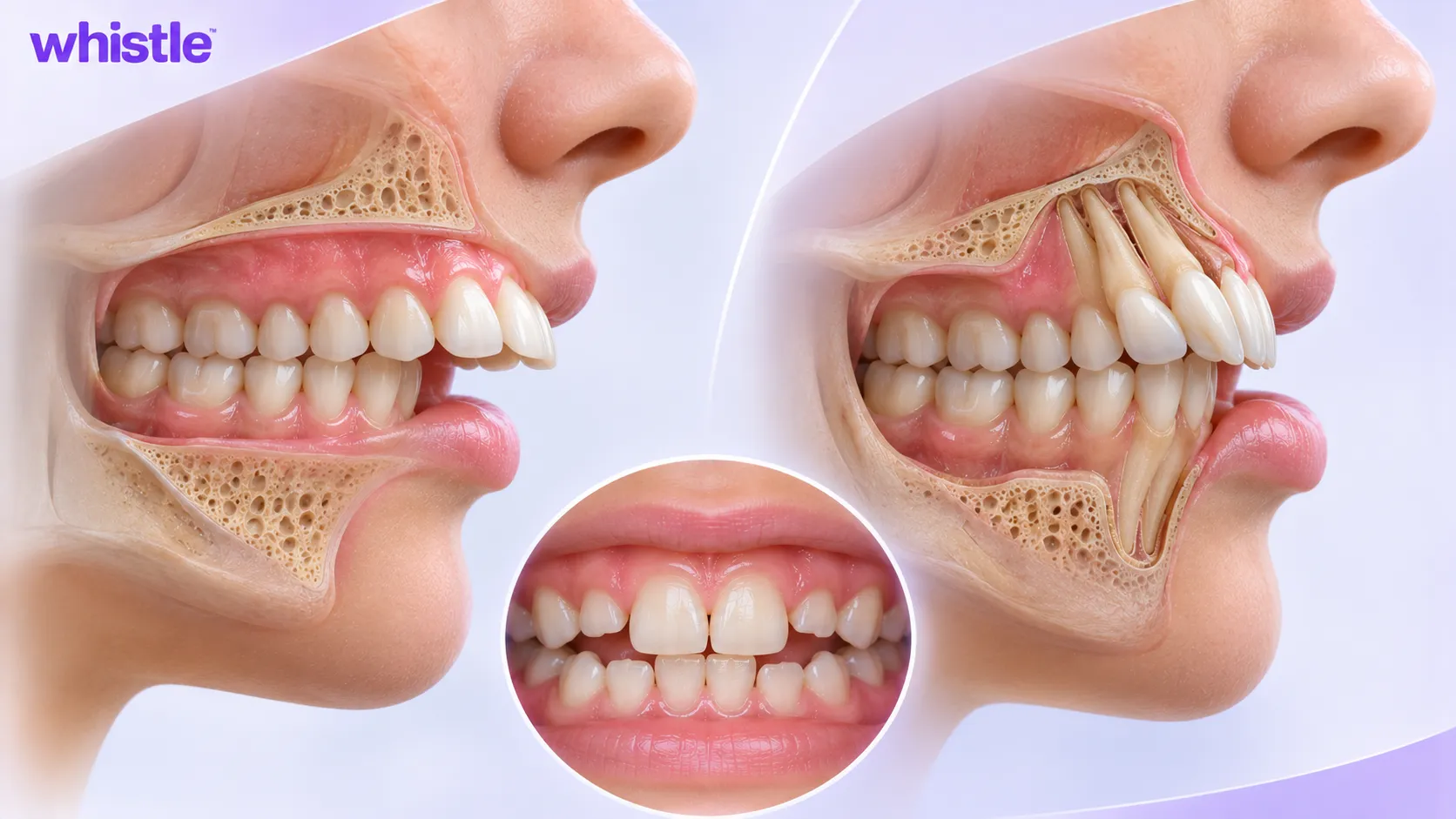
While classic buck teeth usually describe a static Class II skeletal or dental alignment established during early childhood, front teeth coming forward is frequently an active, progressive condition that emerges during adolescence, young adulthood, or later in life.
Understanding this difference is clinically vital. When teeth actively migrate forward in an adult who previously had straight teeth, the shift is rarely a simple cosmetic fluke; it is usually driven by underlying periodontal bone changes, muscular forces, or occlusal instability.
Normal Overjet vs Excessive Dental Flaring:
Primary Causes of Front Teeth Coming Forward Across Life Stages
Unlike static malocclusions, active incisor migration arises from distinct physiological and pathological triggers:
1. Periodontal Gum Disease and Pathologic Tooth Migration (PTM)
In adults aged 30 and older, the primary cause of front teeth suddenly flaring forward and developing new gaps is Pathologic Tooth Migration (PTM). Chronic periodontitis destroys the surrounding periodontal ligament and alveolar bone that anchor the tooth root.
As the bone level drops, the tooth center of resistance shifts toward the root apex. Normal resting pressures from the tongue, which healthy bone easily resists, become overpowering, pushing the weakened tooth forward and outward.
2. Posterior Bite Collapse (Loss of Back Molars)
The human dentition relies on back molars to absorb heavy vertical biting forces. When molars are lost to decay or extraction and never replaced with implants or bridges, the vertical dimension of occlusion collapses. Chewing forces shift entirely onto the front teeth.
Because front incisors are angled and designed only for shearing food, heavy axial loads wedge the upper incisors outward, causing progressive forward flaring and fan-shaped spacing.
3. Oral Myofunctional Imbalances: Tongue Thrusting and Mouth Breathing
The tongue is a remarkably powerful muscular organ, swallowing between 1,200 and 2,000 times each day. In a healthy swallowing pattern, the tongue presses upward against the hard palate. In individuals with a tongue thrust habit, the tongue pushes forward directly against the backs of the front incisors.
Combined with chronic mouth breathing (which drops natural inward lip pressure), this continuous outward force pushes teeth forward over time.
4. Discontinued Retainer Wear (Orthodontic Relapse)
Among adults who had braces or aligners during their teenage years, the most frequent reason for front teeth shifting forward is simply abandoning retainer wear. Periodontal fibers have elastic memory, and natural physiological mesial drift pushes teeth forward throughout life.
Without retainers, previously corrected front teeth gradually relapse into flared positions.
5. Mixed Dentition and the Childhood Ugly Duckling Stage
In children aged 7 to 9, upper front incisors often erupt flared outward with a noticeable gap (diastema). In many cases, this is a normal developmental phenomenon known as Broadbent's Ugly Duckling Stage, caused by unerupted canine crowns pressing against the roots of the incisors.
Once the permanent canines erupt around age 11 to 12, the incisor crowns naturally close and upright, provided childhood habits like thumb-sucking have ceased.
Clinical Health Risks of Untreated Protruding Front Teeth
- Elevated Vulnerability to Dental Trauma and Fractures: Clinical studies establish that children and adults with an overjet greater than 6 mm are three times more likely to fracture, chip, or avulse their front teeth during sports, minor falls, or accidental impacts because the teeth project beyond the protective cushion of the lips.
- Lip Incompetence, Chronic Mouth Breathing, and Xerostomia: Severe protrusion prevents the upper and lower lips from sealing at rest without conscious strain (lip incompetence). This forces chronic mouth breathing, drying out protective saliva and accelerating gum inflammation and enamel decay.
- Masticatory Strain and Temporomandibular Joint (TMJ) Dysfunction: Flared front teeth prevent smooth anterior guidance during chewing, forcing the back teeth to absorb traumatic lateral forces that trigger jaw joint clicking, muscle soreness, and accelerated enamel attrition.
- Aesthetic Convex Facial Profile and Reduced Confidence: Significant front tooth flaring alters lower facial symmetry, protruding the upper lip and creating a convex facial profile that frequently impacts social confidence.
How Orthodontists Plan Tooth Retraction
Correcting front teeth coming forward begins with comprehensive clinical mapping to ensure tooth movement is physiologically safe:
- Periodontal Bone and Sulcus Charting: Before planning any orthodontic movement, the clinician probes periodontal pockets around every tooth. Moving a tooth through active, inflamed periodontitis causes catastrophic, rapid bone loss.
- High-Definition 3D Intraoral Scanning: An optical digital scanner captures the precise 3D spatial alignment of your arches, quantifying overjet, crown tipping, and available arch space without messy impression paste.
- Lateral Cephalometric Radiography: A specialized skull X-ray that measures exact incisor angulation relative to basal jaw structures, confirming whether retraction requires dental tipping, bodily translation, or skeletal guidance.
Treatment Modalities for Protruding Teeth
| Treatment Modality | Primary Mechanism | Clinical Indication | Aesthetic Profile | Specialist Monitoring |
| Whistle Clear Aligners | Staged sequential polymer pressure with composite attachments | Mild to moderate dental flaring, post-braces relapse, adult spacing | Virtually invisible, removable for cleaning and eating | In-person MDS Orthodontist digital tracking every 6 to 8 weeks |
| Fixed Braces with Elastics | Continuous archwire tension with intermaxillary rubber bands | Moderate to severe protrusion, complex torque, significant overjet | Visible metallic or tooth-colored ceramic brackets | Monthly in-person archwire and elastic adjustments |
| Interproximal Reduction (IPR) | Microscopic enamel contouring (0.1-0.3 mm) between contact points | Creating space to retract front teeth without tooth extractions | Invisible, smooth enamel polish preserves natural contours | Administered precisely by licensed orthodontist with calipers |
| Periodontal Stabilization | Ultrasonic scaling, root planing, and antimicrobial therapy | Pathologic tooth migration, bone loss, active pocket bleeding | Therapeutic treatment resolving swollen, bleeding gums | Periodontist clearance required before orthodontic movement |
How to Fix Front Teeth Coming Forward: Modern Treatment Pathways
Correcting protruding teeth requires a coordinated clinical approach that stabilizes supporting tissues before moving teeth backward:
1. Periodontal Therapy and Biological Anchorage Stabilization
If front teeth are migrating due to gum disease, active infection must be eradicated first. Deep scaling and root planing remove subgingival calculus and bacterial endotoxins, allowing gum tissues to reattach and bone levels to stabilize. Once healthy pocket depths are verified, gentle orthodontic forces can be safely introduced.
2. Whistle Clear Aligners: Controlled Bodily Retraction and Torque Control
For mild to moderate dental flaring and orthodontic relapse, Whistle Clear Aligners provide a highly effective, discreet treatment pathway. Custom-engineered through 3D CAD/CAM software, aligners exert gentle, sequential forces that retract flared incisors while controlling root torque.
Tooth-colored composite attachments placed on premolars and canines provide solid mechanical anchors, pulling the front teeth back without tipping roots out of the cortical bone plate.
3. Fixed Braces Paired with Intermaxillary Retraction Elastics
For severe protrusion or cases requiring substantial bite closure, traditional or ceramic fixed braces paired with Class II elastics deliver continuous three-dimensional control. The elastics connect upper front brackets to lower back molars, guiding the upper arch backward while encouraging forward seating of the lower bite.
4. Interproximal Reduction (IPR): Creating Retraction Space
To pull front teeth inward, space must be available in the dental arch. Rather than extracting healthy premolars, orthodontists frequently perform Interproximal Reduction (IPR). Polishing microscopic fractions of enamel between back teeth creates 2 to 4 millimeters of clearance, allowing the front teeth to retract neatly into a smooth, aligned curve.
5. Habit Interception and Myofunctional Therapy
If tongue thrusting or mouth breathing triggered the forward movement, tongue-retraining exercises or myofunctional tongue cribs must be integrated. Unless the muscular habit is corrected, front teeth will inevitably push forward again after appliances are removed.
When to Consult an Orthodontist
- Accelerating Forward Tooth Movement: Noticing teeth tipping outward or new gaps forming over a period of 3 to 6 months signals active bone breakdown or strong muscular pressure requiring immediate triage.
- Tooth Mobility or Spontaneous Bleeding: A front tooth that feels loose, rocks slightly when eating, or bleeds along the gumline demands immediate periodontal evaluation.
- Inability to Close Lips Without Straining: If closing your lips over your front teeth feels tight, strained, or causes dimpling of the chin muscles, professional overjet correction is indicated.
- Routine Pediatric Screening at Age Seven: Early orthodontic screening detects abnormal tongue habits and airway obstructions, preventing minor childhood proclination from developing into severe adult skeletal protrusion.
Ready to Straighten Your Smile? Discover Your Custom Plan with Whistle
Whether your front teeth have shifted from old habits, relapse, or natural change over time, Whistle’s clinically supervised aligner treatment can help retract and stabilize them with a personalized digital plan.
Front teeth coming forward is a dynamic orthodontic condition with clear biological, functional, and periodontal causes.
Whether triggered by adult periodontal bone loss, missing back teeth, persistent tongue thrusting, or neglected retainer wear, protruding teeth can be safely stabilized and retracted.
Also Read:
Book 3D Teeth Scan
Consult our experts and get a 3D preview of your smile transformation!
Front teeth coming forward
Protruding Teeth
FAQ's
Q1.Why are my front teeth suddenly moving forward as an adult?
Sudden movement in adults is often linked to gum disease, a missing back tooth, or discontinued retainer wear, all of which warrant a dental evaluation rather than waiting to see if it stabilises on its own.
Q2.Can front teeth be pulled back without braces?
Yes, clear aligners can retract mild-to-moderate protrusion effectively; more significant cases may need braces with elastics or, rarely, surgery for skeletal causes.
Q3.Is it safe to straighten teeth that have gum disease-related movement?
Orthodontic movement should only begin once gum disease is treated and stabilized by a periodontist; moving teeth through active infection can worsen bone loss.
Q4.How much can aligners retract front teeth?
This varies by case, but most aligner systems can safely retract teeth several millimeters when supported by IPR or extraction space; your orthodontist’s digital plan will show your specific projected movement.
Q5.Will my front teeth shift forward again after treatment?
They can, if a retainer isn’t worn as directed. Long-term, at least part-time, retainer wear is the standard way to prevent relapse indefinitely.



 Medically Reviewed by Whistle Dental Team

 Medically Reviewed by Whistle Dental Team






 Medically Reviewed by Whistle Dental Team