
Improper Teeth Alignment: Causes, Health Effects & Modern Misaligned Teeth Treatment
 Medically Reviewed by Whistle Dental Team
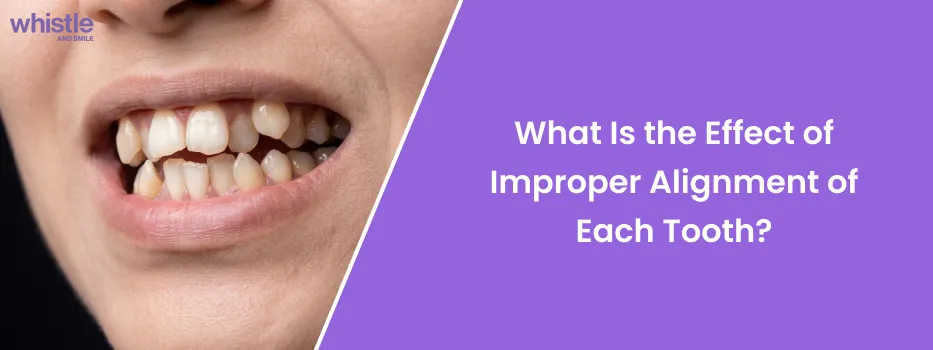
Improper teeth alignment, clinically known as malocclusion (and frequently searched as wrong teeth alignment or mallocusion), is a condition in which the upper and lower teeth do not fit together properly when the mouth is closed. It can include crowded, overlapping, crooked, or protruding teeth and bite problems such as overbite, underbite, and crossbite.
Beyond cosmetic appearance, improper alignment creates tight bacterial traps that trigger gum disease, uneven chewing friction that chips enamel, temporomandibular joint (TMJ) strain causing chronic headaches, and speech lisps.
Key Takeaways
- Biomechanical Disruption: Improper teeth alignment prevents teeth from interlocking properly, concentrating hundreds of pounds of biting force onto isolated teeth instead of spreading pressure evenly across the jaw.
- Tooth-by-Tooth Breakdown: Misaligned front incisors chip and cause speech lisps, twisted canines lose their protective guide rail function, and overloaded back molars suffer micro-cracks and flattened chewing surfaces.
- Hidden Health Complications: Crooked teeth create unreachable plaque traps that accelerate gum disease, chronic bad breath, tooth decay, TMJ jaw clicking, morning tension headaches, and poor digestion.
- Three Recognized Classes: Orthodontists classify alignment into Class 1 (normal jaw bite with crooked teeth), Class 2 (deep overbite or protruding upper teeth), and Class 3 (underbite where lower teeth jut forward).
- Modern Non-Surgical Solutions: Today, digitally planned clear aligners and low-friction self-ligating braces gently guide teeth into harmony, frequently using gentle enamel polishing (IPR) to avoid permanent tooth extractions.
Modern treatment utilizes clear aligners and self-ligating braces to restore long-term oral health without invasive surgery.
What is Improper Teeth Alignment (Malocclusion)?
When you look in the mirror, an overlapping or twisted tooth might seem like a simple cosmetic quirk. However, in orthodontic medicine, tooth alignment is fundamental to your overall oral biology.
Your teeth are engineered to work together like a precision gear system. In an ideal bite, upper front teeth slightly overlap lower front teeth, while upper molars fit neatly into the grooves of lower molars. This balanced contact spreads heavy biting forces evenly across your jawbone.
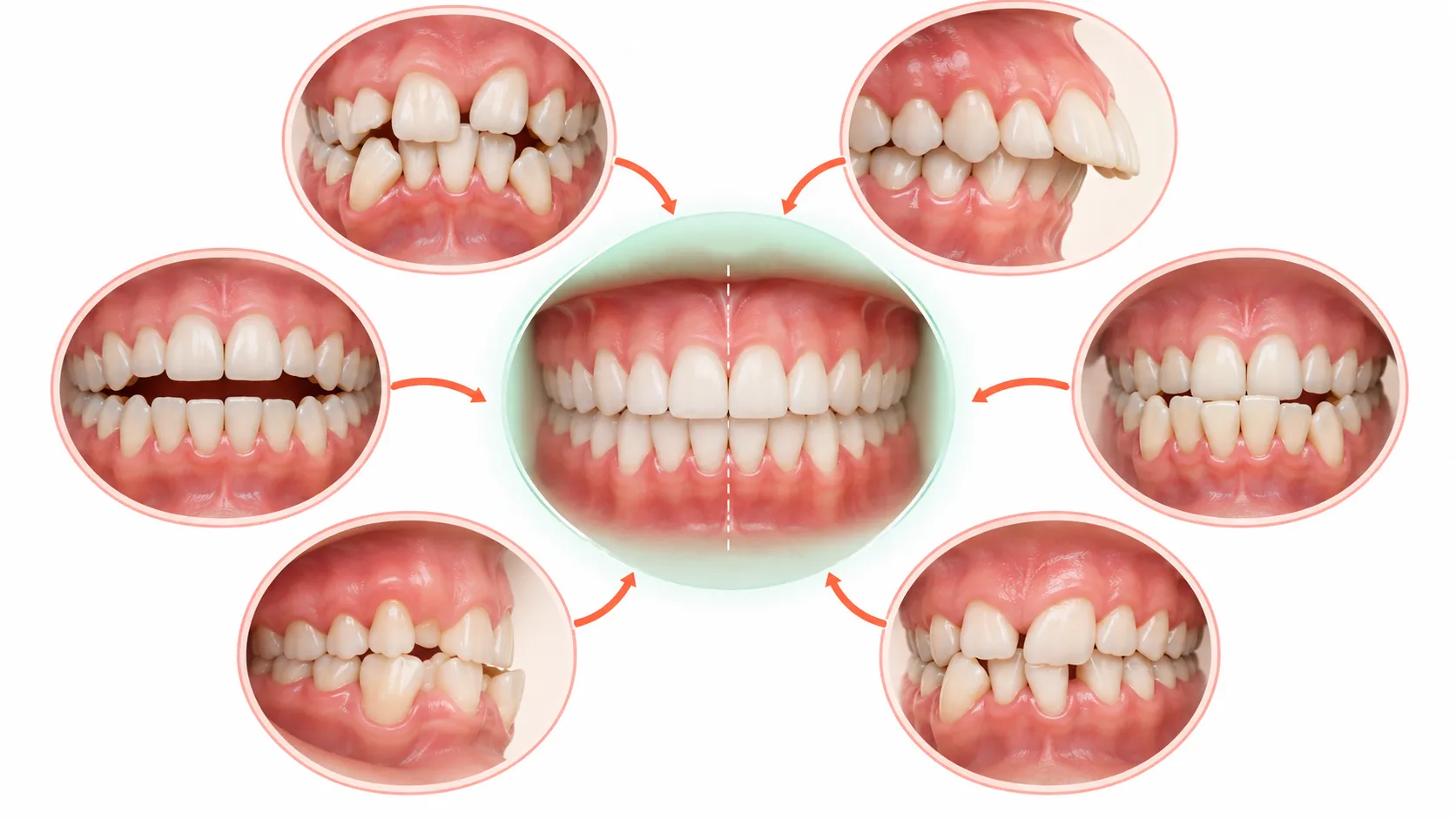
Improper teeth alignment disrupts this mechanical harmony. When teeth are crowded, rotated, or spaced apart, the gears fail to mesh. Just two or three teeth end up absorbing the entire impact of every bite, initiating a slow chain reaction that damages teeth, gums, and jaw joints over time.
The 3 Clinical Classes of Improper Teeth Alignment
Orthodontists classify bite misalignments using Angle's classification system. Knowing which category your bite falls into helps determine your treatment approach:
| Classification | Bite Relationship | Common Visual Signs | Primary Health Impact |
| Class 1 Malocclusion | Normal jaw relationship, but individual teeth are misaligned. | Crowding, overlapping front teeth, tooth rotations, or noticeable spacing gaps. | Plaque accumulation in tight corners, localized enamel chipping, flossing difficulty. |
| Class 2 Malocclusion | Upper jaw and upper teeth sit significantly forward of the lower jaw. | Protruding front teeth (buck teeth), deep overbite, receded or weak-looking chin. | Lower teeth biting into the roof of the mouth, increased risk of front tooth fractures from falls. |
| Class 3 Malocclusion | Lower jaw and lower teeth sit noticeably forward of the upper teeth. | Prominent lower jaw, underbite, edge-to-edge front bite, reverse tooth overlap. | Severe chewing inefficiency, uneven wear on back molars, speech impediments. |
How Misalignment Affects Each Type of Tooth
Every tooth in your mouth has a specific job. A tooth in the wrong position fails at its own job. It also creates problems for its neighbours.
1. Front Incisors (Cutting Teeth)
Your eight incisors are shaped like sharp chisels designed to cut food cleanly. When upper and lower incisors do not meet properly, their thin enamel edges collide unnaturally during speech and chewing.
This leads to micro-cracks, jagged chipping, and premature flattening. Gaps or overlapping incisors also allow air to escape during speech, producing whistling sounds or noticeable lisps.
2. Canines (Corner Guide Rails & Canine Guidance)
Your pointed canines are the sturdiest teeth in your mouth, anchored by exceptionally long roots. In a healthy mouth, they serve as protective guide rails (a biological function called canine guidance). When you slide your jaw sideways, your canines glide against each other, instantly disengaging your back teeth so they do not grind together.
When canines are rotated or pushed out of line, this protective mechanism is lost. Your flat back molars are left exposed to destructive sideways shearing forces that fracture fillings and teeth.
3. Premolars & Molars (Chewing Engines)
Your back teeth do the heavy mechanical work of crushing and grinding food. When upper and lower molars do not interlock neatly, chewing pressure concentrates on isolated tooth cusps rather than spreading across broad surfaces.
This concentrated force causes rapid enamel wear, root fractures, sensitive gumline notches, and muscular tension that travels straight into your jaw joints.
6 Critical Health Complications of Wrong Teeth Alignment
Why Do Teeth Become Misaligned? (Root Causes)
- Genetics and Jaw Size Mismatch: Inheriting a narrow jaw from one parent and wider teeth from the other creates a lack of physical arch space, forcing teeth to overlap as they erupt.
- Childhood Habits: Thumb sucking, prolonged pacifier use past age three, and habitual tongue thrusting push upper front teeth forward and narrow the palate.
- Early Loss of Baby Teeth: When a child loses baby teeth prematurely to decay or injury, adjacent teeth drift into the gap, blocking the path for incoming adult teeth.
- Late Adult Mesial Drift: Throughout adulthood, human teeth have a natural tendency to slowly push forward toward the center of the smile. Combined with natural jaw narrowing over time, this gradual shift often causes lower front teeth to twist and crowd in your twenties and thirties.
Modern Misaligned Teeth Treatment Options
Today, orthodontics offers highly effective, comfortable solutions to correct improper teeth alignment without invasive surgery:
1. Whistle Clear Aligners (Invisible Removable Trays)
Clear aligners are the preferred treatment choice for adults and teens seeking discreet bite correction. Custom-fabricated from advanced 3-layer polyurethane material, Whistle aligners deliver multi-directional, calibrated force vectors. They grip rotated teeth, close gaps, and gently expand the dental arch to align upper and lower teeth up to 33% faster than standard plastic trays.
2. Whistle Self-Ligating Braces (Metal & Zirconia)
For severe bite misalignments involving deep skeletal overbites or crossbites, fixed braces provide exceptional structural control. Whistle self-ligating braces replace elastic rubber ties with a specialized sliding clip mechanism. This reduces friction, allowing teeth to move faster and more comfortably while eliminating plaque-trapping rubber bands.
3. Interproximal Reduction (IPR Enamel Polishing)
IPR is a gentle clinical technique used alongside aligners to relieve crowded misalignment. Your orthodontist carefully polishes microscopic fractions of a millimeter (0.2 to 0.5 mm) from tooth contact points, creating precise space to align teeth without extracting healthy premolars.
4. Arch Expansion
Arch expansion widens a narrow dental arch. By moving teeth outward into a natural, balanced parabolic curve, your orthodontist creates sufficient space for upper and lower teeth to interlock in an ideal bite.
Also Read:
The Fix: Correcting Misalignment Safely
Misaligned teeth (the medical term is malocclusion) should not be left untreated. The complications only grow with time. The good news: modern orthodontics can rebalance your smile comfortably and discreetly.
1. Precision Correction with Whistle Clear Aligners
Does your misalignment involve crowding, gaps, or rotated teeth? Clear aligners offer a highly effective, nearly invisible solution.
At Whistle, we don't just straighten front teeth for looks. Our aligners are engineered to restore proper balance to your entire bite:
- 3-layer material that doesn't quit - Cheap, generic aligner plastics lose their springiness quickly. They fail to move tooth roots effectively. Whistle aligners use a resilient, multi-layered polyurethane material that holds its shape. It applies the gentle, continuous force needed to guide each tooth into exactly the right position.
- Slim and snug - Whistle aligners are custom-fit to your teeth. They hug your smile like a second skin. No metal, no wires, no irritation.
2. Extra Power with Whistle Self-Ligating Braces
Some bite problems are more severe. Think deep overbites or crossbites, where the jaw position itself needs correcting. In these cases, braces may be the recommended route.
- Smoother movement - Whistle Braces use a modern self-ligating design. Built-in doors hold the wire instead of tight elastic bands. This dramatically reduces friction. Your teeth move more smoothly, with fewer tightening appointments.
- Clear, stain-resistant option - Get the structural power of braces without the metal look. Whistle's crystal-clear Zirconia brackets blend into your natural enamel.
What does treatment cost? It varies by how complex your case is. Your Whistle partner doctor will examine your teeth at your first consultation. You'll get a clear treatment plan and pricing, with EMI options available at most partner clinics.
Orthodontist Observation Layer: Common Mistakes Orthodontists Often See
During routine clinical checkups at Whistle partner clinics, orthodontists frequently spot preventable misconceptions about teeth alignment. Here are five observed mistakes:
- Viewing Alignment as Purely Cosmetic: Patients often delay treatment thinking crooked teeth only affect looks, unaware that misalignment causes chronic enamel chipping, gum disease, and TMJ headaches.
- Ignoring Canine Guidance Loss: When misaligned canines lose their protective guide rail function, back molars absorb damaging lateral grinding forces, leading to cracked teeth and worn fillings.
- Relying on Mail-Order DIY Aligners: Moving misaligned teeth without physical clinical exams and 3D X-rays can cause unmonitored force application, resulting in permanent gum recession, root damage, and bite collapse.
- Waiting for Severe Jaw Pain Before Seeking Care: Patients often tolerate morning temple headaches and jaw clicking for years before consulting an orthodontist, allowing joint cartilage to deteriorate.
- Neglecting Post-Treatment Retainer Wear: Teeth have natural elastic memory. Failing to wear custom retainers after alignment allows teeth to drift back into misaligned positions within months.
We partner with a network of 600+ certified dental clinics. When you choose Whistle, an expert doctor physically examines your mouth. They take X-rays and a precise 3D digital scan. Then they build a customized, safe treatment plan for your long-term oral health.
Protect Your Oral Health from the Inside Out
Living with improper teeth alignment puts unnecessary strain on your enamel, gums, and jaw joints every single day. The good news is that modern dental care makes restoring bite harmony gentler, faster, and more discreet than ever before.
At a Whistle partner clinic near you, our experienced orthodontic specialists will:
- Perform a thorough bite evaluation and high-resolution 3D digital intraoral scan.
- Provide an instant 3D smile simulation showing how your teeth and bite will move into alignment.
- Design a personalized treatment plan using clear aligners or modern self-ligating braces.
- Offer transparent clinical pricing with flexible zero-interest monthly EMI assistance.
Protect your oral health and smile with lasting confidence. Book your 3D digital consultation at a Whistle partner clinic near you today.
Also Read:
Book 3D Teeth Scan
Consult our experts and get a 3D preview of your smile transformation!
Effect of Improper Alignment of Each Tooth
Improper Alignment of Tooth
FAQ's
Q1.What problems can misaligned teeth cause?
Misaligned teeth trap plaque in spots a toothbrush can't reach, leading to cavities and gum disease. They put uneven pressure on a few teeth, causing chips, cracks, and worn enamel. They strain your jaw joints, contributing to pain and headaches. They can even affect your speech and chewing.
Q2.Can teeth alignment change on its own as an adult?
Yes. Teeth aren't welded into your jawbone. They sit in living sockets supported by ligaments. As you age, your jawbone gradually loses density, and teeth naturally tend to drift forward. Minor alignment issues in your youth can slowly turn into noticeable crowding or an uneven bite in adulthood.
Q3.How do I know if my jaw clicking is caused by wrong teeth alignment?
If your jaw clicks, pops, or aches primarily while chewing, or if you wake up with jaw stiffness and temple soreness, your bite alignment is likely placing abnormal stress on your jaw joints. An in-person orthodontic evaluation with a 3D digital scan will determine if your bite is the underlying cause.
Q4.Can clear aligners fix a severe bite misalignment?
Whistle clear aligners effectively correct a wide range of issues: crowding, spacing, and mild-to-moderate bite imbalances. For very severe jaw-level misalignments, your Whistle partner orthodontist may recommend self-ligating braces. These provide the extra mechanical support your jaw needs.
Q5.How long does misaligned teeth treatment take?
Most mild to moderate misalignments can be corrected with Whistle clear aligners within 3 to 12 months under consistent daily wear of 22 hours, while complex skeletal cases may take 12 to 18 months with self-ligating braces.
Q6.Can improper teeth alignment cause headaches and neck pain?
Yes. When upper and lower teeth do not fit together in a balanced bite, your chewing muscles must stay in a state of chronic contraction to hold your jaw in position. This constant tension strains your temporomandibular joints (TMJ) and radiates into your temples, face, and neck, triggering frequent tension headaches.
Q7.Do I need to have teeth pulled to fix improper alignment?
In the vast majority of cases, no. Modern orthodontists prioritize non-extraction techniques. Using gentle arch expansion and microscopic enamel polishing (IPR), doctors create the necessary space to align teeth while preserving your full, natural set of teeth.
 Medically Reviewed by Whistle Dental Team
 Medically Reviewed by Whistle Dental Team

 Medically Reviewed by Whistle Dental Team