Abnormal Eruption of Teeth: Causes, Types & Treatment Options
 Medically Reviewed by Whistle Dental Team
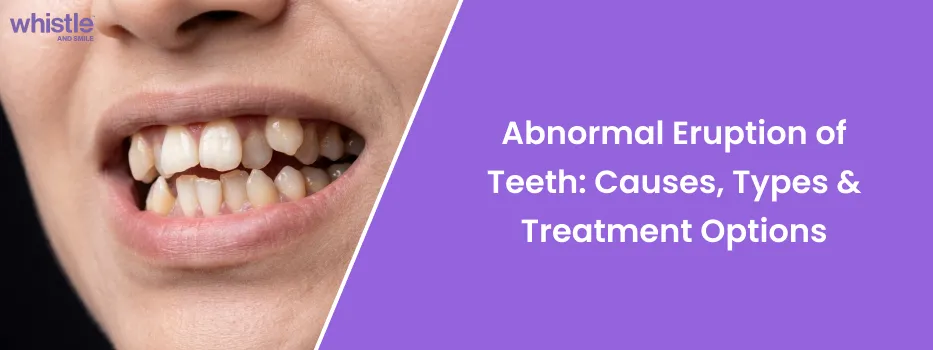
- Biological Disruption: Abnormal eruption occurs when an emerging permanent tooth loses its developmental pathway, appearing twisted, high on the gumline (vampire tooth), or trapped behind baby teeth.
- Root Cause Factors: What causes abnormal eruption of teeth includes genetic jaw-tooth size mismatch, premature loss or stubborn retention of primary teeth, crowded dental arches, and supernumerary (extra) teeth.
- Serious Hidden Risks: Beyond cosmetic disruption, an abnormally erupting tooth can resorb (dissolve) the roots of neighboring healthy teeth, create stubborn bacterial plaque traps, and strain jaw joints.
- Modern Orthodontic Solutions: Abnormal eruption teeth treatment combines early space creation, digitally planned clear aligners, and low-friction braces, sometimes paired with minor surgical exposure to gently pull trapped teeth into position.
- Predictable Recovery Timelines: How long does it take to fix abnormal eruption typically ranges from 6 to 12 months for mild ectopic rotations and 12 to 18+ months for complex impactions or transpositions.
What Is an Abnormal Eruption of Teeth? (The Natural Path Gone Astray)
What Causes Abnormal Eruption of Teeth? (5 Clinical Triggers)
Common Types of Abnormal Tooth Eruption
Abnormal eruption presents in several distinct clinical patterns depending on the trajectory of the misplaced tooth:
| Eruption Pattern | Clinical Description | Common Example | Key Complication |
| Ectopic Eruption | Tooth emerges completely outside its normal arch line. | High upper canine (vampire tooth) protruding above front teeth. | Lip irritation, severe cosmetic concern, adjacent root damage. |
| Lingual or Palatal Eruption | Tooth erupts toward the inside of the mouth (tongue side or roof of mouth). | Lower permanent incisors emerging in a double row behind baby teeth. | Tongue irritation, speech lisps, chronic plaque accumulation. |
| Tooth Transposition | Two adjacent permanent teeth swap biological positions in the arch. | Upper canine erupting in the space reserved for the premolar. | Complex bite interference, challenging root biomechanics. |
| Tooth Rotation | Tooth erupts twisted on its central axis rather than facing forward. | Front incisor turned 90 or 180 degrees sideways. | Food trapping, flossing impossibility, premature enamel chipping. |
| Dental Impaction | Tooth is completely or partially blocked from emerging through gum or bone. | Impacted upper canine or third molar trapped inside jaw. | Cyst formation, resorption of neighboring roots, persistent jaw ache. |
What Causes Teeth to Erupt Abnormally?
Several factors can cause a tooth to lose its way:
- Severe jaw crowding - If your jaw is too small to fit all your permanent teeth, an emerging tooth gets squeezed out of line. It erupts wherever it can find room.
- Premature loss of baby teeth - If a baby tooth is lost too early either through decay or an injury, neighbouring teeth drift into that empty space. They block the pathway for the adult tooth waiting underneath.
- Retained baby teeth - Sometimes a baby tooth simply refuses to fall out on schedule. The adult tooth underneath has no choice but to push out alongside or behind it. This often creates a visible "double row" of teeth.
- Extra teeth (supernumerary teeth) - Some people develop extra teeth inside the jawbone. These act as physical barriers, forcing normal permanent teeth to detour during eruption.
- Genetics and jaw size - Sometimes the jaw and tooth sizes simply don't match, an inherited trait that has nothing to do with habits or hygiene.
What Happens If an Abnormally Erupted Tooth Is Left Untreated?
An abnormal tooth eruption is never just a cosmetic issue. When a tooth emerges out of line, it creates serious functional and biological problems:
- Resorption of Neighboring Roots: An ectopically erupting tooth (especially an upper canine) can press directly against the roots of adjacent front incisors. This pressure can dissolve the root structure of the neighboring tooth, a silent destruction often only spotted on dental X-rays.
- Unreachable Bacterial Traps: Teeth that overlap tightly or erupt behind others create narrow crevices where toothbrushes cannot reach. Sticky plaque and food debris stagnate, triggering cavities between teeth and bleeding gum disease.
- Traumatic Bite Interference: A misplaced tooth strikes opposing teeth at unnatural angles during chewing. This heavy, uneven contact fractures enamel, loosens teeth, and causes facial muscle fatigue.
- Temporomandibular Joint (TMJ) Pain: When your teeth cannot close in harmony, your jaw muscles must twist your lower jaw to achieve contact. This chronic muscle strain leads to jaw joint clicking, ear pain, and morning tension headaches.
How Long Does It Take to Fix Abnormal Eruption?
Treatment timelines vary based on the distance the tooth must travel, bone density, and whether space must be created first:
- Mild Tooth Rotations or Minor Lingual Eruption: 6 to 9 months using clear aligners or localized braces.
- Moderate Ectopic Eruption (e.g., High Canine): 9 to 14 months, allowing time to open arch space, level the tooth vertically, and settle the bite.
- Severe Impactions or Tooth Transpositions: 14 to 20+ months, requiring surgical exposure, careful root torque control, and comprehensive bite coordination.
Also Read:-
Abnormal Eruption Teeth Treatment: Modern Clinical Solutions
- Creating Arch Room First: Before a misplaced tooth can slide into place, aligners gently expand the dental arch or shift adjacent teeth to open a dedicated slot.
- Smart Composite Attachments: Your orthodontist bonds tiny tooth-colored composite buttons onto the misplaced tooth. These serve as biomechanical handles that give the aligner tray the grip needed to untwist, tip, and level the tooth.
- Discreet Lifestyle: Removable for meals, zero dietary restrictions, and effortless to brush and floss.
3. Abnormal Eruption Teeth Braces:
Fixed Biomechanical Control For severe ectopic teeth, transpositions, or teeth trapped high in the bone, fixed braces remain the gold standard
- Continuous 3D Force: Modern self-ligating braces use shape-memory archwires that exert continuous, gentle pressure to guide high canines or palatally placed teeth down into the arch line without excessive friction.
- Surgical Exposure and Traction: If a tooth is completely impacted beneath the gum, an oral surgeon performs a minor, painless procedure to expose the tooth crown and bond a small orthodontic bracket with a delicate gold chain. Your orthodontist then uses braces to gently guide the trapped tooth down into your smile over several months.
Orthodontist Observation: 5 Common Mistakes People Make
1. Waiting for Baby Teeth to Fall Out on Their Own: If an adult tooth is already poking through behind a baby tooth, that baby tooth root has not dissolved properly. Delaying extraction locks the adult tooth in a crowded, misplaced position.
2. Ignoring "High Canines" as Just a Vampire Tooth: Leaving high canines untreated deprives your mouth of canine guidance, leaving your flat back molars vulnerable to destructive sideways chewing wear.
3. Skipping Routine Panoramic X-Rays at Age 7: An OPG X-ray reveals teeth wandering off course years before they attempt to break through the gums, allowing simple interceptive guidance that avoids surgery later.
4. Using Unmonitored Mail-Order Aligners: Attempting to pull an ectopic tooth with DIY mail-order trays without doctor oversight and X-rays can torque roots out of the bone and kill the tooth nerve.
5. Neglecting Post-Treatment Retainers: Abnormally erupted teeth have strong rotational memory in their surrounding periodontal fibers. Wearing nighttime retainers is vital to keep your corrected teeth permanently in line.
Your Next Steps: Guide Your Smile Back into Perfect Harmony
Discovering an abnormally erupted tooth can feel concerning, but with modern orthodontic technology, bringing wandering teeth into a straight, healthy line is predictable and comfortable.
At a Whistle partner clinic near you, our orthodontic team will:
Perform a comprehensive clinical exam and take high-resolution digital X-rays to assess root trajectories.
- Capture a fast 3D intraoral digital scan of your teeth with zero messy putty impressions.
- Design a personalized treatment plan using clear aligners or advanced self-ligating braces.
- Provide transparent clinical guidance with flexible zero-interest monthly EMI assistance.
Protect your oral health and smile with confidence. Book your 3D digital consultation at a Whistle partner clinic near you today.
Take our quick online smile assessment today and book a consultation with a certified Whistle partner clinic near you.
Also Read:-
Book 3D Teeth Scan
Consult our experts and get a 3D preview of your smile transformation!
Abnormal Eruption of Teeth
Tooth Eruption
FAQ's
Q1.Can clear aligners fix an abnormally erupted tooth?
Yes. Clear aligners paired with composite attachments and elastics can successfully treat mild to moderate ectopic teeth, rotated teeth, and teeth that erupted behind the arch. For severe impactions buried in the bone, fixed braces combined with minor surgical exposure are generally recommended.
Q2.Is an abnormal tooth eruption painful?
The eruption itself is not usually painful, though an out-of-place tooth can rub against your lips, tongue, or inner cheeks. Over time, an improperly placed tooth creates uneven biting pressure that can cause sore jaw muscles and enamel sensitivity. Left untreated, the discomfort tends to grow.
Q3.At what age should an abnormal eruption be evaluated?
Q4.Will an abnormally erupted tooth damage neighboring teeth?
Yes, if left untreated. An ectopic tooth growing at an angle can physically press against the root of an adjacent tooth, dissolving its root structure (resorption) and potentially leading to premature tooth loss.
Q5.Do I need surgery to fix an abnormally erupted tooth?
Not always. Many cases respond well to clear aligners or braces alone. Surgery is typically only needed for fully impacted teeth, teeth that are completely buried in the bone and cannot be reached by orthodontic force alone. In those cases, a brief surgical procedure exposes the tooth so a bracket can be attached, then the brace or aligner guides it into position gradually.
 Medically Reviewed by Whistle Dental Team



 Medically Reviewed by Whistle Dental Team






 Medically Reviewed by Whistle Dental Team