
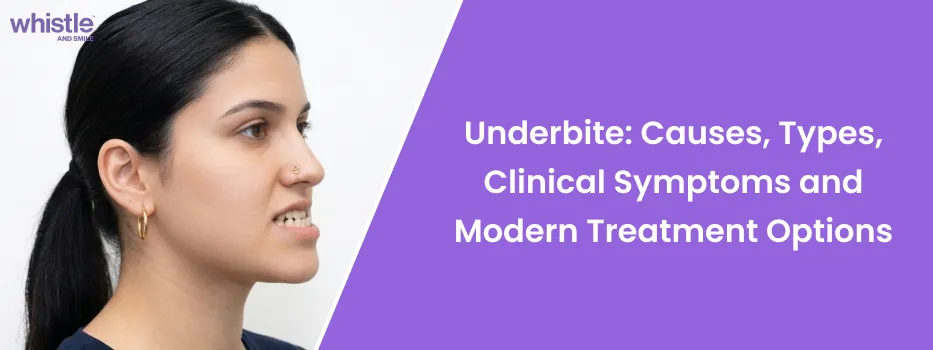
Underbite: Causes, Class III Correction, and Modern Treatment Options
 Medically Reviewed by Whistle Dental Team
An underbite (Class III malocclusion) occurs when the lower front teeth extend beyond the upper front teeth due to differences in tooth alignment or jaw growth. Common causes include genetics, childhood habits, and jaw development differences.
Unlike a normal bite where upper incisors sit roughly 2 to 3 millimeters over the lower incisors, an underbite creates a negative reverse overjet. It develops due to genetics, mandibular overgrowth, maxillary underdevelopment, or childhood oral habits.
- Class III Malocclusion Defined: An underbite occurs when the mandibular teeth extend past the maxillary incisors, producing a negative reverse overjet and altering masticatory function.
- Dental Versus Skeletal Distinction: Dental underbites result from tilted tooth angulation and normal jaw bones, whereas skeletal underbites involve structural discrepancies between the upper and lower jaw bones.
- Early Pediatric Window: Interceptive orthopedic appliances like protraction facemasks and palatal expanders achieve the highest success between ages 6 and 10 while facial bones are still actively growing.
- Clear Aligner Capabilities: Modern orthodontist-supervised clear aligners combined with Class III intermaxillary elastics efficiently resolve mild to moderate dental underbites without conspicuous metal brackets.
- Natural Fix Reality: Natural exercises, jaw posture habits, and DIY hacks cannot reshape adult jawbones or move teeth; verified mechanical orthodontic force or orthognathic surgery is clinically required.
Mild to moderate dental underbites are corrected with orthodontist-supervised clear aligners and Class III elastics, while severe adult skeletal discrepancies require orthognathic corrective surgery.
What Is an Underbite? Edward Angle Class III Malocclusion and Reverse Overjet
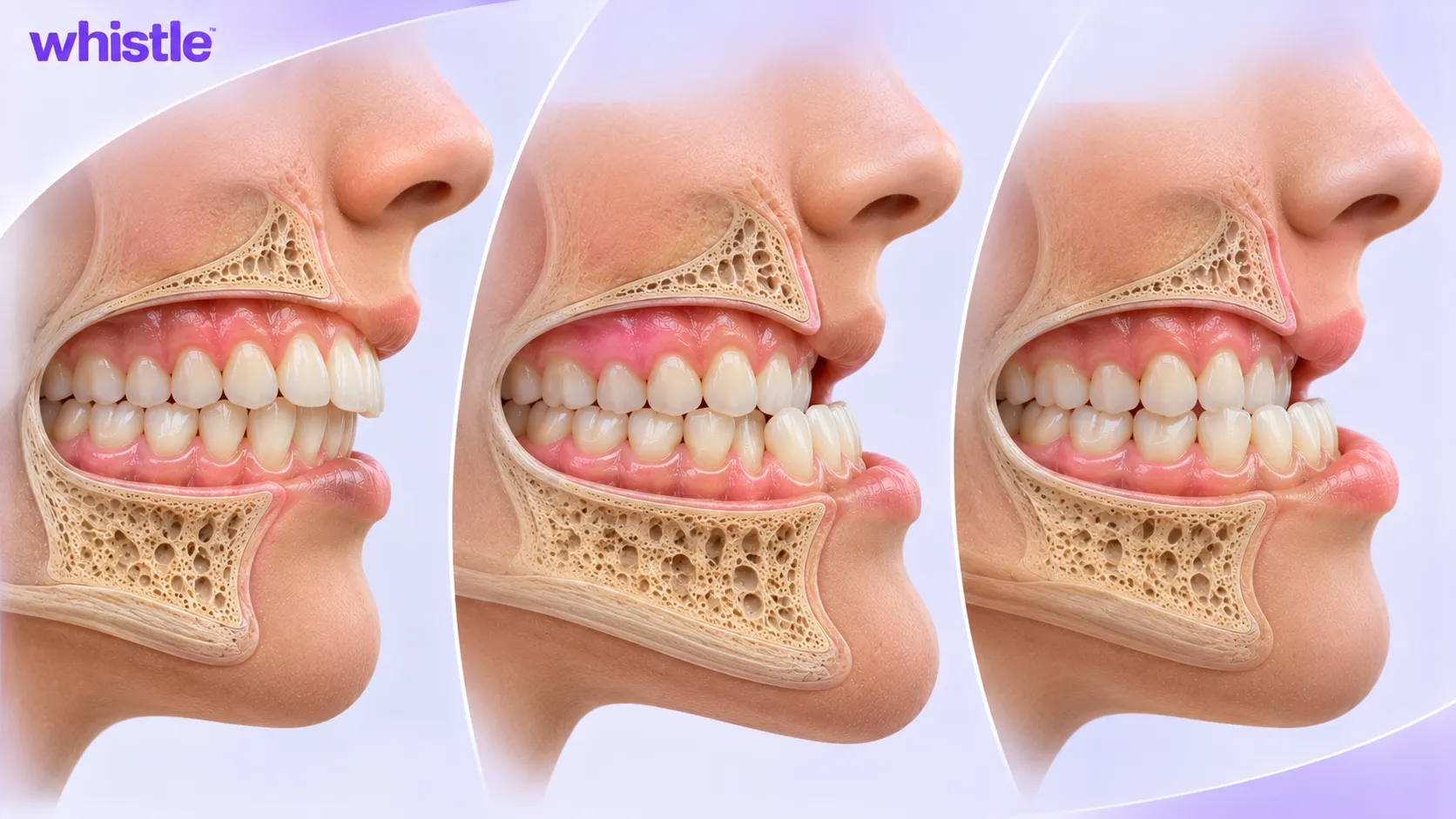
Clinical Types: Dental Underbite versus Skeletal Underbite
- Dental Underbite (Anterior Crossbite): In a dental underbite, the underlying maxillary and mandibular jawbones are completely normal in size, shape, and cranial relationship. The malocclusion arises purely because of improper axial inclination of the incisors. Specifically, the upper front teeth are retroclined (tipped inward toward the tongue) or the lower front teeth are proclined (flared outward toward the lips). The facial soft-tissue profile remains balanced, and the chin does not protrude excessively. These cases respond exceptionally well to clear aligners or fixed braces.
- Skeletal Underbite (Mandibular Prognathism or Maxillary Hypoplasia): A skeletal underbite is caused by a true structural discrepancy between the upper and lower facial skeletons. This may stem from an overgrown or forward-positioned lower jaw (mandibular prognathism), an underdeveloped or retruded upper jaw (maxillary hypoplasia or midface deficiency), or a complex combination of both. Patients exhibit a concave facial profile with a prominent chin and sunken midface cheek contours. Correcting skeletal underbites in adults requires either dental camouflage or combined orthognathic surgery.
Severity Classifications: Mild, Moderate, and Severe
- Mild Underbite: Reverse overjet measures between 0 and negative 2 mm. Typically dental in nature, with little to no disruption of facial balance. Easily addressed with clear aligners.
- Moderate Underbite: Reverse overjet ranges from negative 2 to negative 4 mm. Involves mixed dental and moderate skeletal discrepancies. Successfully treated with comprehensive aligner therapy combined with Class III elastics or fixed braces.
- Severe Underbite: Reverse overjet exceeds negative 4 mm, frequently accompanied by negative ANB skeletal angles. Characterized by pronounced facial concavity and significant functional impairment. Demands surgical-orthodontic collaboration.
Primary Causes and Etiology: Why Does an Underbite Develop?
An underbite develops through a multifactorial interplay of hereditary craniofacial architecture and early environmental growth disruptions:
- Hereditary Craniofacial Genetics: Genetics is the leading primary factor behind Class III skeletal patterns. Jaw size, arch dimensions, and cranial base growth angles are strongly inherited polygenic traits. If one or both parents present with a prominent lower jaw or anterior crossbite, children carry a substantially elevated genetic likelihood of developing an underbite.
- Childhood Oral Habits: Prolonged non-nutritive sucking habits continuing past age three, including extensive thumb sucking, pacifier reliance, and extended bottle feeding, exert prolonged abnormal pressure against developing alveolar bone, causing incisor tipping.
- Tongue Thrust and Atypical Swallowing: An abnormal forward resting tongue posture or persistent tongue thrust during swallowing pushes against the lingual surfaces of the lower front teeth, flaring them forward while depriving the upper arch of lateral expansive tongue pressure.
- Chronic Mouth Breathing and Airway Obstructions: Children with chronically inflamed adenoids, tonsillar hypertrophy, or severe nasal allergies frequently breathe through their mouths. This forces the tongue to drop to the floor of the oral cavity, leading to a constricted, underdeveloped maxillary arch that fails to overlap the mandible.
- Facial Trauma or Congenital Syndromes: Childhood facial trauma affecting mandibular condyles or midface suture lines can trigger asymmetrical or excessive jaw growth. Congenital conditions like cleft lip and palate also restrict maxillary advancement, predisposing patients to severe Class III relationships.
Functional Health Risks of Leaving an Underbite Untreated
An underbite is frequently misunderstood as merely a cosmetic issue. In clinical reality, chronic anterior bite reversal produces cascading mechanical and biological complications across the stomatognathic system:
- Accelerated Enamel Attrition and Chipping: Because incisal edges clash unnaturally during mastication, the protective enamel layer wears down rapidly, exposing sensitive dentin and causing premature tooth fracture and incisal flattening.
- Temporomandibular Joint (TMJ) Strain and Pain: To achieve maximal intercuspation, patients with an underbite chronically posture their jaw forward, placing tremendous unnatural tension on the temporomandibular joints, lateral pterygoid muscles, and articular discs, leading to chronic clicking, headaches, and myofascial pain.
- Masticatory Inefficiency and Gastrointestinal Stress: Inability of anterior teeth to shear food and poor posterior interdigitation prevents thorough food bolus mastication, placing secondary digestive burdens on the gastrointestinal tract.
- Speech Articulation and Enunciation Difficulties: Correct pronunciation of fricative and sibilant consonants, particularly 's', 'z', 'f', and 'v', relies on precise upper incisor to lower lip contact. An underbite causes acoustic distortion, lisps, and vocal fatigue.
- Periodontal Breakdown and Gingival Recession: Traumatic occlusal forces driven against the thin labial cortical bone of the lower anterior incisors frequently induce chronic gingival recession, alveolar bone loss, and tooth mobility.
- Facial Esthetic Concavity and Social Confidence: Severe underbites produce a pronounced lower jaw prominence with a sunken midface profile, which often impacts personal self-esteem and social interactions across adolescence and adult life.
Clinical Orthodontic Examination and Diagnostic Evaluation
Precise diagnosis is foundational to successful correction. Whistle partner orthodontists execute comprehensive diagnostics using three core clinical modalities:
- Digital Cephalometric Radiography and Skeletal Tracing: A lateral cephalometric X-ray allows the orthodontist to measure specific craniofacial angles, notably the SNA angle (maxillary position), SNB angle (mandibular position), and the ANB difference. In Class III patients, the ANB angle is zero or negative. Wits appraisal further validates whether the disharmony is purely skeletal.
- 3D Intraoral Scanning and Centric Bite Registration: Advanced 3D digital intraoral scanners capture micron-accurate virtual impressions of both dental arches, eliminating uncomfortable alginate trays. Clinicians record the bite in centric relation (relaxed jaw) to identify any functional mandibular shifts.
- Dynamic Photographic and Facial Profile Analysis: Standardized clinical photographs evaluate soft-tissue balance, lip competence, nasolabial angle, and chin prominence in resting and smiling views to plan precise tooth positions that complement overall facial harmony.
How to Fix an Underbite: Modern Clinical Treatment Pathways
Clinical interventions for an underbite range from non-invasive tooth alignment to advanced orthopedic and surgical corrections, guided by the patient's skeletal maturity:
- Interceptive Pediatric Orthopedics (Ages 6 to 10): During active childhood growth, skeletal underbites can be intercepted without surgery. A rapid palatal expander (RPE) widens the constricted upper jaw, loosening midfacial sutures. Simultaneously, a reverse-pull protraction facemask applies orthopedic traction to guide the maxillary bone forward and redirect mandibular growth, establishing normal dental overlap.
- Clear Aligner Therapy with Class III Intermaxillary Elastics: For teenagers and adults with mild to moderate dental underbites, custom clear aligners provide an exceptional, discreet solution. Orthodontists design computerized force vectors to procline retruded upper incisors and retrocline lower anterior teeth. Precision precision cuts or bonded attachments allow the patient to wear Class III elastics running from the lower anterior aligner to the upper posterior molar, delivering continuous horizontal traction to seat the bite correctly.
- Comprehensive Fixed Braces and Arch Decompensation: Self-ligating or traditional metal/ceramic braces deliver robust three-dimensional control. They are ideal for moderate to severe cases, allowing precise bodily tooth movement and arch decompensation prior to corrective orthognathic surgery.
- Orthodontic Camouflage and Interproximal Reduction (IPR): In mild to moderate adult skeletal cases where the patient prefers not to undergo surgery, camouflage orthodontics can achieve a functional bite. Interproximal reduction (IPR), the microscopic, painless polishing of contact enamel points between lower teeth, creates 1 to 3 millimeters of space, allowing lower incisors to be retracted behind the upper arch.
- Orthognathic Double-Jaw Surgery (Adults with Severe Discrepancies): In fully grown adults with severe skeletal Class III discrepancies (reverse overjet exceeding 5 mm or severe facial concavity), orthodontics alone cannot bridge the gap. An oral and maxillofacial surgeon performs orthognathic surgery (such as a Le Fort I maxillary advancement, bilateral sagittal split osteotomy mandibular setback, or both). Clear aligners or braces are worn before and after surgery to coordinate the dental arches with the newly positioned jawbones.
Can You Fix an Underbite Naturally?
A common query among patients searching online is how to fix an underbite naturally without braces, aligners, or surgery. It is clinically essential to separate valid preventative habits from dangerous internet fallacies.
- The Pediatric Reality: Habit Interception: In young children under age seven whose bones are malleable, natural myofunctional therapy and habit elimination can prevent a minor dental issue from progressing into a severe malocclusion. Teaching a child proper resting tongue posture against the palate and resolving mouth breathing or tongue thrusting supports natural maxillary expansion. However, this is preventative habit guidance, not active mechanical bone reshaping.
- The Adult Biological Barrier: Once jaw growth plates fuse during late adolescence (ages 16 to 18 in females, 18 to 21 in males), adult jawbones cannot be moved, shortened, or elongated through natural exercises, massage, facial yoga, or mewing. Moving teeth requires controlled cellular bone remodeling, mediated by osteoclasts breaking down bone under pressure and osteoblasts forming bone under tension. Natural exercises exert intermittent, erratic forces that cannot induce physiological remodeling.
- Dangers of DIY Underbite Hacks: Viral online videos advocating chewing on wooden ice-cream sticks, wrapping household rubber bands around front teeth, or aggressively pushing the lower jaw backward with hands pose catastrophic dental risks. These unsanctioned forces can rupture the periodontal ligament, cause severe root resorption, trigger permanent nerve death (pulpal necrosis), and induce irreversible bone loss. Underbites require clinically calibrated, continuous orthopedic or orthodontic force supervised by a licensed dental specialist.
Underbite Treatment Cost in India: Aligners and Braces Price Guide
The investment required to correct an underbite in India depends on the clinical origin (dental versus skeletal), case severity, chosen appliance, and patient age. Educational estimated fee bands include:
- Traditional Metal and Ceramic Braces: Ranges approximately from Rs. 35,000 to Rs. 95,000 depending on bracket tier (conventional metal versus self-ligating ceramic) and case complexity.
- Clear Aligner Treatment: Ranges typically from Rs. 65,000 to Rs. 2,50,000 depending on whether the underbite is mild, moderate, or comprehensive, requiring customized Class III attachments and elastics.
- Interceptive Pediatric Orthopedics: Ranges from Rs. 25,000 to Rs. 60,000 for palatal expansion and protraction facemask therapy during childhood growth stages.
- Orthognathic Surgical Correction: Ranges from Rs. 2,50,000 to Rs. 6,00,000 or more, reflecting combined hospital surgical fees, anesthesiology, inpatient admission, and pre- and post-surgical orthodontics.
Whistle partner dental clinics offer complete financial transparency with detailed clinical fee breakdowns and flexible zero percent interest monthly EMI options, ensuring quality orthodontic treatment remains accessible.
Your Next Steps
Underbite correction demands rigorous clinical oversight and specialist expertise. Whistle, in partnership with Clove Dental across 600+ partner dental clinics nationwide, delivers high-standard orthodontic care supported by over 1,500 experienced dentists and orthodontists.
Every patient undergoes a thorough clinical assessment featuring 3D intraoral optical scanning, digital lateral cephalometric tracing, and customized treatment simulation before an aligner is fabricated. With clinic access in nearly every major city and continuous progress monitoring, patients receive safe, predictable, and medically verified smile transformations.
Book 3D Teeth Scan
Consult our experts and get a 3D preview of your smile transformation!
Underbite
FAQ's
Q1.What is the primary difference between a dental and a skeletal underbite?
A dental underbite is caused strictly by the tilt or position of the teeth (such as retroclined upper front teeth or flared lower teeth) while the upper and lower jawbones are properly aligned. A skeletal underbite occurs when there is a true structural bone mismatch where the lower jaw is overgrown (mandibular prognathism), the upper jaw is underdeveloped (maxillary hypoplasia), or both.
Dental underbites are corrected with clear aligners or braces, whereas severe skeletal underbites in adults often require orthognathic surgery.
Q2.Can you fix an underbite naturally at home?
No, an established underbite cannot be fixed naturally at home. Once childhood jaw growth is complete, jawbones cannot be reshaped and teeth cannot be relocated through jaw exercises, massage, or mewing. Attempting viral DIY hacks like chewing sticks or using household rubber bands can cause irreversible root resorption, tooth loss, and severe gum damage. Safe tooth movement requires biologically calibrated mechanical forces under orthodontic supervision.
Q3.Does an underbite change your facial profile?
Yes, particularly in skeletal underbites. A skeletal Class III malocclusion produces a concave, or scooped, facial profile with a prominent chin and a sunken, flat midface appearance. A purely dental underbite typically preserves a normal facial profile since the underlying jaw bones are correctly proportioned.
Q4.How long does it take to fix an underbite with clear aligners?
For mild to moderate dental underbites, clear aligner treatment typically requires 12 to 20 months of consistent wear (20 to 22 hours daily). Complex cases involving significant lower arch crowding or interproximal reduction (IPR) may extend to 24 months. Total duration depends on case severity and patient compliance with aligners and elastics.
 Medically Reviewed by Whistle Dental Team
 Medically Reviewed by Whistle Dental Team

 Medically Reviewed by Whistle Dental Team