Deep Bite Symptoms That Most People Mistake for Normal Teeth Problems
 Medically Reviewed by Whistle Dental Team
When your teeth feel uncomfortable, it’s easy to guess the cause. A sharp ache usually means a cavity. Bleeding gums tell you to floss more. A sore jaw makes you think you just slept awkwardly or had a stressful day.
We are used to treating these as separate, everyday mouth issues. But what if those chipped tooth edges, persistent morning headaches, and sensitive front teeth are actually connected?
Often, these aren’t random problems at all. They are hidden warning signs of a deep bite.
A deep bite is an alignment issue where your upper front teeth overlap your lower teeth much more than they should. Because it doesn't always look crooked from the outside, millions of adults live with it without realizing it. They spend years treating the individual symptoms, never discovering that their bite architecture is the real culprit.
At Whistle, we design premium orthodontic products to balance your bite and protect your long-term health. Let’s look at how to self-assess for a deep bite at home and uncover five hidden symptoms that most people mistake for ordinary dental issues.
The 60-Second Mirror Test: Is Your Bite Too Deep?
You can check your vertical alignment right now with this quick, three-step mirror test:
- The Squeeze Check: Close your mouth completely and swallow so your back teeth rest together naturally. Don't force your jaw forward.
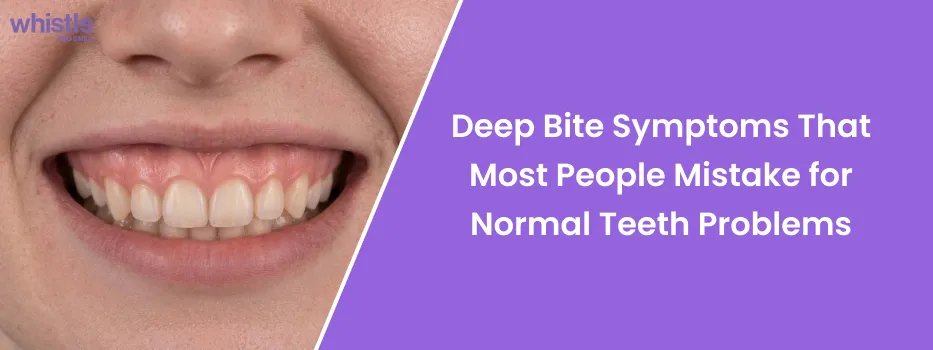
- The Overlap Inspection: Smile as wide as you can in the mirror. Look at your lower front teeth. In a balanced smile, the top teeth should only cover about 20% to 30% of the bottom teeth. If your lower front teeth are more than halfway hidden, or completely invisible, you have a deep bite.
- The Roof-of-Mouth Check: Open slightly and feel behind your top front teeth. If your lower teeth are actually touching the sensitive gum tissue or the roof of your mouth when you bite down, it is a severe deep bite that requires structural correction.
5 Hidden Deep Bite Symptoms You Might Be Misinterpreting
Because a deep bite changes the physical mechanics of how you chew, talk, and swallow, it puts intense, uneven pressure on your mouth. Here are five common problems that are frequently triggered by a deep bite:
1. Front Teeth That Constantly Chip and Flatten
The Mistake: You notice the edges of your front teeth look uneven, chipped, thin, or worn down. You assume it’s just a sign of aging or a bad habit like chewing on ice, pens, or maybe grinding your teeth.
The Deep Bite Reality: When your upper teeth overlap too far vertically, your lower front teeth are forced to slide and scrape against the backs of your upper teeth every time you chew. This constant friction acts like sandpaper, quietly grinding away your protective enamel and causing your teeth to chip and flatten prematurely.
2. Stubborn Cold Sensitivity in Your Front Teeth
The Mistake: Drinking a cold glass of water causes a sharp flash of pain in your front teeth. You assume you have a cavity, are brushing too hard or that you're just using the wrong toothpaste.
The Deep Bite Reality: Because a deep bite causes your teeth to continuously knock against each other at unnatural angles, the enamel on the edges wears away. As this outer shield thins, the sensitive inner layer of the tooth (dentin) becomes exposed, leading to chronic, painful temperature sensitivity.
3. Frequent Morning Headaches and Jaw Fatigue
The Mistake: You wake up with a dull ache in your temples or a stiff, clicking jaw joint (TMJ). You blame a bad pillow, poor sleep, or everyday stress.
The Deep Bite Reality: A deep bite forces your lower jaw backward into an unnatural, cramped position. Your facial muscles have to work overtime just to keep your jaw closed comfortably. This constant muscular strain never lets your jaw joints rest, leading directly to morning tension headaches and facial fatigue.
4. Painful Sores on the Roof of Your Mouth
The Mistake: You develop a painful cut or mouth ulcer right behind your top front teeth. You assume you accidentally scratched yourself with a sharp chip or burned your mouth on hot food.
The Deep Bite Reality: In severe cases, the lower front teeth are so elevated that they physically strike the soft gum tissue behind your upper teeth every time you close your mouth. Over time, this repetitive punching motion strips the delicate gums away, causing chronic sores, irritation, and bleeding.
5. Premature Wrinkling around the Mouth (A "Collapsed" Profile)
The Mistake: You notice the lower third of your face looks shorter, your chin looks deeply recessed, or the corners of your mouth naturally turn downward, making you look older. You assume it's just natural facial aging or genetics.
The Deep Bite Reality: Your teeth act like structural pillars that hold up the height of your face. When a deep bite allows the upper teeth to over-swallow the lower jaw, the vertical distance between your nose and chin collapses. This forces your lips to bunch together tightly, accelerating fine lines and altering your natural facial balance.
Moving Your Teeth with Precision Engineering
Resolving a deep bite requires highly specialized mechanics. To fix the overlap, your treatment must execute two delicate movements at once: it must softly nudge your over-erupted front teeth back down into the jawbone (intrusion), while slightly lifting your back molars downwards (extrusion) to act as natural props that keep the front of your jaw open.
At Whistle, we engineer advanced material solutions designed to manage these complex vertical forces smoothly.
Option A: Whistle Clear Aligners
Option B: Whistle Braces
Advanced Products Meets Professional Care
Fixing a deep bite changes the physical dynamics of your entire jaw. Because the relationship between your teeth and joints is so complex, we do not believe in unsupervised, direct-to-consumer "at-home" aligner treatments. Moving teeth without professional evaluation can severely damage your roots or worsen your jaw pain.
Whistle provides premium orthodontic products. We manufacture world-class, clinically validated materials and partner exclusively with an elite network of over 800+ certified dental clinics and orthodontists. When you choose Whistle, your specific treatment plan is mapped out and physically monitored by a hands-on professional doctor, ensuring a safe, comfortable, and highly successful transformation. Ask your dentist about Whistle products today!
Uncover the Smile You've Been Hiding
Your teeth shouldn't have to work against each other every time you smile or chew. If you are experiencing unexplained jaw pain, sensitive front teeth, or a profile that feels out of balance, a deep bite could be the hidden root cause. Resolving it is an investment that protects your teeth for life.
Take the first step toward lasting comfort and balance today. Head over to our website to take our quick smile assessment and find a certified Whistle partner clinic near you for an expert, hands-on evaluation!
Also Read
Book 3D Teeth Scan
Consult our experts and get a 3D preview of your smile transformation!
deep bite symptoms
deep bite treatment
deep bite correction
FAQ's
Q1.Is a deep bite just a cosmetic issue?
Not at all. While a deep bite certainly changes the balance of your smile and facial profile, it is primarily a functional health issue. Left untreated, the uneven forces can cause permanent enamel wear, chipped teeth, gum recession, chronic TMJ (jaw joint) pain, and severe tension headaches.
Q2.Can a deep bite be corrected in adults?
Yes! While it is easier to guide jaw growth in children, adult teeth can be safely and permanently realigned at any age. Advanced materials like Whistle clear aligners and self-ligating braces are highly effective at leveling an adult deep bite, provided your teeth and gums are healthy.
Q3.How long does it take to fix a deep bite?
Because vertical movements must be executed slowly to protect the tooth roots and jaw joints, deep bite corrections typically take between 12 to 24 months. The exact timeline depends on whether your case is moderate or severe, and will be mapped out precisely by your Whistle partner doctor.
Q4.Will fixing my deep bite change how my face looks?
Yes, in a very positive way. By lifting your back teeth and opening up the front of your bite, orthodontic treatment gently increases the vertical height of your lower face. This relieves the "sunken" or collapsed look around the mouth, balances your chin profile, and provides a more relaxed, youthful jawline.
Q5.Why do my jaw joints click if I have a deep bite?
A deep bite forces your lower jaw to sit too far back in its socket, compressing the delicate cartilage disc inside your temporomandibular joint (TMJ). When you open wide to speak or chew, that compressed disc can pop or click out of place, often causing stiffness, soreness, or muscle spasms over time. Rebalancing your bite helps relieve this joint pressure.

 Medically Reviewed by Whistle Dental Team



 Medically Reviewed by Whistle Dental Team




 Medically Reviewed by Whistle Dental Team