
Buck Teeth: Causes, Effects and How to Fix Them
 Medically Reviewed by Whistle Dental Team
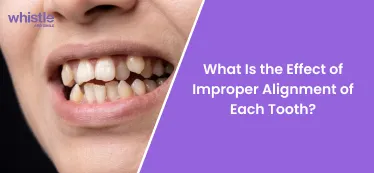
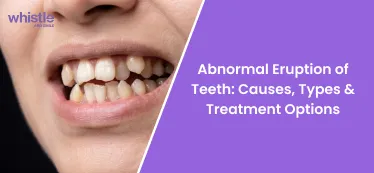
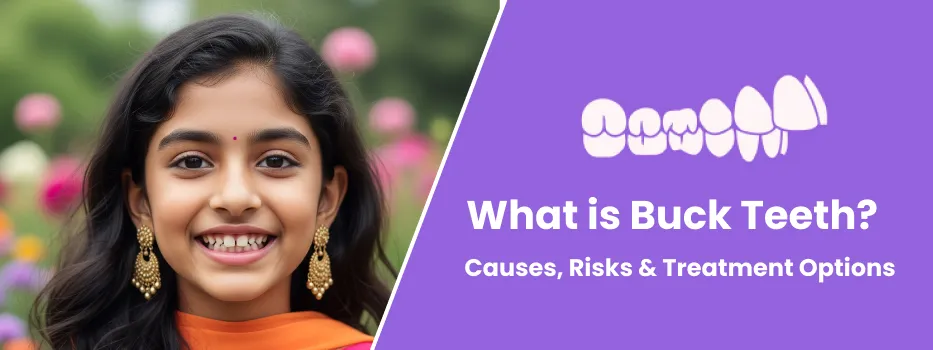
Buck teeth refers to an orthodontic malocclusion clinically classified as an increased overjet (Class II malocclusion), where the upper front incisors project noticeably forward past the lower dental arch.
While an average anatomical overjet measures between 1 and 3 millimeters, severe overjet can exceed 6 to 10 millimeters due to genetics, prolonged childhood thumb sucking, or jaw discrepancies.
Correction involves clear aligners, modern braces, or functional orthopedic appliances managed by an MDS orthodontist across Whistle partner clinics, in partnership with Clove Dental. Early diagnosis prevents dental trauma, speech difficulties, and enamel wear.
Key Takeaways
- Clinical Definition (Overjet): Buck teeth refer to a horizontal outward projection of the upper front teeth, which is distinctly different from a vertical deep bite (overbite).
- Primary Triggers: Skeletal genetics (small lower jaw relative to upper jaw), childhood thumb-sucking past age 3, tongue-thrust swallowing habits, and chronic airway mouth breathing.
- Significant Oral Health Risks: Flared teeth are highly vulnerable to accidental fractures during sports, accelerate dry mouth and gum inflammation, and make full lip closure difficult.
- Invisible Treatment Solutions: Whistle clear aligners gently retract flared incisors using precision 3D CAD-CAM staging, molar distalization, and smart composite attachments without metal wires.
Being called "buck toothed" as a child is a memory many adults carry well into their professional lives. When your front teeth stick out prominently, it is not just an aesthetic insecurity; it physically affects how you speak, how you chew, and even how your lips rest.
Today, modern orthodontics corrects buck teeth seamlessly using doctor-directed clear aligners or low-friction braces. Across 600+ physical Whistle partner clinics nationwide, customized clear aligner treatments range flexibly between Rs. 60,000 and Rs. 2.25 Lakhs with flexible monthly EMI options available.
Buck Teeth Meaning: Decoding the Difference Between Overjet and Overbite
Understanding the true buck tooth meaning requires clarifying common clinical confusion. In popular culture, people frequently conflate overjet and overbite. However, orthodontists measure them along completely distinct spatial dimensions:
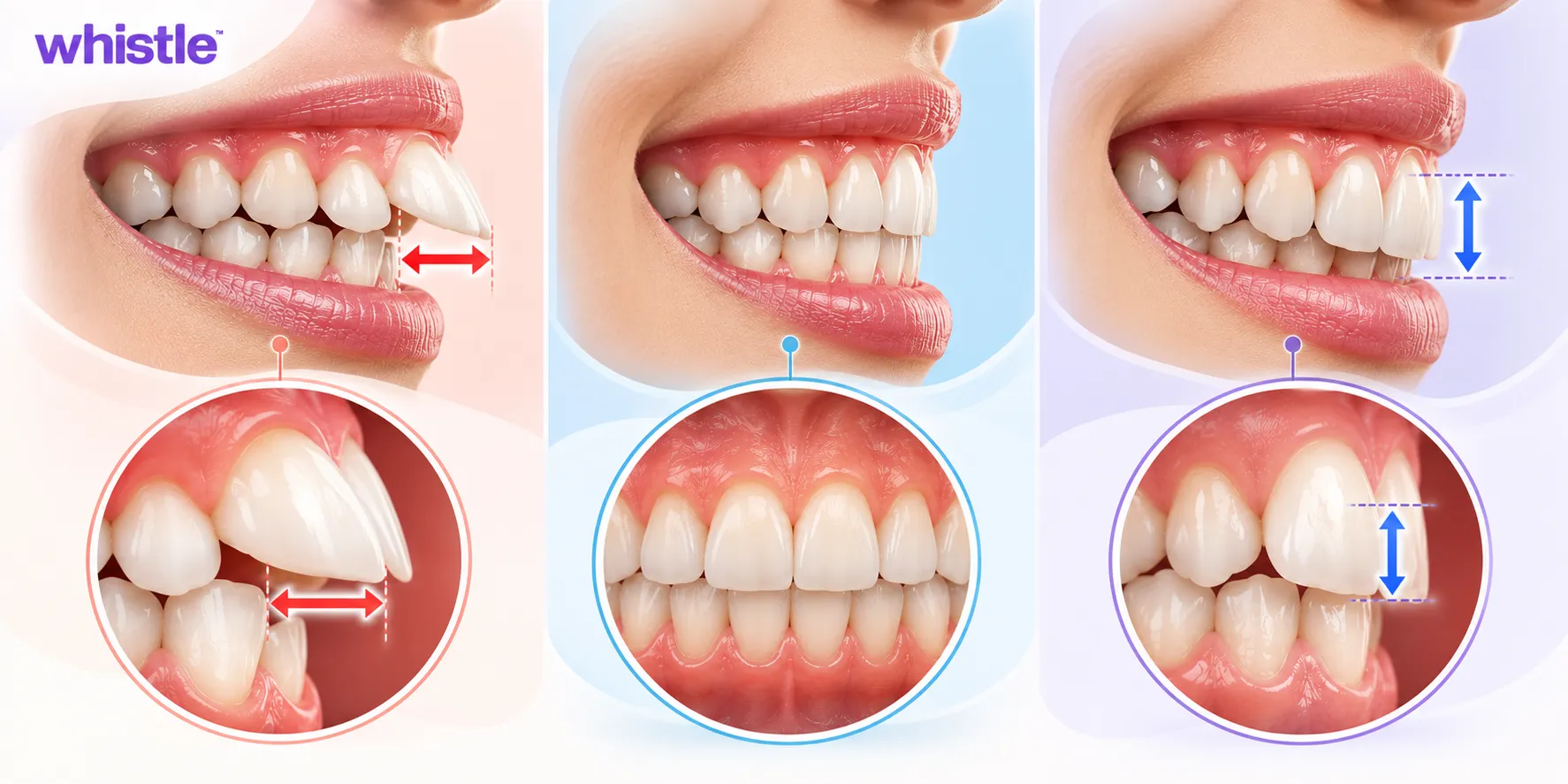
- Overjet (Horizontal Protrusion): This is the clinical definition of buck teeth. Overjet measures the horizontal anterior-posterior distance between the biting edge of the upper central incisors and the facial surface of the lower central incisors. Normal overjet is 1 to 3 millimeters. When this gap exceeds 4 millimeters, upper incisors flare outward.
- Overbite (Vertical Overlap): Overbite measures the vertical distance that the upper front teeth overlap the lower front teeth when biting together. Normal vertical overlap covers approximately one-third of the lower incisors (2 to 4 millimeters). An excessive vertical overlap is termed a deep bite, not buck teeth.
Overjet vs. Overbite: Understanding the Critical Difference
Many patients confuse an overjet with an overbite. Understanding the directional difference helps clarify your orthodontic diagnosis:
| Bite Category | Measurement Plane | Normal Clinical Range | Typical Orthodontic Risk |
| Ideal Normal Occlusion | Balanced horizontal and vertical relationship | Overjet: 1 to 3 mm; Overbite: 2 to 3 mm | Minimal risk; standard periodontal maintenance |
| Increased Overjet (Buck Teeth) | Horizontal plane (Anterior-posterior dimension) | Overjet exceeds 4 mm (can reach 10+ mm) | High risk of incisor trauma, fractured enamel, dry mouth |
| Deep Overbite | Vertical plane (Superior-inferior dimension) | Overbite exceeds 4 mm (covering 50% to 100% of lower teeth) | Palatal soft tissue impingement, severe lower incisor attrition |
What Causes Buck Teeth? Biological and Habit Triggers
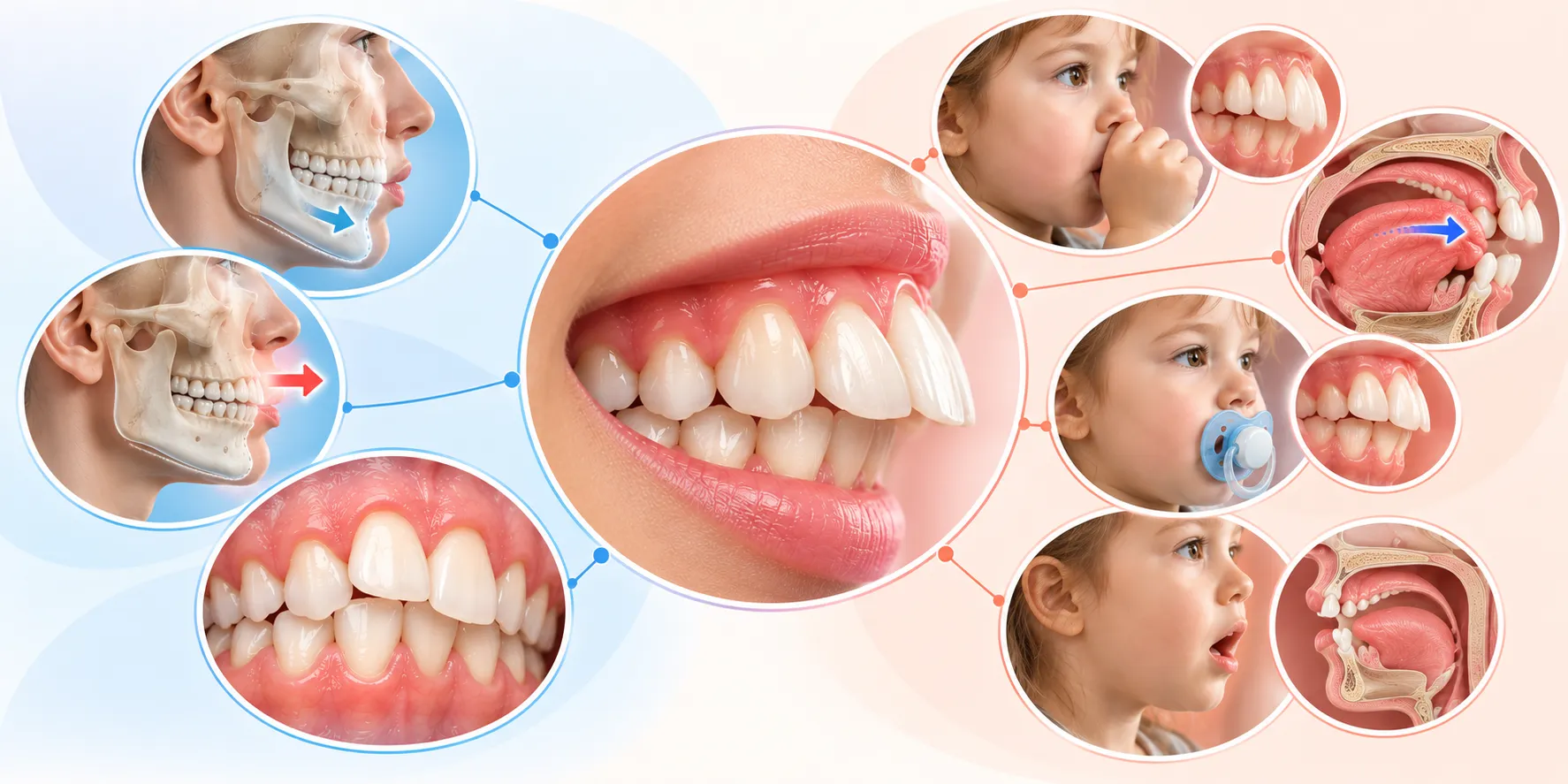
- Mandibular Retrognathism: In many patients, the upper jaw is normal, but the lower jaw (mandible) is genetically underdeveloped or positioned too far back, creating an apparent severe protrusion.
- Maxillary Prognathism: The upper jaw (maxilla) grows excessively forward relative to the cranial base, pushing the entire maxillary arch outward.
- Tooth-to-Jaw Size Discrepancies: Inheriting large teeth from one parent and a small jaw from another forces upper front incisors to flare outward due to crowding.
2. Childhood Oral Habits and Mechanical Pressures
- Prolonged Thumb or Finger Sucking: Sucking habits extending past age 3 place continuous forward pressure on the back of the upper incisors and inward pressure on the lower incisors, widening the horizontal overjet gap.
- Tongue Thrust Swallowing Pattern: During an infantile swallow, the tongue pushes forcefully against the back of the front teeth instead of the palate. Repeating this 1200 to 2000 times daily acts like an orthodontic appliance pushing teeth forward.
- Chronic Pacifier Use: Prolonged pacifier sucking alters the shape of the growing alveolar bone, resulting in both an open bite and flared upper incisors.
- Chronic Mouth Breathing and Airway Obstruction: Enlarged adenoids, chronic allergic rhinitis, or deviated nasal septa force children to breathe through their mouths. This alters resting tongue posture, drops the mandible downward, and causes facial elongation and dental protrusion.
Health Risks of Leaving Buck Teeth Untreated
Beyond cosmetic concerns, living with protruding teeth introduces significant clinical risks:
- High Risk of Dental Trauma & Chipped Teeth: Protruding front teeth are completely unprotected by the lips. In slips, falls, sports collisions, or car bumps, these teeth absorb the direct impact, leading to chipped enamel, fractured crowns, or avulsed (knocked-out) teeth.
- Lip Incompetence & Chronic Mouth Breathing: When teeth project outward, lips cannot seal comfortably at rest. The resulting mouth breathing dries out saliva, which drastically increases the risk of tooth decay, plaque buildup, and chronic bad breath.
- Speech Lisps & Articulation Difficulties: Producing clear phonetic sounds like 'S', 'Z', 'F', and 'V' requires proper contact between the tongue, lower lip, and incisors. An excessive horizontal gap leads to persistent lisps.
- Chewing Fatigue & TMJ Joint Pain: Because front teeth do not meet to shear food, back molars must work twice as hard, leading to jaw joint inflammation, neck stiffness, and headaches.
Single Buck Tooth vs. Bilateral Protrusion
While most cases involve all four upper front incisors flaring outward together, many patients visit our clinics concerned about a single protruding buck tooth. An isolated buck tooth occurs when:
- An individual adult tooth erupts outside the dental arch due to severe localized crowding.
- An extra tooth (supernumerary tooth) or dental cyst in the jawbone physically pushes one root forward.
- Local trauma or unaddressed tongue habits specifically target a single tooth.
Modern clear aligners can isolate and retract a single protruding tooth using targeted CAD-CAM staging without disturbing the alignment of the surrounding healthy teeth.
Modern Treatment Options to Fix Buck Teeth
| Treatment Modality | Best Patient Profile | Mechanism of Correction | Typical Duration | Clinical Key Benefit |
| Clear Aligners (Whistle) | Teens & Adults with mild to moderate overjet (up to 5-6 mm) | Sequential polyurethane trays using attachments, sequential distalization, and Class II intermaxillary elastics | 9 to 18 months | Virtually invisible, removable for hygiene, comfortable, digital treatment simulation |
| Fixed Braces (Ceramic / Metal) | Children, teens, and adults with moderate to severe overjet | Archwires, brackets, and orthopedic intermaxillary elastics to upright and retract incisors | 12 to 24 months | Continuous force application, high biomechanical control for complex multi-plane movements |
| Growth Modification Appliances | Growing children (ages 8 to 12) during pubertal growth spurt | Functional orthopedic appliances (Twin Block, Herbst) that reposition the lower jaw forward | 9 to 14 months | Harnesses natural skeletal growth, potentially avoiding future adult jaw surgery |
| Orthognathic Jaw Surgery | Adults with severe skeletal Class II discrepancies (overjet > 8-10 mm) | Surgical repositioning of the mandible forward (BSSO) combined with pre- and post-surgical orthodontics | 18 to 24 months total | Corrects fundamental skeletal profile and facial balance permanently |
Can Clear Aligners Fix Buck Teeth?
- Sequential Molar Distalization: Aligners systematically shift posterior molars backward one by one into ideal Class I intercuspation, creating space in the dental arch to retract protruding front incisors.
- Precision Composite Attachments: Tooth-colored geometric resin buttons bonded to specific teeth give aligners the purchase needed to apply bodily root torque, preventing incisors from merely tipping backward.
- Integrated Class II Elastics: Precision hooks built directly into aligner trays allow wearing intermaxillary elastics from the upper canines to lower molars, gently guiding the lower jaw forward and upper teeth back.
- Interproximal Reduction (IPR): In cases with mild crowding and flaring, polishing microscopic fractions of a millimeter (0.2 to 0.3 mm) between select teeth releases sufficient arch perimeter to retract incisors safely without extractions.
Orthodontist Observation Layer: 5 Critical Mistakes Buck Teeth Patients Make
- Biting Hard Foods with Protruding Front Teeth: Flared incisors experience high mechanical shear stresses. Biting directly into hard apples, sugarcane, or cracking nuts with front teeth risks fracturing the enamel. Cut firm foods into small pieces and chew with back molars.
- Delaying Treatment Until Accidental Trauma Occurs: Over 30% of children and adults with untreated buck teeth experience accidental dental fractures during sports or falls. Straightening teeth pulls them safely behind the protective lip line.
- Ignoring Ongoing Mouth Breathing Habits: If chronic nasal congestion or mouth breathing caused your front teeth to flare, treating the teeth without addressing the airway will lead to post-treatment relapse. Orthodontists work alongside ENT specialists to ensure clear nasal breathing.
- Skipping Silicone Chewies During Incisor Retraction: Retracting front teeth requires intimate contact between the aligner tray and the tooth surface. Biting on silicone chewies for 3 to 5 minutes daily ensures full force transmission to upright roots.
- Neglecting Post-Treatment Retainers: Flared teeth have strong periodontal elastic memory. Failing to wear custom clear retainers after treatment allows tongue pressure to push teeth back outward.
Symptom and Treatment Triage: Expected Sensations vs Clinical Red Flags
During orthodontic overjet correction, understanding what is normal versus what requires immediate attention ensures a smooth treatment journey:
- Mild Pressure After Tray or Wire Change (Normal: Days 1 to 3): Dull ache or tooth tenderness when biting into solid food indicates that mechanical forces are activating osteoclastic remodeling. Managed with cool liquids and soft foods.
- Temporary Lisp (Normal: Days 1 to 5): Mild difficulty with 's' and 'th' sounds as tongue adapts to aligner trays or bracket volume. Resolves automatically with reading aloud.
- Sharp Poking Wire or Broken Bracket (Requires Clinic Attention): Cover the offending edge with orthodontic relief wax and schedule a partner clinic visit for adjustment.
- Tooth Mobility with Severe Spontaneous Throbbing (Emergency): Significant looseness or throbbing pain without chewing signals possible periodontal or pulpal trauma, requiring immediate clinical evaluation.
Your Next Steps
You do not have to live with the physical risks and aesthetic frustrations of protruding front teeth. Whether your overjet requires the discreet, targeted retraction power of Whistle clear aligners, or a more comprehensive approach to balance your jaw, modern orthodontics provides a clear path forward.
Stop hiding your smile and start protecting your teeth from future trauma. Book a free Smile Assessment at your nearest Whistle Partner clinic today to receive a personalized, 3D treatment plan.
Also Read:-
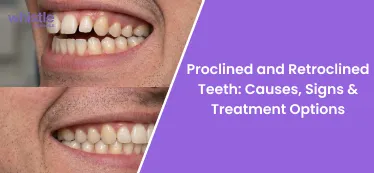
- Proclined and Retroclined Teeth: Causes, Effects & Treatment
- Correct Teeth Alignment
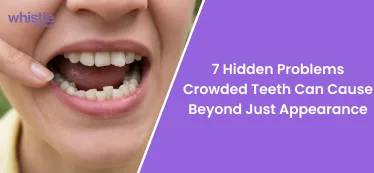
- Crowded Teeth Problems
- Effects of Improper Teeth Alignment
Book 3D Teeth Scan
Consult our experts and get a 3D preview of your smile transformation!
Buck teeth
buch teeth causes
buck teeth treatments
FAQ's
Q1.Can clear aligners fix severe buck teeth?
Yes, Whistle clear aligners are highly effective at treating mild to moderate overjet (buck teeth) by gently retracting the flared incisors. However, if the protrusion is caused by a massive skeletal jaw mismatch, jaw surgery combined with aligners or braces may be required.
Q2.Will my buck teeth get worse as I age?
Yes, untreated protruding teeth can worsen over time. A natural phenomenon called mesial drift (the natural forward shift of teeth as we age) combined with the constant outward pressure of your tongue can cause the teeth to flare even further forward in adulthood.
Q3.Is it painful to push buck teeth backward?
Moving teeth always involves a dull, aching pressure for the first few days of wearing a new aligner tray. However, because the movement is microscopic and highly controlled, the discomfort is entirely manageable and fades quickly as the teeth adapt.
Q4.Why do my protruding teeth make my gums bleed?
People with significant overjet often cannot close their lips comfortably, leading to chronic mouth breathing. This dries out the saliva that naturally washes away plaque, drastically increasing the accumulation of bacteria that causes periodontal disease (bleeding gums).
Q5.How long does it take to fix buck teeth with aligners?
For minor to moderate cases, patients often see significant retraction of their front teeth within 8 to 18 months of consistent Whistle clear aligner wear. Complex cases requiring significant bite correction will take longer.
Q6.What is buck teeth and how does it happen?
Buck teeth (clinically known as an overjet) is an orthodontic condition where the upper front teeth stick out horizontally past the lower teeth. It is caused by inherited jaw size discrepancies, prolonged childhood thumb-sucking, tongue thrusting, or chronic mouth breathing.
Q7.Will fixing buck teeth change my facial appearance?
Yes. Retracting protruding front teeth allows your upper and lower lips to close naturally without strain, softens harsh facial profiles, balances the chin, and significantly enhances smile aesthetics.
Q8.What is the difference between buck teeth (overjet) and a deep bite (overbite)?
An overjet refers to horizontal front-to-back projection where upper teeth stick forward away from lower teeth. An overbite refers to vertical overlap where top teeth overlap downwards and cover the bottom teeth.
Q9.Can buck teeth be fixed without braces or surgery?
Yes. Mild to moderate buck teeth can be successfully treated with custom clear aligners. By using precision composite attachments and intermaxillary elastics, aligners gradually retract protruding teeth without metal wires or surgical intervention.


 Medically Reviewed by Whistle Dental Team

 Medically Reviewed by Whistle Dental Team




 Medically Reviewed by Whistle Dental Team