

Perfect Teeth Smile: Golden Proportions, Beautiful Teeth Shapes & Smile Design
 Medically Reviewed by Whistle Dental Team
- Consonant Smile Arc Is Essential: The biting edges of your upper front teeth should follow the natural upward curve of your lower lip, creating a youthful and harmonious smile curve.
- Teeth Shape Determines Personality: From square and oval to triangular profiles, finding a beautiful teeth shape depends on matching tooth line angles to your unique facial geometry.
- The Golden Proportion Guideline: Aesthetic dentists use geometric ratios (1.618 to 1 to 0.618) to ensure front teeth look naturally balanced in perspective without appearing oversized.
- Non-Invasive Alignment Beats Invasive Shaving: Modern clear aligners move natural teeth into ideal symmetry, avoiding the permanent enamel destruction required by aggressive porcelain veneers.
- Healthy Gums Frame the Smile: Balanced pink gum architecture with 1mm to 3mm of display frames your teeth, while excessive display or uneven scalloping disrupts overall smile aesthetics.
What Scientifically Makes a Perfect Teeth Smile?
When you see a captivating, natural smile on camera or across a room, your brain registers beauty in fractions of a second. But what actually creates that visual appeal? In aesthetic orthodontics and cosmetic dentistry, a perfect teeth smile is not about artificial, blindingly white chiclet teeth lined up like piano keys. True smile beauty is governed by facial harmony, anatomical proportion, and biological balance.
A smile must complement your unique facial features, your lips, your age, and your jawline. When dentists plan a personalized smile design, they evaluate eight distinct anatomical pillars to ensure every tooth looks vital, balanced, and effortlessly natural.
Visual Anatomy: 8 Things That Make a Smile Look Beautiful
A beautiful smile is not just about having straight, white teeth. The way your teeth line up, how much gum shows, the shape of your teeth, and how your smile fits with your face all matter.
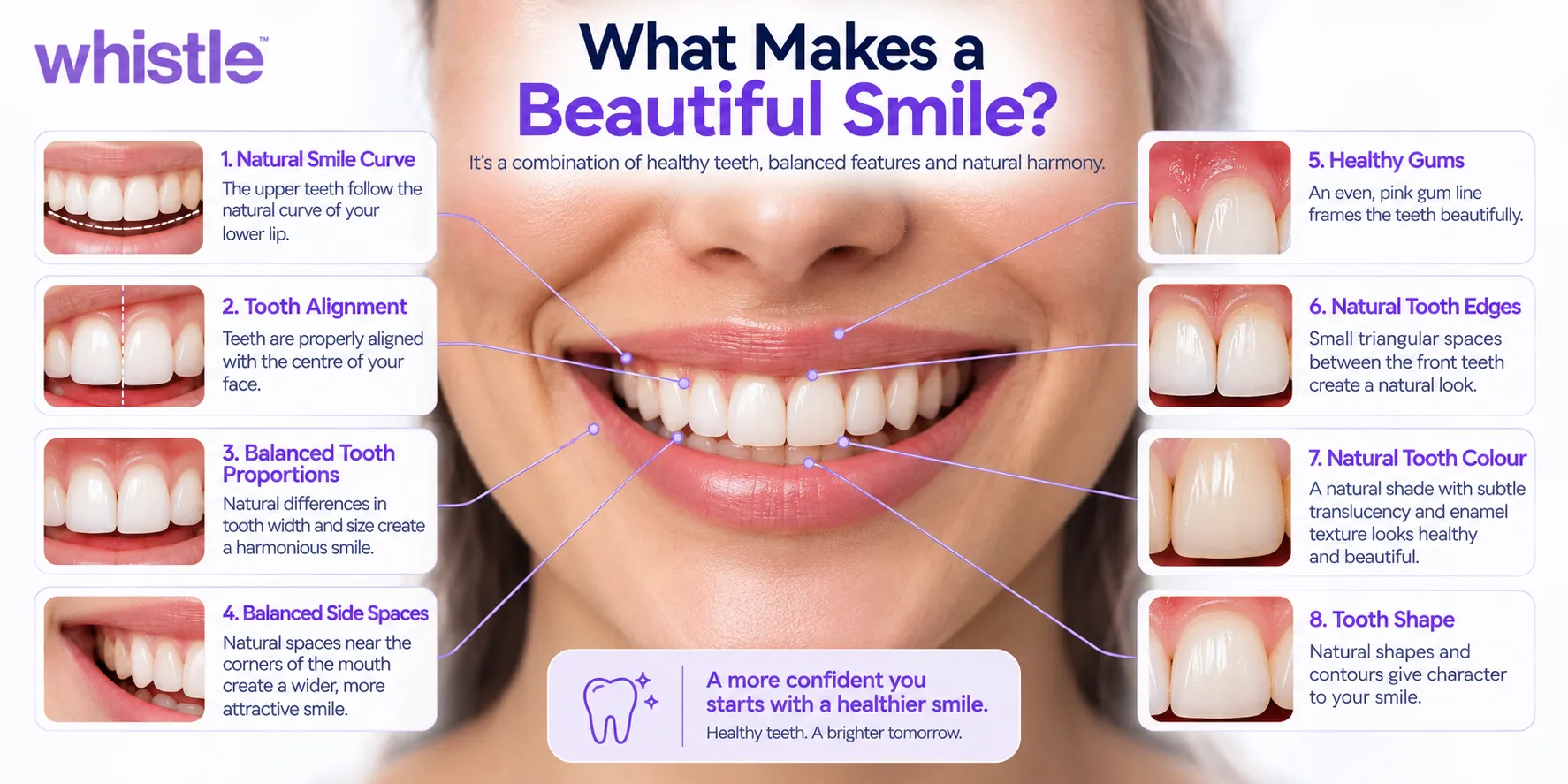
Dentists look at several of these details when planning a smile makeover. Here are eight important features that can make a smile look natural and attractive.
1. A Natural Smile Curve
When you smile, the edges of your upper front teeth should follow the natural curve of your lower lip. This creates a smooth and balanced look.
As we get older, our teeth can wear down and become flatter. When this happens, the natural curve of the smile can become less noticeable, making the smile look shorter or less youthful.
2. Teeth That Are Properly Aligned
The two upper front teeth usually look best when they are well aligned with the centre of the face. The centre line between these teeth should ideally look balanced with the centre of your face.
Small differences are completely normal, though. A beautiful smile does not have to be perfectly symmetrical. What matters more is that the teeth look balanced together.
3. Balanced Tooth Proportions
The size of each tooth also affects how a smile looks. Your front teeth should have proportions that look natural when compared with the teeth next to them.
You may sometimes hear dentists talk about the golden proportion, a mathematical ratio of 1:1.618 that has been used when discussing facial and dental aesthetics. However, it is not a rule that every beautiful smile has to follow. Tooth size and proportions should also suit your face and overall appearance.
4. The Space at the Sides of Your Smile
When you smile, you may notice a small amount of space between your back teeth and the corners of your mouth. These spaces are normal and can actually help make a smile look natural.
If the dental arch is very narrow, the spaces can look larger and make the smile appear smaller. On the other hand, a smile with very little space can also look less natural. The aim is to create a comfortable balance.
5. Healthy and Balanced Gums
Your gums are an important part of your smile too. Healthy gums usually look firm, pink, and even around the teeth.
Swollen, red, uneven, or overly visible gums can affect the appearance of a smile and may also be a sign that your gums need attention. That's why a good-looking smile should always start with healthy gums.
6. Natural Spaces Between the Front Teeth
Look closely at the edges of your front teeth and you'll notice small, triangular spaces between them. These spaces are part of the natural shape of your teeth.
They are usually smaller between the two front teeth and become slightly larger as you move towards the side teeth. Keeping these small details natural can make a smile look much more realistic.
7. Natural Tooth Colour and Shine
Healthy teeth are not completely flat or one solid shade of white. Natural enamel has slight differences in colour and allows some light to pass through it, especially around the edges.
This gives teeth depth and makes them look more natural. Extremely bright, completely opaque teeth can sometimes look artificial. A natural-looking shade with a healthy shine often gives a more pleasing result.
8. The Shape of Your Teeth
Teeth come in many different shapes. Some are more square, while others are more rounded or slightly triangular.
There isn't one tooth shape that looks best on everyone. The right shape depends on your facial features, smile, age, and personal preference. Choosing a shape that works well with the rest of your face can make the final smile look more natural rather than making every smile look the same.
Also Read:-
How Smile Design Can Differ for Men and Women
There is no single smile that looks perfect on everyone. The shape of your teeth and the way your smile is designed can depend on your facial features, personal preferences, and the overall look you want.
That said, dentists may consider some general differences when designing a smile for men and women. These are not strict rules, but they can help create a result that feels natural and suits the person's face.
1. Smile Design for Men
Men's smiles are often designed with slightly stronger and more defined features. Tooth shapes may be more square or rectangular, with less emphasis on rounded edges.
The smile curve may also be a little flatter, and the teeth may have a more defined appearance. These choices can complement facial features such as a stronger jawline and create a balanced, natural-looking smile.
2. Smile Design for Women
Women's smiles are often designed with softer and more rounded features. Teeth may have more oval or gently curved shapes, while the front teeth can have slightly more tapering towards the edges.
A more noticeable smile curve can also create a softer and youthful appearance. The aim is usually to create smooth transitions between the teeth rather than sharp, straight lines.
Is There a Perfect Smile for Men or Women?
Not really. These are general aesthetic preferences, not fixed rules. A woman may prefer a sharper, more defined smile, while a man may prefer softer, rounded teeth.
The best smile design is the one that fits your face, looks natural, and matches what you want. Your dentist should consider your facial features, tooth shape, gum line, and personal preferences instead of simply following a standard male or female template.
Common Flaws That Disrupt Smile Harmony (And How to Fix Them)
Nobody's born with a textbook-perfect smile, and that's fine. Most "flaws" are really just common, fixable disruptions to the eight pillars above. Here's what tends to throw a smile off balance, and what actually helps.

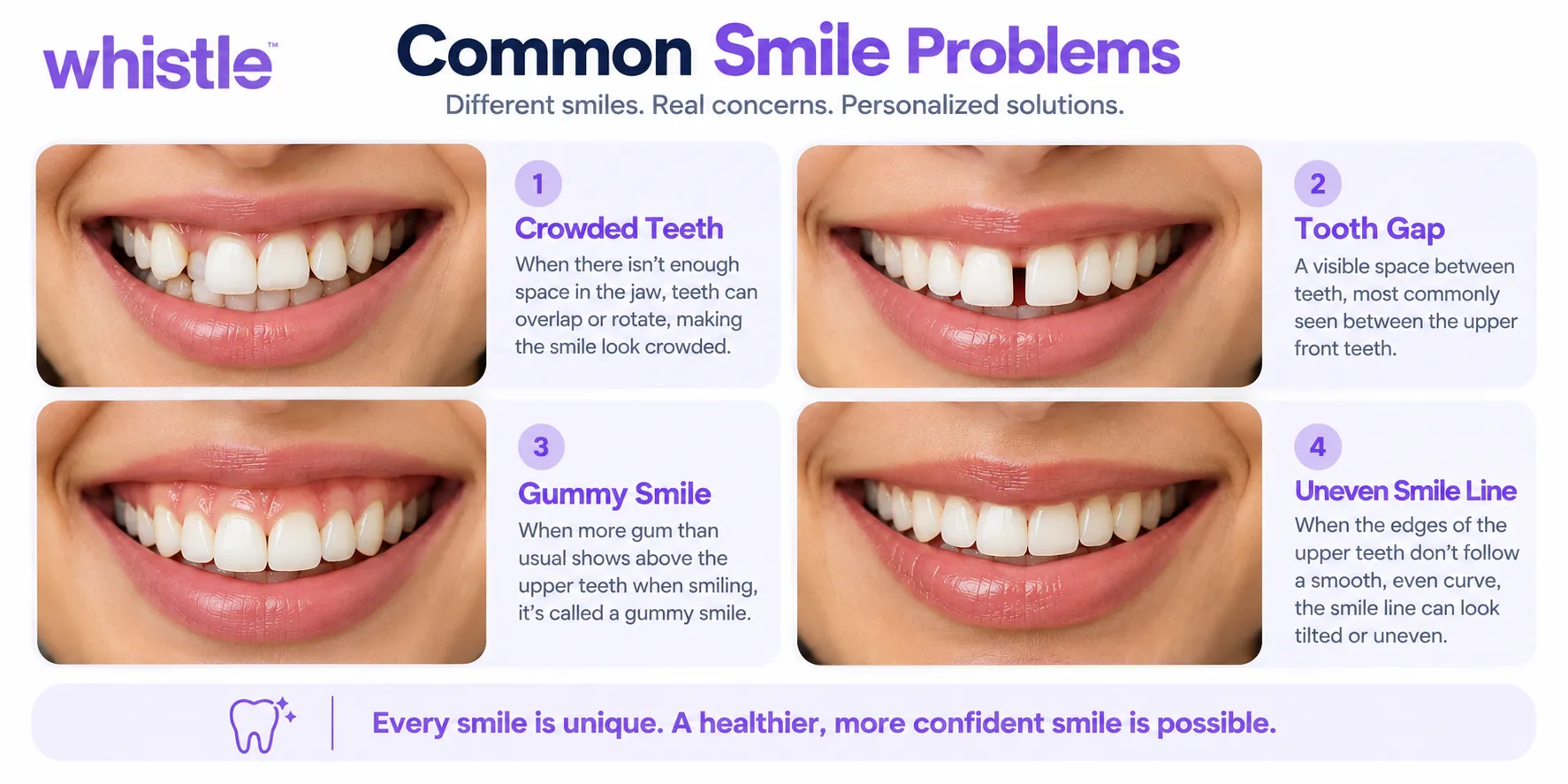
1. Crowding, Rotations & Overlapping Front Teeth
Crowded or rotated teeth interact with light unevenly and disturb the smile arc and incisal embrasures discussed earlier. The fix doesn't have to involve metal brackets; clear aligners are specifically built to gently guide crowded teeth back into their ideal arc, often in a fraction of the time people expect.
2. Diastemas (Midline Spacing & Tooth Gaps)
A diastema is simply a gap between two teeth, most commonly right between the front two. Some people (hi, Madonna, hi, Lauren Hutton) turn it into a signature. For everyone else who wants it closed, aligners can gradually pull the teeth together without touching healthy enamel at all- no bonding, no shaving, no drilling.
3. The Gummy Smile (Excessive Gingival Display)
When more than 3–4mm of gum shows above the upper teeth on a full smile, it's generally classified as a "gummy smile." It's not a flaw to hide behind a closed-mouth smile forever, it's usually very treatable, often with a minimally invasive gum contouring procedure that reshapes the gumline in a single visit.
4. Asymmetrical or Flat Occlusal Planes
The occlusal plane is the imaginary line running across the biting edges of your teeth. When it tilts or flattens unevenly, the whole smile can look subtly "off" even if no individual tooth looks wrong. This is a typical case where orthodontic movement of teeth using clear aligners.
Modern Pathways to Achieve a Perfect Teeth Smile
So you know what "perfect" actually means aesthetically. Now, how do you get there — without turning your mouth into a construction site? There's a spectrum of options, from fully non-invasive to genuinely risky, and it's worth knowing where each one sits.
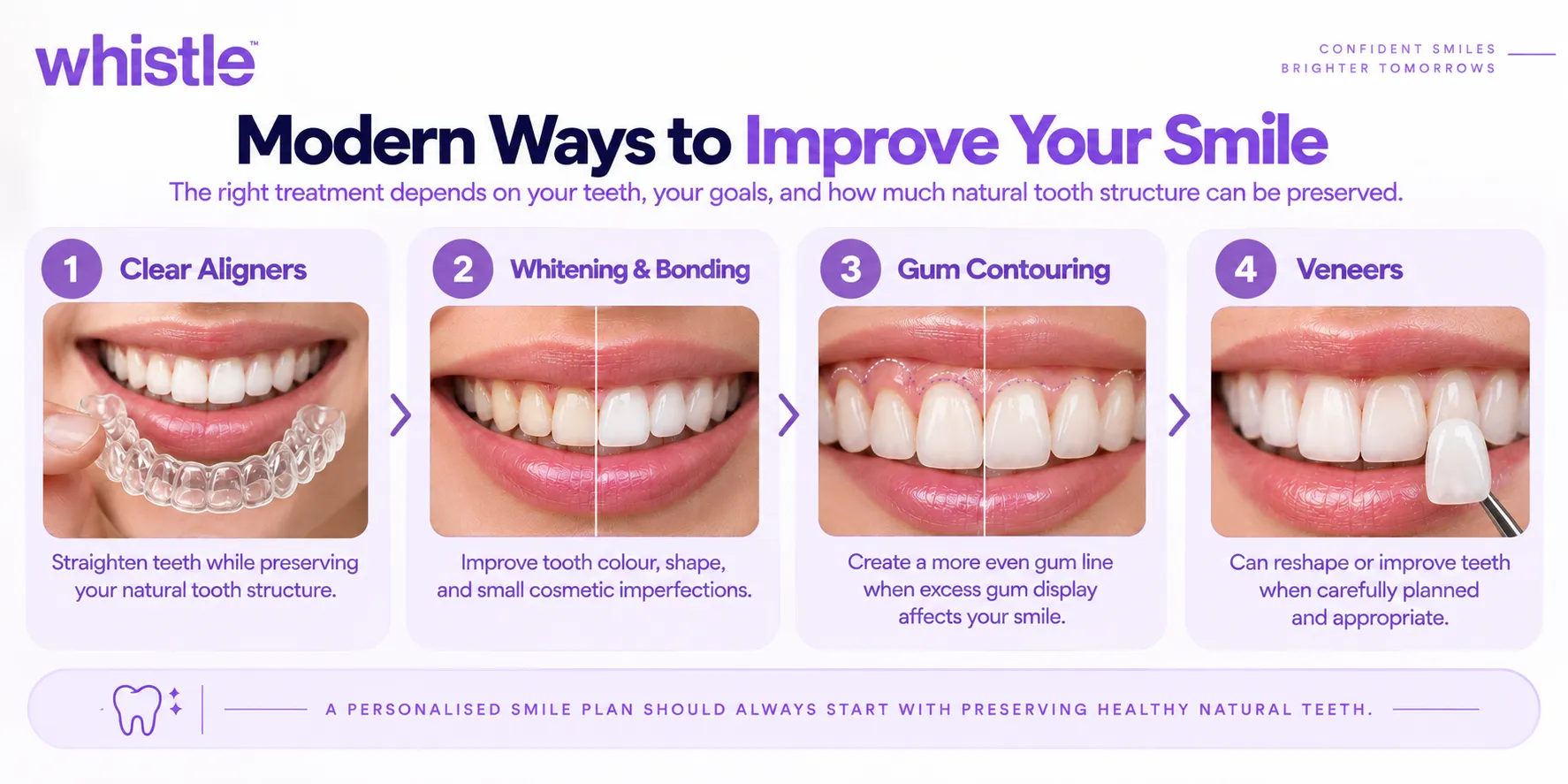
1. Whistle Clear Aligners: The Non-Invasive Foundation
Whistle Clear Aligners, work by moving the roots of your teeth into the right position. This is important because it is the ‘bodily movement’ of the teeth. It’s not a fix or a superficial trick. Instead, it creates an arc, a correct midline, and balanced tooth proportions. The best part? No healthy enamel is removed. No tooth is shaved down. For people who want a beautiful smile, this is the right place to begin.
2. Conservative Cosmetic Enhancements (Bonding & Whitening)
Once alignment is taken care of, conservative cosmetic changes can improve a smile. Whitening can help achieve a specific shade, and a little composite bonding can fix a chipped edge or close a gap. These help refine the look. Conservative changes are easy to reverse, noninvasive, and keep the natural tooth structure intact.
3. Minimally Invasive Gum Contouring (Gingivoplasty)
Gingivoplasty is a fast, laser dental procedure that reshapes the gumline to make the smile look more balanced and natural. For a gummy smile or uneven gumline, a gingivoplasty reshapes the gum tissue, reveals more of the natural tooth, and restores that ideal gum-to-tooth ratio. It's a short procedure and improves how balanced a smile looks.
4. Be Careful With Aggressive “Instant Veneers”
The idea of getting a completely new smile in just one visit can sound exciting, but it is important to understand what the treatment involves before making a decision.
Some traditional veneers require a dentist to remove a layer of natural enamel so the veneers can fit properly. How much tooth preparation is needed depends on the condition and position of your teeth, the type of veneers being used, and the result you want.
Once natural enamel is removed, it does not grow back. Removing too much tooth structure can also make teeth more sensitive and may create problems if the treatment is not planned carefully. Veneers also do not last forever, so they may need to be repaired or replaced in the future.
Your Next Steps
A beautiful smile is not about having perfectly white teeth or making every tooth look exactly the same. It is about creating a smile that looks healthy, natural, balanced, and right for your face. The shape and alignment of your teeth, the curve of your smile, your gums, tooth color, and even small details between the teeth can all affect how your smile looks.
At the same time, there is no single formula that works for everyone. What looks great on one person may not suit another. Ultimately, the best smile is one that looks natural, feels healthy, and gives you the confidence to smile without hesitation.
Also Read:-
Book 3D Teeth Scan
Consult our experts and get a 3D preview of your smile transformation!
Perfect smile
Perfect Teeth Smile with braces
FAQ's
Q1.What is considered the "golden ratio" for a perfect smile?
It's the 1:1.618 proportion where each front tooth appears about 61.8% as wide as the one next to it, moving outward from the centre. It's a guideline dentists use to judge visual balance, not a rigid rule all smiles must match exactly.
Q2.Can you get a perfect teeth smile without veneers or fake teeth?
Yes, for most people, alignment (via clear aligners), whitening, and occasionally minor bonding or gum contouring achieve a naturally more beautiful smile while keeping your own enamel intact.
Q3.How do clear aligners improve the natural smile arc?
By gradually moving the roots and crowns of the front teeth into a curve that follows the lower lip, aligners restore or create the consonant smile arc that flat, crowded, or misaligned teeth frequently disrupt.
Q4.What is the most attractive tooth shape for a smile?
There isn't one universal winner - square, oval, and triangular shapes each fit different face shapes and personalities. The most attractive result matches tooth shape to the individual face, not a single trend.
Q5.Are naturally straight teeth completely white?
No, and they shouldn't be. Natural teeth have subtle shade variation and translucency at the edges. Straightening improves alignment, not color — pure opaque white is a cosmetic choice, not a natural trait.
Q6.How do buccal corridors affect how wide a smile looks in photos?
More dark space at the corners of the mouth means the buccal corridors are broader. It can make a smile look narrower, while very narrow corridors can make the smile look artificially wide. A balanced, moderate corridor tends to make the smile most natural.
Q7.Can an adult achieve a perfect smile without metal braces?
Clear aligners first came to the market specifically designed for discreet, adult-friendly treatment and can correct crowding, spacing, and malocclusion issues without brackets or wires for the vast majority of common alignment cases.



 Medically Reviewed by Whistle Dental Team

 Medically Reviewed by Whistle Dental Team





 Medically Reviewed by Whistle Dental Team