
Best Options to Close Teeth Gaps | Treatments & Solutions
 Medically Reviewed by Whistle Dental Team
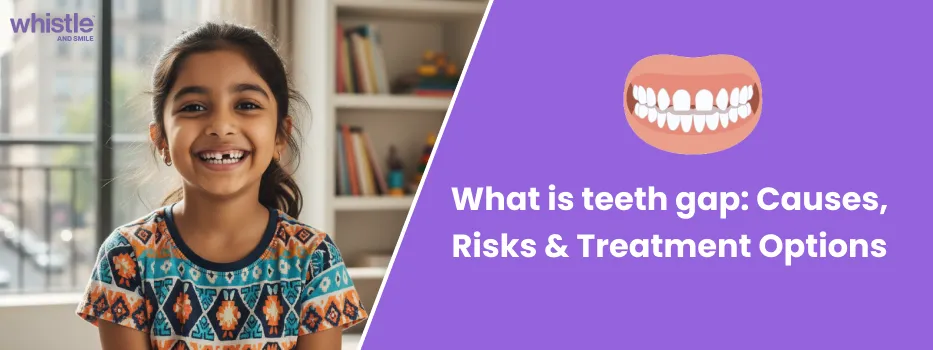
Conscious of gaps in the teeth - We have the best solution for you. Gaps can occur between the upper front two teeth and also between any number of teeth. When gaps occur between two teeth, it is called a Diastema.
When the upper front two teeth are called the midline Diastema. When in the upper teeth, it is called the Maxillary Diastema. When in the lower teeth called Mandibular Diastema.
When to consider the teeth as gap teeth -
When the space is wider than 0.5 mm
But before moving on to the treatment options, first, we should understand why it happens.
Causes for gaps in teeth
1. Discrepancy between tooth size and the size of jaw jawbone- When the size of jaw jawbone is large, and the size of the teeth is small, it leads to spaces between teeth.
2. Sometimes, a thick and fleshy fold of soft tissue or muscle in between the two teeth, called the Frenum, is responsible for the spacing between the teeth. When it overgrows, it leads to more space between the teeth and gum recession.
3. Genetics - The Size of your teeth and jaws is largely governed by genetics. If other family members have spaces in their teeth, then the possibility of having spaces increases.
4. Oral Habits - Oral habits like thumb sucking, using a pacifier, tongue thrusting ( normally the tongue should rest on the palate when we are in a rest position, but if the tongue rests on the back surface of front teeth and pushes them), if prolonged for a long time, often lead to spaces in the front teeth.
5. Bruxism or Night grinding or Clenching of Jaws - It causes teeth to flare out and leads to gaps between them.
6 . Teeth lost in early childhood - Trauma to the milk teeth causes spaces in them. Also, if the adult teeth are lost or require removal, it also causes space in the teeth
7 . Gum diseases - Swollen gums with calculus cause bone loss, which ultimately leads to movement of teeth away from one another ,leading to spaces between them.
Consequences of gaps in teeth
1. Less Confidence - If a person is self-conscious leads to loss of confidence in professional settings.
2. Speech difficulties - Gaps between teeth lead to lisping.
3. Chewing difficulties.
4 . Oral Health Problems - Gaps between teeth lead to deposition of plaque
accumulation and calculus, leading to caries, gingival diseases, and bone loss, ultimately periodontitis.
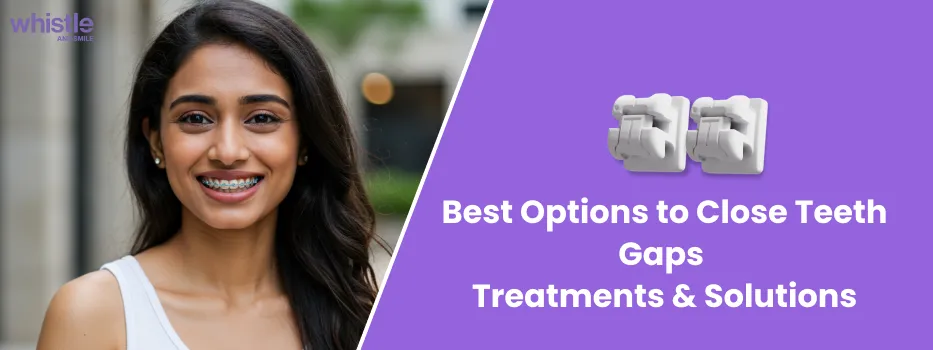
With the advancement in dentistry, there are many ways to close the gaps between teeth, but the tried and tested all-time Ortho treatment is the gold standard. The best treatment option for closing the tooth gaps is going for orthodontic treatment, either with braces or aligners.
Depending on the space and condition of the teeth and bone, various treatment modalities are available in your nearest Whistle partner dental clinic.
Difference between Braces and Aligners
| Braces | Aligners |
| 1. Fixed to the tooth surface can not be removed at will. | 1. Removable can be removed at will. |
| 2. Brackets and wires are visible. | 2. Clear Transparent trays are there. |
| 3. Dietary restrictions ( Cannot bite sticky and hard food items ). | 3. Can eat anything after removing trays |
| 4. Every month, a visit to the dental clinic is a must. | 4. It is not mandatory to visit the dental clinic. Can visit for follow-up. |
| 5. More discomfort. | 5. Less discomfort. |
| 6. Patient has to visit monthly, so compliance is needed. | 6. Compliance is needed as the patient has to wear the trays and shift to other trays on time. |
| 7. Results cannot be seen until the treatment is completed. | 7. Results can be visualized before the treatment is started with the help of a customised scan. |
| 8. Braces can treat even complex cases. | 8 . Complex cases are treated using Aligners in combination with Auxiliaries. |
| 9. Maintaining oral hygiene is tough; extra effort is needed. | 9. Maintaining Oral Hygiene is easy, as trays can be removed. |
| 10. Less costly, but when the overall cost is combined almost equal. | 10. More costly when compared to Braces. |
Braces, by applying pressure on teeth, help in moving them to the desired position and hence in closing the gaps . There are various types of braces used for the correction of gaps between teeth -
1. Metal braces - Consists of wires and brackets.
2. Ceramic Braces - Esthetic solution (as a blend with the colour of the tooth) for correction of gaps. Prone to fractures easily. Also stains with time.
3. Self-Ligating - Don't require elastics to tie the wire.
4. Whistle braces - Revolution in the field of braces with exceptional strength and zirconia brackets. Custom-made
Precision-fit Whistle braces are not prone to fracture, nor do they stain with time.
Aligner Brand available in India, matching International Standards, is WHISTLE ALIGNERS.
Why to choose Whistle Aligners ?
- Whistle Aligners are designed specifically according to the needs of the individual using AI Technology.
- A scan can be done before starting the treatment, in which the results attained after the treatment can be visualized, which is a unique feature.
- Transparent /Invisible trays are fabricated after the scan.
- Highly comfortable and soft material is equivalent to that used in Invisalign.
- A team of senior Orthodontists is involved at the backend, dealing with the preparation of the plan and close monitoring of the changes to achieve the desired results, rather than a single Orthodontist.
- The number of trays and time period needed for the treatment is decided keeping in view the amount of discrepancy.
Other Options
Keeping in view the pros and cons of the Aligners and Braces treatment option can be selected. Apart from that, other ways of correcting the gaps between the teeth will lead to loss of natural tooth structure.
But still the choice varies from case to case depending on a lot of factors such as the amount of gap present, its location, the amount of severity, the Cost factor, Time involved, etc.
Other options are :
1. Veneers – Porcelain veneers matching the tooth colour can be done in front teeth. But the drawback is that a substantial amount of enamel has to be removed, leading to loss of natural tooth structure.
2. Dental Bonding / Composite Build-up
1. Composite resin material is used to conceal the gap.
2. Quick and affordable approach.
3. It can also be used for chipped teeth.
4. It cannot be used if spaces are large and there is more discrepancy in alignment.
Dental Bonding and Veneers come under Cosmetic options, and both of them cover the situation rather than correcting it from the depths. As Braces and Aligners close the gaps by movement of teeth and correct the malalignment, they are the best option.
3. Dental Bridge – If the gap is due to the missing of one tooth in between the two teeth, it can be the choice. The drawback of the Bridge is that two healthy adjacent teeth are unnecessarily sacrificed as reshaping of the tooth surface is reshaped. So a better option is to go for an Implant in such a scenario.
Preventive measures to prevent gaps in Teeth if the underlying cause is below mentioned one :
Frenectomy – Sometimes Frenum, ie, A thick fold of tissue, when removed, allows teeth to come back to their normal position. Must be done if needed to prevent the relapse in combination with Ortho Treatment, ie, Braces and Aligners.
Deep Scaling and Curettage – If bad Oral Hygiene leading to calculus deposition and bone loss is leading to gaps in teeth. Oral hygiene needs to be addressed.
To conclude
Tried and tested, all-time gold standard Braces and Aligners are the best option for closing the gaps. So, without any second thought, go for Whistle Braces and Whistle Aligners.
 Medically Reviewed by Whistle Dental Team
 Medically Reviewed by Whistle Dental Team

 Medically Reviewed by Whistle Dental Team