Correct Teeth Alignment: What Should an Ideal Bite Look Like?
 Medically Reviewed by Whistle Dental Team
- The Ideal Anatomical Bite: In healthy alignment, the upper front teeth overlap the lower front teeth by 2 to 3 millimetres vertically (overbite) and 2 to 3 millimetres horizontally (overjet), while the back molars interlock in a stable Class 1 relationship.
- Modern Alternatives to Fixed Braces: Patients exploring how to align teeth without braces can successfully correct mild to moderate crowding, spacing, and bite issues using custom clear aligners, which are virtually invisible and fully removable for meals.
- Root Causes of Misalignment: Dental malocclusion stems from genetic factors (jaw-to-tooth size mismatch), early loss of primary milk teeth, facial trauma, or prolonged childhood habits like thumb sucking and mouth breathing.
- Clinical Dangers of Unsupervised DIY Kits: Using mail-order rubber bands, household objects, or unmonitored plastic trays risks irreversible root resorption, gum recession, and permanent tooth loosening. Orthodontic movement requires in-person clinical supervision.
- In-Person Specialist Care: Achieving stable, long-lasting teeth alignment begins with accurate 3D intraoral scans, digital smile simulations, and individualized orthodontic planning supervised by certified orthodontists.
What Does Correct Teeth Alignment Look Like?
When people discuss teeth alignment, they often picture a row of perfectly even, bright front teeth. In clinical orthodontics, however, correct teeth alignment involves both static symmetry (how teeth look at rest) and dynamic function (how upper and lower teeth come together during chewing, swallowing, and speaking). Orthodontists assess your smile across three spatial dimensions: front-to-back (sagittal), vertical, and side-to-side (transverse).
1. The Front View (Overbite and Midline Symmetry)
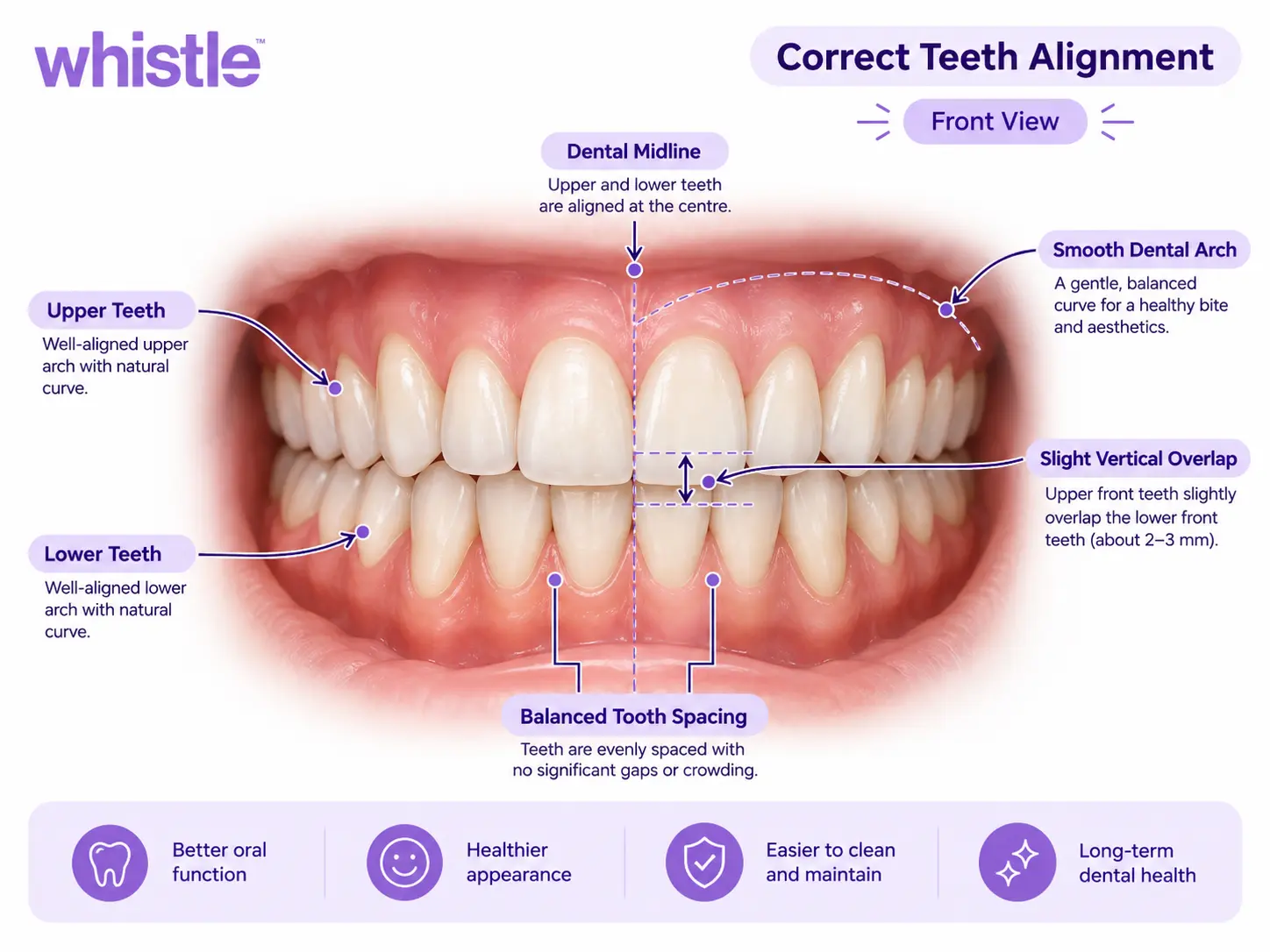
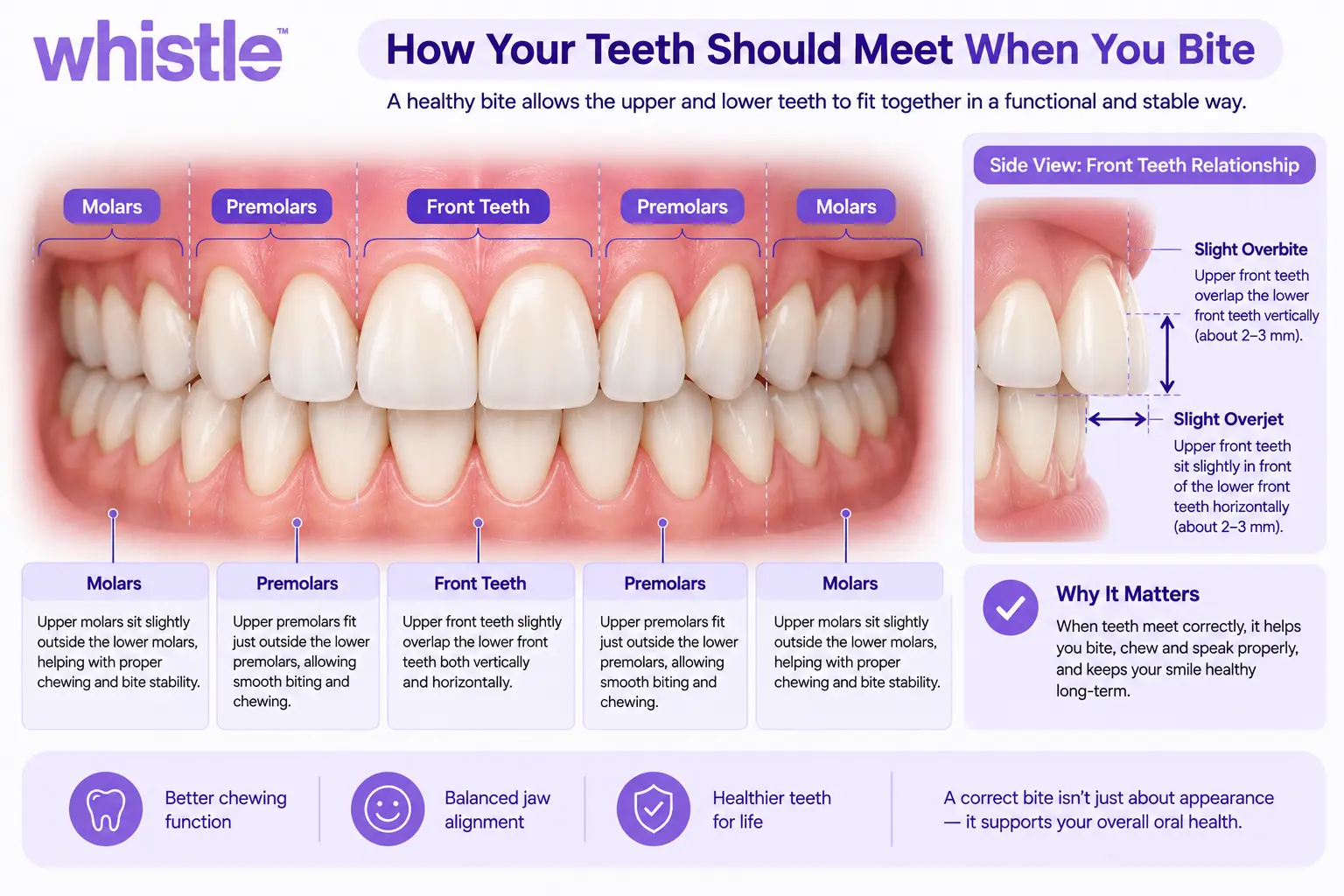
When you close your teeth normally, your upper incisors should gently cover the top one-third of your lower incisors. Clinically, this vertical overlap is called an overbite, and its ideal measurement ranges between 2 to 3 millimetres (or approximately 20% to 30% coverage).
If the upper teeth cover the lower teeth entirely, it indicates a deep bite; if they fail to touch or overlap at all, it forms an open bite. Furthermore, the facial midline (the line between your two upper front teeth) should align with the midline of your lower teeth and the center of your philtrum (the groove beneath your nose).
2. The Side View (Overjet and Angle's Class 1 Molar Relationship)
From a side perspective, your upper front teeth should naturally rest slightly ahead of your lower front teeth with a horizontal gap of 2 to 3 millimetres, known clinically as overjet. When overjet becomes excessive, it creates protruding teeth (commonly called buck teeth). More importantly, your first permanent molars (the large back teeth) should fit together like interlocking puzzle pieces.
In an ideal Class 1 occlusion, the front cusp of your upper first molar rests squarely in the central groove of your lower first molar, distributing chewing forces evenly across your dental arch.
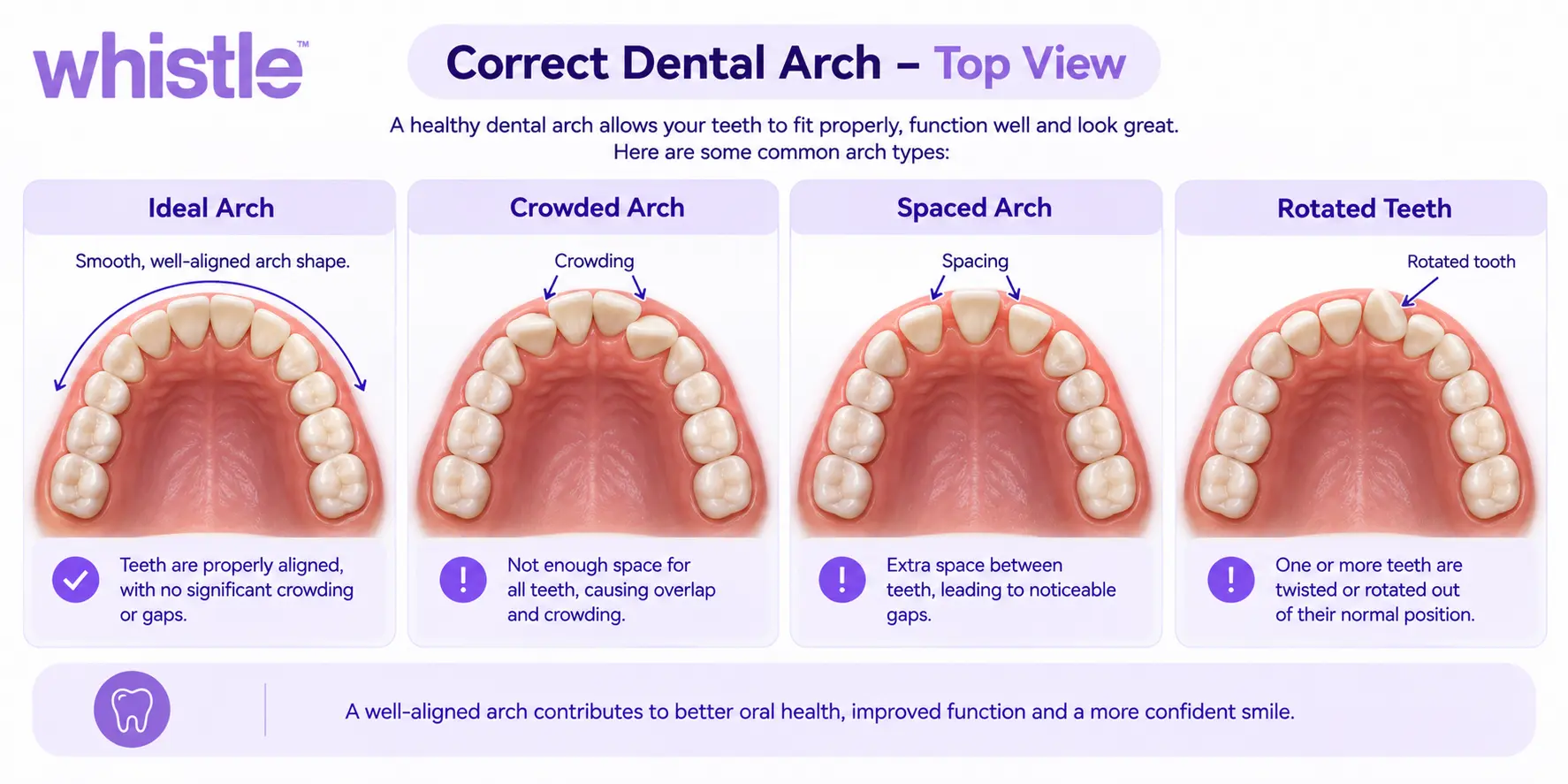
3. The Arch View (Spacing, Crowding, and Arch Form)
Looking directly down at the dental arch (the U-shaped curve of your jaw), each tooth should touch its immediate neighbours without overlapping, twisting, or leaving large gaps.
There should be adequate jaw space for every tooth to erupt naturally along a smooth, continuous parabolic arch. When jaw dimensions and tooth widths do not match, dental crowding or unwanted gaps (diastema) develop.
Why Do Teeth Become Misaligned?
Understanding why misalignments develop is key to choosing the right correction strategy. Dental alignment is rarely influenced by a single factor; rather, it is shaped by an interplay between genetics, developmental patterns, and daily habits.
- Genetics and Heredity: Most bite discrepancies are inherited. You may inherit a small jaw from one parent and large teeth from the other, leading to severe crowding, or inherit a skeletal jaw imbalance such as a prominent lower jaw.
- Premature Loss of Baby Teeth: Primary milk teeth act as natural space maintainers for incoming adult teeth. When a baby tooth is lost early due to decay or injury, neighbouring teeth tilt into the open space, blocking permanent teeth from erupting in their correct positions.
- Prolonged Childhood Habits: Thumb sucking, prolonged pacifier use beyond age three, or tongue thrusting (pushing the tongue against front teeth during swallowing) exert continuous light pressure that reshapes pliable jawbone tissue and tips front teeth outward.
- Chronic Mouth Breathing and Airway Obstructions: Enlarged tonsils, adenoids, or untreated nasal allergies force children to breathe through their mouths. Chronic mouth breathing alters resting tongue posture, lowering it from the palate and allowing the upper jaw to narrow into a high-vaulted, constricted arch.
- Dental Trauma and Untreated Adult Tooth Loss: Accidents, sports injuries, or unreplaced missing adult teeth disrupt arch integrity. When a tooth is removed without prompt replacement, adjacent and opposing teeth slowly drift and over-erupt into the void, throwing off bite alignment.
Common Types of Teeth Misalignment (Malocclusion)
Malocclusion is the official medical term for teeth that do not fit together in healthy harmony. The World Health Organization and global orthodontic associations classify misalignments into specific clinical patterns:
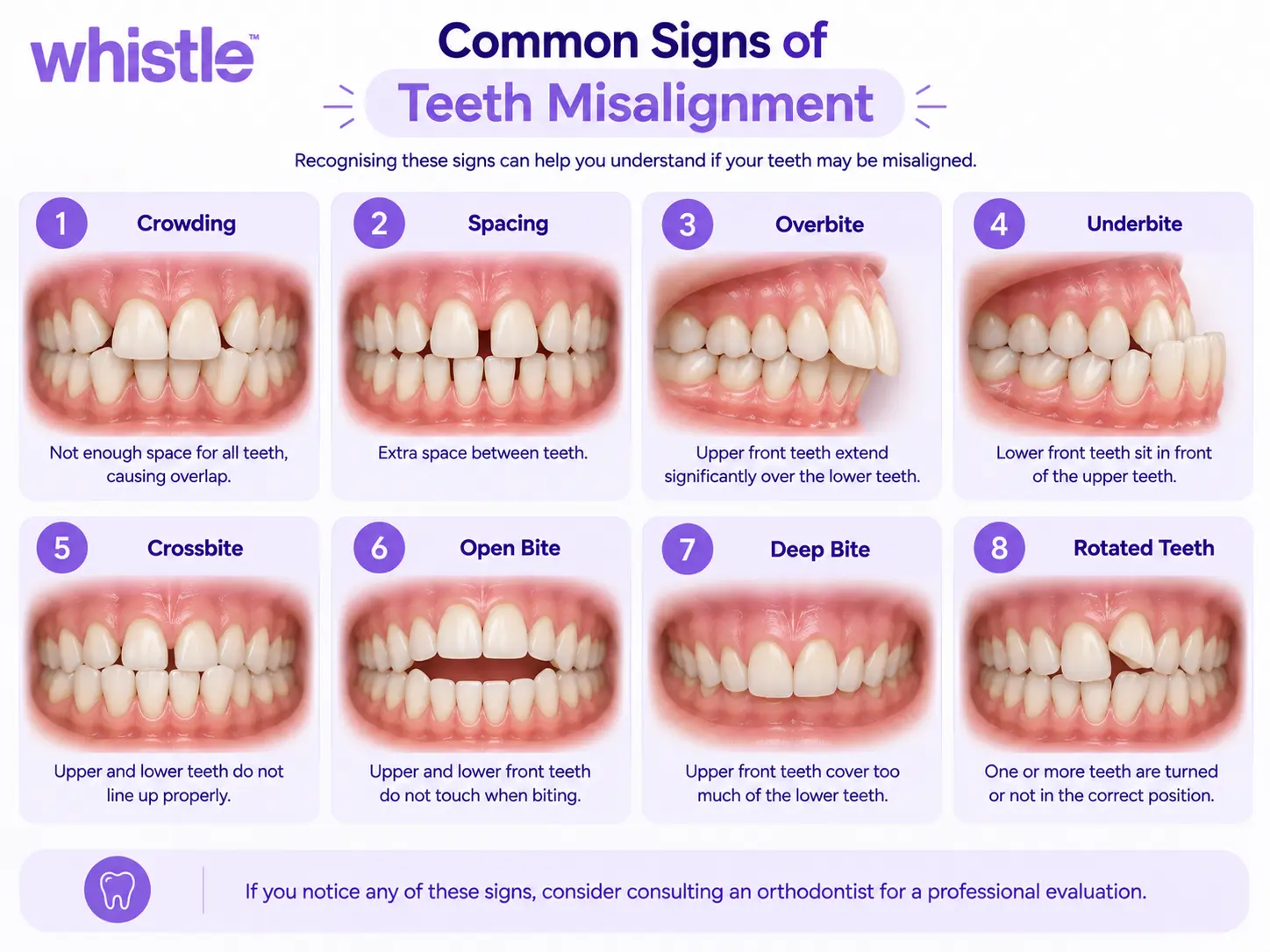
- Dental Crowding: Occurs when the dental jawbone is too narrow or teeth are too wide, forcing teeth to rotate, overlap, or erupt behind one another.
- Excessive Spacing (Diastema): Gaps or empty spaces between teeth caused by missing teeth, small tooth sizes, or an oversized labial frenum (the tissue band connecting the upper lip to the gum).
- Overjet (Protrusion): Upper front teeth push excessively outward beyond the lower teeth, increasing the risk of accidental dental trauma and lip incompetence.
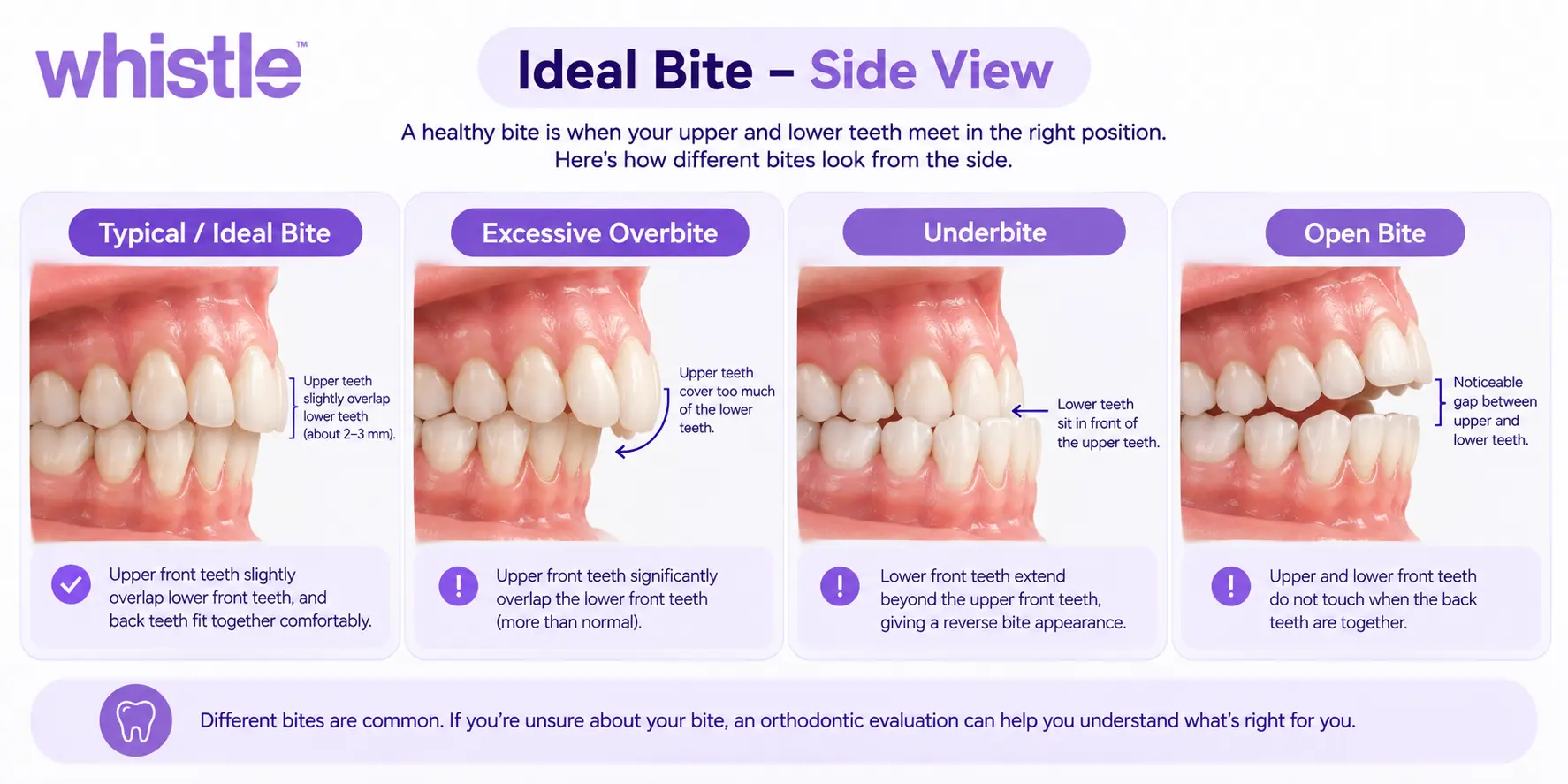
- Deep Bite (Overbite Discrepancy): Upper front teeth overlap lower front teeth excessively, sometimes causing lower incisors to bite into the roof of the mouth, causing palate irritation.
- Underbite (Class 3 Malocclusion): The lower jaw or lower teeth sit forward in front of the upper teeth, frequently related to underlying skeletal jaw growth imbalances.
- Crossbite: One or more upper teeth bite inside the lower teeth rather than outside, occurring either in the front teeth (anterior) or back teeth (posterior), causing facial asymmetry and uneven wear.
- Open Bite: Front upper and lower teeth do not touch when the back teeth close together, creating an open window that impairs biting into food and triggers speech lisps.
How to Straighten Teeth: Clinical Orthodontic and Dental Solutions
When addressing how to straighten teeth, orthodontic specialists first evaluate whether the concern is dental (involving tooth positions within the bone) or skeletal (involving the size and relationship of the upper and lower jawbones). Modern dentistry offers several proven pathways to achieve correct teeth alignment:
1. Clear Aligners (Orthodontic Movement Without Braces)
Clear aligners represent the premier modern solution for patients researching how to align teeth without braces. Fabricated from medical-grade, BPA-free transparent thermoplastic polymers, clear aligners fit snugly over your dental arch. Using advanced digital treatment planning software, orthodontists design a sequence of customized trays. Each tray applies calibrated, gentle forces to guide specific teeth by 0.2 to 0.25 millimetres per stage.
Patients wear each set for 20 to 22 hours per day, switching to the next tray in the series every 7 to 14 days under regular specialist oversight. Clear aligners excel at treating mild, moderate, and many complex cases of crowding, spacing, rotated teeth, and bite discrepancies while remaining virtually invisible and completely removable for meals and daily oral hygiene.
2. Traditional Fixed Metal and Ceramic Braces
Fixed braces remain a reliable and versatile orthodontic appliance, particularly for severe malocclusions, significant skeletal discrepancies, rotated premolars, or deeply impacted teeth (such as impacted canines). High-grade stainless steel or tooth-coloured ceramic brackets are bonded to the front surface of each tooth and connected with nickel-titanium and stainless-steel archwires. Periodic adjustments by an orthodontist guide the teeth into harmony over a typical duration of 12 to 24 months.
3. Lingual Braces
Lingual braces function similarly to traditional fixed appliances but are customized and bonded to the back (tongue-facing) surfaces of the teeth. While they offer complete cosmetic discretion, they can cause initial tongue irritation and temporary speech alterations, and they require specialized orthodontic training to adjust.
4. Interceptive Orthodontic Appliances (for Growing Children)
For young patients between ages 7 and 11, early interceptive devices such as palatal expanders, space maintainers, or functional appliances can guide jaw growth, widen constricted dental arches, and create necessary space for erupting adult teeth, reducing the complexity of future orthodontic treatment.
5. Restorative and Cosmetic Camouflage (When Orthodontic Movement Is Not Feasible)
For adults with minor aesthetic irregularities, slight edge chipping, or minor tooth size discrepancies who do not require bite correction, cosmetic dentistry options such as composite bonding or porcelain veneers can provide visual harmony. However, it is vital to recognise that cosmetic veneers and bonding mask tooth contours by adding or reshaping surface enamel; they do not physically move roots or correct an underlying misaligned bite.
How to Align Teeth Without Braces: What Works and What Does Not
A common question among adults and teenagers is whether teeth alignment can be achieved without traditional brackets and wires. The short answer is yes, clear aligners are the scientifically validated, clinically proven method to align teeth without braces by moving the teeth bodily through alveolar bone. However, understanding the boundaries between orthodontic movement and cosmetic masking is crucial for realistic expectations:
- True Orthodontic Correction (Clear Aligners): Clear aligners physically move the entire tooth, including the root beneath the gumline, into correct physiological alignment. This improves both appearance and bite function while preserving natural tooth enamel.
- Removable Minor Retainers: Retainers are primarily designed to hold teeth in place after orthodontic therapy. In select adult cases with very minor single-tooth relapse (a fraction of a millimetre), a spring retainer can deliver small nudges, but retainers cannot correct generalized crowding or bite malocclusions.
- Cosmetic Dental Veneers (Visual Camouflage): Veneers cover the front surface of teeth to create the illusion of straightness. While quick, veneers require irreversible removal of healthy tooth enamel and do not correct deep bites, underbites, or severe crowding.
- Cosmetic Dental Bonding: Resin bonding can fill minor uneven edges or small gaps between teeth in a single visit, but it does not reposition teeth within the jawbone.
Types of Teeth Alignment and Bite Problems
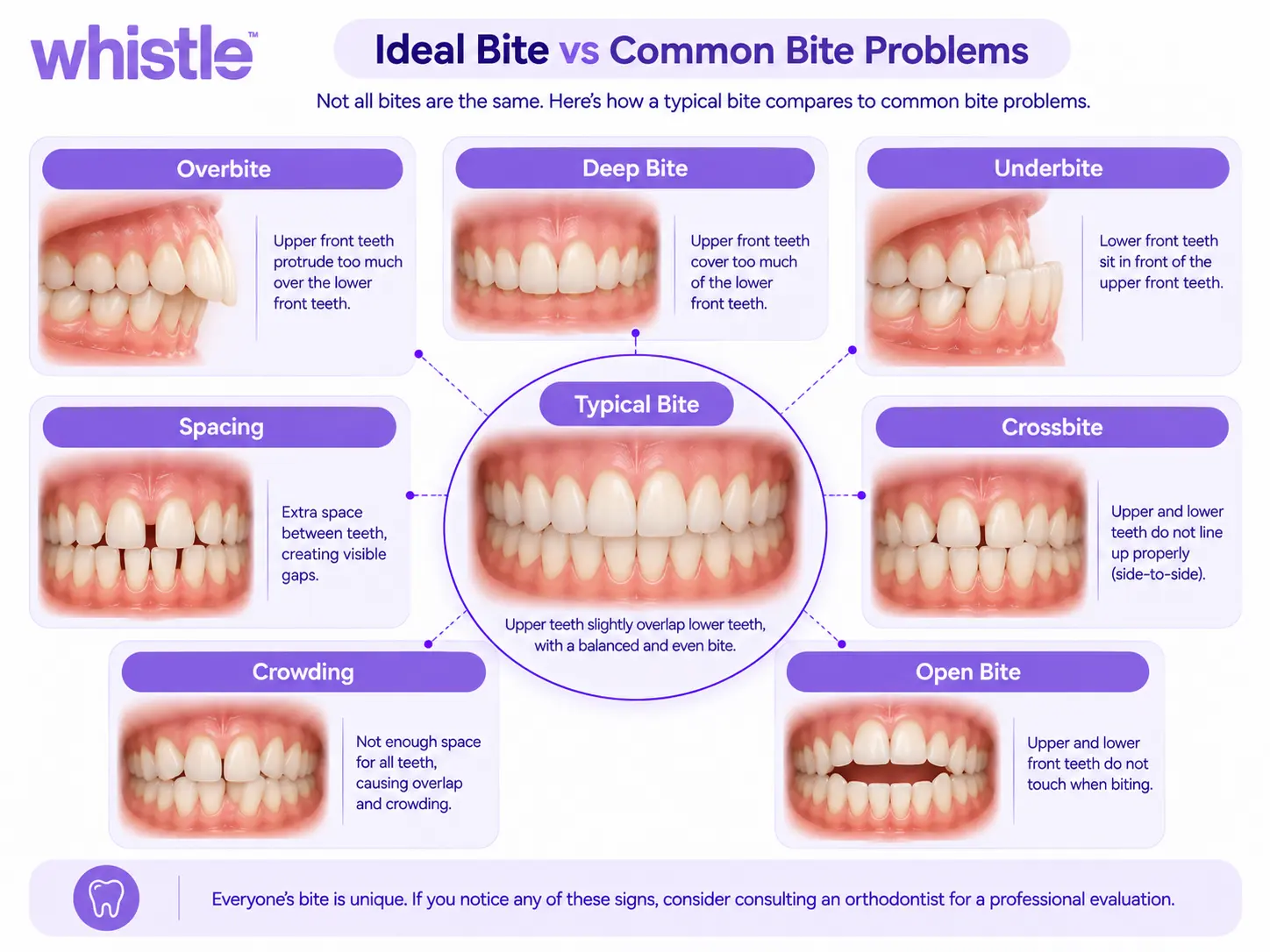
Not every bite looks the same, and not every difference requires treatment. Orthodontic problems can involve the position of individual teeth, the relationship between the upper and lower dental arches, or the relationship between the jaws.
- Overbite: Overbite refers to the vertical overlap of the upper front teeth over the lower front teeth.
- Underbite: An underbite occurs when the lower front teeth sit ahead of the upper front teeth when the teeth are brought together. The appearance can vary depending on whether the difference is mainly related to tooth position, jaw position, or both.
- Crossbite: A crossbite occurs when one or more upper teeth sit inside the lower teeth rather than outside them. It can affect front teeth, back teeth, or both and may occur on one side or multiple areas of the mouth.
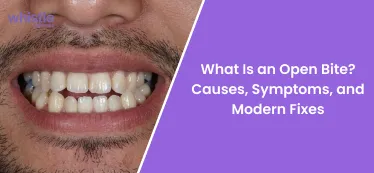
- Open Bite: An open bite occurs when some teeth remain separated when the mouth is closed. For example, the front teeth may not meet even though the back teeth do.
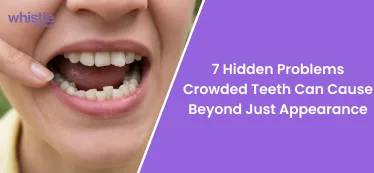
- Crowding: Crowding occurs when teeth do not have enough space to align normally. Teeth may overlap, rotate, or erupt in an unusual position. The amount and location of crowding can vary considerably between individuals.
- Teeth Gaps: Spacing refers to visible gaps between teeth. Some spacing is normal in certain stages of dental development, while persistent or larger spaces in adults can have different causes.
Why Correct Teeth Alignment Matters: Oral Health Benefits Beyond Aesthetics
- Easier and More Effective Plaque Removal: Crowded, overlapping teeth create tight crevices that toothbrush bristles and dental floss cannot easily access. Straight teeth eliminate these plaque traps, drastically reducing your risk of gingivitis, bleeding gums, and periodontal disease.
- Reduced Risk of Tooth Decay: Food debris and cariogenic bacteria thrive in interdental overlaps. Proper alignment allows salivary flow and standard brushing to cleanse tooth surfaces naturally, lowering the incidence of dental cavities.
- Even Bite Force Distribution and Less Enamel Wear: When teeth do not interlock correctly, certain teeth bear disproportionate chewing forces. This concentrated stress causes abnormal enamel abrasion, chipped edges, microfractures, and premature tooth flattening.
- Relief for the Temporomandibular Joint (TMJ): A misaligned bite forces the jaw joints and masticatory muscles into unnatural strain during chewing. Correcting malocclusion helps alleviate chronic muscle fatigue, morning jaw stiffness, clicking sensations, and tension headaches.
- Clearer Speech and Articulation: Teeth and tongue coordination is essential for pronouncing distinct sounds like 's', 'z', 't', and 'th'. Correcting open bites or severe gaps can resolve speech lisps and improve conversational clarity.
How Do Orthodontists Check Teeth Alignment?
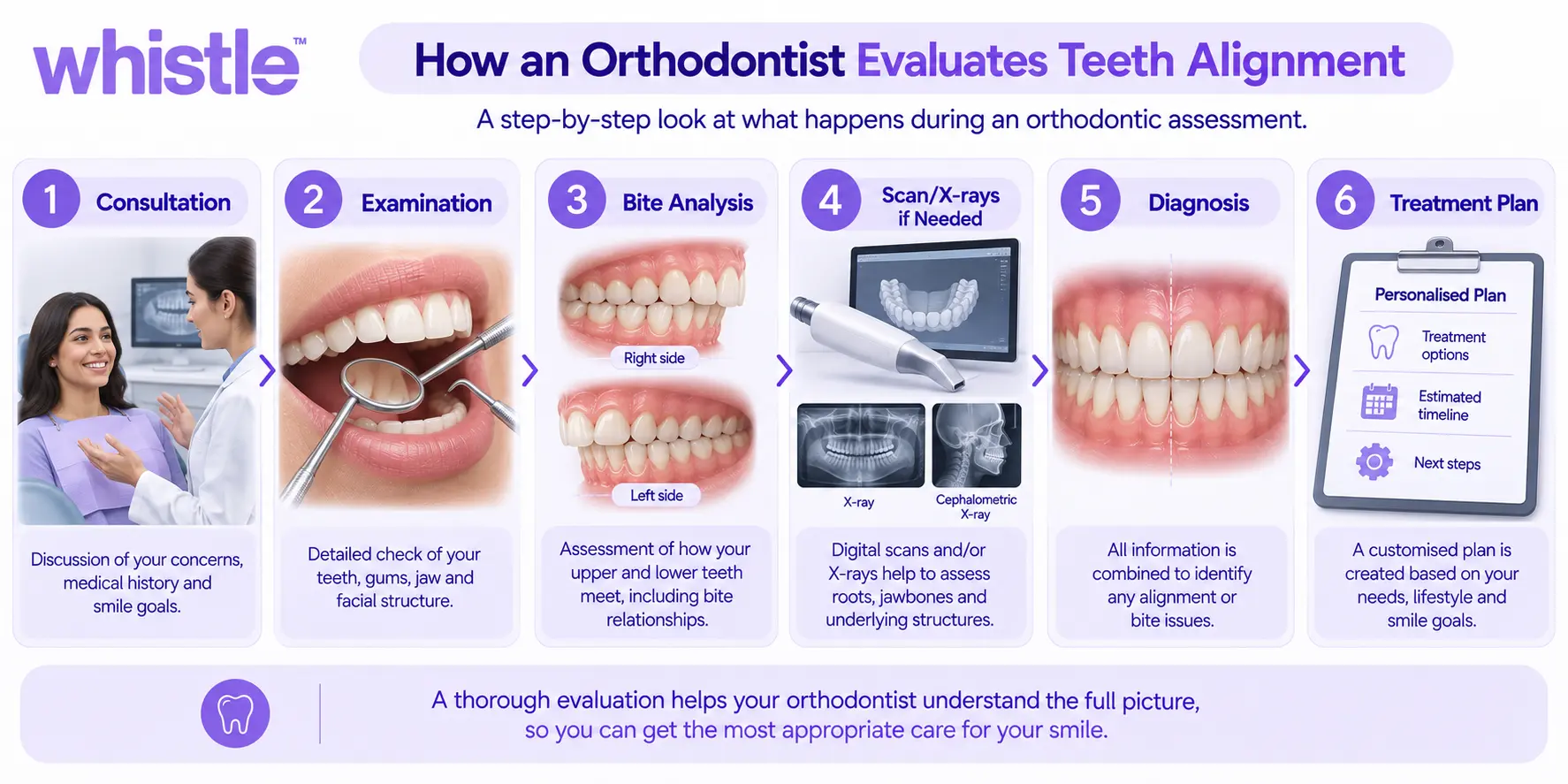
If you experience difficulty biting into food, notice abnormal wear on your tooth edges, suffer from frequent cheek biting, or feel self-conscious about your smile, scheduling an in-person orthodontic consultation is the safest and most effective first step.
During a comprehensive evaluation, your orthodontist will perform digital 3D intraoral scanning, take diagnostic panoramic or cephalometric radiographs, and evaluate your jaw joint function. This ensures that whether you choose clear aligners or traditional braces, your treatment plan addresses the biological root cause of your malocclusion.
For patients seeking discreet, lifestyle-friendly treatment, Whistle offers advanced clear aligners planned by experienced orthodontic specialists. Whistle, in partnership with Clove Dental across 600+ partner dental clinics nationwide, ensures that every patient receives professional in-person scans, continuous doctor monitoring, and clinically supervised progress checks throughout their teeth alignment journey.
Conclusion and Next Steps for Your Smile
Book 3D Teeth Scan
Consult our experts and get a 3D preview of your smile transformation!
perfect teeth alignment
FAQ's
Q1.What is correct teeth alignment?
Q2.What should correctly aligned teeth look like?
From the front, teeth generally follow a smooth arch without significant crowding, spacing, or rotation. The upper front teeth typically overlap the lower front teeth slightly.
From the side, the upper front teeth generally sit slightly ahead of the lower teeth, with an appropriate overbite and overjet. The back teeth should also have a stable relationship.
Small variations are normal, so correctly aligned teeth do not have to look perfectly symmetrical.
Q3.How can I check my teeth alignment at home?
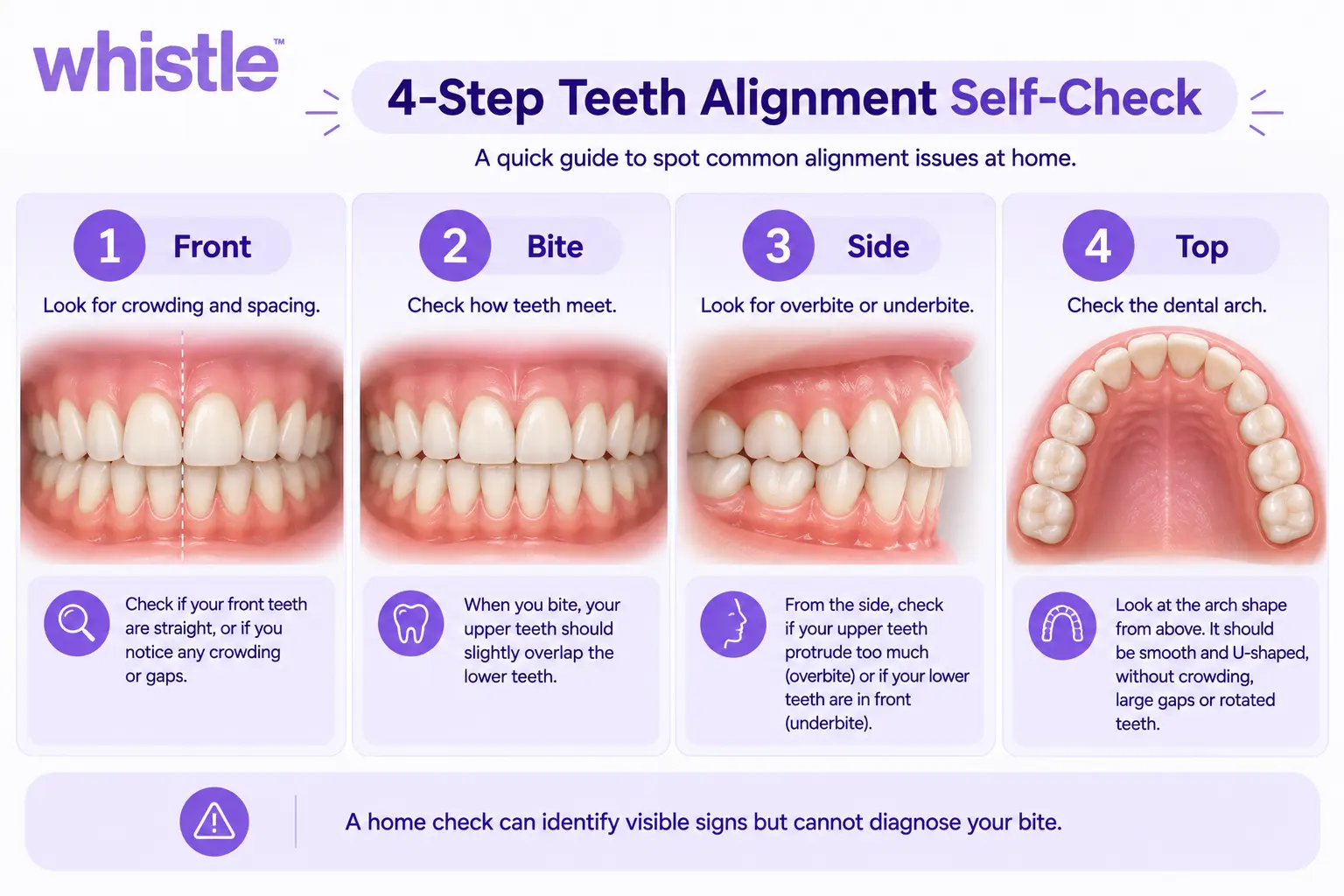
You can look at your teeth from the front, side, and top and check for noticeable crowding, spacing, rotations, protrusion, overbite, underbite, or other visible differences.
You can also close your teeth naturally and observe whether they meet comfortably or whether your jaw shifts.
However, a home check cannot diagnose an orthodontic condition. A professional assessment is needed for a complete evaluation.
Q4.What does an ideal bite look like from the side?
From the side, the upper front teeth generally sit slightly ahead of the lower front teeth and overlap them vertically to some degree.
The back teeth should also have a stable relationship. Significant differences such as a pronounced underbite, excessive overbite, or open bite may indicate an altered bite relationship.
Q5.What is the difference between correct teeth alignment and straight teeth?
Straight teeth refer purely to visible cosmetic alignment in the front arch. Correct teeth alignment encompasses both aesthetic straightness and proper functional occlusion, meaning the upper and lower teeth interlock harmoniously to distribute chewing forces safely without straining jaw joints.
Q6.Do I have to wear a retainer after teeth alignment treatment?
Yes. Wearing retainers is essential after any orthodontic treatment. Surrounding bone and periodontal fibres require time to stabilize in their new positions. Without retainers, natural relapse will cause teeth to gradually shift back toward their original positions.
 Medically Reviewed by Whistle Dental Team


 Medically Reviewed by Whistle Dental Team
 Medically Reviewed by Whistle Dental Team