Different Types of Teeth Alignment Problems and how to fix them
Aligners

Different Types of Teeth Alignment Problems and how to fix them

Dr. Wynne VelazquezMedically Reviewed by Whistle Dental Team
Written by Dr. Wynne Velazquez
· 24 min read

Understanding the different types of teeth alignment problems (known clinically as malocclusions) is the first step toward achieving a healthy, balanced smile. The most common dental alignment issues include crowding, spacing gaps, overbites, overjet, underbites, crossbites, and open bites.


Key Takeaways 

  • Bite Classification: Teeth alignment is classified into Angle Class I, Class II, and Class III based on how the upper and lower first molars interlock.
  • 8 Common Alignment Problems: The major dental issues include crowding, spacing (diastema), deep overbite, overjet protrusion, underbite, crossbite, open bite, and dental midline shift.
  • Clear Aligner Superiority: Custom clear aligners efficiently correct mild to severe spacing, crowding, and moderate bite misalignments without metal brackets or dietary restrictions.
  • Self-Ligating Braces for Complex Cases: Severe skeletal discrepancies and severe open bites often benefit from the continuous gentle torque of modern self-ligating braces.
  • Transparent Indian Pricing: Whistle provides all-inclusive clear aligner packages from Rs. 60,000 to Rs. 2.5 Lakhs and self-ligating braces from Rs. 45,000 to Rs. 70,000 with flexible monthly EMI options.


Modern corrective solutions range from virtually invisible Whistle Clear Aligners (Rs. 60,000 to Rs. 2.5 Lakhs) to precision Whistle Self-Ligating Braces (Rs. 45,000 to Rs. 70,000), supported by flexible monthly EMI options and full in-person MDS Orthodontist supervision across 600+ partner clinics nationwide.


Different Types of Teeth Alignment Problems
Crooked front teeth detract from one's smile. Minor misalignment can be fixed with teeth straightening. More severe cases may need braces. Braces use mild pressure to gradually move the teeth to their correct position. Invisible aligners are another option. They involve wearing clear plastic trays for 22 hours each day. Trays gradually shift teeth in small increments.


Both braces and Clear aligners take around 6 to 18 months for good results. Misaligned Teeth (Malocclusion) is a dental condition in which the alignment of our upper and lower teeth is poorly aligned. Teeth alignment issues come in various forms. Before learning about the treatment for teeth alignment, you first need to understand the different types of teeth alignment problems that can happen. Here is the list of all the issues:

Below is a detailed breakdown of the eight major types of teeth alignment problems diagnosed and treated by orthodontists.

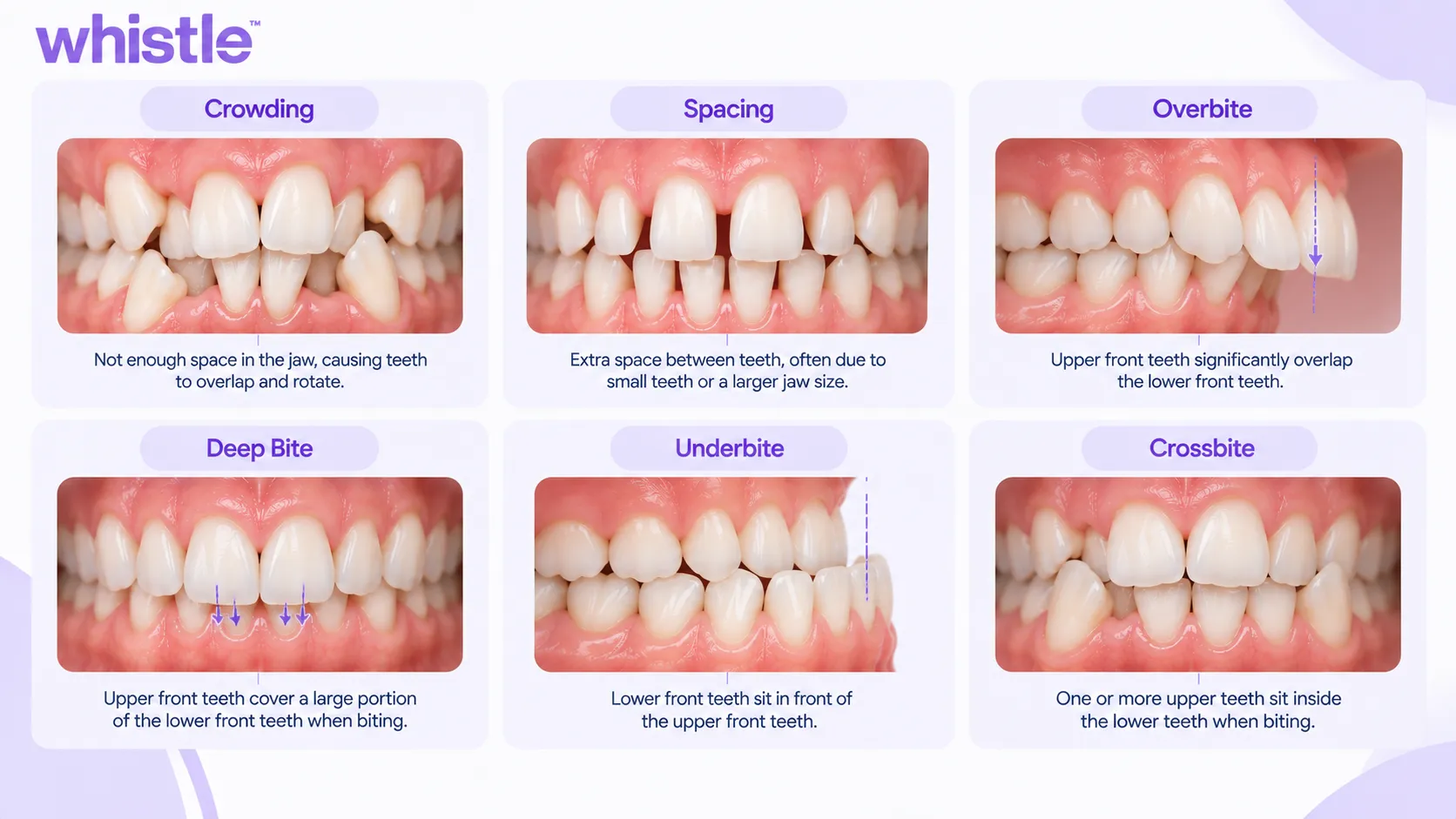
1. Teeth Crowding (Dental Overcrowding)

Teeth crowding occurs when there is insufficient space within the dental arch to accommodate all adult teeth in their natural positions. Lacking adequate room, teeth rotate, push forward or backward, and overlap on top of each other.

1. Clinical Causes: Genetic mismatch between small jaw size and large tooth crowns, premature loss of baby teeth leading to space collapse, or late eruption of impacted wisdom teeth.
2. Health Complications: Overlapping teeth make thorough daily flossing nearly impossible, drastically increasing plaque accumulation, interdental cavities, and gingivitis.
3. Modern Solution: Whistle Clear Aligners are highly effective for mild to moderate crowding. Severe crowding is treated using clear aligners or self-ligating braces combined with gentle interproximal reduction (IPR) or orthodontic arch expansion.

2. Teeth Spacing and Diastema (Gaps Between Teeth)

Teeth spacing is the opposite of crowding. It presents as visible gaps between two or more teeth, most noticeably between the upper two front incisors (known clinically as a midline diastema).

1. Clinical Causes: Disproportionately small teeth in a broad jawbone, congenitally missing teeth (such as missing lateral incisors), an oversized labial frenum (the muscle tissue attaching the upper lip to the gumline), or chronic tongue thrusting habits.
2. Health Complications: Open interdental spaces easily trap food debris, causing bad breath, localized gum inflammation, and speech lisps.
3. Modern Solution: Whistle Clear Aligners offer the most predictable, rapid, and aesthetically pleasing method for closing spacing gaps and establishing continuous contact points.

3. Overbite (Deep Bite / Vertical Overlap)

While a slight vertical overlap of 1 to 2 mm is completely normal, an excessive overbite occurs when the upper front teeth cover more than 30% to 50% of the lower front teeth. In severe deep bites, the lower front teeth can bite directly into the soft palatal tissue behind the upper incisors.

1. Clinical Causes: Underdeveloped lower jaw, overgrowth of the upper jaw, or excessive natural eruption of front incisors.
2. Health Complications: Palatal soft tissue trauma, excessive enamel wear on the lower incisal edges, and severe strain on the temporomandibular joint (TMJ).
3. Modern Solution: Whistle Clear Aligners equipped with precision bite ramps, or Whistle Self-Ligating Braces paired with leveling archwires and intermaxillary elastics.

4. Overjet (Protruding Front Teeth / Buck Teeth)

Often confused with an overbite, overjet is a horizontal misalignment where the upper front teeth flare forward at an outward angle, creating a large horizontal distance between the upper and lower incisors.

1. Clinical Causes: Prolonged childhood thumb sucking, extended pacifier use, tongue thrust swallowing patterns, or skeletal jaw discrepancy.
2. Health Complications: Protruding incisors are at high risk of accidental trauma, chipping, and sports injuries, while preventing natural lip seal and leading to chronic mouth breathing.
3. Modern Solution: Retraction of flared incisors using clear aligners with precision attachments, or self-ligating braces to reposition the teeth within the dental bone base.

5. Underbite (Class III Malocclusion / Anterior Reverse Articulation)

An underbite occurs when the lower jaw extends outward past the upper jaw, resulting in the lower front teeth sitting in front of the upper front teeth when the mouth is closed.

1. Clinical Causes: Strong genetic skeletal inheritance, underdevelopment of the maxilla (upper jaw), or overgrowth of the mandible (lower jaw).
2. Health Complications: Severe difficulty biting and chewing food, uneven tooth wear, facial profile distortion, and accelerated TMJ deterioration.
3. Modern Solution: Dental underbites are corrected using clear aligners or fixed braces with Class III elastics. Severe skeletal underbites in adults may require a combination of orthodontics and corrective orthognathic surgery.

6. Crossbite (Anterior and Posterior)

A crossbite occurs when one or more upper teeth fit inside the lower teeth rather than resting slightly on the outside. Crossbites can occur in the front teeth (anterior crossbite) or back molars (posterior crossbite) on one or both sides of the arch.

1. Clinical Causes: A constricted or narrow upper palate, delayed shedding of baby teeth, or habitual mouth breathing during childhood.
2. Health Complications: Patients often shift their lower jaw sideways to chew comfortably, leading to asymmetric facial development, jaw joint clicking, and lopsided tooth wear.
3. Modern Solution: Upper arch expansion followed by Whistle Clear Aligners or self-ligating braces to reposition teeth into a stable, functional transverse bite.

7. Open Bite (Anterior and Posterior)

An open bite is a vertical misalignment where the upper and lower teeth do not touch when the jaw is fully closed. When back molars contact, a visible vertical window remains between the front teeth (anterior open bite), making it impossible to bite cleanly into sandwiches or apples.

1. Clinical Causes: Chronic childhood thumb sucking, pacifier use beyond age 3, tongue thrusting against front teeth during swallowing, or abnormal vertical jaw growth.
2. Health Complications: Severe chewing inefficiency, speech articulation difficulties (lisps on S and Z sounds), and accelerated wear on back molars.
3. Modern Solution: Habit correction therapies combined with clear aligners with vertical extrusion attachments, or fixed self-ligating braces with specialized vertical elastics.

8. Dental Midline Shift (Smile Asymmetry)

A midline discrepancy occurs when the vertical center line between your two upper front incisors does not match the center line between your two lower front incisors, or fails to align with the vertical midline of your face.

1. Clinical Causes: Early unilateral loss of primary teeth, asymmetric jaw growth, missing permanent teeth on one side, or an untreated unilateral crossbite.
2. Health Complications: Asymmetric bite forces and noticeable facial or smile asymmetry.
3. Modern Solution: Targeted tooth translation and inter-arch coordination using Whistle Clear Aligners or self-ligating braces with asymmetric elastics.

What Is Teeth Alignment and Why Does It Matter?

In clinical dentistry, teeth alignment refers to the exact spatial relationship between your upper and lower teeth when your jaws are fully closed. When teeth meet in ideal harmony, your upper front teeth overlap your lower front teeth slightly by 1 to 2 millimeters, the upper dental arch is slightly wider than the lower arch, and your biting forces distribute evenly across all teeth.

When teeth erupt at irregular angles, overlap, or fail to meet properly, the condition is termed a malocclusion or a bite misalignment. Untreated alignment issues do not just affect your physical appearance.
Over time, poorly aligned teeth create plaque traps that lead to tooth decay, accelerated gum recession, abnormal enamel wear, chronic jaw joint tension (TMJ pain), and difficulties with clear speech and efficient food digestion.

Clinical Classification: How Orthodontists Categorize Teeth Alignment


Orthodontists worldwide use Dr. Edward Angle's foundational classification system to evaluate dental alignment and jaw relationships:

  • Class I (Normal Molar Relationship with Dental Misalignment): The upper and lower first molars meet in an ideal relationship, but the individual teeth are crowded, rotated, overlapping, or spaced out.
  • Class II (Retrognathism / Distocclusion): The upper jaw and front teeth sit significantly ahead of the lower jaw, creating a prominent overbite or forward overjet protrusion.
  • Class III (Prognathism / Mesiocclusion): The lower jaw protrudes forward past the upper jaw, causing the lower front teeth to overlap the upper front teeth in an underbite.


How to Check Your Bite at Home


Curious about your specific tooth alignment? Try this quick visual test:

  • The Mirror Bite: Close your teeth naturally in front of a mirror and pull your lips back. 
  • The Overlap: Do your top front teeth completely cover your bottom front teeth? (This is a deep bite).
  • The Gap: When your back teeth touch, is there a physical gap between your upper and lower front teeth? (This is an open bite).
  • The Result: Any major deviation from a slight, gentle overlap indicates a specific malocclusion that requires professional diagnosis.

Modern Types of Teeth Alignment Treatments and Appliances

Today's orthodontic technology allows patients to choose between discreet clear aligners and high-efficiency braces based on lifestyle, budget, and case complexity.

1. Whistle Clear Aligners (Precision Thermoplastic Trays)


Whistle Clear Aligners are custom-engineered from multi-layered medical-grade polyurethane plastic. Designed using advanced 3D intraoral scanning and computer-aided finite element modeling, each aligner applies gentle, calibrated forces to guide teeth gradually into position.

  • Best For: Spacing, mild to severe crowding, moderate overbites, overjet, crossbites, and relapse cases from previous orthodontic treatments.
  • Key Benefits: 100% removable for meals, zero food restrictions, virtually invisible in social and professional settings, easy oral hygiene, and fewer clinic visits.
  • Pricing: Rs. 60,000 to Rs. 2.5 Lakhs with flexible monthly EMI options available.


2. Whistle Self-Ligating Braces (Advanced Low-Friction System)


Self-ligating braces utilize specialized micro-slide mechanisms or doors to hold the orthodontic wire in place, eliminating the need for colored elastic ties. This dramatically reduces frictional resistance, allowing teeth to move more freely with lighter forces and greater biological comfort.

  • Best For: Severe deep bites, complex skeletal underbites, severe open bites, and high-anchorage orthodontic cases.
  • Key Benefits: Faster wire adjustments, lower plaque accumulation than traditional elastic braces, and exceptional biomechanical control.
  • Pricing: Rs. 45,000 to Rs. 70,000 with flexible monthly EMI options available.


3. Aesthetic Ceramic Braces


Ceramic braces function similarly to traditional brackets but are crafted from translucent, tooth-colored polycrystalline ceramic material that blends with natural enamel for improved aesthetics during fixed appliance therapy.

4. Orthodontic Retainers (Post-Alignment Maintenance)


Once teeth reach their ideal alignment, custom retainers (removable clear Essix retainers, Hawley wire retainers, or bonded lingual wires) are essential to prevent biological relapse while the surrounding alveolar bone and periodontal fibers mature.

Diagnostic Table: Normal Adaptation Sensations vs Red-Flag Clinical Symptoms

Patient Sensation / SymptomNormal Adaptation (Expected)Red-Flag Concern (Requires Doctor Visit)Recommended Action
Tooth TendernessMild, dull pressure for 24 to 72 hours after new tray switch or wire tightening.Severe, sharp, throbbing pain preventing chewing for more than 7 days.Stick to soft foods; contact orthodontist if severe pain persists.
Soft Tissue SensationSlight tongue or inner cheek awareness during the first week.Deep bleeding ulcers, lacerations, or allergic swelling of lips/tongue.Apply orthodontic wax over rough spots; visit clinic immediately for ulceration.
Aligner Tray SeatingTrays fit snugly over all teeth with minor tightness on day one.Visible gap greater than 1 mm between tooth edge and aligner tray.Use silicone aligner chewies 5 minutes daily; schedule tracking review.
Jaw Joint Clicking / TMJMild temporary muscle fatigue as the jaw adapts to new biting positions.Jaw locking, inability to open mouth, or loud painful joint clicks.Schedule immediate clinical TMJ evaluation with your orthodontist.

Orthodontist Observation Layer: 5 Critical Mistakes Patients Make with Teeth Alignment

Clinical insights from Dr. Shreya Sharma, BDS, MDS (Orthodontics), Whistle Partner Clinic:

  • Delaying Treatment Assuming It Is Purely Cosmetic: Many patients postpone orthodontic care because they view crooked teeth as a cosmetic issue. In reality, misaligned teeth concentrate excessive bite stress on isolated enamel points, leading to cracked teeth, premature tooth wear, and costly root canals later in life.
  • Falling for Unmonitored Direct-to-Consumer DIY Aligners: Mail-order aligner kits without in-person 3D scans, full-mouth X-rays, or physical doctor oversight carry serious clinical risks. Moving teeth without evaluating root lengths and bone density can cause permanent gum recession, loose teeth, and irreversible bite collapse.
  • Neglecting Wear Time Discipline with Clear Aligners: Clear aligners require 20 to 22 hours of daily wear to maintain continuous biological bone remodeling. Wearing them for only 14 to 16 hours causes teeth to bounce back and forth, leading to lost tracking and extended treatment durations.
  • Ignoring Childhood Oral Habits Early: Parents often dismiss mouth breathing, thumb sucking, or tongue thrusting as temporary childhood habits. When left unaddressed, these habits physically alter facial bone growth and produce severe anterior open bites and skeletal crossbites.
  • Skipping Retention After Treatment: Teeth have a natural biological memory and will gradually drift back toward their original positions without retainers. Wearing retainers diligently as prescribed ensures your beautiful smile remains stable for a lifetime.


Your Next Steps

Correct teeth alignment is not a one-size-fits-all process. Understanding the exact mechanical problem occurring in your mouth is the first step toward a permanent, healthy solution. Whether you need the invisible precision of clear aligners or the biological power of self-ligating braces, modern orthodontics can safely correct almost any malocclusion.

Don't let a bad bite dictate your confidence or your oral health. Book a free consultation at your nearest Whistle Partner clinic today to get your personalized diagnostic report.

Also Read:


Book 3D Teeth Scan

Consult our experts and get a 3D preview of your smile transformation!

I give my consent to receive information about products and services from Whistle, its affiliates and business partners, by telephone / emails / messages, or other digital means.
Tag Cloud

aligners

braces

invisible braces

orthodontist

FAQ's

Q1.What are the main types of teeth alignment problems?

The eight main types of teeth alignment problems are teeth crowding, spacing gaps (diastema), overbites (deep bites), overjet (protruding buck teeth), underbites, crossbites, open bites, and dental midline shifts. Each condition is diagnosed through 3D intraoral scans and clinical bite evaluations.

Q2.Can clear aligners fix all types of teeth alignment problems?

Modern clear aligners like Whistle Clear Aligners can treat the majority of mild, moderate, and severe alignment issues, including crowding, spacing, overbites, and crossbites. Highly complex skeletal discrepancies or severe open bites may be treated using a combination of clear aligners with precision attachments or self-ligating braces.

Q3.What is the cost of teeth alignment treatment in India?

In India, Whistle Clear Aligners range from Rs. 60,000 to Rs. 2.5 Lakhs depending on case complexity. Whistle Self-Ligating Braces range from Rs. 45,000 to Rs. 70,000. Both treatment options include flexible monthly EMI options, full 3D diagnostic scans, and complete in-person doctor monitoring across 600+ partner clinics.

Q4.Can adults get teeth alignment treatment at any age?

Yes. Teeth can be safely aligned at any age as long as your gums and supporting jawbone are healthy. More than 40% of Whistle patients are working professionals and adults aged 20 to 50+ who choose clear aligners for their discreet appearance and lifestyle convenience.

Q5.What happens if teeth alignment issues are left untreated?

Leaving teeth alignment issues untreated can lead to premature tooth wear, difficulty chewing, speech impediments, chronic jaw joint (TMJ) disorders, headaches, and increased vulnerability to gum disease and tooth decay due to hard-to-clean overlapping tooth surfaces.

You May Also Like

7 Key Benefits of Choosing Clear Aligners
Aligners
Dr. Wynne VelazquezMedically Reviewed by Whistle Dental Team
Written by Dr. Wynne Velazquez
Oct 01, 2026 · 8 min read
Read More
Braces vs Clear Aligners
Aligners
Dr. KartikaMedically Reviewed by Whistle Dental Team
Written by Dr. Kartika
Jul 24, 2026 · 16 min read
Read More
The benefit of using teeth aligners over traditional braces
Aligners
Dr. KartikaMedically Reviewed by Whistle Dental Team
Written by Dr. Kartika
Jul 24, 2026 · 23 min read
Read More
Misaligned Teeth - Causes, Treatments, and Why Teeth Aligners Are Best
Aligners
Dr. KartikaMedically Reviewed by Whistle Dental Team
Written by Dr. Kartika
Jul 24, 2026 · 22 min read
Read More
Teeth Crowding Treatment with Clear Aligners - Regain your Confident Smile
Aligners
Dr. Wynne VelazquezMedically Reviewed by Whistle Dental Team
Written by Dr. Wynne Velazquez
Oct 01, 2026 · 18 min read
Read More
The Evolution of Clear Aligners: Straightening Teeth & Smiles
Aligners
Dr. Wynne VelazquezMedically Reviewed by Whistle Dental Team
Written by Dr. Wynne Velazquez
Jul 24, 2026 · 13 min read
Read More
Crossbite - Causes, Types and Treatment with Clear Aligners
Aligners
Dr. Wynne VelazquezMedically Reviewed by Whistle Dental Team
Written by Dr. Wynne Velazquez
Jul 24, 2026 · 20 min read
Read More
Deep Bite - Causes, Effects, and Treatment with Clear Aligners
Aligners
Dr. Wynne VelazquezMedically Reviewed by Whistle Dental Team
Written by Dr. Wynne Velazquez
Jul 24, 2026 · 5 min read
Read More
7 Easy Steps to Maintain Your Teeth Aligners
Aligners
Dr. Wynne VelazquezMedically Reviewed by Whistle Dental Team
Written by Dr. Wynne Velazquez
Jul 24, 2026 · 9 min read
Read More
The Process of Getting Teeth Aligners and What to Expect
Aligners
Dr. Wynne VelazquezMedically Reviewed by Whistle Dental Team
Written by Dr. Wynne Velazquez
Jul 24, 2026 · 13 min read
Read More
Aligners vs Braces Cost in India
Aligners
Dr. Wynne VelazquezMedically Reviewed by Whistle Dental Team

Written by Dr. Wynne Velazquez
Oct 01, 2026 · 17 min read
Read More
Teeth aligners Cost in India
Aligners
Dr ShreyaMedically Reviewed by Whistle Dental Team

Written by Dr Shreya
Oct 07, 2026 · 17 min read
Read More
Teeth aligners cost in Delhi
Aligners
Dr ShreyaMedically Reviewed by Whistle Dental Team
Written by Dr Shreya
Oct 01, 2026 · 25 min read
Read More
Teeth aligners Cost in Mumbai
Aligners
Dr ShreyaMedically Reviewed by Whistle Dental Team

Written by Dr Shreya
Oct 06, 2026 · 19 min read
Read More
Teeth aligners Cost in Pune
Aligners
Dr ShreyaMedically Reviewed by Whistle Dental Team
Written by Dr Shreya
Oct 01, 2026 · 20 min read
Read More
Invisible Braces Cost in Chennai
Aligners
Dr ShreyaMedically Reviewed by Whistle Dental Team
Written by Dr Shreya
Oct 01, 2026 · 51 min read
Read More
attachment in aligners
Aligners
Dr. Wynne VelazquezMedically Reviewed by Whistle Dental Team
Written by Dr. Wynne Velazquez
Oct 01, 2026 · 16 min read
Read More
How to wear Aligners
Aligners
Dr. Wynne VelazquezMedically Reviewed by Whistle Dental Team

Written by Dr. Wynne Velazquez
Jul 24, 2026 · 20 min read
Read More
Teeth Aligners Cost in Bangalore
Aligners
Dr ShreyaMedically Reviewed by Whistle Dental Team
Written by Dr Shreya
Oct 01, 2026 · 20 min read
Read More
Clear Aligners: How Do They Move Teeth Without Wires
Aligners
Dr. Wynne VelazquezMedically Reviewed by Whistle Dental Team
Written by Dr. Wynne Velazquez
Jul 24, 2026 · 21 min read
Read More
How to Fix Crooked Teeth without Braces
Aligners
Dr. Divya ChawlaMedically Reviewed by Whistle Dental Team

Written by Dr. Divya Chawla
Oct 01, 2026 · 28 min read
Read More
Are Aligners Only for Minor Corrections? Not Anymore
Aligners
Dr ShreyaMedically Reviewed by Whistle Dental Team
Written by Dr Shreya
Jul 24, 2026 · 14 min read
Read More
3D Scanning: How Your Aligner Treatment Is Planned to the Micromillimeter
Aligners
Dr. Wynne VelazquezMedically Reviewed by Whistle Dental Team
Written by Dr. Wynne Velazquez
Jul 24, 2026 · 14 min read
Read More
Whistle Clear Aligners: Powered by Digital Dentistry
Aligners
Dr ShreyaMedically Reviewed by Whistle Dental Team
Written by Dr Shreya
Jul 24, 2026 · 15 min read
Read More
Orthodontic Tooth Movement with Clear Aligners
Aligners
Dr. Wynne VelazquezMedically Reviewed by Whistle Dental Team
Written by Dr. Wynne Velazquez
Jun 09, 2026 · 12 min read
Read More
Who Is the Right Candidate for Invisible Teeth Aligners?
Aligners
Dr. Wynne VelazquezMedically Reviewed by Whistle Dental Team
Written by Dr. Wynne Velazquez
Jul 24, 2026 · 30 min read
Read More
Things You Should Avoid While Wearing Teeth Aligners
Aligners
Dr. Wynne VelazquezMedically Reviewed by Whistle Dental Team

Written by Dr. Wynne Velazquez
Jul 24, 2026 · 29 min read
Read More
Deep Bite Correction
Aligners
Dr ShreyaMedically Reviewed by Whistle Dental Team
Written by Dr Shreya
Oct 06, 2026 · 19 min read
Read More
aligners gum irritation
Aligners
Dr ShreyaMedically Reviewed by Whistle Dental Team
Written by Dr Shreya
Sep 01, 2026 · 12 min read
Read More
Do Aligners Work for Seniors Over 50
Aligners
Dr. Wynne VelazquezMedically Reviewed by Whistle Dental Team
Written by Dr. Wynne Velazquez
Oct 03, 2026 · 7 min read
Read More
Teeth Alignment Without Braces
Aligners
Dr ShreyaMedically Reviewed by Whistle Dental Team
Written by Dr Shreya
Oct 13, 2026 · 19 min read
Read More
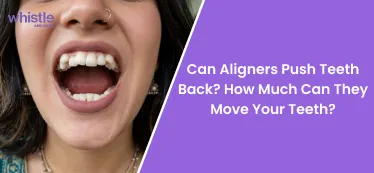
Can Aligners Push Teeth Back
Aligners
Dr. Wynne VelazquezMedically Reviewed by Whistle Dental Team
Written by Dr. Wynne Velazquez
Oct 03, 2026 · 14 min read
Read More