
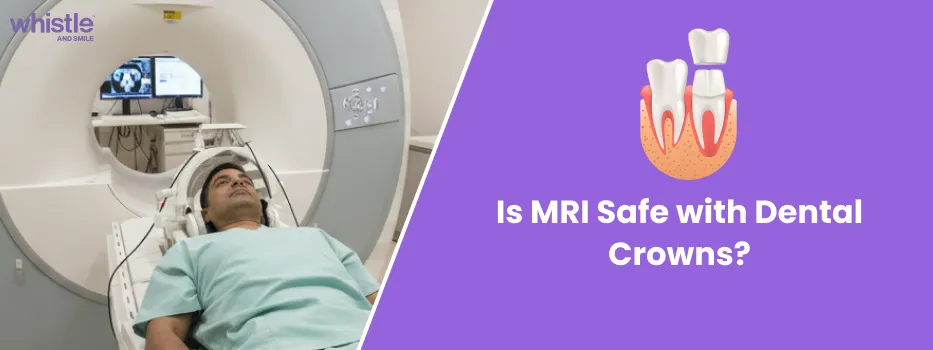
Is MRI Safe with Dental Crowns? What You Need to Know
 Medically Reviewed by Whistle Dental Team
Patients often bring up dental work when they’re scheduled for an MRI, and crowns are usually the first concern.
Yes, in almost all cases, it is completely safe to undergo an MRI with dental crowns. Modern dental crowns - including all-ceramic, porcelain, zirconia, and non-ferromagnetic metals like gold or titanium do not react dangerously to strong magnetic fields. Your dental crowns will not heat up, warp, or pull loose during an MRI scan. The primary consideration is image distortion, known as an artifact, which occurs when metal in a crown creates a minor shadow or blur on the MRI image if the scan is focused on your head, neck, or jaw. Always inform your radiologist and dentist about your dental history before your scan.
Key Facts:-
- High safety profile: Modern dental materials are non-ferromagnetic, meaning they are completely safe inside an MRI machine magnetic field.
- No physical displacement: Your crowns will not move, dislodge, or cause pain during the scan.
- Potential for image artifacts: Metallic crowns can cause localized distortion on MRI scans focused near the face or brain.
- Radiologist communication is key: Techs can adjust scan parameters to reduce interference if they know you have dental crowns.
- Advanced modern materials: Whistle partner clinic uses high-grade, biocompatible ceramic and zirconia materials that minimize MRI distortion completely.
The question comes up for a simple reason:
MRI scanners use strong magnets, and anything even slightly metallic can make patients uneasy.
In routine radiology practice, however, crowns almost never create real problems.
Most of the concern comes from not knowing what the crown is made of or how the MRI actually works.
Why MRI Teams Ask About Dental Work
MRI relies on magnetic fields and radiofrequency waves to create internal images.
The screening form includes pacemakers, joint replacements, surgical clips, and occasionally dental work simply because the team prefers complete information.
If a crown has older metal components, they want to be aware of it - not because it is unsafe, but because it can create a small artefact in certain imaging angles.
Why do MRI machines react to certain metals?
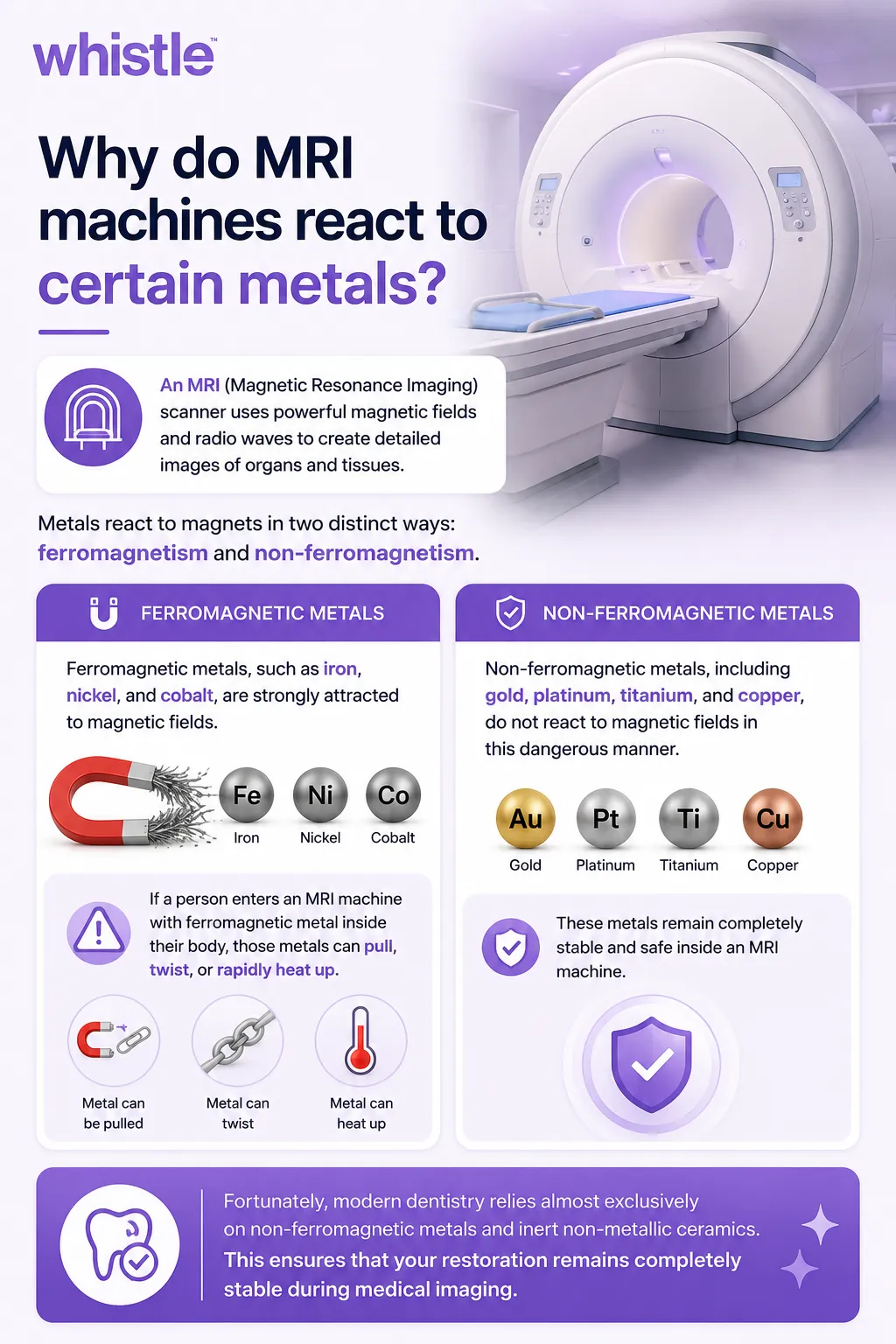
ses powerful magnetic fields and radio waves to create detailed images of organs and tissues. Metals react to magnets in two distinct ways: ferromagnetism and non-ferromagnetism.
Ferromagnetic metals, such as iron, nickel, and cobalt, are strongly attracted to magnetic fields. If a person enters an MRI machine with ferromagnetic metal inside their body, those metals can pull, twist, or rapidly heat up. Non-ferromagnetic metals, including gold, platinum, titanium, and copper, do not react to magnetic fields in this dangerous manner.
Fortunately, modern dentistry relies almost exclusively on non-ferromagnetic metals and inert non-metallic ceramics. This ensures that your restoration remains completely stable during medical imaging.
What Modern Crowns Are Made Of
Crowns placed today are almost always ceramic-based. Porcelain, zirconia, and lithium disilicate (E-max) are common options because they are strong, aesthetic, and completely stable in an MRI environment.
These materials are non-metallic, non-magnetic, and do not respond to heat generated during MRI sequences.
They stay exactly where the dentist placed them, regardless of the magnetic field strength. Even repeated MRI scans do not alter their structure or their bond with the tooth.
Many patients have several ceramic crowns without even knowing the exact material, and all of these remain unaffected during MRI.
Are metal crowns safe in an MRI scan?
Can MRI be done with Dental Crowns?
Yes, you can usually undergo an MRI safely even if you have dental crowns. Most modern dental crowns - including zirconia, ceramic, gold alloy, titanium, and porcelain-fused-to-metal (PFM) crowns are considered MRI-compatible and do not need to be removed before the scan.
While dental crowns generally do not move, loosen, or become dangerously hot inside an MRI machine, some metal-containing crowns may create minor image artifacts (distortions), particularly during MRI scans of the head, face, jaw, or neck.
These artifacts usually do not affect MRI scans of other body parts, such as the spine, knee, shoulder, or abdomen.
Before your MRI appointment, it's important to inform the MRI technologist or radiologist about any dental crowns, bridges, implants, or other dental restorations.
Older Crowns With Metal Layers
Some patients still have porcelain-fused-to-metal (PFM) crowns.
These contain a thin inner layer made from alloys such as nickel–chromium or cobalt–chromium. These alloys are only weakly magnetic.
In most cases, the MRI machine does not exert enough force to move or heat them.
- The only effect seen occasionally is a small imaging blur when the scan focuses directly on the jaw or sinuses.
- This does not harm the crown or the patient. It is simply a minor limitation for the radiologist, and they are familiar with interpreting such artefacts.
- Patients who have had their crowns for 15–20 years are more likely to have this design, although even many older PFM crowns remain fully MRI-safe.
Are PFM crowns safe for an MRI scan?
Yes, PFM (Porcelain-Fused-to-Metal) crowns are generally safe during an MRI scan. They do not need to be removed before the procedure and are not considered a safety risk for most patients.
A PFM crown consists of two layers:
- An inner metal framework that provides strength and durability.
- An outer porcelain layer that mimics the natural color and appearance of your teeth.
The metal alloys used in modern PFM crowns are typically non-ferromagnetic or only weakly magnetic, meaning they are not attracted strongly to the MRI's magnetic field. As a result, PFM crowns do not move, loosen, or become dangerously hot during an MRI scan.
Does MRI Affect Crown Adhesives or Cement?
Adhesives used in dentistry-glass ionomer, resin cement, zinc-based cements-do not react to magnetic fields.
They do not melt, weaken, or loosen under MRI conditions.
Radiology departments see patients with multiple crowns, full-mouth restorations, or large bridges undergoing scans daily.
The crowns stay intact. The cement does not soften.
There is no mechanism through which the MRI could alter the strength of the bonding material.
MRI Compatibility of Different Dental Crown Materials
Different dental crown materials interact differently with MRI scanners, but most modern crowns are considered safe and only vary in the level of image interference they may cause.
| Crown Material | Metallic Composition | Heating or Pulling Risk | MRI Image Artifact Risk | Overall MRI Compatibility |
|---|---|---|---|---|
| Zirconia (All-Ceramic) | Non-metallic zirconium oxide ceramic | None | None to Minimal | Excellent (Highly MRI Compatible) |
| E-Max (Lithium Disilicate) | Glass-ceramic (Lithium disilicate) | None | None to Minimal | Excellent (Highly MRI Compatible) |
| Gold / Noble Alloy Crown | Gold, platinum, palladium, and other noble metals | None | Mild (Localized image distortion) | Safe (Highly MRI Compatible) |
| Titanium Crown | Pure titanium or titanium alloy (Ti-6Al-4V) | None | Low to Moderate | Safe (Highly MRI Compatible) |
| Porcelain-Fused-to-Metal (PFM) Crown | Porcelain over cobalt-chromium or nickel-chromium alloy | None | Moderate (May affect head and neck MRI images) | Safe (Inform MRI Staff) |
| Stainless Steel Crown (Temporary/Pediatric) | Stainless steel (iron, chromium, nickel alloy) | None (Securely cemented) | Moderate to High (Near the mouth and jaw) | Safe (Inform MRI Staff) |
Wondering if your current dental work is ready for modern medical imaging? Book a free Whistle Smile Assessment at your nearest Whistle partner clinic (no commitment required).
Implants and Orthodontic Appliances
Titanium dental implants are MRI-compatible. Titanium is non-ferromagnetic, meaning it does not react to the magnet.
It may produce a faint local image distortion if the scan is very close to the implant, but this does not affect safety.
Fixed orthodontic braces behave differently. Brackets and wires can interfere with head or neck scans because of their metal content.
This is mostly an imaging issue, not a physical risk. If the patient has removable retainers with metal parts, these are usually taken out before the scan.
What should you do before getting an MRI with dental crowns?
If you have one or more dental crowns, there's usually no need to worry before an MRI scan. Most modern crowns are MRI-compatible and do not need to be removed. However, taking a few simple precautions can help ensure your scan is safe and produces the best possible images.
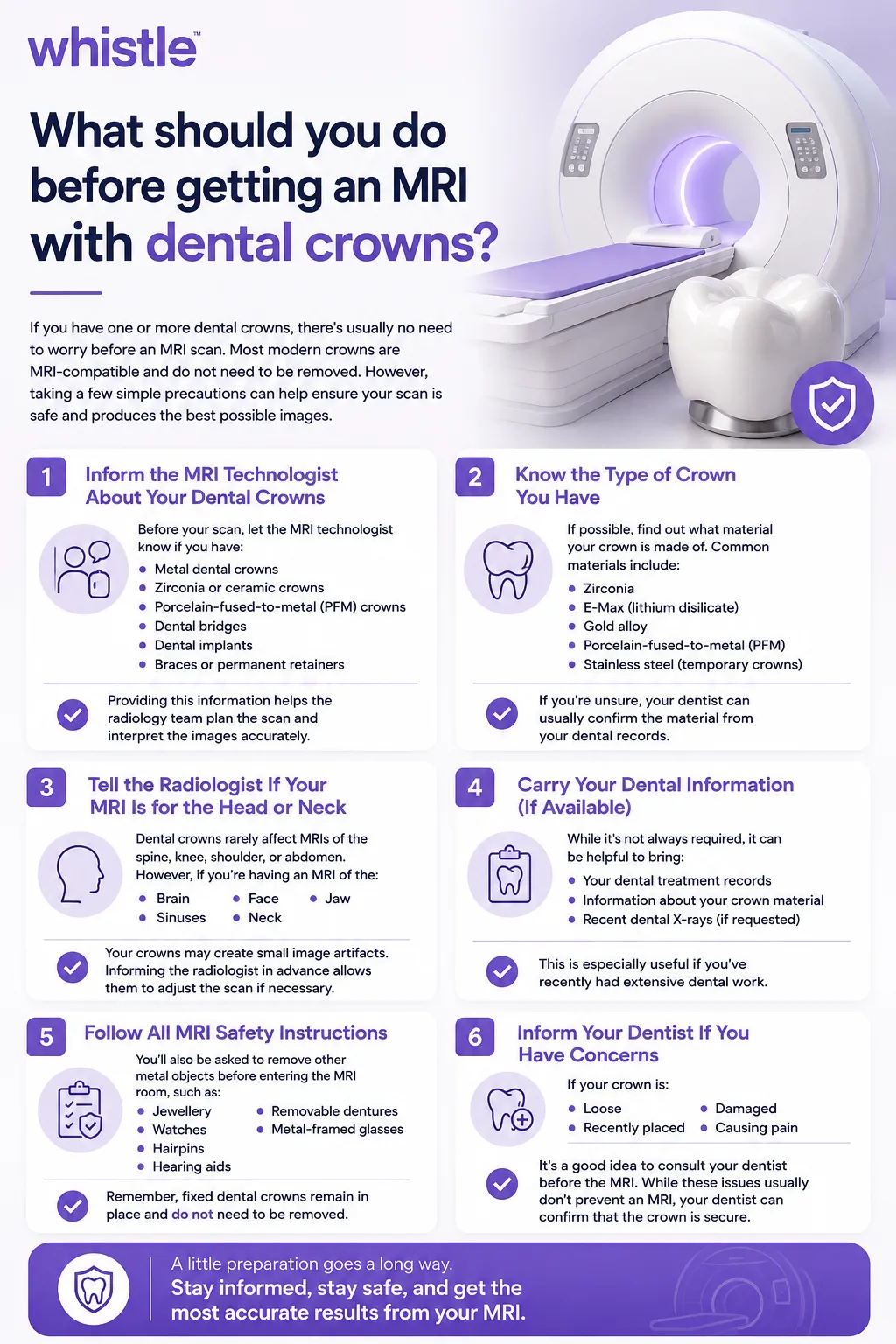
1. Inform the MRI Technologist About Your Dental Crowns
Before your scan, let the MRI technologist know if you have:
- Metal dental crowns
- Zirconia or ceramic crowns
- Porcelain-fused-to-metal (PFM) crowns
- Dental bridges
- Dental implants
- Braces or permanent retainers
Providing this information helps the radiology team plan the scan and interpret the images accurately.
2. Know the Type of Crown You Have
If possible, find out what material your crown is made of. Common materials include:
- Zirconia
- E-Max (lithium disilicate)
- Gold alloy
- Porcelain-fused-to-metal (PFM)
- Stainless steel (temporary crowns)
If you're unsure, your dentist can usually confirm the material from your dental records.
3. Tell the Radiologist If Your MRI Is for the Head or Neck
Dental crowns rarely affect MRIs of the spine, knee, shoulder, or abdomen. However, if you're having an MRI of the:
- Brain
- Face
- Jaw
- Sinuses
- Neck
Your crowns may create small image artifacts. Informing the radiologist in advance allows them to adjust the scan if necessary.
4. Carry Your Dental Information (If Available)
While it's not always required, it can be helpful to bring:
- Your dental treatment records
- Information about your crown material
- Recent dental X-rays (if requested)
This is especially useful if you've recently had extensive dental work.
5. Follow All MRI Safety Instructions
You'll also be asked to remove other metal objects before entering the MRI room, such as:
- Jewellery
- Watches
- Hairpins
- Hearing aids
- Removable dentures
- Metal-framed glasses
Remember, fixed dental crowns remain in place and do not need to be removed.
6. Inform Your Dentist If You Have Concerns
If your crown is:
- Loose
- Damaged
- Recently placed
- Causing pain
It's a good idea to consult your dentist before the MRI. While these issues usually don't prevent an MRI, your dentist can confirm that the crown is secure.
If You Are Unsure What Material Your Crown Contains
Patients who are unsure about their crown material can simply inform the radiology team.
They can check with the dentist, look at past X-rays, or request a quick dental radiograph if needed.
Most crowns placed in India in the past decade are zirconia or all-ceramic, so uncertainty rarely prevents the scan from going forward.
- Getting a Dental Crown After Root Canal: What to Expect
- Everything You Need to Know About Dental Crown Replacement
- Is Tooth Capping Painful? What Do Patients Experience?
- Tooth Cap vs Crown: What’s the Difference & Which Is Better?
What should you do before getting an MRI with dental crowns?
Guessing your dental crown material or delaying an MRI can lead to unnecessary concerns, so it's always best to inform your healthcare provider and let the radiology team assess your dental restorations before the scan.
Before You Go in for the Scan
A few steps help ensure everything goes smoothly:
– Inform the staff about all dental restorations.
– Remove oral piercings or jewellery.
– Mention older crowns, even though the risk is extremely low.
– Follow the technician’s instructions for keeping still, especially if the scan is near the face or neck.
These steps help the radiology team prepare the imaging sequence properly.
Also Read:
Your Next Steps
Undergoing an MRI scan when you have dental crowns is a routine, safe experience. Thanks to non-ferromagnetic dental metals and advanced all-ceramic materials, you do not need to worry about your crowns shifting, heating up, or detaching.
While metal-based crowns can occasionally create mild image artifacts on head and neck scans, experienced radiologists easily manage these distortions using advanced scanning adjustments.
If you are planning upcoming dental work or considering replacing older metal restorations, choosing modern zirconia or ceramic crowns gives you complete peace of mind for both aesthetic appeal and future medical imaging needs.
Ready to see what your smile could look like with advanced, biocompatible restorations? Book a free Whistle Smile Assessment at your nearest Whistle partner clinic today.
Also Read:
- Toothache After Dental Crown: Is It Normal & When to Worry?
- What are the different types of crowns for teeth?
- What Is a Dental Crown?
- Pros and Cons of Dental Crowns: What to Consider
Book 3D Teeth Scan
Consult our experts and get a 3D preview of your smile transformation!
Is MRI Safe with Dental Crowns
FAQ's
Q1.Will my dental crown heat up during an MRI scan?
No, your dental crown will not heat up during an MRI. The radiofrequency energy used in MRI machines does not induce thermal heating in non-ferromagnetic dental alloys or ceramic structures.
Q2.Can an MRI be done with dental crowns?
Yes, an MRI can be done safely with dental crowns. Modern crowns are made from materials like ceramic, zirconia, gold, or non-ferromagnetic alloys that do not pull or heat up inside the magnetic field.
Q3.Are dental implants safe for an MRI scan?
Yes, dental implants are safe for an MRI. Dental implants are almost universally made from high-grade titanium or zirconia, both of which are non-magnetic and highly biocompatible.
Q4.Are Whistle clear aligners safe during an MRI?
Yes, Whistle clear aligners are made from medical-grade, multi-layer polyurethane plastic. They contain zero metal and are 100% MRI-safe, causing no image distortion whatsoever during bite correction therapy.

 Medically Reviewed by Whistle Dental Team








 Medically Reviewed by Whistle Dental Team

 Medically Reviewed by Whistle Dental Team