
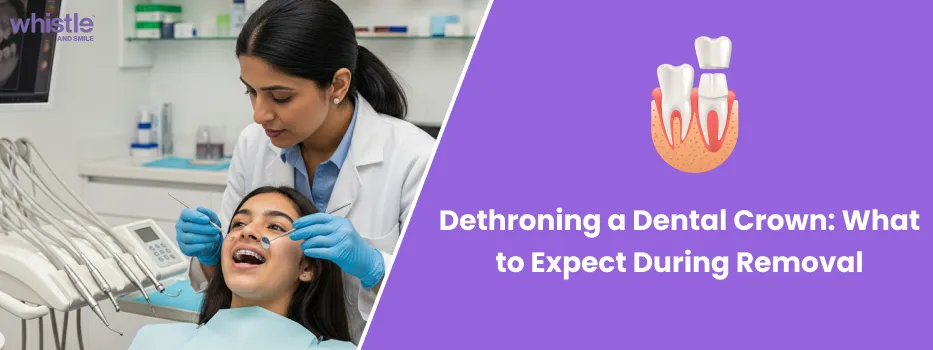
Dethroning a Dental Crown: What to Expect During Removal
 Medically Reviewed by Whistle Dental Team
If your dentist has told you that your dental crown needs to come off, you probably have a few immediate questions:
- "Is this going to hurt?"
- "How do you take off something that's been stuck to my tooth?"
- "Can a tooth cap even be removed?"
The short answer: yes, it can and no, it usually doesn't hurt.
Removing a dental crown is actually one of the more routine things that happens in a dental chair. It is simpler than you'd expect; in fact, it is often easier than removing a stubborn sticker from a mug. This blog walks you through the whole process, including what makes it comfortable, what to expect on the day, and what the recovery actually looks like.
Key Takeaways:
- Dental crowns can be safely removed by dentists without damaging the underlying tooth in most cases.
- Crown removal is a routine dental procedure and is generally simpler than most patients expect.
- The procedure is usually painless, especially when local anesthesia is used for sensitive teeth.
- Root canal-treated teeth often require little or no anesthesia because the nerve has already been removed.
- Common reasons for crown removal include decay beneath the crown, crown damage, poor fit, cosmetic replacement, or additional dental treatment.
- Dentists may use specialized instruments, ultrasonic devices, or sectioning techniques to safely detach the crown.
- Some crowns can be removed intact, while heavily cemented crowns may need to be cut into sections for safe removal.
- After removal, dentists clean away old cement and inspect the tooth for decay, cracks, or structural damage.
Can a Tooth Cap Be Removed?
Yes - A dental crown or tooth cap can be removed, and your dentist does it routinely. Crowns are cemented onto your tooth with dental adhesive, not permanently fused to the bone. When removal is needed, a dentist uses specialised tools to loosen the cement and gently detach the crown without harming the natural tooth underneath.
Whether you need removal for decay treatment, a poor fit, or a cosmetic upgrade, the procedure is well within the scope of any experienced dental team.
So… Why Would Anyone Have to Remove a Crown?
Crowns are designed to last for several years, sometimes even decades. But like anything in life— your phone battery, your patience - sometimes they don’t last forever. Here are the most common reasons dentists decide it’s time for a crown to retire:
1. Decay Has Sneaked In
If dental caries are found inside the crown, or some level of discomfort arises on the crowned tooth, then your dentist might need to remove the crown and see what's happening underneath
2. The Crown Is Damaged
Crowns can crack, chip, or loosen especially if you grind your teeth or chew on ice or constantly eat chewy sweets or gums (yes, your dentist knows you do it).
3. The Crown Doesn’t Fit Like It Used To
Your occlusion, meaning your bite can change over time due to various reasons. If a crown starts causing unease, jaw pain, or chewing issues, removal and replacement might be required
4. Cosmetic Upgrade
Maybe your old crown looks a bit too “1990s dentistry style,” and you want one that blends better with your natural teeth.
5. Additional Treatment Needed
If that tooth needs another root canal treatment or any other more extensive modification, the crown has to come off so your doctor can get access and visibility
Whatever the reason, crown removal is a normal, everyday dental task—nothing dramatic or scary.
Is Permanent Crown Removal Painful?
This is the question most patients ask before their appointment and it deserves a direct answer.
During the procedure: For most patients, crown removal is not painful. If your tooth has any sensitivity or exposed nerve tissue, your dentist will apply local anaesthesia before starting. Once the area is numb, you'll feel pressure and vibration but not pain. If a root canal has already been performed on that tooth, there may be no need for anaesthesia at all, since the nerve has already been treated.
After the procedure: Some mild soreness around the gum line is normal for 24-48 hours after the crown is removed. This is from the instruments gently working around the gum margin, not from the tooth itself. It fades quickly and is usually managed with over-the-counter pain relief if needed.
| Phase | What You Feel | Anaesthesia Needed? |
|---|---|---|
| During removal (with live nerve) | Pressure, slight vibration | Yes - local anaesthesia |
| During removal (root canal tooth) | Minimal - nerve is gone | Usually not required |
| Immediately after | Mild gum soreness | Typically no |
| 24–48 hours after | Slight tenderness | OTC pain relief if needed |
| 48+ hours after | None in most cases | Not required |
The honest summary: Dental crown removal is one of the less uncomfortable dental procedures. Most patients are surprised by how manageable it is.
Before the Appointment: What Should You Do?
The good news is… not much! Dental crown removal doesn’t require fasting, prayer circles, or handwritten goodbye notes to your crown. But here are some useful tips:
- Expect an X-ray: It helps the dentist see what’s happening under the crown.
- Ask about numbing: Some people don’t need it; others prefer it just for peace of mind.
And you’re all set!
What Actually Happens When a Crown Is Removed
Let me walk you through the procedure in simple steps.
1. Anaesthetising the Tooth (If Needed)
First things first: If your tooth is sensitive or painful, the doctor might give you a little shot to keep you comfortable. If a root canal has been previously done in that tooth, you might not need any numbing at all because the nerve is already gone. Lucky you!
Don’t worry numbing shots nowadays are fast, small, and surprisingly gentle.
2. Checking Out the Crown
The dentist takes a good look at your crown to understand how it was attached and how strong the cement is. Some crowns pop off easily. Others… Well, they like to pretend they’re part of your skeleton now.
3. Loosening the Crown (The Fun Gadget Part)
Dentists have tools that sound intimidating but are actually super gentle. They might use:
A tiny device that taps or vibrates the crown
Small instruments that help nudge the crown loose
An ultrasonic scaler that breaks down the cement around the edge
You may feel some vibration on the tooth surface. It's just like wiggling a jar in order to open it
4. Splitting the Crown (Only If Necessary)
If the crown is being well cemented and seated on the tooth surface, then the doctor may need to
They make small slits in the crown by using tiny drill-like pieces.
The crown weakens and opens slightly.
It is not a painful procedure at all; it is one of the safest and easiest ways to remove a dental crown. In this process, we might need to sacrifice the old crown because of the modification made to open it, but don't worry, you will get a new shiny one!
Sometimes the dentist must sacrifice the old crown, but that’s okay—you’ll get a shiny new one.
5. Clearing Up the Old Cement
Once the crown is removed, all the residual cement from the tooth will be cleaned. This procedure makes sure the tooth is clean and smooth
At this point, your doctor will also check for decay or damage that needs attention.
6. Restoring the Tooth (If Needed)
If a cavity is found under the crown, this is when the doctor removes it and rebuilds the area with tooth coloured restoration material. It’s like fixing the foundation before putting on a new roof—important, necessary, and completely vital
7. Fixing on Temporary Crown
Most of the time, you’ll be given a temporary crown until you get your final prosthesis. Until then, this temporary crown will guard the tooth, help you chew, prevent any other anatomical changes, and also save you from walking around with funny-looking gaps, especially in the case of front teeth.
Temporary crowns are often fixed with gentle cement, so they pop off easily when your permanent one arrives.
- Everything You Need to Know About Dental Crown Replacement
- Getting a Dental Crown After Root Canal: What to Expect
- Pros and Cons of Dental Crowns: What to Consider
- What are the different types of crowns for teeth?
How to Remove a Root Canal Cap - Is It Different?
Many patients specifically search how to remove a root canal cap because they're unsure whether treating a previously root-canal-treated tooth makes the crown harder or more painful to remove.
Here's what you need to know: The removal process is identical. The same tools, the same technique, the same steps apply regardless of whether the tooth has had a root canal.
The key difference is comfort. A tooth that has undergone root canal treatment no longer has a live nerve inside it. This means the removal process is often quicker and more comfortable for those patients because there is no nerve sensitivity to manage. Many patients with root canal crowns don't even require local anaesthesia for the removal.
Your dentist will still take an X-ray before proceeding, since the underlying tooth structure and the crown's cementation need to be assessed regardless of the tooth's nerve status
The Two Main Techniques Dentists Use to Remove Crowns
How Long Does Crown Removal Take?
Crown removal itself typically takes 15 to 45 minutes, depending on:
- How firmly the crown is cemented
- Whether sectioning (cutting) is required
- Whether there's decay underneath that needs immediate attention
- Whether impressions for a new crown are taken in the same visit
If your appointment includes a scan or impression for the replacement crown and placement of a temporary, expect the full visit to run 45–90 minutes. Your dentist will give you a more accurate timeline during the assessment.
What Do We Need to Know After the Procedure?
You may feel a little sore around your gums and teeth. This normally resolves within a day or two.
Postoperative care:
- Mild pain relievers, if needed
- Soft diet for the first day
- Brushing softly around the temporary crown
- Also, do not to take any chewy sticky foods like caramels, taffy, or gum
Also Read:
- How Long Does Tooth Pain Last After Getting a Crown?
- Do we need crowns for crooked front teeth?
- Tooth Cap vs Crown: What’s the Difference & Which Is Better?
- Is Tooth Capping Painful? What Do Patients Experience?
Final Intellections: You’ve Got This!
Getting a dental crown removed is not a painful process. In fact, it’s one of the easier dental procedures. With evolution, we have got good anaesthetic agents, precise tools, and a doctor who knows what they’re doing; the whole process is usually smooth, comfortable, and faster than you expect.
Consider the crown removal procedure as giving your tooth a fresh start. Whether you're replacing, repairing, or removing, fixing, or upgrading to something more natural-looking, you’re taking care of your oral health—and that’s always a win.
Book 3D Teeth Scan
Consult our experts and get a 3D preview of your smile transformation!
FAQ's
Q1.Can a tooth cap be removed and replaced?
Yes, dental caps (crowns) are cemented, not permanently fused, to your teeth. They can be removed by your dentist and replaced with a new one. Removal is routine and is done regularly for reasons including decay, damage, poor fit, or cosmetic preference.
Q2.How do you remove a crown from a tooth if it's firmly attached?
For firmly cemented crowns, dentists use one of two approaches: they apply a specialised crown-removal tool that vibrates or applies directional force to break the cement seal, or they section the crown using a fine dental bur, removing it in pieces. Both methods are designed to protect the underlying tooth.
Q3.How do you remove a root canal cap?
The process for removing a crown from a root canal-treated tooth is the same as any other crown removal. The difference is that the tooth has no live nerve, which makes the procedure even more comfortable — often requiring no local anaesthesia. Your dentist will X-ray the tooth beforehand to assess the root and underlying bone.
Q4.Will my tooth look strange after crown removal?
The tooth underneath a crown is typically prepared (shaped) when the crown was first fitted, which means it won't look exactly like an untouched tooth. A temporary crown is almost always placed immediately after removal to protect it until your permanent replacement is ready.
Q5.Will my tooth look strange after crown removal?
The tooth underneath a crown is typically prepared (shaped) when the crown was first fitted, which means it won't look exactly like an untouched tooth. A temporary crown is almost always placed immediately after removal to protect it until your permanent replacement is ready.



 Medically Reviewed by Whistle Dental Team
 Medically Reviewed by Whistle Dental Team
 Medically Reviewed by Whistle Dental Team