
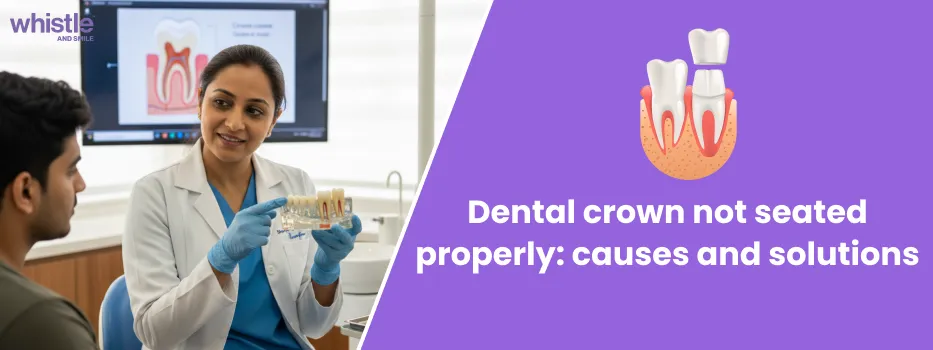
Dental Crown Not Seated Properly? Causes & Fixes
 Medically Reviewed by Whistle Dental Team
Dental crowns are one of the most common standard restorative procedures in today's dentistry.
A properly placed dental crown will restore the natural tooth function and strength.
You just walked out of the clinic with a brand new crown. It looks perfect in the mirror. But the moment you bite down, something feels incredibly wrong. Your teeth do not meet naturally, or perhaps you feel a sharp pinch in your gums. You try to ignore it, hoping you will just "get used to it." Please do not ignore it. When a restoration does not feel like your own tooth, you are dealing with a clinical issue.
Key Takeaways:-
- The Bite Risk: An ill fitting dental crown can cause jaw pain, radiating headaches, and permanent wear on your opposite teeth.
- The Bacteria Trap: A gap at the gumline allows "microleakage," where plaque destroys the tooth underneath the cap.
- Precision Matters: The dental crown fitting procedure requires absolute accuracy during both the digital scanning and the cementation phases.
- Fast Fixes: If caught early, a dentist can often adjust a high bite or remove excess cement without needing to fabricate a entirely new crown.
What happens when your dental crown not seated propely? A poorly seated cap means there is a microscopic gap between the porcelain and your natural tooth structure. This prevents a healthy bite and allows aggressive bacteria to leak underneath the crown, causing deep decay. If your bite feels high or your gums are bleeding, you must have it adjusted by a restorative dentist immediately.
In case of not seated properly, that dental crown will lead to dysfunction, discomfort and other dental issues and also affect the long term oral health function if not treated.
In this blog, we will explore the causes of dental crowns not seating properly and also the right solutions to fix this dental issue.
How to Check Your Crown Fit at Home
If you suspect your new cap is not sitting right, try these two physical checks before calling your clinic:
- The Tap and Hold Test: Bite down very slowly. Pay attention to exactly which teeth touch first. Your upper and lower teeth should meet simultaneously across your entire mouth. If your crowned tooth hits first and stops your other teeth from touching, the bite is high.
- The Floss Catch Test: Take a piece of dental floss and slide it gently between the crown and your adjacent tooth. Pull the floss back up along the side of the crown. If the floss snags, shreds, or gets stuck on a sharp ledge, your crown margin is open or poorly seated.
What is meant by “not seated properly’’ ?
A good dental crown is considered proper when it perfectly fits over the prepared tooth and completes marginal adaptation overall with surrounding teeth and gum tissues, with good biting occlusion.
When a dental crown is not seated properly, there will be a gap between the teeth and crown, leading to improper bite occlusion and uneven contact with surrounding tissues.
Common causes of an improper seated dental crown
Impression and digital scanning errors: Sometimes, during impression taking, errors can happen to inaccurately fabricate the crown, and also during digital scanning, data errors can lead to crown fabrication failure; these two things can cause the crowns not to seat properly.
Crown material issues: certain materials like zirconia or ceramic crowns need a precise making process during milling, sintering, and porcelain layering, so that if any minor inaccuracies can affect the internal fit of the crown.
Cementation errors: the wrong luting cement and too much cement application can affect the complete crown seating, and also, adequate pressure should be maintained during cementation; otherwise, it will hinder the seating.
Tight proximal contact: the excessive proximal tight contact with adjacent teeth can prevent the crown from complete seating,g even if it is clinically acceptable seating.
Also Read:
- What are the different types of crowns for teeth?
- Toothache After Dental Crown: Is It Normal & When to Worry?
- Pros and Cons of Dental Crowns: What to Consider
- Side Effects of Teeth Capping: Risks, Pain & What to Expect
What Does an Ill Fitting Dental Crown Actually Feel Like?
Your mouth is highly sensitive to changes. Even a discrepancy of a fraction of a millimeter will trigger warning signs.
- Constant Sensitivity: You feel sharp pain when drinking hot coffee or cold water, indicating the root is exposed.
- Food Impaction: Meat or fibrous vegetables constantly get stuck perfectly between the crown and your gums.
- Bleeding Gums: The gum tissue around the specific tooth remains red, inflamed, or bleeds when brushing days after the procedure.
- Halitosis: You notice a persistent bad breath specifically coming from that side of your mouth, indicating bacterial growth under the cap
Why is a Poorly Seated Crown a Serious Dental Emergency?
When a crown is fabricated, it must create a perfect seal around the prepared tooth. Dentists call this "marginal adaptation."
According to NIH clinical research, if the gap between the crown and the tooth exceeds 120 micrometers, it creates a massive tunnel for oral bacteria. This is called microleakage, saliva washes away the dental cement, and biofilm begins colonizing under the crown. Because you cannot brush under a crown, the bacteria rapidly cause secondary caries (deep decay) and pulpal infection. You could lose the entire tooth if the ill fitting dental crown is not corrected.
Signs and symptoms of a poorly seated crown
- Patients can feel persistent pain or sensitivity after crown placement.
- They can feel the bite is high or uneven.
- Food lodgement can happen around the dental crown.
- Bleeding gums, gum irritation, or mild swelling can be expected near the crown margin.
- Halitosis or bad breath indicates that bacterial growth affects oral health.
- Repeated dislodgement of dental crowns or loose fit.
Why is a poorly seated crown a serious issue?
A crown that is not seated properly will create a microscopic gap that will colonize the microorganism to grow and penetrate under the crown. Eventually, it will lead to pulpal infections and decay in other parts of a tooth, and also can cause periodontal diseases.
In addition to that. An improper bite occlusion causes jaw pain, radiating headaches, and excessive wear on the opposite teeth. An early intervention approach is better for preventing further dental problems.
- Do we need crowns for crooked front teeth?
- Tooth Cap vs Crown: What’s the Difference & Which Is Better?
- Is Tooth Capping Painful? What Do Patients Experience?
- Everything You Need to Know About Dental Crown Replacement
Why Does a Crown Fail to Seat?
- Inadequate Tooth Preparation: If the tooth is not tapered correctly by the dentist, the crown simply cannot slide down all the way.
- Cement Interference: Sometimes, old temporary cement or tiny amounts of plaque block the crown from sitting flush against the margin.
- Impression Errors: Traditional putty impressions can shrink or distort. If the lab gets a distorted mold, they will fabricate a distorted crown.
- Tight Proximal Contacts: If the crown is made slightly too wide, it will wedge tightly against your neighboring teeth and refuse to drop down fully onto the gumline.
The Dental Crown Fitting Procedure: How Experts Fix the Problem
Fixing the issue depends entirely on why the crown failed to seat:
- Clinical Adjustment: If the crown simply has a high spot on the chewing surface or slightly tight sides, your dentist can safely polish and adjust the porcelain right in the dental chair.
- Removal and Recementation: If trapped debris or excess luting cement caused the gap, the dentist will carefully remove the crown, thoroughly clean the tooth, and perform the dental crown fitting procedure again under strict moisture control.
- Total Replacement: If the crown was fabricated poorly due to a distorted impression, no amount of adjusting will fix it. Your dentist must take a new, highly accurate 3D scan and send it back to the laboratory for a complete replacement.
Solutions for dental crown not seated properly
- Clinical Evaluation: A clinical examination is the first step we have to take after crown placement to check the crown margin fit, occlusion, and contact points. Dental X-rays are used to check for hidden gaps and dental cement remnants.
- Crown adjustment: Tight contact and high bite can be easily adjusted in the clinic by polishing and making minor adjustment dental crowns.
- Crown removal and recementation: If any luting cement errors or plaque presence are present, the crown has to be removed and followed by proper teeth cleaning. After that, we can do the recementation of the same crown under good isolation.
- Crown replacement: A new crown is the ideal choice for poorly fitting crowns and fabrication errors by either improper impression or a digital scanning mistake. A good crown will ensure long-term success.
- Improved techniques and materials: High-quality impression materials and a good brand of digital scanning can reduce the risk of dental crown seating problems.
What are the ways to prevent crown seating problems
- An ideal tooth preparation with good clearance.
- During cementation, a good isolation is needed for proper cementation.
- A good, accurate impression or intraoral scans.
- We should check the crown fit before final cementation.
- A right selection of luting cement can ensure good cementation.
These are the ideal points we keep in mind to get long-lasting results.
A dental crown seating issue is not a minor clinical problem that needs immediate attention.
At the same time, patients should report to the dentist as soon as possible if they face discomfort, pain, or uneven bite issues after crown placement.
Early diagnosis of this issue can save the tooth and prevent long-term complications.
- Is MRI Safe with Dental Crowns? What You Need to Know
- How long should tooth pain last after getting a crown?
- What Is the Best Material for Your Dental Crown?
- How Long Does Tooth Pain Last After Getting a Crown?
Your Next Steps
A dental crown is supposed to look, feel, and function exactly like a natural tooth. You should never have to consciously think about it when you chew. If you are compensating for a weird bite or avoiding cold drinks because of sensitivity, you are risking the health of the tooth underneath.
Stop tolerating pain. Book a free consultation at your nearest Whistle Partner clinic today to get your bite restored properly.
Book 3D Teeth Scan
Consult our experts and get a 3D preview of your smile transformation!
FAQ's
Q1.Is it normal for a new crown to feel weird at first?
It is normal for it to feel slightly different to your tongue for a few days. However, it is absolutely not normal for it to cause sharp pain, hit your opposite teeth early, or cause your jaw to ache.
Q2.Can a dentist fix an ill-fitting crown without replacing it?
Sometimes. If the issue is just a high chewing surface or slightly tight contacts, the dentist can polish and adjust the porcelain. If the margin near the gumline is open, the crown must be replaced.
Q3.Does recementing a crown hurt?
No. Recementing involves removing the loose crown, cleaning the tooth thoroughly, and applying new bonding cement. Your dentist may use local anesthesia to ensure you are completely comfortable during the cleaning process.
Q4.How do 3D intraoral scanners prevent crown seating issues?
Traditional putty impressions can shrink or tear. 3D digital scanners take a mathematically perfect picture of your prepared tooth, allowing the laboratory to mill a crown with zero distortion.

 Medically Reviewed by Whistle Dental Team

 Medically Reviewed by Whistle Dental Team
 Medically Reviewed by Whistle Dental Team