

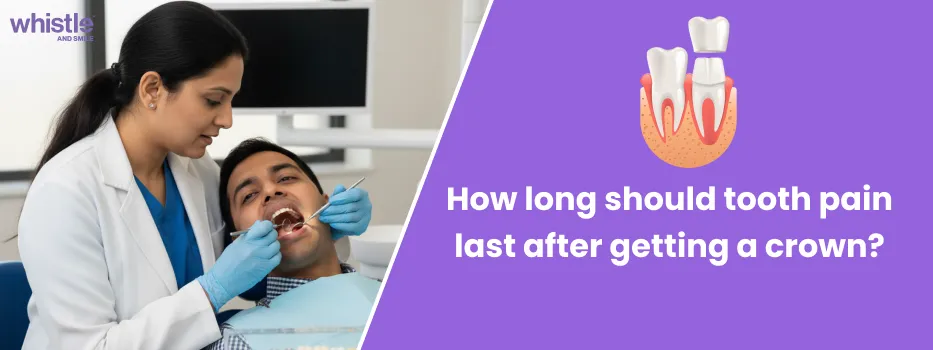
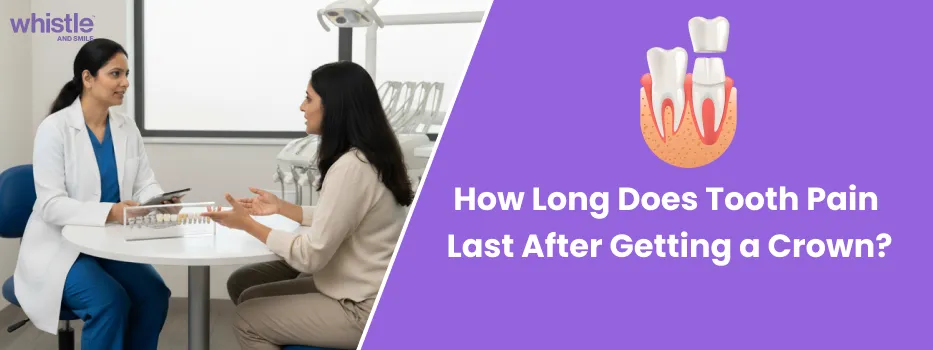
How long should tooth pain last after getting a crown?
 Medically Reviewed by Whistle Dental Team
Most people assume that once a crown goes on, the tooth is completely fixed and the pain is gone forever. So, it can be incredibly frustrating when, a few hours later, the tooth starts to ache or feels sharply sore when you chew.
Dental crown is a treatment which is done to preserve or protect the damaged natural tooth. A tooth can be damaged either due to caries or trauma. Placing a crown over an existing tooth allows the natural root to stay in place and function normally. This also helps to maintain the normal bone integrity. Dental crowns can be of different types depending upon the need. They can be temporary, permanent, esthetic (metal free) or non-esthetic (metal) crowns.
Key Takeaways
- The 2-Week Window: Mild soreness and sensitivity to hot or cold are completely normal for the first few days, but the pain should steadily decrease. If the pain persists or worsens after 14 days, contact your dentist.
- The "High Bite" Issue: If you feel a sharp pain only when you bite down, your crown is likely sitting slightly too high. This is incredibly common and takes a dentist less than five minutes to adjust.
- Temporary Crown Pain: It is completely normal for temporary crowns to be highly sensitive to cold, as they do not seal the tooth as tightly as a permanent crown will.
- Red Flags: If your pain wakes you up at night, throbs constantly without chewing, or spreads to your ear or jaw, you likely have an inflamed nerve that may require a root canal.
If you are experiencing dental crown tooth pain, take a deep breath. Usually, it is perfectly normal. A mild ache is simply your tooth and surrounding gum tissue adjusting to the new crown and recovering from the dental work. However, if the pain lasts longer than a couple of weeks, or if you feel a sharp, throbbing pain that wakes you up at night, it is time to investigate further.
Here is everything you need to know about tooth pain after capping, what causes it, and exactly how to relieve it.
How long should tooth pain last after getting a crown?
The process of getting a crown involves a few steps, one of which is getting a temporary crown. A temporary crown is a protective layer that is placed for the time till the permanent crown gets fabricated in the lab.
It is normal for a tooth to be sore/ sensitive for the first 24-48 hours after getting a temporary or a permanent crown.
This can be due to high points, food lodgment, post-operative effects of local anesthesia, pressure of a foreign material, or irritation of the gums due to dental cement.
Pain After Permanent Crown Placement: Causes and Relief
High points are generally adjusted immediately after the crown procedure. When an anesthetic is used during the crown procedure, its numbing effects can last for a few hours.
During this time, the lips or cheeks are more prone to burn, bite or get ulcers and cause pain/sensitivity before the numbing waives off.
There may also be some bruising and inflammation at the site of the anesthetic injection shortly after the dental crown procedure, particularly on the lower jaw. This should go away spontaneously without the need for treatment.
7 Common Causes of Pain After Putting a Crown on a Tooth
If you are currently at home dealing with an aching crown, one of these seven issues is likely the culprit:
1. Natural Tissue Trauma (Sore Gums)
The tooth under the crown is surrounded by sensitive ligaments, bone, and gum tissue. During the procedure, the dentist must drill and shape the tooth to fit the crown. This process naturally irritates the surrounding tissue.
- The Symptom: A dull, generalized ache and tender, swollen gums.
- The Solution: This is normal and fades within 3 to 4 days.
2. A "High" Bite
This is the most common reason for crown pain. If the crown is even a micro-millimeter too tall, it hits your opposite teeth before the rest of your mouth closes. This puts immense, isolated pressure on the single tooth root.
- The Symptom: A sharp, localized pain precisely when you bite down or chew food.
- The Solution: Visit your dentist. They will use a piece of articulating paper to find the high spot and gently polish it down.
3. Nerve Inflammation (Pulpitis)
If your crown was placed over a live tooth (meaning you did not have a root canal first), the nerve inside the tooth (the pulp) might have become inflamed from the drilling process or the cement.
- The Symptom: Severe sensitivity to hot or cold temperatures that lingers for minutes, or a throbbing pain that happens even when you are not eating.
- The Solution: If the inflammation is mild, it will heal on its own. If it is severe and irreversible, you will likely need a root canal.
4. Teeth Grinding (Bruxism)
If you chronically clench or grind your teeth in your sleep, you are putting massive, unnatural pressure on your new crown.
- The Symptom: Waking up with a sore jaw, a headache, and aching pain around the crowned tooth.
- The Solution: Your dentist can fabricate a custom night guard for you to wear while you sleep.
5. Poor Crown Fit or Cement Leakage
If the crown does not fit perfectly against your natural gumline, or if the dental cement has slightly washed out, microscopic gaps are left behind.
- The Symptom: Severe sensitivity, especially to sugary foods, or a bad taste in your mouth.
- The Solution: The dentist will need to re-cement the crown or, in rare cases, have a new crown fabricated to ensure a tight seal.
6. Recurrent Decay Under the Crown
A crown cannot get a cavity, but the natural tooth stump underneath it certainly can. If bacteria breach the seal of an older crown, rot can begin at the gumline.
- The Symptom: Localized pain, sensitivity, and sometimes a foul odor around the tooth.
- The Solution: The crown must be removed, the decay treated, and a new crown placed.
7. A Fractured Tooth
If the natural tooth beneath the crown develops a hairline crack—often from chewing on hard foods or ice—it can expose the inner pulp.
- The Symptom: Sharp pain specifically upon releasing a bite.
- The Solution: Depending on the severity of the crack, the tooth may need a root canal, or in worst cases, an extraction.
After fixing cap on tooth
If the pain continues beyond several weeks or it is severe, it may be necessary to seek dental advice to investigate the situation. While it is normal for the crown to feel strange as patients get used to the feel of it in their mouth, in some cases the crown may need some adjustment to properly fit the shape of the mouth.
The Crown Healing Timeline: What to Expect
Every mouth heals differently, but here is a general timeline to help you gauge whether your pain is normal or abnormal.
| Time After Placement | Normal Sensations | Abnormal Red Flags (Call Dentist) |
|---|---|---|
| Days 1 to 3 | Mild soreness, tender gums, sensitivity to extreme cold. | Sharp, unbearable pain; severe facial swelling. |
| Days 4 to 7 | Gums begin to feel normal; chewing becomes easier. | Pain is actively getting worse rather than better. |
| Week 2 | Tooth feels almost completely normal. | Pain when biting down (indicates a high bite). |
| Week 3+ | Rare, mild twinge with ice water. | Throbbing pain; pain that wakes you up at night. |
5 Home Remedies to Relieve Crown Pain Safely
If you are waiting a few days to see if the pain subsides, or if you are waiting for a dental appointment, you can safely manage the discomfort at home:
- Over-the-Counter Painkillers: Ibuprofen (Advil) or Acetaminophen (Tylenol) are excellent for reducing both pain and tissue inflammation.
- Warm Saltwater Rinses: Dissolve half a teaspoon of salt in a glass of warm water. Swish gently for 30 seconds to reduce gum inflammation and kill bacteria.
- Chew on the Other Side: Give the tooth a break. Eat soft foods (like yogurt, soup, and mashed potatoes) and chew exclusively on the opposite side of your mouth.
- Desensitizing Toothpaste: Use a toothpaste designed for sensitive teeth (containing potassium nitrate) and brush gently around the gumline.
- Avoid Extreme Temperatures: Skip the ice water and the piping hot coffee until the nerve settles down.
When Should You Go Back to the Dentist?
Do not try to tough it out if the pain changes from an annoyance to an agony. You should immediately call your Whistle Partner Clinic if you experience:
- Pain that persists throughout the night and prevents you from sleeping.
- A pimple-like bump (abscess) forming on the gums near the crown.
- Visible swelling in your gums, cheek, or jaw.
- The crown feels physically loose or wiggles when you touch it.
- A sudden, persistently foul taste or smell coming from the tooth.
- These are classic signs of an infection or irreversible nerve damage. They will not go away on their own.
Your Next Steps
Pain after a crown is usually just the tooth settling down after the trauma of being reshaped. In the vast majority of cases, it resolves within a week. But if the pain lingers, throbs, or spreads, do not wait it out. Dental crowns are meant to protect your smile, not punish you.
If your crown does not feel right, trust your gut. Book an appointment at your nearest Whistle Partner clinic today. A simple five-minute bite adjustment could be all that stands between you and a pain-free smile.
Book 3D Teeth Scan
Consult our experts and get a 3D preview of your smile transformation!
How long should tooth pain last after getting a crown?
FAQ's
Q1.Why does my temporary crown hurt so much?
Temporary crowns are made from relatively weak acrylic or resin and are cemented using temporary, easily breakable glue. Because they do not create a perfect, airtight seal like a permanent crown, they are highly susceptible to cold air and hot liquids irritating the underlying tooth. This sensitivity is normal and will disappear when the permanent crown is placed.
Q2.Can a crown be adjusted without taking it off?
Yes! If your pain is caused by a "high bite," the dentist does not need to remove the crown. They will simply use a specialized dental bur to gently polish down the top surface of the crown until it aligns perfectly with your natural bite.
Q3.Why does my tooth hurt 2 years after getting a crown?
If a crown suddenly starts hurting years after placement, the tooth beneath it has likely developed an issue. The most common causes are a newly formed cavity under the crown's margin, a fractured tooth root from chewing hard foods, or the onset of an infection in the nerve.
Q4.How do you know if a dental crown is infected?
How do you know if a dental crown is infected? An infected crown (or rather, an infected tooth beneath the crown) typically presents with a constant throbbing ache, severe pain when pressure is applied, swelling of the surrounding gums or jaw, a fever, or a small, pimple-like bump on the gumline that oozes pus. If you experience these symptoms, seek emergency dental care.

 Medically Reviewed by Whistle Dental Team
 Medically Reviewed by Whistle Dental Team
 Medically Reviewed by Whistle Dental Team
 Medically Reviewed by Whistle Dental Team


