
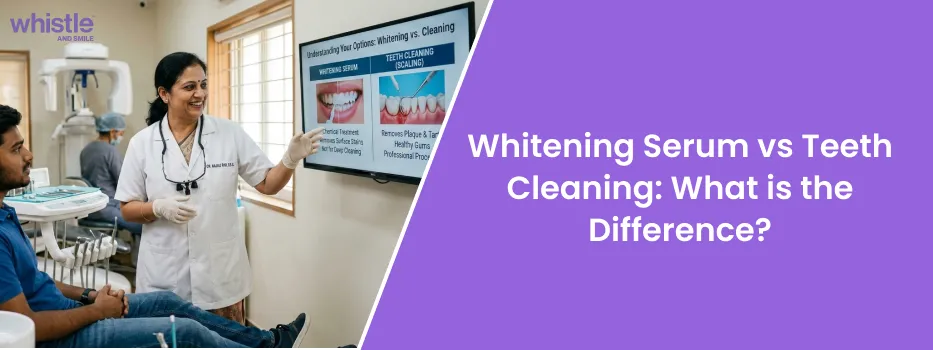
Whitening Serum vs Teeth Cleaning: What is the Difference?
 Medically Reviewed by Whistle Dental Team
Key Takeaways
- Teeth whitening serums: Most trending purple serums use colour theory to mask yellow stains temporarily. They do not chemically whiten your teeth.
- The Tartar Reality: A teeth cleaning gel cannot dissolve calculus (hardened plaque). That requires professional scaling.
- Hidden Brightness: Many "yellow" teeth are just dirty. Removing external stains often reveals a naturally white smile beneath.
- Enamel Protection: Unsupervised, continuous use of abrasive gels can permanently thin your enamel.
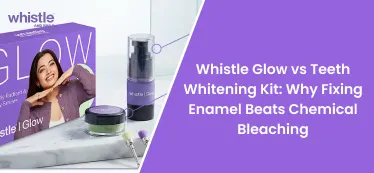
- The Whistle Glow Difference: Instead of aggressive bleaching, Whistle Glow uses biomimetic remineralization (depositing minerals back into the tooth) to create a naturally glossy, brighter surface.
Why are my teeth still looking yellow?
A whitening serum and a professional cleaning solve two different problems. The confusion happens because both are marketed around brightness. But brightness is not a single biological issue.
A whitening serum is usually designed to change shade. Some use peroxide, while others rely on polishing agents. A few newer formulations speak about enamel care. But most of them work only on surface discoloration. They neither remove tartar nor treat bleeding gums. And they certainly do not clean below the gumline.
Many patients searching online for ‘teeth whitening at home’ or ‘best whitening serum for teeth in India’ assume these products can replace a clinical procedure. They cannot.
Alternatively, professional teeth cleaning, also called dental scaling and polishing, removes plaque and hardened deposits that may have been sitting on your tooth for months. Once plaque turns into calculus, no gel or serum can dissolve it safely at home. It requires clinical instruments, visibility, and a trained hand.
That is the basic difference between the two. One modifies appearance while the other restores health.
What Causes "Yellow Teeth" in the First Place?
- Daily Dietary Stains: In India, our daily habits are heavily chromogenic (stain-causing). Multiple cups of tea, filter coffee, and rich spices deposit colour onto the enamel surface daily.
- Plaque Accumulation: If you skip flossing or rush your brushing, plaque builds up. Over time, it hardens into tartar, which is naturally yellow or brown.
- Enamel Thinning: As we age, our enamel naturally thins. This reveals more of the dentin (the yellowish inner layer of the tooth) underneath.
Why Do Many “Yellow Teeth” Do Not Need Whitening?
What many people describe as “yellowing” is often just accumulation. In India, especially, tea and coffee are daily habits. Add occasional smoking, irregular flossing, or even one missed cleaning that becomes two years. Over time, these factors leave external stains and plaque deposits on the enamel surface.
After scaling, patients frequently look in the mirror and say, “I didn’t know my teeth were this white.” Nothing was bleached, though. What was removed was simply what did not belong there.
Here is something most people do not realise: enamel is naturally slightly translucent. If plaque coats it, light reflection changes, and the surface appears dull. Once polished, it reflects light differently. This alone can improve perceived tooth shade without any whitening agents.
Are there cases in which whitening is required? Yes. Age-related darkening, intrinsic staining, certain medications, fluorosis in some regions, or post-orthodontic uneven shades may require aesthetic intervention. These are situations that may be discussed after clinical evaluation. But whitening without cleaning first rarely produces satisfying results. It is like polishing a car without washing it.
Also Read:
- How to Get Visibly Brighter Teeth Fast: Dentist-Approved Tips and Treatments
- How to Whiten Teeth Fast: Dentist-Approved Tips & Treatments
- How to Remove Yellow Stains from Teeth: Effective Home Remedies & Professional Treatments
- Top 6 Reasons for Yellow Teeth: Causes, Prevention, and Safe Whitening Options
How Does a Teeth Whitening Serum Gel Actually Work?
Can a Teeth Cleaning Gel Replace Professional Scaling?
Why Are My Teeth Still Looking Yellow?
Which Approach Fits Your Needs?
| Feature | Teeth Whitening Serum | Professional Cleaning | Whistle Glow Treatment |
| Primary Goal | Temporary visual brightness | Complete removal of plaque and tartar | Long-term enamel gloss and brightness |
| How It Works | Deposits purple pigment to cancel yellow tones | Ultrasonic scaling safely removes hardened deposits | Biomimetic remineralization restores microscopic surface flaws |
| Expected Result | Washes away in hours | Naturally clean, healthy enamel | A highly glossy, naturally brighter smile |
How Does Whistle Glow Enhance Your Smile?
For patients who want a peroxide-free, lasting enhancement, modern dentistry offers better options than temporary purple serums.
Whistle Glow takes a "teeth facial" approach. Instead of aggressive bleaching chemistry, the procedure focuses on biomimetic remineralization. The formulation deposits mineral-rich compounds that integrate directly with your enamel. This helps restore microscopic irregularities. The result is not a chemically bleached, unnatural white. It is a cleaner, highly glossy enamel surface that reflects light perfectly, giving your teeth a naturally brighter appearance while actively supporting your tooth integrity.
How to Protect Your Natural Brightness
Safety, Cost, and the Order That Actually Works
Cost-wise, many patients repeatedly buy over-the-counter products, thinking they are saving money.
A single session of professional cleaning in major Indian cities ranges between ₹1,000 and ₹3,500, depending on location and clinical complexity, which in turn depends on the amount of tartar present and gum condition.
Whitening serums may cost less per unit, but repeated unsupervised use can lead to tooth sensitivity or gum irritation, particularly with peroxide-based products.
Teeth are not meant to be bleached continuously since enamel does not regenerate. Once significantly thinned, it does not grow back. That is why indiscriminate use of whitening agents should be avoided.
There is also a newer direction in dentistry. The focus is gradually shifting towards strengthening enamel so that it naturally appears brighter and smoother. A healthy enamel surface reflects light more efficiently than a compromised one. That is basic biology, not any marketing language.
In most cases, the correct sequence is simple: Diagnosis → Cleaning → Re-evaluation → Whitening if required.
If you are considering professional teeth whitening in India, it should ideally follow an oral examination first and then a clinical cleaning. If your gums bleed, if your breath is inconsistent, or if you have not had scaling in six months, whitening is and should not be your starting point.
Alongside these conventional whitening approaches, newer in-clinic cosmetic treatments such as Whistle Glow are gaining attention for patients who prefer a peroxide-free alternative. Rather than relying on aggressive bleaching chemistry, the procedure focuses on a teeth facial approach, combining biomimetic remineralization with surface gloss enhancement.
The formulation works by depositing mineral-rich compounds that integrate with the enamel surface, helping restore microscopic irregularities while improving optical brightness.
The result is not a chemically bleached white, but a cleaner, glossier enamel surface that reflects light more uniformly, giving the teeth a naturally brighter appearance while simultaneously supporting enamel integrity.
Brightness that rests on unhealthy foundations rarely lasts. If you are unsure what your teeth need, the answer is not another product. It is an examination. Every smile has a reason behind its shade. Treat the reason first.
Your Next Steps
Every smile has a reason behind its shade. Treat the reason first. If your gums bleed, or if you have not had a cleaning in six months, a temporary serum is not your starting point. Ready to see what your smile could look like with professional care? Book a free Smile Assessment at your nearest Whistle Partner Clinic today.
Also Read:
Stained Teeth From Braces: Why Some People Get White Spots While Others Don't
Book 3D Teeth Scan
Consult our experts and get a 3D preview of your smile transformation!
FAQ's
Q1.Which is better, teeth whitening or cleaning?
Teeth cleaning and teeth whitening serve different purposes. Professional teeth cleaning removes plaque, tartar, and surface stains to maintain oral health, while teeth whitening focuses on improving the color of your teeth.
If your teeth look dull due to plaque buildup, professional cleaning may be enough to brighten them slightly. However, if you want noticeably whiter teeth, teeth whitening treatments are more effective because they use whitening agents to lighten tooth enamel.
Best approach: Most dentists recommend getting teeth cleaned before whitening for better results.
Q2.What is the 3-3-3 rule for teeth?
The 3-3-3 rule for teeth is a simple oral hygiene habit used to maintain good dental health. It generally means:
- Brush your teeth 3 times a day
- Brush for at least 3 minutes each time
- Avoid eating or drinking for 3 minutes after brushing
Following this rule helps remove plaque, maintain fresh breath, and support healthier teeth and gums.
Q3.Does whitening serum work for teeth?
Yes, teeth whitening serums can help reduce mild stains on teeth. Most whitening serums contain ingredients such as hydrogen peroxide, carbamide peroxide, or natural whitening agents that gradually lighten tooth discoloration.
Q4.Is whitening serum better than whitening strips?
Whitening strips are generally more effective than whitening serums.
Whitening strips contain higher concentrations of whitening agents and stay on the teeth longer, allowing deeper stain removal.
Whitening serum
- Easy to apply
- Gentle on teeth
- Better for maintenance
Whitening strips
- Stronger whitening effect
- Faster results
- Better for noticeable discoloration
Q5.Should I do teeth cleaning before whitening?
Yes, dentists usually recommend teeth cleaning before whitening treatments.
Professional cleaning removes plaque, tartar, and surface stains that may block whitening agents from reaching the tooth enamel.
Benefits of cleaning before whitening:
- More even whitening results
- Better penetration of whitening products
- Healthier gums and teeth before treatment
This step ensures the whitening treatment works more effectively.
Q6.Can yellow teeth turn white again?
Yes, yellow teeth can often become white again with proper treatments.
Common methods include:
- Professional teeth whitening at a dental clinic
- Whitening strips or gels
- Whitening toothpaste
- At-home whitening kits
However, results depend on the cause of discoloration. Surface stains from food, coffee, tea, or smoking are usually easier to remove, while deeper stains may require professional treatments.
Q7.Does whitening serum bleach teeth?
Some whitening serums do contain mild bleaching agents, such as hydrogen peroxide or carbamide peroxide.
These ingredients break down stains in the enamel and dentin, making teeth appear whiter over time. However, most serums have lower concentrations, so the whitening effect is usually gradual and gentler than professional bleaching treatments.
Q8.What is the healthiest way to whiten teeth?
The healthiest way to whiten teeth is through professional dental whitening supervised by a dentist. This method is safe, controlled, and minimizes the risk of tooth sensitivity or enamel damage.
Other safe whitening options include:
- Dentist-approved whitening kits
- Whitening toothpaste
- Maintaining good oral hygiene
- Reducing staining foods and drinks
Regular brushing, flossing, and dental checkups help maintain naturally bright teeth while keeping them healthy.
Q9.Is it safe to use a teeth cleaning gel every day?
It depends on the ingredients. Gels meant for simple plaque control are safe. However, highly abrasive gels marketed as "stain removers" can damage your enamel if overused. Always consult your dentist.
Q10.Does Whistle Glow cause tooth sensitivity?
No, because Whistle Glow focuses on remineralization and avoids harsh peroxide bleaching agents, it is highly comfortable and actively strengthens your enamel while brightening it.
 Medically Reviewed by Whistle Dental Team

 Medically Reviewed by Whistle Dental Team

 Medically Reviewed by Whistle Dental Team