
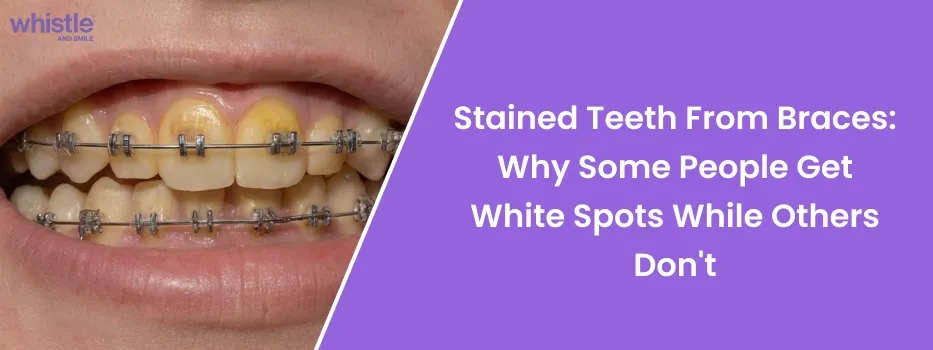
Stained Teeth From Braces: Why Do Some People Get White Spots After Braces?
 Medically Reviewed by Whistle Dental Team
Stained teeth from braces are caused by plaque buildup and food particles trapped around brackets and archwires, rather than the metal or ceramic materials themselves. Unbrushed bacterial plaque releases acids that leach calcium and phosphate minerals from tooth enamel.
This demineralization creates chalky white spot lesions or brown stains on teeth from braces when porous enamel absorbs pigments from chai, coffee, or dark foods. Preventing braces marks on teeth requires daily interdental brushing and fluoride mouthwashes.
To fix stained teeth from braces after bracket removal, dentists use remineralization pastes, enamel microabrasion, Icon resin infiltration, or professional whitening. Removable Whistle clear aligners prevent bracket stain traps entirely under physical orthodontist supervision.
Key takeaways:
- Braces hardware does not stain enamel: Stains and white spots are caused by trapped bacterial plaque producing enamel-dissolving acids.
- White spots are early decalcification: Chalky white marks represent mineral loss beneath the enamel surface, not simple surface dirt.
- Brown stains come from food pigments: Demineralized, porous enamel acts like a sponge, absorbing dark colors from Indian chai, coffee, and sodas.
- Avoid whitening toothpaste during braces: Bleaching exposed enamel while brackets are on creates uneven discolored square patches upon bracket removal.
- Whistle clear aligners prevent stain traps: Removable polyurethane aligners allow 100% unobstructed brushing and flossing, virtually eliminating post-treatment stains.
Let’s understand what’s actually happening under the surface, why these spots pop up on some teeth but not others, and most importantly, how to remove stains from teeth after braces.
Understanding Why Braces Cause Teeth Stains
Your tooth enamel is composed of hydroxyapatite crystal lattice, a hard matrix of calcium and phosphate. When metal or ceramic brackets are glued to your teeth, they create hundreds of microscopic ledges where food debris and bacterial plaque collect.
When you consume carbohydrates or sugars, bacteria (like Streptococcus mutans) ferment these sugars to produce lactic acid. This acid lowers your oral pH below 5.5, dissolving the calcium and phosphate minerals inside your hydroxyapatite lattice. This process is called demineralization. In its early stage, demineralized enamel loses its natural translucency, turning into an opaque, chalky white spot lesion.
If left untreated and exposed to dark beverages, these porous white spots absorb tannins and chromogens, rapidly turning into dark brown stains on teeth from braces.
The Culprit Behind the Spots: It’s Not the Braces!
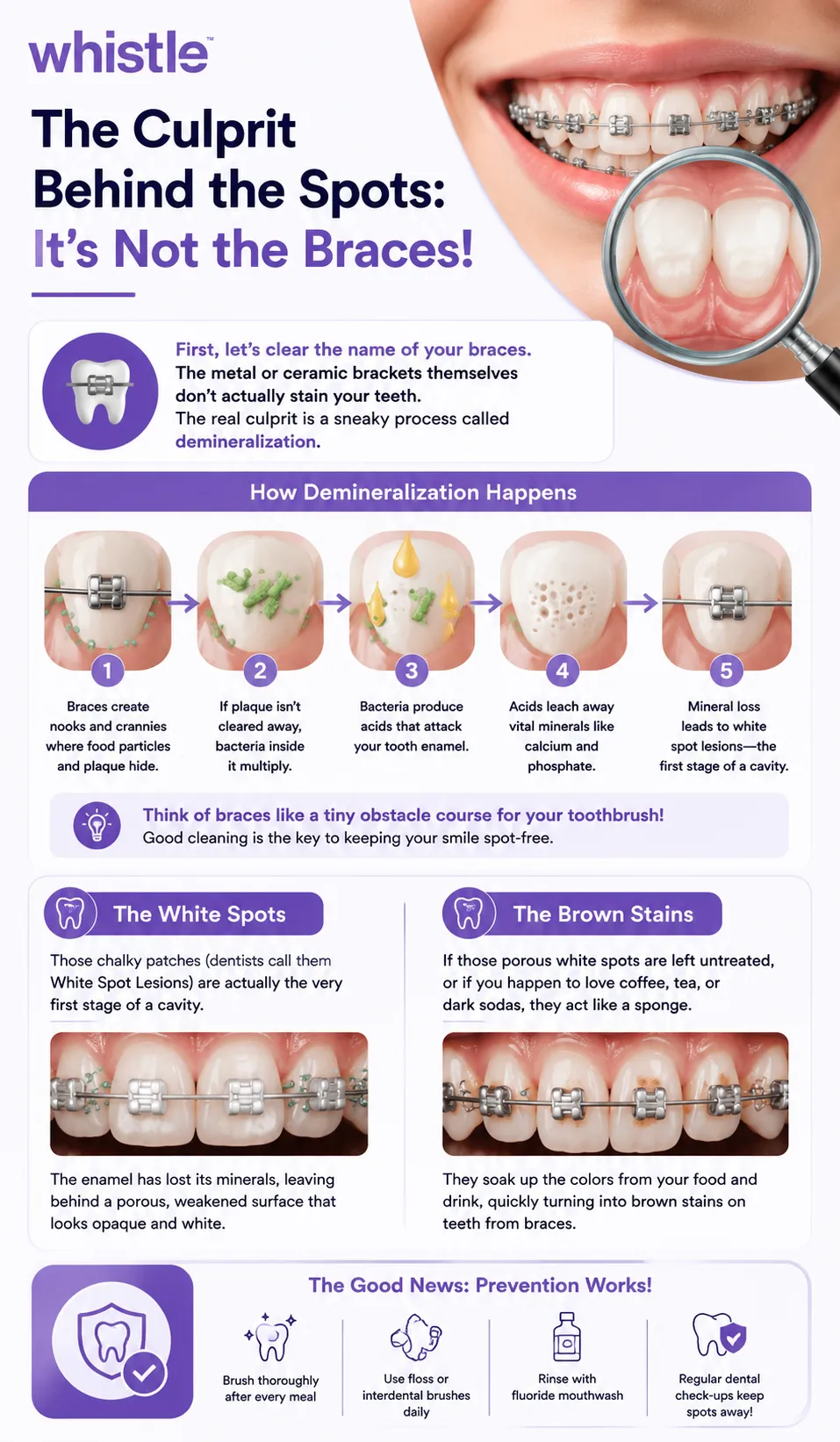
First, let’s clear the name of your braces. The metal or ceramic brackets themselves don't actually stain your teeth. The real culprit is a sneaky process called demineralization.
Think of braces like a tiny obstacle course for your toothbrush. They create endless little nooks and crannies where food particles and plaque love to hide. If that plaque isn't completely cleared away, the bacteria inside it throw a bit of a party, producing acids that attack your tooth enamel. These acids leach away vital minerals like calcium and phosphate.
- The White Spots: Those chalky patches (dentists call them White Spot Lesions) are actually the very first stage of a cavity. The enamel has lost its minerals, leaving behind a porous, weakened surface that looks opaque and white.
- The Brown Stains: If those porous white spots are left untreated, or if you happen to love coffee, tea, or dark sodas, they act like a sponge. They soak up the colors from your food and drink, quickly turning into brown stains on teeth from braces.
Why Stains Develop Differently for Every Patient
It feels unfair, right? Two people can wear braces for two years, yet have totally different results. Here is why some people are more prone to these post-braces marks than others:
1. The Oral Hygiene Hustle
Let’s be real: brushing with braces is a chore. It takes patience, time, and a whole arsenal of tools like interdental brushes and floss threaders. Missing the spots right around the brackets just a few times gives plaque the green light to start eating away at your minerals. Some people are just a bit more meticulous (or lucky) with their cleaning routines.
2. Diet Choices
What you eat during your orthodontic journey matters a lot. A diet heavy on sugary snacks, starchy carbs, and highly acidic drinks (looking at you, sodas and sports drinks) essentially feeds the bacteria in your mouth. This accelerates the acid production, making demineralization happen much faster.
3. Your Saliva Superpowers
Saliva is your mouth’s natural defense system. It washes away food debris and actually contains minerals that remineralize and repair your enamel on the fly. However, everyone's saliva is a little different. If someone naturally has dry mouth or less mineral-rich saliva, their teeth don't have the same built-in shield.
4. Genetics
Yep, sometimes it just comes down to the luck of the draw. Some of us are born with naturally dense, rock-solid enamel that can withstand a lot of acid pressure. Others have slightly softer enamel that is a bit more sensitive and prone to scarring or staining.
Professional Treatments for Stained Teeth After Braces
If you’ve already noticed some discoloration after your braces were removed, take a deep breath. Your teeth aren't permanently ruined! There are some fantastic, highly effective ways to get your smile looking uniform and bright:
1. Give it a Minute (and Remineralize)
Right after your braces come off, your saliva can finally reach every part of your tooth again. Sometimes, mild white spots will naturally fade over a few months with great brushing and a good fluoride toothpaste. Your dentist might also suggest a specialized remineralizing paste (like those with hydroxyapatite) to help pump those missing minerals right back into the enamel.
2. Professional Teeth Whitening
For surface discoloration and those pesky brown spots, professional whitening works wonders. However, you have two great pathways here depending on what your teeth need:
- Traditional Whitening: Uses peroxide-based gels to actively break down deep stains. Dentists usually recommend waiting about 6 months after braces removal for this, as your teeth can be quite sensitive right after the brackets come off.
- Whistle Glow Treatment: If you want to skip the chemical bleaching and avoid sensitivity altogether, Whistle Glow is an incredible post-orthodontic finishing option. Instead of harsh peroxides, it uses a specialized bio-active serum with nano-hydroxy-peptide crystals. It’s essentially a premium "facial" for your teeth that polishes away external stains while remineralizing your enamel. By smoothing out micro-scratches left by braces, it brings back your teeth's peak natural brightness and a beautiful, glossy reflection.
3. Microabrasion
If the stains are just slightly below the surface, your dentist can perform a quick, painless procedure called microabrasion. They use a gentle, abrasive gel to carefully buff away a microscopic layer of the stained enamel, revealing the smooth, beautifully uniform tooth structure underneath.
4. Resin Infiltration (The Icon Treatment)
This is a brilliant, modern option specifically for those chalky white spots. The dentist applies a specialized, clear liquid resin that seeps directly into the porous white spot. It fills the gaps, blocks future acid, and changes the way light reflects off the tooth, so the spot completely blends in with the rest of your smile.
5. Dental Bonding or Veneers
In more severe cases where the demineralization actually damaged the structure of the tooth or left deep, unshakeable stains, cosmetic dentistry can save the day. A bit of tooth-colored composite bonding or a sleek porcelain veneer can be placed over the tooth for a flawless finish.
What causes brown stains on teeth from braces vs. white spot lesions?
Honestly, knowing the difference between white spots and brown stains helps you choose the right corrective treatment.
White Spot Lesions (Enamel Decalcification)
White spot lesions appear as chalky, dull white outlines where your brackets used to sit. They represent early-stage tooth decay where acid-producing plaque sat undisturbed around bracket bases. The enamel surface remains intact, but the subsurface mineral layer is severely depleted.
Brown Stains on Teeth From Braces (Chromogen Absorption)
Brown stains occur when demineralized, porous enamel absorbs dark organic dyes. In India, daily consumption of hot chai, dark coffee, turmeric curries, soy sauce, or dark carbonated sodas penetrates into the microscopic pores of unmineralized enamel. Because the area directly beneath the bracket was sealed by dental glue, the surrounding exposed enamel turns brown while the center stays white, leaving noticeable braces marks on teeth.
Restoring Your Smile After Braces Removal
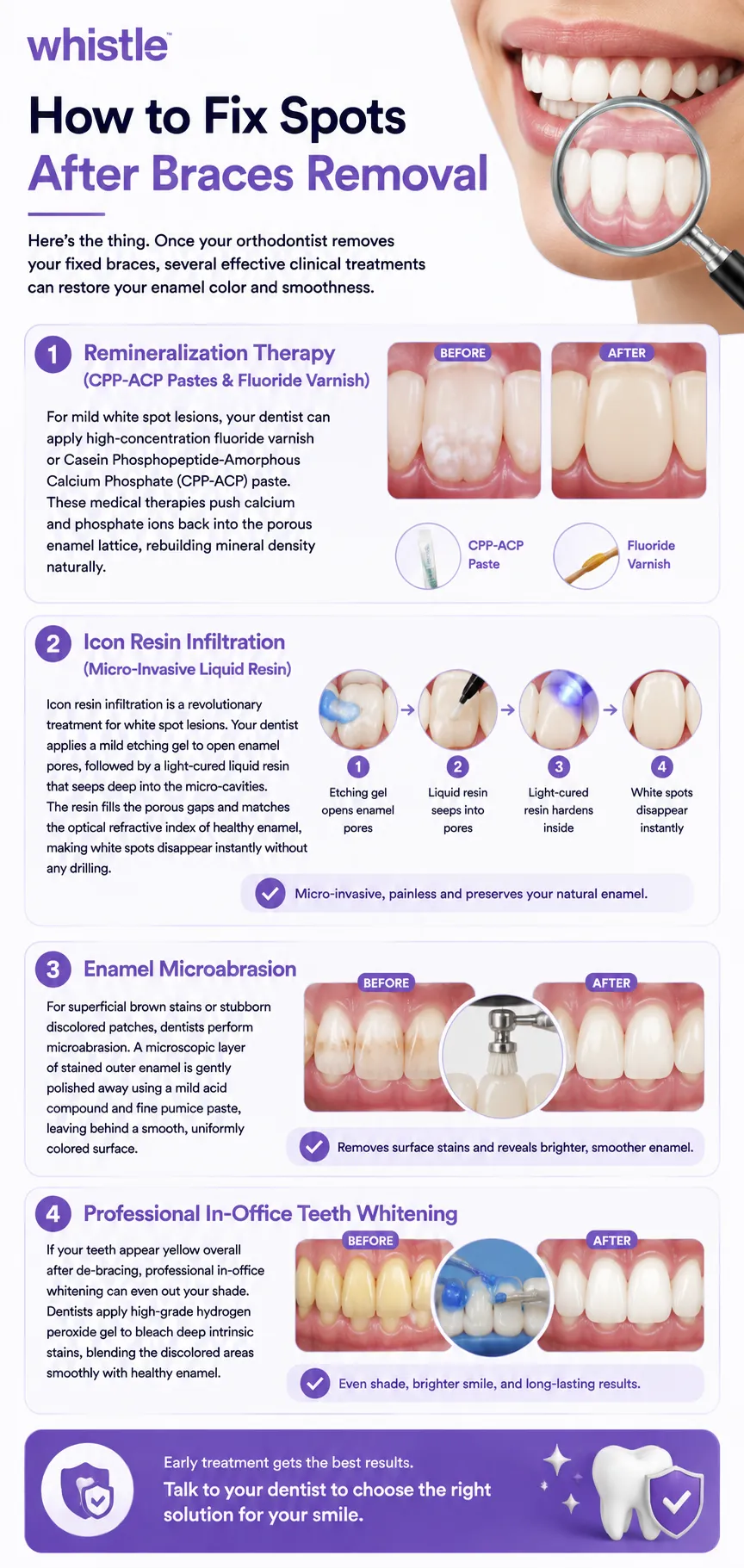
Here's the thing. Once your orthodontist removes your fixed braces, several effective clinical treatments can restore your enamel color and smoothness.
1. Remineralization Therapy (CPP-ACP Pastes & Fluoride Varnish)
For mild white spot lesions, your dentist can apply high-concentration fluoride varnish or Casein Phosphopeptide-Amorphous Calcium Phosphate (CPP-ACP) paste. These medical therapies push calcium and phosphate ions back into the porous enamel lattice, rebuilding mineral density naturally.
2. Icon Resin Infiltration (Micro-Invasive Liquid Resin)
Icon resin infiltration is a revolutionary treatment for white spot lesions. Your dentist applies a mild etching gel to open enamel pores, followed by a light-cured liquid resin that seeps deep into the micro-cavities. The resin fills the porous gaps and matches the optical refractive index of healthy enamel, making white spots disappear instantly without any drilling.
3. Enamel Microabrasion
For superficial brown stains or stubborn discolored patches, dentists perform microabrasion. A microscopic layer of stained outer enamel is gently polished away using a mild acid compound and fine pumice paste, leaving behind a smooth, uniformly colored surface.
4. Professional In-Office Teeth Whitening
If your teeth appear yellow overall after de-bracing, professional in-office whitening can even out your shade. Dentists apply high-grade hydrogen peroxide gel to bleach deep intrinsic stains, blending the discolored areas smoothly with healthy enamel.
How to prevent braces marks on teeth during treatment?
Preventing teeth stains from braces requires upgrading your daily hygiene tools while your appliances are on:
- Use Interdental "Christmas Tree" Brushes: Standard toothbrushes cannot reach under archwires. Slide interdental brushes vertically beneath the wire and around bracket wings after every meal.
- Incorporate a Water Flosser: A water flosser uses targeted water pressure to blast away hidden food debris and plaque around brackets before it mineralizes into tartar.
- Brush with Fluoride Toothpaste: Fluoride strengthens hydroxyapatite crystals against acid attacks. Avoid charcoal or harsh whitening toothpastes while wearing braces.
- Avoid Whitening Products During Braces: Never use whitening strips or bleaching rinses while fixed brackets are bonded to your teeth. Bleaching only lightens exposed enamel, leaving dark square patches under the brackets when they are removed.
Why clear aligners prevent teeth stains from braces?
| Parameter | Traditional Metal Braces | Ceramic Braces | Whistle Clear Aligners |
|---|---|---|---|
| Plaque Build-up Risk | High, brackets and wires can trap plaque and food debris | High, thicker ceramic brackets may retain plaque if not cleaned properly | Very low, removable aligners allow thorough cleaning of teeth |
| Brushing & Flossing | More difficult, often requires floss threaders or interdental brushes | More difficult, requires extra cleaning aids | Easy, simply remove the aligners before brushing and flossing |
| Risk of White Spot Lesions | Higher if oral hygiene is poor during treatment | Higher if oral hygiene is poor during treatment | Very low with good oral hygiene, as aligners are removable |
| Risk of Staining | Higher, stains may develop around brackets if plaque accumulates | Higher, stains may develop around ceramic brackets and bonding areas | Minimal, no bonded brackets to trap stains on the tooth surface |
| Dietary Restrictions | Avoid hard, sticky, and chewy foods to prevent bracket damage | Avoid hard, sticky, and chewy foods to protect ceramic brackets | No major food restrictions, remove aligners before eating or drinking anything except water |
Common Mistakes Orthodontists Often See
In clinical practice, orthodontists frequently observe patient habits that lead to severe post-braces staining. Here are five common mistakes to avoid:
- Using Whitening Toothpaste While Wearing Braces: Bleaching exposed enamel while brackets are bonded creates discolored square patterns upon bracket removal.
- Skipping Interdental Brushes: Relying solely on a flat manual toothbrush leaves bacterial plaque trapped under archwire slots.
- Sipping Dark Chai and Soda Through Braces: Allowing acidic, pigmented liquids to pool around bracket margins accelerates enamel demineralization.
- Scrubbing White Spots with Abrasive Charcoal: Attempting to scrub away white spot lesions with harsh charcoal scratches weak enamel and deepens stain absorption.
- Delaying Remineralization Treatment After De-Bracing: Ignoring white spot lesions after braces removal allows them to progress into structural cavities
Daily oral care routine for fixed braces wearers
If you currently wear fixed metal or ceramic braces, follow this 4-step daily hygiene regimen to prevent post-braces marks:
- Step 1: Brush at a 45-Degree Angle: Angle soft bristles above and below each bracket to clear plaque from the gumline and bracket ledges.
- Step 2: Clean Under Wires with Interdental Brushes: Push an interdental brush under the main archwire to scrub the sides of every bracket.
- Step 3: Floss with Orthodontic Threaders: Thread dental floss beneath the wire daily to clean between tight tooth contact points.
- Step 4: Swish with Alcohol-Free Fluoride Mouthwash: Rinse for 60 seconds before bed to remineralize microscopic enamel scratches.
Expected vs. Red-Flag Emergency Signals
| Symptom | Normal & Expected | Contact Your Dentist or Whistle Partner Clinic Immediately If… |
|---|---|---|
| Enamel Appearance | Mild chalky areas or small white spots may become noticeable after braces are removed, especially if oral hygiene was challenging during treatment. | You notice pitted enamel, visible holes, dark brown spots, or signs of tooth decay that require prompt dental evaluation. |
| Tooth Sensitivity | Mild sensitivity to cold foods or drinks after professional cleaning or bracket removal is common and usually temporary. | You experience severe, persistent, or throbbing pain, especially in a discoloured tooth or one that hurts when biting. |
| Gum Health | Slight redness or mild swelling around previously bracketed teeth may occur and generally improves with good oral hygiene. | Your gums bleed heavily, recede noticeably, develop deep pockets, or show signs of infection, such as swelling or pus. |
| Appliance Status | Brackets, wires, and elastomeric ties should remain clean, secure, and free from food debris throughout treatment. | A bracket becomes loose, a wire breaks, or food becomes trapped around damaged appliances, causing pain, swelling, or a bad taste or odour. |
Your Next Steps
Dealing with stained teeth from braces can feel disappointing after months of orthodontic effort, but understanding the cause is the first step toward restoring your smile. Remember, braces hardware does not stain teeth; trapped bacterial plaque and acid demineralization are the true culprits behind white spot lesions and brown stains.
Ready to see how clean and straight your smile can be? Book a free Whistle Smile Assessment at your nearest Whistle partner clinic today.
Also Read:
Book 3D Teeth Scan
Consult our experts and get a 3D preview of your smile transformation!
Stained Teeth From Braces
brown stains from teeth
FAQ's
Q1.Are stained teeth from braces permanent?
No, most teeth stains from braces are not permanent. Surface brown stains can be polished away through scaling and microabrasion, while white spot decalcifications can be remineralized or treated with Icon resin infiltration.
Q2.Why do braces leave white marks on teeth?
Braces leave white marks (white spot lesions) because plaque trapped around brackets produces acids that leach calcium and phosphate out of tooth enamel, causing localized decalcification.
Q3.Can I whiten my teeth while wearing metal braces?
No, you should never whiten your teeth while wearing metal braces. Bleaching agents cannot reach the enamel beneath brackets, resulting in dark, unbleached square patches once braces are removed.
Q4.Are clear aligners safer than braces for preventing teeth stains?
Yes, custom clear aligners like Whistle aligners are much safer because they are removable, allowing 100% unobstructed brushing and flossing to prevent plaque accumulation.
Q5.How do I remove brown stains on teeth from braces at home?
You should not attempt to remove brown stains at home with harsh abrasives. Maintain excellent brushing with fluoride toothpaste and visit your dentist for professional microabrasion or remineralization therapy.
Q6.How much does it cost to fix braces stains on teeth in India?
The cost to fix braces stains in India ranges depending on the procedure. Fluoride remineralization and polishing are economical, while Icon resin infiltration or professional in-office whitening range from moderate to premium.
Q7.Are clear aligners safer than braces for preventing teeth stains?
Yes, custom clear aligners like Whistle aligners are much safer because they are removable, allowing 100% unobstructed brushing and flossing to prevent plaque accumulation.

 Medically Reviewed by Whistle Dental Team
 Medically Reviewed by Whistle Dental Team



 Medically Reviewed by Whistle Dental Team